

Insights & Perspectives
Rigorous thinking on the questions our clients are asking right now.

Latest thinking
UAE Foreign Tax Credit: Preventing Double Taxation on Overseas Income
The UAE Foreign Tax Credit under Article 47 reduces UAE Corporate Tax for qualifying foreign tax on income that remains taxable in the UAE. This guide explains who can claim, which taxes qualify, how the cap works with worked examples, timing, refunds, treaty interaction and evidence.

UAE Corporate Tax Position on Foreign Branches
A foreign branch is part of the same taxpayer as its UAE head office, so its profits and losses are in the UAE tax base unless the Foreign Permanent Establishment exemption applies. This guide explains the election, the 9% test, losses, dealings with head office and how to choose between exemption and credit.
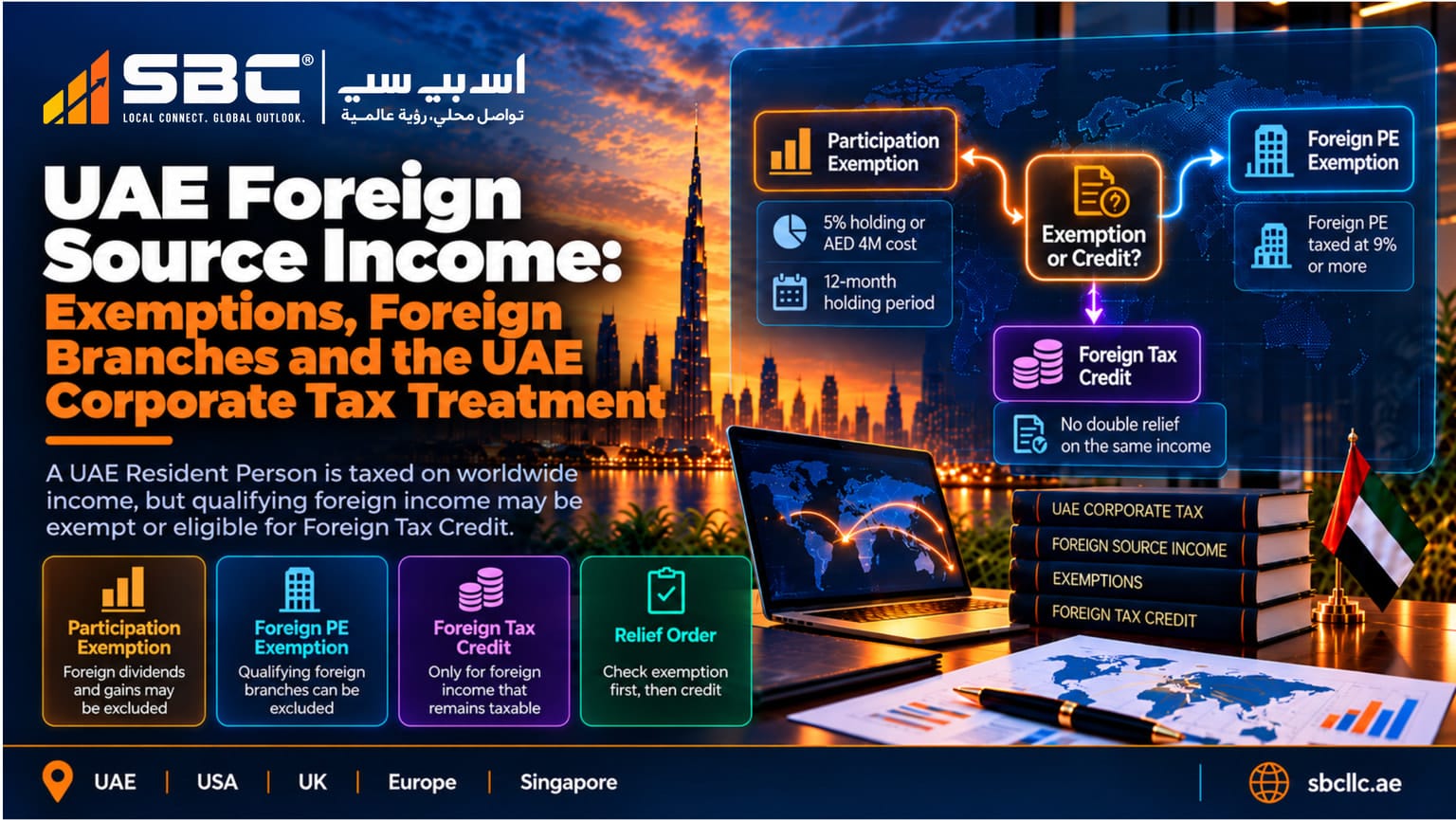
UAE Foreign Source Income: Exemptions, Foreign Branches and the UAE Corporate Tax Treatment
The UAE taxes Resident Persons on worldwide income but offers targeted exemptions for qualifying foreign dividends, gains and foreign branches. This guide explains the conditions, the interaction with the Foreign Tax Credit, the Free Zone angle and how to choose between relief routes.

UAE Corporate Tax and Foreign Source Income: When Is Overseas Income Taxable in the UAE?
UAE Resident Persons are taxed on worldwide income, so overseas income is not automatically outside UAE Corporate Tax. This guide explains what foreign source income is, who is taxed on it, when it is recognised, how it is computed and which reliefs apply.

AI in Transfer Pricing UAE: How AI Is Transforming Transfer Pricing Analysis
AI is changing how transfer pricing teams analyse data, conduct benchmarking and prepare documentation. Learn what this means for UAE businesses and how SBC demonstrated TP DOC GEN AI at the ITR AI in Tax Forum Middle East 2026

UAE Tax Residency for Companies and Individuals: Residence, TRCs and Treaty Position
Resident Person, Tax Resident and treaty resident are three different UAE concepts. This guide sets out the tests for companies and individuals, how a Tax Residency Certificate is obtained and used, and how double tax treaties decide dual residence.

UAE Tax Residency for Companies: Where Is Your Business Tax Resident?
UAE-incorporated companies are generally Resident Persons, and a foreign company can become one through effective management and control. This guide explains the test, the evidence that matters, dual-residence risk and how residence differs from registration, treaty residence and a TRC.

Permanent Establishment in the UAE: Comprehensive Corporate Tax Guide
A practical guide to Permanent Establishment (PE) under Article 14 of the UAE Corporate Tax Law: what creates a PE, what does not, how treaties change the thresholds, how profits are attributed, how Free Zone entities are affected and what evidence to keep.

UAE Corporate Tax for Foreign Companies: When Does a Foreign Business Have a UAE Tax Obligation?
A foreign company is not taxed in the UAE just because it has UAE customers. This guide explains the four routes into UAE Corporate Tax (residence, permanent establishment, nexus and UAE-sourced income), how treaties change the result and what to document.

SBC Tax Consulting Wins Two IFLR & ITR Middle East Awards 2026 for Tax Innovation and Tax Technology
SBC Tax Consulting won Tax Innovator of the Year and Tax Technology Firm of the Year at the IFLR Middle East Awards 2026, held with ITR, in Dubai.

GCC Transfer Pricing Compliance Calendar 2026: UAE, KSA, Bahrain, Qatar
The UAE, Saudi Arabia, Bahrain and Qatar each run their own transfer pricing calendar, threshold set and penalty regime. Here is one consolidated 2026 view for groups planning compliance across all four at once.

Transfer Pricing Back-Office Support: What a White-Label TP Desk Actually Covers
Your firm has the client relationship but not an in-house transfer pricing bench. Here is exactly what a white-label TP back-office desk delivers — benchmarking, Local Files, and FTA-facing support, under your own name.

What Should Be in a UAE Transfer Pricing Defence File Before the FTA Ever Asks?
Understand how to build and maintain an audit-ready UAE transfer pricing defence file, including transaction records, functional analysis, benchmarking, agreements and FTA-ready evidence.

How to Set Up a Transfer Pricing SOP for a UAE Business
Learn how to create a practical transfer pricing SOP for a UAE business, covering transaction mapping, documentation thresholds, benchmarking, disclosure, ownership and FTA readiness.

SBC Tax Consulting UAE Shortlisted for Nine Categories at the ITR Middle East Tax Awards 2026
SBC Tax Consulting LLC has been shortlisted for nine categories at the ITR Middle East Tax Awards 2026, including Transfer Pricing Firm of the Year – United Arab Emirates and multiple regional tax, technology and innovation categories.

Why Leading UAE Businesses Choose SBC for Transfer Pricing and Tax Advisory
SBC Tax Consulting LLC is a Dubai-based specialist tax advisory firm supporting multinational enterprises and regional businesses with transfer pricing, UAE Corporate Tax and international tax. The firm reports 450+ MNEs served, 250+ professionals, 2,000+ benchmarking studies, 175+ Local Files and 100+ Master Files.
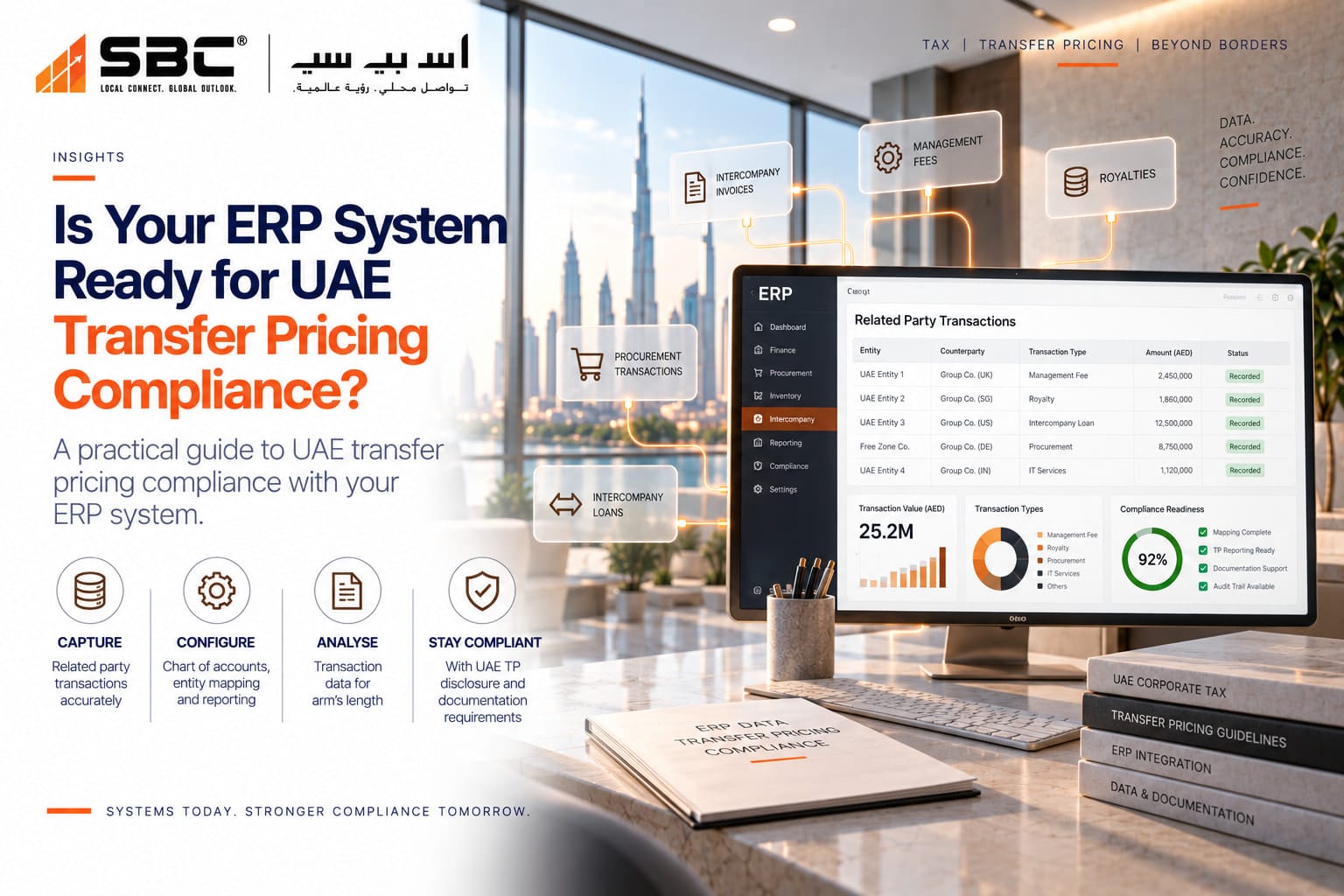
Is Your ERP System Ready for UAE Transfer Pricing Compliance?
Most UAE groups already record intercompany invoices, loans and management fees in their ERP. Few have configured that system so the same data can prove arm's-length pricing. This guide explains how ERP master data and postings feed the related-party disclosure, Local File and Master File, and the practical configuration steps finance teams can take.

What Is an Arm's-Length Fee for a Related Party Procurement Function?
A related-party procurement fee in the UAE is not a default markup. The arm's-length charge depends on whether the entity is an agent that only negotiates purchases, or a principal that takes title, holds inventory and bears risk. This guide explains how to price both models, treat rebates, test the 5% low value-adding safe harbour, and evidence the arrangement for the FTA.

Royalty Payments in the UAE: How to Benchmark the Arm's Length Royalty Rate
A practical guide to benchmarking royalty payments in the UAE under the arm's-length principle, covering DEMPE analysis, royalty CUPs, TNMM, profit split, comparability factors, cost contribution arrangements and transfer pricing documentation.

Does the Contract Decide Your Transfer Pricing, or Does Your Conduct?
A practical guide to UAE transfer pricing where intercompany agreements differ from actual conduct, covering accurate delineation, functions, assets, risks, decision-making and risk control.

Business Restructuring in UAE: When Can Transfer Pricing Compensation Arise?
Understand when a UAE business restructuring may create a transfer pricing compensation issue and how to assess the change using a before-and-after FAR analysis, contractual rights, realistically available options and supporting evidence.

Intellectual Property Transactions in UAE: DEMPE and Transfer Pricing Explained
Learn how UAE transfer pricing applies to intellectual property transactions, including DEMPE functions, legal ownership, risk control, valuation, documentation and arm's-length remuneration.

Transfer Pricing Benchmarking, Local File & Master File in the UAE: Free Zones, Intercompany Loans and Management Fees
AED 200 million and AED 3.15 billion trigger a UAE Local File and Master File - they do not switch on the arm's length principle. How to build the benchmarking study, segmented P&L, Free Zone file, loan pricing and management-fee evidence before the FTA asks.

Transfer Pricing Services in Dubai, UAE: 2026 Guide to Related Parties, Documentation and FTA Compliance
UAE transfer pricing applies to Related Party and Connected Person dealings whether the counterparty is in Dubai, another Emirate, a Free Zone or overseas. This 2026 guide covers disclosure thresholds, Local File, Small Business Relief and what to do before filing.

Best Transfer Pricing Firm in UAE: How to Identify the Top Transfer Pricing Consultants in 2026
There is no universal 'best' transfer pricing firm in the UAE. Use this 2026 buyer's scorecard - six workstreams, ITR rankings and FTA-facing questions — to shortlist a specialist that can defend the transaction, not only file a Local File.

Intercompany Agreements in the UAE: Why They Matter for Transfer Pricing
An intercompany agreement is supporting evidence of what related parties agreed and how they operate — not proof that the price is arm's length. Keep the contract, actual conduct and transfer pricing analysis telling the same story.

Centralised Group Services: How Should UAE Headquarters Charge GCC Subsidiaries?
A UAE regional headquarters cannot charge GCC subsidiaries a flat percentage of turnover. Charges need a benefit test, stewardship exclusions, allocation keys and a GCC withholding overlay.

Secondment and Employee Cost Recharges: Transfer Pricing Issues UAE Groups Often Miss
A secondment is not automatically an at-cost payroll recharge. UAE groups must test benefit, exclude stewardship, and decide whether a mark-up — including the 5% LVAIGS shortcut — actually fits.

Cash Pooling and Intercompany Financing: Transfer Pricing Considerations for GCC Groups
A GCC cash pool is a set of related-party financial transactions. Each member balance and the pool leader's spread need arm's length pricing under UAE Article 34 and KSA TP bylaws.

Long Outstanding Related Party Receivables: When Can Transfer Pricing Interest Become an Issue?
Trade credit that ages well beyond third-party terms can be recharacterised as an interest-free loan. The FTA can impute arm's length interest on the UAE creditor from the end of the commercial credit period.

Marketing and Business Development Support Services: What Is an Arm's Length Mark-Up?
There is no universal 5% mark-up for UAE marketing and BD support. The return follows the functional profile, pass-through media spend should not be marked up, and binding authority can create PE risk.

Intercompany Guarantees: When Should a UAE Company Charge a Guarantee Fee?
A group guarantee that cheapens a UAE company's borrowing is a Related Party benefit. Most explicit guarantees need an arm's length fee; implicit support does not automatically wipe it out.

Interest-Free Related Party Loans: A Hidden Transfer Pricing Risk in the UAE
A zero rate is a cash-flow choice, not a tax position. UAE related-party loans still need an arm's length interest analysis under Article 34 — including when no cash interest is paid.

Management Fees in the UAE: How to Demonstrate Arm's Length Pricing and Business Benefit
A UAE management fee is deductible only if the price is arm's length and the recipient can show a genuine business benefit — pricing alone is not enough.

Commission and Agency Arrangements: How to Benchmark an Arm's Length Commission
A UAE sales agent or commissionaire that never takes title still needs an arm's length commission, tested against agency comparables rather than distributor margins.
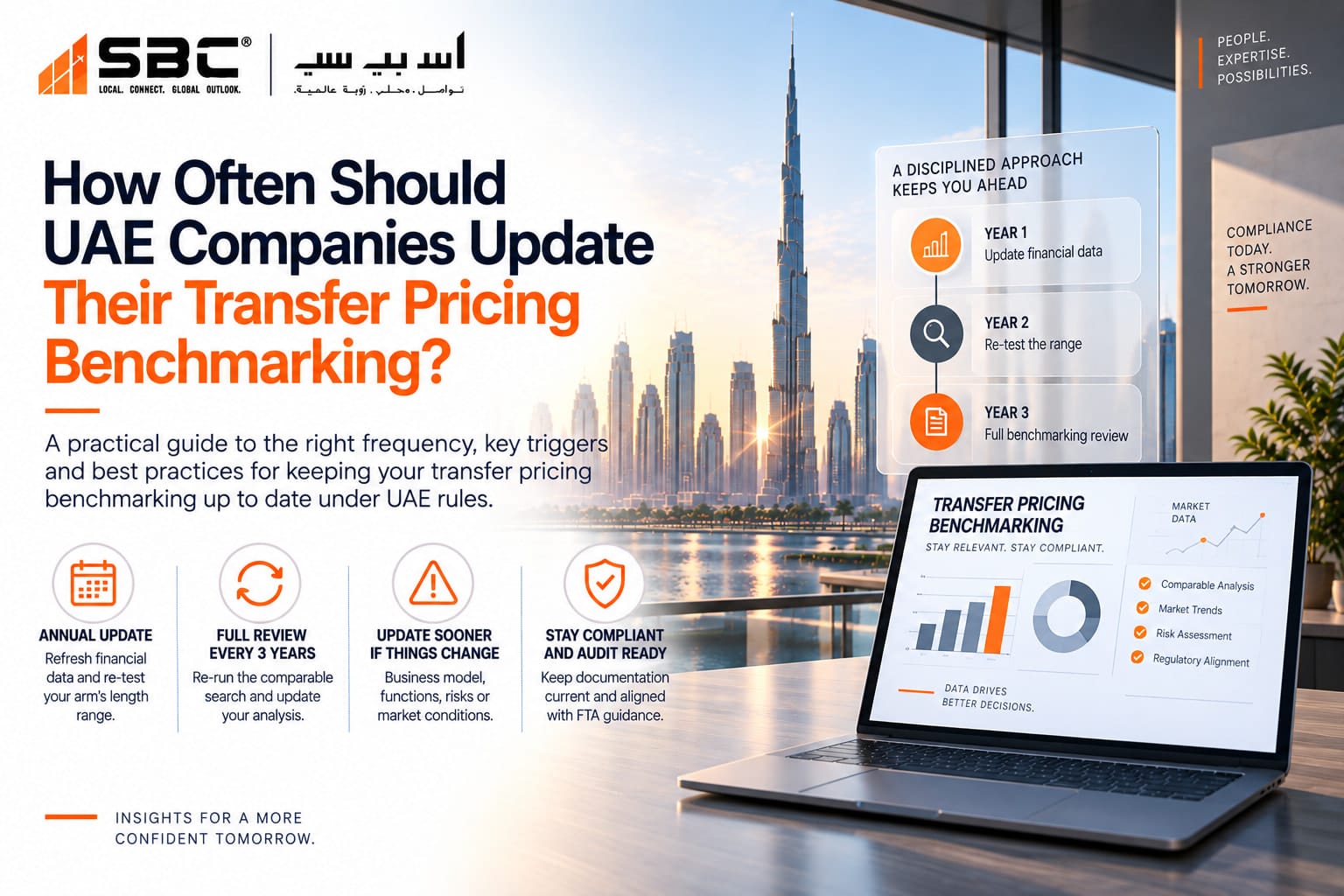
How Often Should UAE Companies Update Their Transfer Pricing Benchmarking?
Refresh comparable financial data every year, re-run the full search about every three years, and rebuild immediately when the FAR profile or the market moves.

Related Party Trading Transactions: How UAE Distributors Should Determine Arm's Length Margins
A UAE distributor buying from an overseas Related Party must support its trading margin with FAR analysis and RPM or TNMM — not a figure that merely looks reasonable.

Transfer Pricing Benchmarking Challenges: When Can the FTA Reject Your Comparables?
The FTA reviews the comparables behind the range, not just the range. Independence, functional mismatch, unexplained losses and geography can each take a study apart.

How Do You Actually Select Reliable Comparables for UAE Transfer Pricing?
Selecting UAE transfer pricing comparables is a documented search from the tested-party FAR profile — not the first page of an industry-code database screen.

What Does a Proper Functional Analysis Look Like Under UAE Transfer Pricing Rules?
A functional analysis determines how a UAE entity should be characterised, which transfer pricing method fits, and what it should earn. Treat it as the Local File core, not a department narrative.

Does Your Multinational Group Actually Need a UAE Master File?
A UAE Master File is not automatic at AED 200 million. Ministerial Decision No. 97 of 2023 needs a revenue test and a genuinely multinational group — UAE-only businesses typically owe a Local File instead.

UAE Transfer Pricing Disclosure Form: A Practical Step-by-Step Guide
The UAE Transfer Pricing Disclosure Form is not a separate filing. It is two schedules inside the Corporate Tax Return, triggered by AED 40 million and AED 500,000 thresholds.

Do Domestic Related Party Transactions Need Transfer Pricing in the UAE?
Article 34 applies even when both parties are in the UAE. Mainland–Free Zone pricing, Small Business Relief and Local File carve-outs do not remove the arm's length requirement.

UAE Related Party Transactions: What Businesses Need to Report
Reporting related-party transactions in the UAE is a two-schedule exercise: Related Party transactions above AED 40 million and Connected Person payments above AED 500,000, each tested independently.

UAE Local File: What Should It Contain and How Should Businesses Prepare?
A UAE Local File is not filed with the Corporate Tax Return — it has to be ready. Who must prepare one, what it should contain, and how to produce it within 30 days of an FTA request.

Connected Persons Under UAE Corporate Tax: Payments, Benefits and Transfer Pricing Risks
Article 36 tests payments and benefits to owners, directors and officers against Market Value. After CTP010, director and officer status follows actual authority — not the job title on the payroll.

How Do You Identify Related Parties Under UAE Corporate Tax?
UAE Related Party status is broader than parent and subsidiary. Article 35 covers 50% ownership, indirect holdings, control without shares and fourth-degree kinship — and missing a relationship breaks the TP file.

UAE Transfer Pricing Compliance: A Complete Guide for Businesses
UAE transfer pricing compliance turns the arm's length principle into identification, documentation, disclosure and, for larger groups, Master File and Local File obligations. This guide covers what businesses actually have to do.

UAE Transfer Pricing Rules: Who Is Covered and What Transactions Are Included?
UAE transfer pricing starts with two tests: who is a Related Party or Connected Person, and which transactions fall under Article 34. Kinship, control and in-scope payments are wider than most businesses assume.

How Should a UAE Property Developer Price Fees Charged Between Related Entities?
Development, project management and marketing fees between related UAE developer entities should follow functions, assets and risks — not a round percentage chosen at project start.

Is a Related Party Property Deal Priced at Market Value or Just at “Fair”?
UAE transfer pricing tests Related Party property sales, leases and contributions against independent Market Value — not a figure the parties merely consider reasonable.

From Policy to Invoice: How to Operationalise Transfer Pricing in the UAE
A UAE transfer pricing policy only works when invoices, ERP codes, margin monitoring and year-end true-ups match the documented method throughout the year.
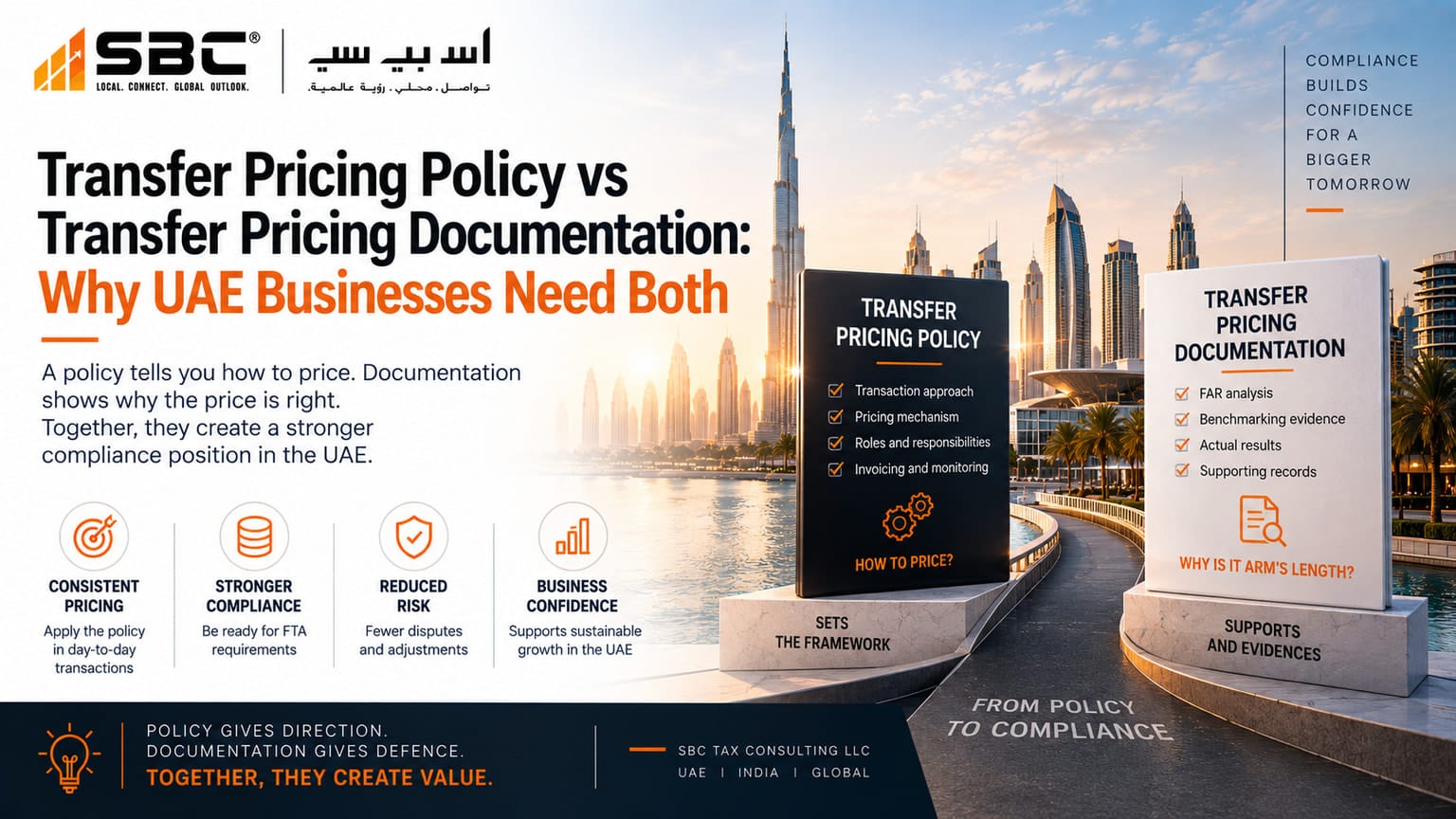
Transfer Pricing Policy vs Transfer Pricing Documentation: Why UAE Businesses Need Both
A UAE transfer pricing policy tells the group how to price Related Party transactions. Documentation shows why those prices are arm's length. Businesses need both.

How to Build a Transfer Pricing Policy for a UAE Group
A practical UAE framework for identifying Related Party transactions, completing FAR analysis, selecting methods, setting pricing mechanisms and keeping the policy current.

When Are UAE and Global Pillar Two Filings Due? 2026-2027 Compliance Calendar
A practical compliance calendar for UAE and global Pillar Two obligations, including the 30 November 2026 registration date and separate 2027 P2IR and Top-up Tax deadlines.

How Should UAE-Headquartered Groups Structure Holdings, IP and Financing Under Pillar Two?
Pillar Two changes the objective from finding the lowest rate to building a commercially sound structure that remains efficient after jurisdictional blending and a 15% floor.

Why Does 9% UAE Corporate Tax Not Simply Mean a 6% Pillar Two Top-up?
The UAE's 9% Corporate Tax rate is not automatically topped up by 6%. Pillar Two uses a different income base, tax numerator and jurisdictional calculation.

How Does Transfer Pricing Change a UAE Pillar Two and DMTT Result?
Transfer pricing determines where group profit is recorded; Pillar Two tests the tax on that profit. See how UAE policies, true-ups and disputes affect DMTT.
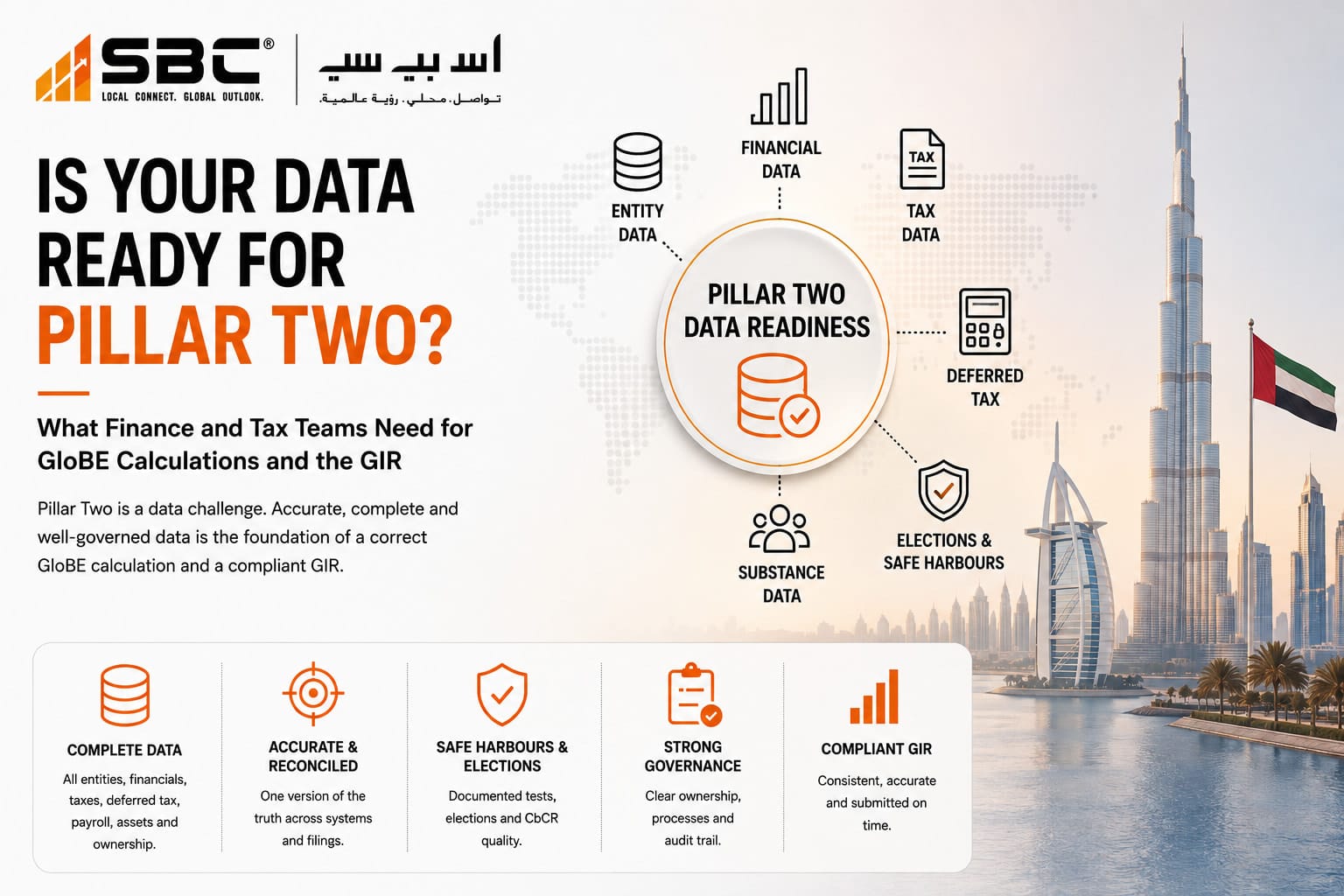
Is Your UAE Pillar Two Data Ready? GloBE Calculation and GIR Checklist
Pillar Two is a cross-functional data programme. Use this UAE-focused checklist to prepare entity, accounting, tax, deferred-tax, substance and GIR data before filing.
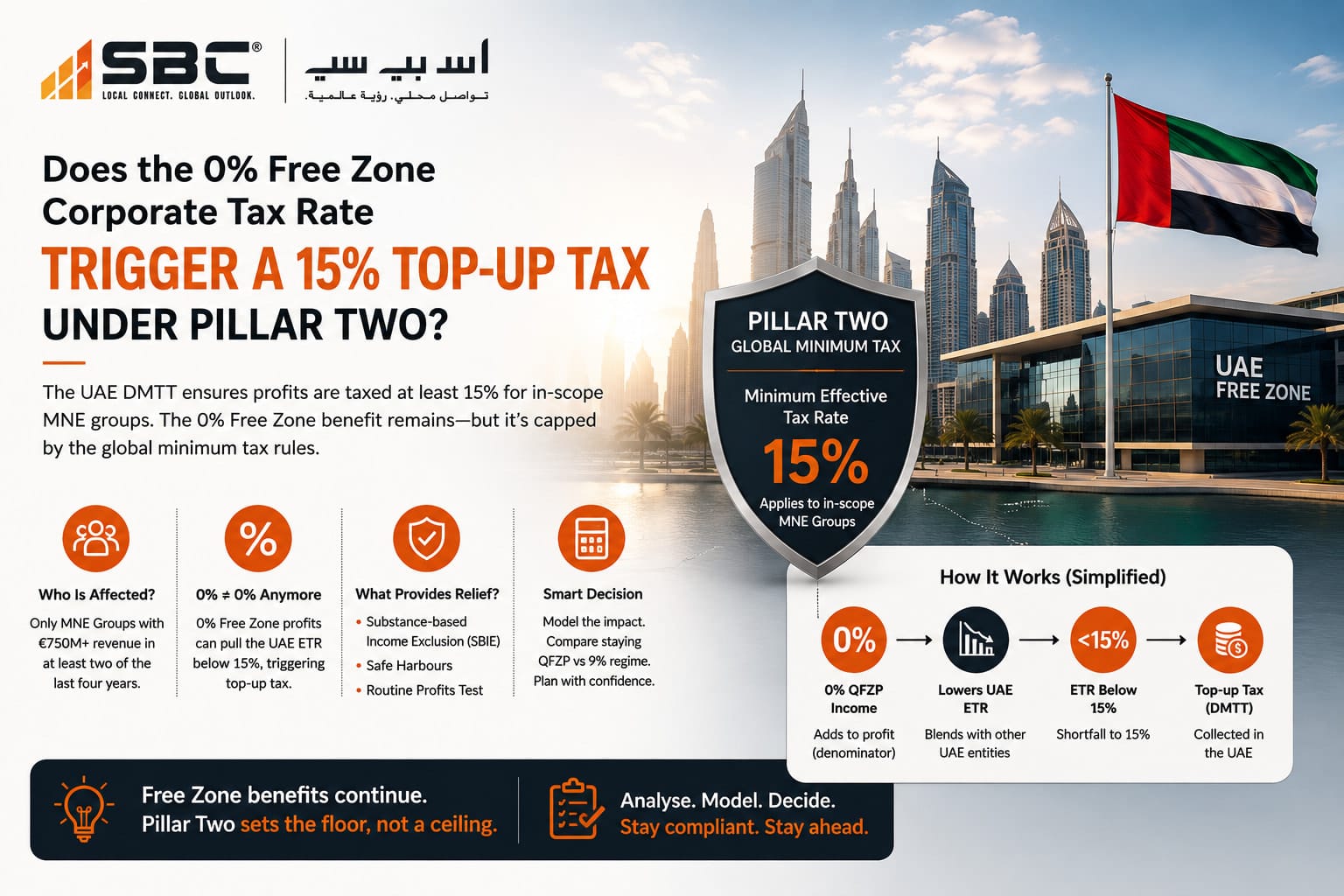
Does the UAE Free Zone 0% Corporate Tax Rate Trigger Pillar Two Top-up Tax?
The 0% UAE free-zone rate remains available, but large multinational groups may face UAE DMTT. See who is affected, how blending and SBIE work, and what to model.

Can Your Group Avoid a Full GloBE Calculation? UAE Pillar Two Safe Harbours Explained
A practical UAE guide to the Pillar Two safe harbours, the three Transitional CbCR tests, the QDMTT Safe Harbour and the evidence multinational groups should prepare.

Best Transfer Pricing Firms in the UAE: What Should You Actually Look For?
Looking for the best transfer pricing firm in the UAE? Compare adviser types, understand UAE TP requirements, and see what separates a strong transfer pricing practice from a generic tax provider.
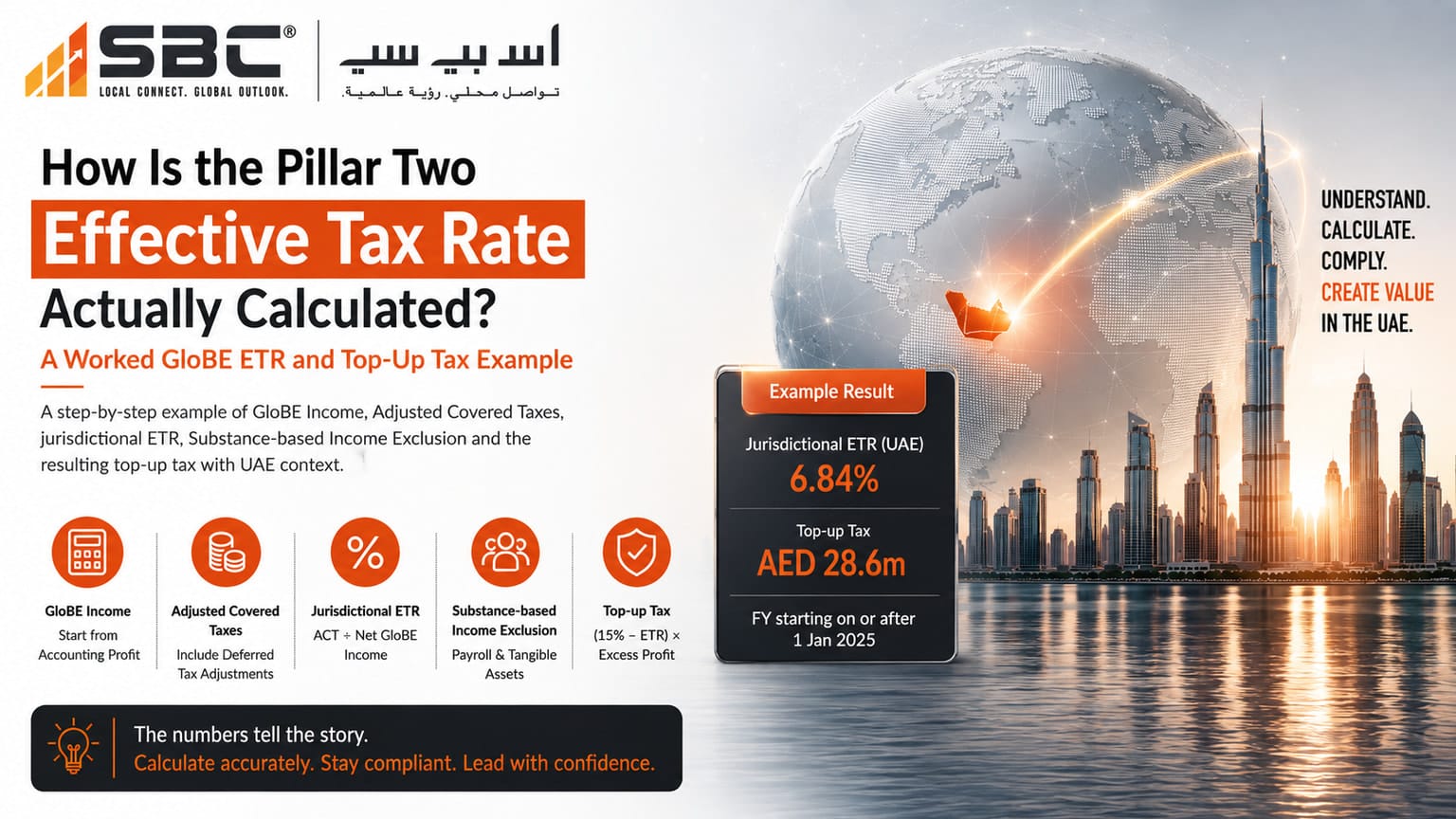
UAE Pillar Two ETR Calculation: A Worked DMTT Example
This worked example calculates a 6.84% UAE GloBE ETR, the 2025 substance-based exclusion and an indicative AED 28.59 million DMTT liability.

Transfer Pricing Services in Dubai, UAE: 2026 Guide to Corporate Tax, Related Parties and FTA Compliance
UAE transfer pricing guide covering Related Parties, Connected Persons, Local File, Master File, benchmarking, Free Zones, loans and FTA compliance.

UAE Pillar Two Information Return: Who Must File, What to Report and When
Ministerial Decision No. 133 of 2026 identifies the UAE entities that must file the Pillar Two Information Return and when a filing by the UPE or designated filing entity can discharge local filing.

UAE Pillar Two DMTT Guide 2026: Scope, 15% ETR and Filing Deadlines
The UAE’s Domestic Minimum Top-up Tax is now a live compliance regime, not a future policy proposal. Here is what an in-scope multinational group needs to know and do.

Pillar Two Updates June 2026: Global Minimum Tax Roundup
June 2026 brought a wave of Pillar Two developments — the OECD's GIR XML filing guidance, Side-by-Side adoption across four jurisdictions, and filing extensions in Portugal, Belgium and Turkey.
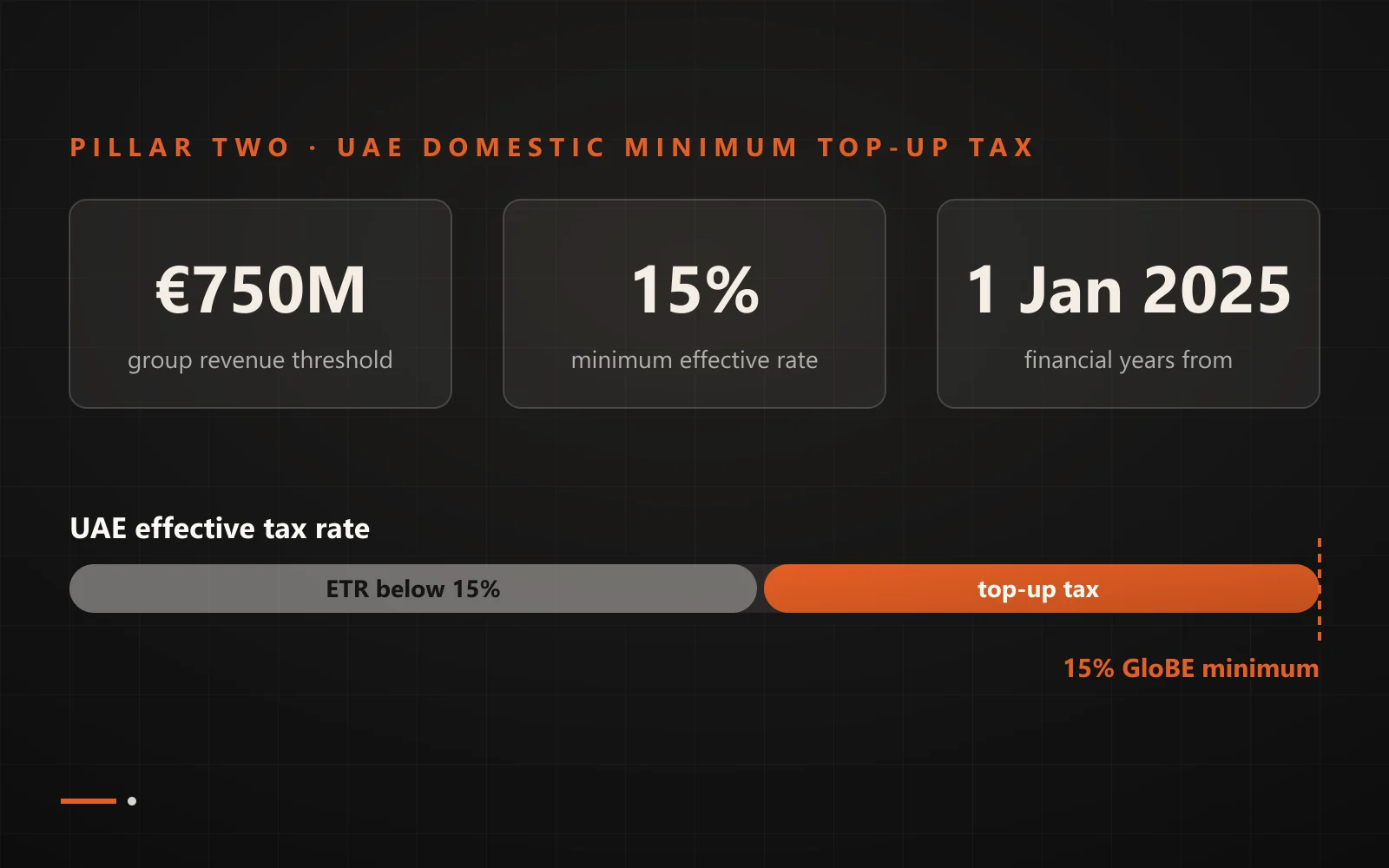
Achieving DMTT Readiness in Dubai: A Practical Guide for MNEs
A practical guide to UAE DMTT readiness for Dubai MNEs: scope, 15% ETR, safe harbours, deadlines, and a step-by-step compliance roadmap.

Ministerial Decision No. 96 of 2026: UAE Pillar Two Guidance
Ministerial Decision No. 96 of 2026 adopts the latest OECD GloBE commentary and guidance for the UAE Top-Up Tax, replacing Ministerial Decision No. 88 of 2025 from 22 June 2026.
KSA Transfer Pricing: Local File and Master File Thresholds
In Saudi Arabia a Local File and Master File become mandatory once related-party transactions exceed SAR 6 million for taxpayers, or SAR 100 million for zakat payers during the 2024 to 2026 phase-in.
Bahrain's First Transfer Pricing Guide: What UAE Groups With Bahrain Operations Need to Know
A practical UAE guide to Bahrain's first transfer pricing guide under the DMTT, its scope, methods, documentation, and what it means for UAE groups.

UAE Pillar Two Top-Up Tax Registration on EmaraTax: A Guide
The FTA has added a dedicated Pillar Two Top-Up Tax Registration service on EmaraTax, letting in-scope MNE groups register under the UAE's DMTT regime as an individual entity or a designated filing entity.
UAE Corporate Tax: AED 10,000 Late Registration Penalty Waiver
The UAE Ministry of Finance and FTA will waive the AED 10,000 late corporate tax registration penalty if a business files its first tax return or annual declaration within seven months of its first tax period.
OECD Transfer Pricing Country Profiles Now Cover 83 Jurisdictions
The OECD has expanded its Transfer Pricing Country Profiles to 83 jurisdictions, adding 8 countries and giving multinationals a comparative map of how each applies the arm's length principle.
Zakat vs Corporate Income Tax in Saudi Arabia Explained
In Saudi Arabia, zakat applies to Saudi and GCC ownership at 2.5%, while corporate income tax applies to non-GCC ownership at 20%. A mixed-ownership company pays both, on separately computed bases.

UAE Family Foundations Guide 2026: What the CTGFF1 Update Changes
The FTA's June 2026 Family Foundations Corporate Tax Guide keeps the Article 17 fiscal-transparency conditions but clarifies that LLCs are not similar entities and adds asset-transfer and family-office rules.
Business Restructuring in Saudi Arabia: SEZ and RHQ Routes
Saudi Arabia offers two government-backed restructuring routes — Special Economic Zones and the RHQ programme — and, with no domestic Pillar Two top-up tax yet in force, a window to realign operating models.
KSA Transfer Pricing Penalties for Non-Compliance
Missing Saudi Arabia's transfer pricing disclosure deadline triggers a penalty of at least 1% of revenue, while misrepresentation can cost 25% of the tax difference and late payment adds 1% every 30 days.
Saudi Transfer Pricing: What General Documentation Requires
General Documentation is Saudi Arabia's catch-all transfer pricing record for taxpayers exempt from the Local and Master File. It has no set format but must still prove related-party pricing is at arm's length.
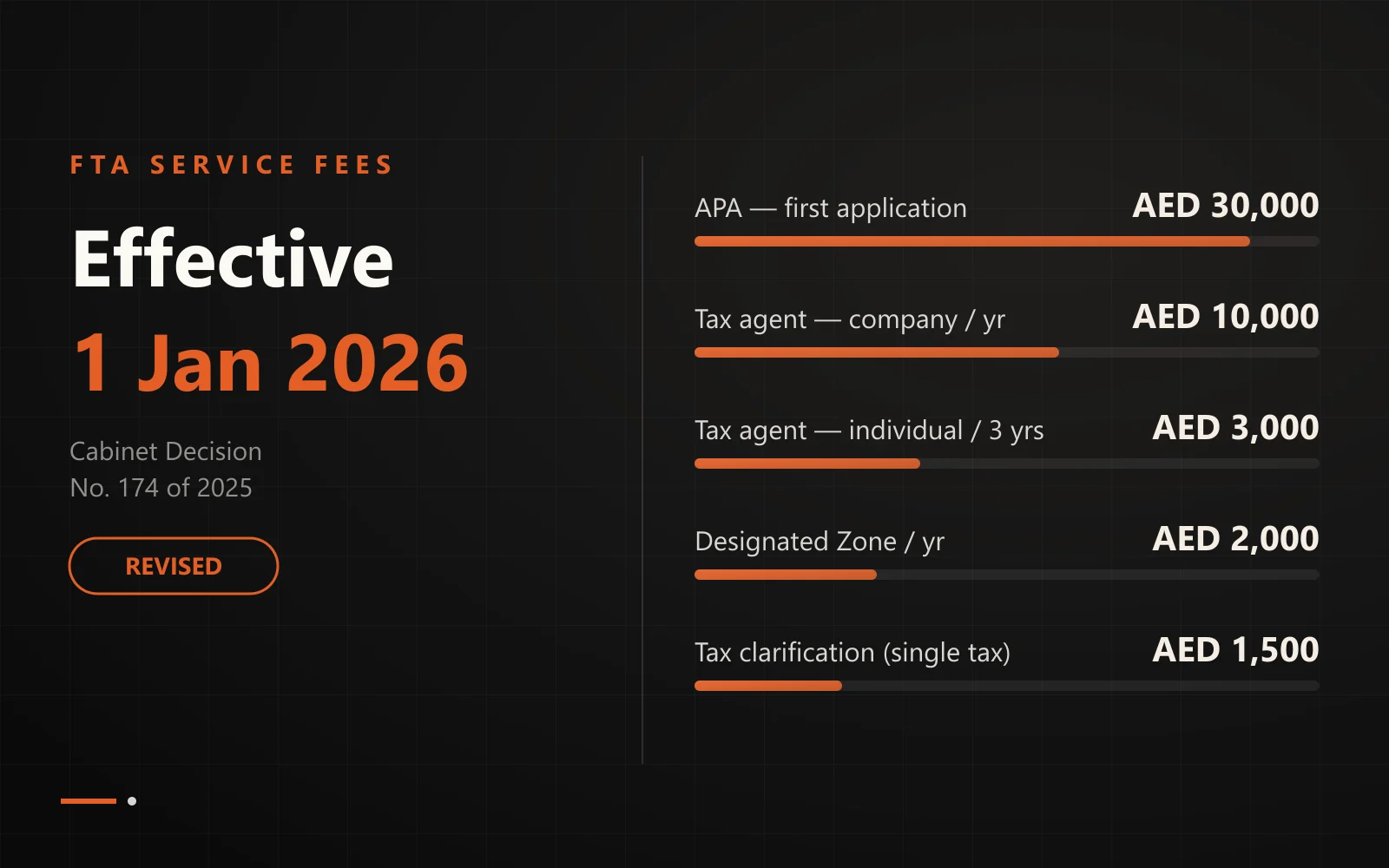
Revised UAE Federal Tax Authority Service Fees Effective from 1 January 2026
The UAE Cabinet has introduced revised Federal Tax Authority (FTA) service fees effective from 1 January 2026. Explore updated charges for TRC services, tax agent registration, designated zones, clarification requests, and advance pricing agreements.
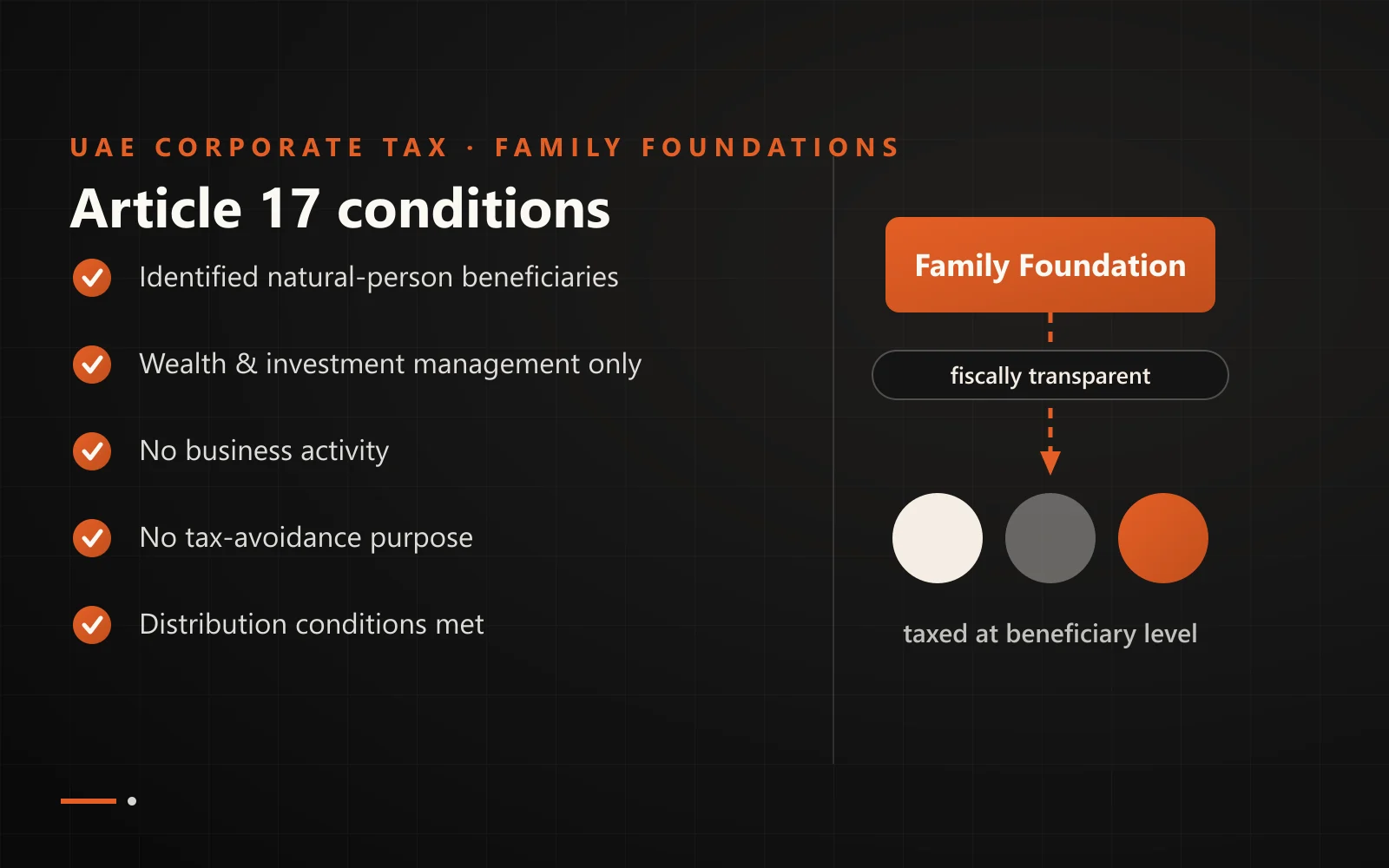
UAE Family Foundations and Corporate Tax: Complete Guide for Wealth Preservation in 2025
Discover how UAE Family Foundations are taxed under the latest Corporate Tax regulations. Learn about eligibility conditions, tax transparency, compliance requirements, multi-tier structures, and strategic wealth preservation benefits for families and investors in the UAE.
Cabinet Decision No. 129 of 2025: UAE Tax Penalty Changes
Cabinet Decision No. 129 of 2025 resets the UAE's administrative tax penalties from 14 April 2026, introducing a 14% annual late-payment charge and cutting several fixed penalties.

Cabinet Decision No. 17 of 2026: UAE Tax Procedures Update
Cabinet Decision No. 17 of 2026 amends the UAE Tax Procedures Executive Regulations from 1 April 2026, easing voluntary disclosures while setting a hard five-year refund deadline.

GCC Tax Compliance Calendar: May 2026 Deadlines
The key GCC tax deadlines for May 2026: the UAE corporate tax return with the TP Disclosure Form is due 31 May for year-ends of 31 August 2025, alongside VAT, excise and withholding tax filings across the region.

Qatar Extends the 2025 Tax Return Deadline to June 2026
Qatar's General Tax Authority has extended the deadline for filing 2025 tax year returns on the Dhareeba portal from 30 April to 30 June 2026 — for all taxpayers except the petroleum and petrochemical sectors.
Saudi Transfer Pricing Compliance and the 30 April Disclosure Form
In Saudi Arabia, any taxpayer with related-party transactions must file a Controlled Transaction Disclosure Form (CTDF) and auditor affidavit with the tax return within 120 days of the year-end.

How UAE Corporate Tax Defines a Director and Officer (CTP010)
An FTA public clarification, CTP010, defines who is a Director or Officer under UAE Corporate Tax: natural persons with genuine decision-making authority, not job titles, making them Connected Persons.
EmaraTax APA Programme Is Live: How to Apply in the UAE
The UAE's Advance Pricing Agreement programme is now live on the EmaraTax portal. Businesses can file APA pre-filing requests online for domestic transactions, following the FTA's 31 December 2025 guidance.
Tariffs and Transfer Pricing: Managing the Twin Enforcement Trap
Customs wants intercompany values high to collect more duty; transfer pricing wants them low to raise taxable profit. This twin enforcement trap can leave UAE importers double taxed unless both positions align.

Qatar's Capital Gains Tax Exemption for Group Restructuring
Qatar's Decision No. 3 of 2026, effective 2 March 2026, disregards capital gains on qualifying intra-group restructurings for income tax — subject to prior GTA approval and a clawback if conditions are later breached.

GCC Tax Compliance Calendar: April 2026 Deadlines
The key GCC tax deadlines for April 2026: the UAE corporate tax return with the TP Disclosure Form is due 30 April for year-ends of 31 July 2025, alongside VAT, excise, WHT and Zakat filings across the region.
Global Transfer Pricing Updates 2026: Five Jurisdictions to Watch
March 2026 brought new transfer pricing obligations across five jurisdictions, from Colombia's return adjustments and Georgia's GEL 500,000 reporting threshold to Latvia's overhauled framework.

Pillar Two Global Updates 2026: Country Implementation Roundup
Across Sweden, the Netherlands, Japan, Greece, Ireland, Austria and Belgium, jurisdictions are refining their Pillar Two rules in 2026 — adopting the OECD Side-by-Side package and setting GloBE filing mechanics.
Economic Substance and Transfer Pricing Risk in Offshore Structures
Offshore entities that exist only on paper, with no people, functions or genuine decisions, risk having profits reallocated to where value is actually created under BEPS and UAE anti-avoidance rules.

Bahrain DMTT: The 15% Domestic Minimum Top-Up Tax Explained
Bahrain's Domestic Minimum Top-Up Tax (DMTT), under Decree-Law No. 11 of 2024, imposes a 15% minimum effective tax rate on the Bahrain profits of large multinational groups from 1 January 2025.
Cabinet Decision No. 209 of 2025: UAE Tax Information Exchange
Cabinet Decision No. 209 of 2025 upgrades the legal framework the UAE uses to share tax information with foreign authorities on request, covering ownership, banking, entity and accounting records.
Intragroup Services Transfer Pricing: The Benefit Test Explained
An intragroup service charge is arm's length only if it passes the benefit test: proof the activity gave the recipient economic value that an independent party would have paid for.
UAE Advance Corporate Tax Payments: How the EmaraTax Option Works
From Financial Year 2026 the UAE FTA lets businesses make voluntary advance corporate tax payments through EmaraTax, credited to their account and offset against a future liability rather than a final tax.

Qatar Introduces Pillar Two and a Domestic Minimum Top-Up Tax
Qatar has implemented OECD Pillar Two through Council of Ministers Resolution No. 2 of 2026, adding a Domestic Minimum Top-Up Tax that ensures a 15% effective rate for large multinational groups from FY2025.
Saudi Arabia's SEZ Bylaws 2026: CIT, Zakat, TP and WHT
Saudi Arabia's SEZ Regulatory Bylaws, issued under Cabinet Resolution No. 233, keep zone companies in corporate income tax but remove them from Zakat, while transfer pricing rules continue to apply in full.
ZATCA Extends Its Fines Cancellation Initiative to June 2026
ZATCA's initiative to cancel fines and exempt tax penalties now runs from 1 January to 30 June 2026, covering late registration, late payment and late returns across VAT, corporate tax and other taxes.
UAE Advance Pricing Agreements: A Transfer Pricing Certainty Guide
An Advance Pricing Agreement lets a UAE business agree its related-party transfer pricing with the FTA in advance, fixing the arm's length method for three to five years and removing the risk of a later dispute.
UAE Transfer Pricing 2025: The Year TP Went Live in CT Filings
2025 was the year UAE transfer pricing became operational — embedded in corporate tax returns with mandatory disclosures, audit-ready Local and Master Files, and a direct link to Pillar Two minimum-tax outcomes.

Cabinet Decision No. 1 of 2026: UAE Sports Entity Tax Exemption
Cabinet Decision No. 1 of 2026 gives qualifying sports entities a UAE corporate tax exemption, applied retrospectively from 1 June 2023, provided five strict conditions are met.

OECD Pillar Two Side-by-Side Safe Harbours: 2026 Package
On 5 January 2026, 147 members of the OECD Inclusive Framework agreed a new Pillar Two package adding five safe harbours, including a Side-by-Side safe harbour that considers US minimum tax rules.

UAE Tax Restructuring: Models and Business Restructuring Relief
With UAE corporate tax, transfer pricing and substance rules in force, groups are restructuring to preserve free zone benefits, fix entity mischaracterisation and access tax-neutral Business Restructuring Relief.
KSA Withholding Tax on Technical and Consultancy Fees
ZATCA's December 2025 bulletin sets withholding tax on non-resident fees: 5% on technical services, 15% on royalties, with treaty relief cutting KSA tax to nil where there is no permanent establishment.
UAE Tax Procedures Law 2026: What Decree-Law 17 of 2025 Changes
Federal Decree-Law No. 17 of 2025 amends the UAE Tax Procedures Law from 1 January 2026, introducing a strict 5-year limitation on tax credits and refunds, simpler error corrections and binding FTA directives.
TNMM Transfer Pricing: Four Benchmarking Pitfalls to Avoid
The Transactional Net Margin Method tests related-party margins against comparables, but four errors in the FAR analysis, tested party, PLI and data routinely make TNMM benchmarks indefensible.
Transfer Pricing for Intangibles: The DEMPE Framework
Transfer pricing for intangibles turns on DEMPE: which group entity develops, enhances, maintains, protects and exploits the asset and bears the risk. Substance, not legal title, decides who earns the return.

Why UAE Businesses Must Register on the goAML Portal
UAE DNFBPs and financial institutions must register on the goAML portal run by the Financial Intelligence Unit. Non-registration risks fines from AED 50,000 to AED 1,000,000 and suspension of the trade licence.
Distribution Models in Transfer Pricing: FFD, LRD and Agent
A distributor's transfer pricing profit must match its real functions and risks: full-fledged distributors earn entrepreneurial margins, while limited-risk distributors and commission agents earn routine returns.

FTA Decision No. 9 of 2025: When the FTA Can Withhold Tax Refunds
FTA Decision No. 9 of 2025 lets the Federal Tax Authority decline refunds of residual VAT, Excise and Corporate Tax during a tax audit, where returns are outstanding or evasion is suspected, from 1 January 2026.

How Tax Technology Strengthens UAE Compliance and Risk
Tax technology moves UAE compliance from periodic filing to real-time data management. SBC's TaxMate automates corporate tax computations, transfer pricing documents and audit-ready records to cut errors and manage risk.
UAE Corporate Tax: Key Decisions Shaping FY 2025-26
A wave of Ministerial, Cabinet and FTA decisions effective from 2025 reshapes UAE corporate tax groups, participation exemption, Pillar Two, non-resident nexus and fund rules for the FY 2025-26 filing cycle.
Cost Contribution Arrangements Under UAE Transfer Pricing
A cost contribution arrangement lets group companies share the costs and benefits of jointly developing assets or services. Under UAE rules, each participant's contribution must match its expected share of the benefit.

Saudi Arabia RHQ Programme: Licensing Rules and 0% Tax
Saudi Arabia's RHQ Rules, under Cabinet Resolution No. 338, give licensed regional headquarters a 0% corporate income tax and 0% withholding tax regime for 30 years, subject to strict substance and activation tests.
UAE QFZP Framework: Ministerial Decision 229 of 2025 Explained
Ministerial Decision No. 229 of 2025 rewrites the UAE's free zone activity rules, retrospective to 1 June 2023, broadening qualifying commodities and treasury income while tightening the 51% distribution test.
Royalty Payments in Transfer Pricing: Arm's Length Rates
Royalty payments between related parties must be set at an arm's length rate and backed by benchmarking, DEMPE analysis and a benefit test. Weak documentation is the most common reason royalty deductions are challenged.

FTA Decision 7 of 2025: Audited Accounts for UAE Tax Groups
FTA Decision No. 7 of 2025 requires UAE Corporate Tax groups to prepare, audit and file aggregated financial statements, combining the parent and subsidiaries, within nine months of the tax period end.
Ministerial Decision 173: UAE Fair-Value Property Depreciation
Ministerial Decision No. 173 of 2025 allows an elective tax depreciation deduction on IAS 40 fair-value investment properties, restoring parity with historical-cost taxpayers.
UAE Interest Deduction Limitation Rules: The 30% EBITDA Cap Explained
The UAE caps a business's net interest deduction at the higher of 30% of adjusted EBITDA or an AED 12 million de minimis threshold, with a separate specific rule that can disallow related-party interest in full.
Cabinet Decision No. 35 of 2025: UAE Non-Resident Nexus Rules
Cabinet Decision No. 35 of 2025 extends the UAE non-resident nexus to foreign investors in Qualifying Investment Funds and REITs, applying to tax periods from 1 January 2025.

Ministerial Decision No. 84 of 2025: Who Needs Audited Accounts
Ministerial Decision No. 84 of 2025 sets who must keep audited financial statements for UAE Corporate Tax: businesses over AED 50 million revenue, all Qualifying Free Zone Persons, and every Tax Group.
Advance Pricing Agreements in Saudi Arabia: How ZATCA's APA Works
An Advance Pricing Agreement lets a Saudi taxpayer agree its transfer pricing method with ZATCA in advance. ZATCA currently offers only unilateral APAs, for transactions of at least SAR 100 million a year.

UAE Pillar Two and DMTT: How the 15% Top-Up Tax Works
The UAE's Domestic Minimum Top-up Tax (DMTT) charges large multinational groups a 15% minimum effective tax rate in the UAE for financial years starting on or after 1 January 2025.

UAE Ministry of Finance Pillar Two Guidance: What It Means
The UAE Ministry of Finance's Pillar Two Guidance Document, issued 8 February 2025 and effective from 1 January 2025, sets out how the UAE applies the OECD 15% global minimum tax to MNE groups over EUR 750 million.
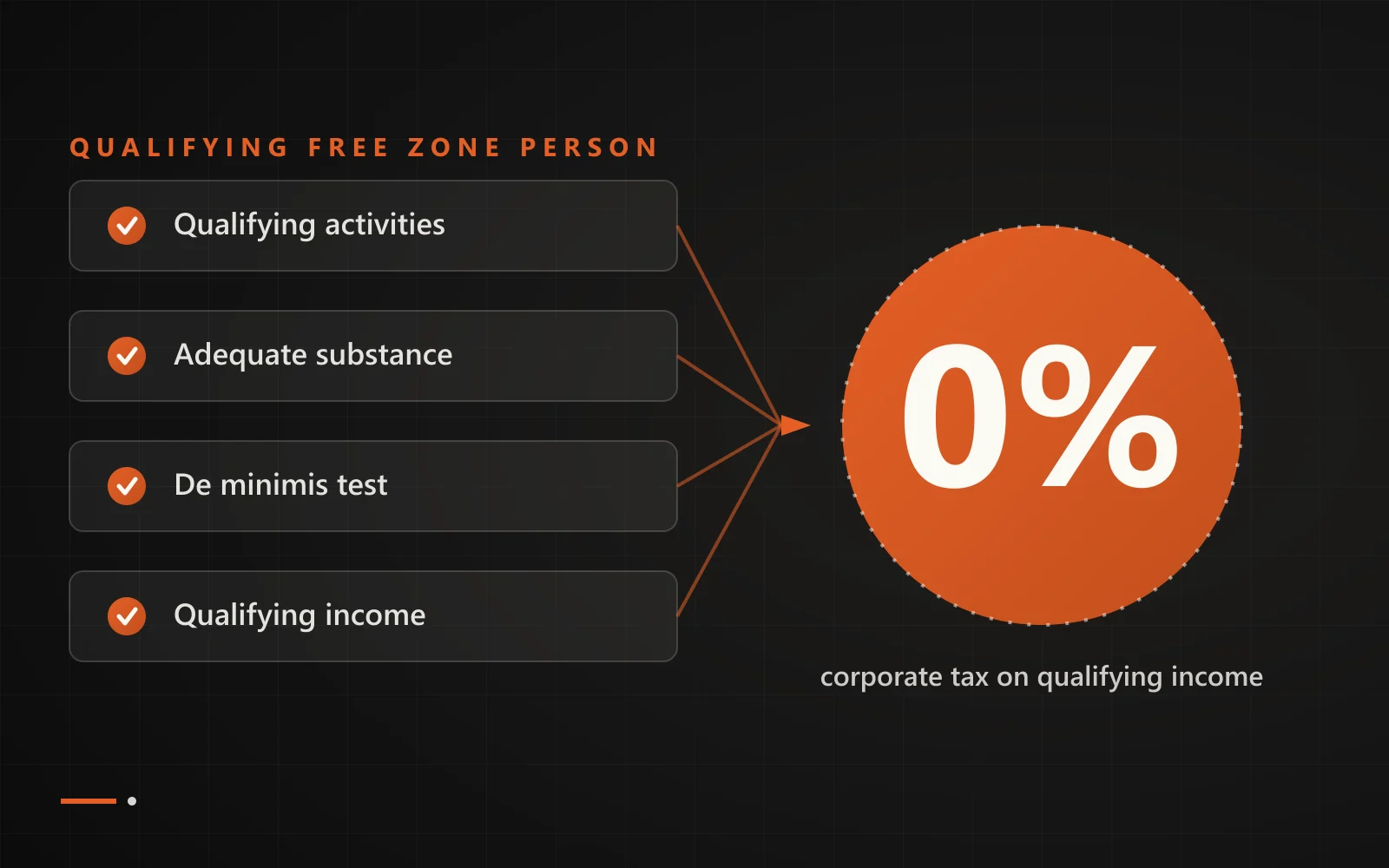
Free Zone Tax Regimes Under UAE Corporate Tax — What Qualifying Income Really Means
With the UAE Corporate Tax law now fully in force, free zone entities face a critical question: does your income actually qualify for the 0% rate? We break down the substance requirements, income tests, and common pitfalls.

UAE Tax Group Registration and the 31 December 2024 Deadline
UAE businesses that want to form a Corporate Tax group for a January to December 2024 tax period must file a joint application with the FTA by 31 December 2024, with every member resident and sharing the same tax period.