
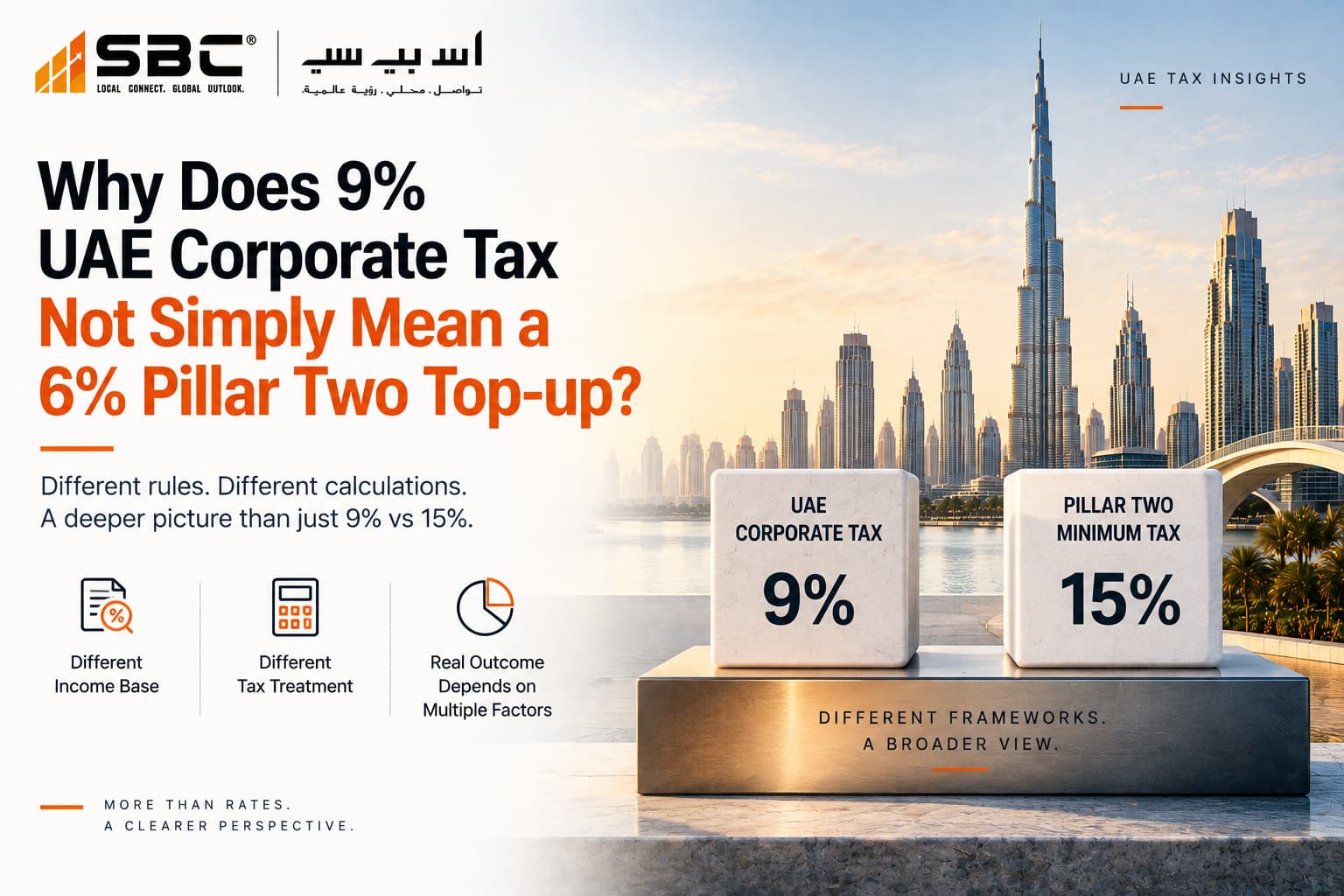
The UAE's 9% Corporate Tax rate does not automatically create a 6% Pillar Two top-up because the two regimes calculate different amounts on different bases. UAE Corporate Tax applies statutory rates to taxable income determined under the Corporate Tax Law. Pillar Two calculates a jurisdictional effective tax rate by dividing Adjusted Covered Taxes by Net Pillar Two Income under the GloBE rules.
The UAE Pillar Two ETR can therefore be lower than 9%, close to 9%, above 9% or even above 15%. Free-zone income, exempt income, deferred tax, foreign taxes allocated to UAE entities, accounting adjustments, losses and the mix of UAE constituent entities can all change the result. If the ETR is below 15%, the shortfall is applied to Excess Profit after the substance-based income exclusion, not automatically to UAE taxable income or total accounting profit.
For an in-scope multinational group, the only reliable answer is a GloBE calculation supported by a Corporate Tax-to-GloBE bridge. The shortcut "9% plus 6% equals 15%" is useful only as a warning that exposure may exist; it is not a tax computation.
What is the difference between UAE Corporate Tax and Pillar Two?
UAE Corporate Tax and the UAE Domestic Minimum Top-up Tax, or DMTT, operate alongside each other. The UAE Corporate Tax Law determines taxable income and the ordinary Corporate Tax liability. The general rate structure includes 0% on taxable income up to and including AED 375,000 and 9% on the portion above that threshold, while a Qualifying Free Zone Person may benefit from 0% on qualifying income subject to the conditions in the law.
The UAE DMTT has a different purpose and scope. Cabinet Decision No. 142 of 2024 implements the domestic top-up tax for UAE constituent entities of in-scope multinational enterprise groups. The Ministry of Finance Top-up Tax page confirms that the regime generally applies where the ultimate parent's consolidated annual revenue is at least EUR 750 million in at least two of the four immediately preceding fiscal years, for fiscal years beginning on or after 1 January 2025.
| UAE Corporate Tax lens | Pillar Two/DMTT lens |
|---|---|
| Taxable income under UAE domestic law | Net Pillar Two Income after GloBE adjustments |
| Entity or UAE tax-group compliance | Jurisdictional calculation, with special treatment for certain categories |
| 0% and 9% statutory rates | 15% jurisdictional minimum ETR |
| Current tax liability and domestic reliefs | Adjusted Covered Taxes, including prescribed current and deferred-tax treatment |
| Ordinary Corporate Tax return | Separate registration, information-return and top-up-tax compliance |
The regimes interact because eligible UAE Corporate Tax is generally part of Adjusted Covered Taxes. However, "counts as a covered tax" does not mean the Corporate Tax return amount is copied unchanged into the Pillar Two numerator.
Why is 9% not necessarily the UAE GloBE effective tax rate?
The simplified GloBE formula is:
UAE Pillar Two ETR = Adjusted Covered Taxes ÷ Net UAE Pillar Two Income
A statutory rate would translate into the same effective rate only if the domestic taxable-income base and the GloBE income base were identical, the same entities were combined, the tax expense were recognised consistently and no special adjustments applied. That is rarely true across a large multinational group.
The UAE Corporate Tax return may exclude or relieve income that remains in financial accounting profit. Conversely, GloBE removes some accounting income, including qualifying excluded dividends and certain excluded equity gains or losses. Current tax may be adjusted for taxes related to excluded income, while deferred tax can enter the numerator under a separate set of rules. The OECD GloBE Model Rules and 2026 Consolidated Commentary provide the international framework adopted for UAE purposes through current guidance.
Reason 1: taxable income and GloBE income are different denominators
UAE taxable income starts from accounting income and is adjusted under domestic law. The FTA's Determination of Taxable Income Guide explains the domestic process and key adjustments. Pillar Two instead starts with the financial accounting net income or loss of each constituent entity used in preparing the ultimate parent's consolidated financial statements, then applies GloBE adjustments.
Differences can arise from:
-
participation-exempt dividends and gains.
-
qualifying free-zone income taxed at 0%.
-
group relief, business restructuring relief and transfers within a qualifying group.
-
non-deductible expenses and domestic interest-limitation adjustments.
-
fair-value movements, stock-based compensation and pension accounting.
-
permanent establishments and cross-border income allocations.
-
prior-period corrections and accounting-policy differences.
-
transactions or entity classifications treated differently under GloBE.
The direction is not always the same. If UAE taxable income is smaller than GloBE income, the Pillar Two ETR may be lower than the statutory rate. If GloBE excludes accounting income while related covered tax remains appropriately included, the ETR may rise. A reconciliation is therefore more informative than a rate comparison.
Reason 2: Adjusted Covered Taxes are not simply current Corporate Tax
The numerator starts with covered taxes recognised in the financial accounts and then applies detailed adjustments. Current UAE Corporate Tax can contribute, but the group may also need to analyse deferred tax, withholding taxes, controlled foreign company taxes, permanent-establishment taxes and taxes booked in one entity in respect of another entity's income.
Deferred tax is particularly important. Relevant movements may be recast at the 15% minimum rate, tested for recapture and tracked by underlying attribute. A deferred tax liability that does not reverse within the prescribed period can affect a later calculation. Valuation allowances, losses, tax credits and rate changes can also produce a different ETR from a cash-tax calculation.
The UAE's current interpretative instrument is Ministerial Decision No. 96 of 2026. It applies to fiscal years beginning on or after 1 January 2025, adopts the 2026 OECD Commentary and agreed guidance, and repeals Ministerial Decision No. 88 of 2025. Models should therefore be based on the current 2026 materials.
Reason 3: UAE entities are generally blended at jurisdiction level
The DMTT calculation generally combines the ordinary UAE constituent entities of the group within one jurisdictional result, subject to separate calculations and special rules for categories such as joint ventures, minority-owned subgroups and investment entities.
This means a mainland entity taxed at 9%, a Qualifying Free Zone Person earning 0% qualifying income and another UAE entity with tax losses can influence the same blended ETR. No single entity's rate gives the group answer.
The FTA Free Zone Persons Guide remains essential for determining the QFZP's ordinary Corporate Tax position. Pillar Two then overlays the jurisdictional GloBE calculation. A transfer of profit between two UAE constituent entities may change ordinary Corporate Tax and QFZP consequences without removing the profit from the UAE Pillar Two denominator.
For a fuller free-zone analysis, see SBC's guide to UAE free zones and Pillar Two top-up tax.
Reason 4: the top-up percentage is applied only to Excess Profit
Even after the group calculates an ETR below 15%, the percentage shortfall is not automatically applied to every dirham of accounting or taxable profit.
The simplified sequence is:
-
calculate Net UAE Pillar Two Income.
-
calculate the UAE jurisdictional ETR.
-
determine the top-up percentage as 15% minus the ETR.
-
calculate the substance-based income exclusion, or SBIE.
-
subtract the SBIE from Net Pillar Two Income to determine Excess Profit.
-
apply the top-up percentage to Excess Profit, followed by any additional adjustments.
The SBIE is linked to eligible payroll costs and eligible tangible assets in the UAE. It rewards operating substance by reducing the top-up base. It does not raise the ETR and should not be described as an exemption from Corporate Tax.
Reason 5: safe harbours can deem top-up tax to be zero
An in-scope group may qualify for an available Pillar Two safe harbour. The Transitional CbCR Safe Harbour uses qualified Country-by-Country Reporting information and applies alternative de minimis, simplified ETR and routine-profits tests. If one test is satisfied for the jurisdiction and the required election is made, top-up tax may be deemed zero for that year.
Safe-harbour eligibility does not mean the UAE headline rate has become 15%. It means the group qualifies for an agreed simplification. Registration, the information return, election reporting and evidence may still be required. The OECD Pillar Two implementation hub contains the current safe-harbour materials, including the 2026 updates.
For the tests and evidence requirements, read SBC's UAE Pillar Two safe-harbours guide.
A UAE example: why the shortfall can be 11.4%, not 6%
Assume an in-scope MNE group has the following simplified UAE profile for one fiscal year:
| Item | Mainland entities | QFZP | UAE total |
|---|---|---|---|
| Net Pillar Two Income | AED 120m | AED 180m | AED 300m |
| Adjusted Covered Taxes | AED 10.8m | AED 0 | AED 10.8m |
| Indicative ETR | 9% | 0% | 3.6% |
The UAE jurisdictional ETR is AED 10.8 million divided by AED 300 million, or 3.6%. The top-up percentage is therefore 11.4%, not 6%.
If the SBIE is AED 30 million, Excess Profit is AED 270 million. The simplified indicative top-up is AED 30.78 million: 11.4% multiplied by AED 270 million.
This example ignores deferred tax, excluded income, foreign-tax allocation, losses, elections, additional current top-up tax and special entity rules. Its purpose is to show why blending and the top-up base matter. SBC's UAE Pillar Two ETR calculation example provides a broader numerical walkthrough.
Can the UAE GloBE ETR be above 15% even when the rate is 9%?
Yes. For example, Adjusted Covered Taxes may include relevant deferred-tax expense or taxes allocated to UAE income, while GloBE adjustments may remove part of accounting profit from the denominator. The resulting jurisdictional ETR can exceed 15%, in which case no ordinary percentage shortfall arises for that year.
That does not necessarily eliminate compliance. Scope is based primarily on group revenue and entity classification, not the amount of top-up tax payable. The group may still have registration, Pillar Two Information Return, Top-up Tax Return, election and recordkeeping obligations.
The OECD Central Record should also be checked when the group relies on qualified status or a QDMTT Safe Harbour in another jurisdiction.
Can the UAE GloBE ETR fall below 9% without free-zone income?
Yes. The result can fall below 9% where Net Pillar Two Income exceeds domestic taxable income, where covered tax is reduced by an adjustment, where losses and timing differences affect the numerator, or where an entity's accounting and tax positions do not align in the tested year.
Free-zone income is a common and visible driver, but it is not the only one. Participation exemptions, branch allocations, tax incentives, tax credits, prior-year tax changes and accounting adjustments can all contribute. This is why a group should collect entity-level data before forming a view from its consolidated tax expense.
What should UAE finance and tax teams calculate?
1. Build a Corporate Tax-to-GloBE income bridge
Start with each UAE constituent entity's consolidation-basis accounting result. Reconcile it to statutory accounts and taxable income, then label every difference by Corporate Tax and GloBE treatment.
2. Reconstruct Adjusted Covered Taxes
Map current tax, deferred tax and cross-border tax allocations. Track the underlying deferred-tax attributes and identify tax associated with excluded income.
3. Model the complete UAE jurisdiction
Include mainland entities, free-zone entities, branches and relevant special categories. Do not model only the entity expected to pay the DMTT.
4. Calculate substance and safe harbours
Collect payroll and tangible-asset data for the SBIE. Test all available safe harbours using qualified information and document elections.
5. Connect the result to compliance and provisioning
Reconcile the final model to Corporate Tax returns, CbCR, the tax provision, the Pillar Two Information Return and the UAE Top-up Tax Return. Use the result for cash forecasting and financial-statement review.
The FTA Corporate Tax guides and references should be monitored alongside the Pillar Two materials.
Frequently asked questions
Is UAE DMTT simply an additional 6% on 9% Corporate Tax?
No. The top-up percentage is 15% minus the actual UAE jurisdictional GloBE ETR, which uses Net Pillar Two Income and Adjusted Covered Taxes. The result can be higher or lower than a 6% shortfall.
Does UAE Corporate Tax count towards the 15% minimum?
Generally, eligible UAE Corporate Tax is a covered tax and contributes to Adjusted Covered Taxes. It may require allocation or adjustment before entering the GloBE numerator.
Can a group have a Pillar Two ETR below 9%?
Yes. This is common where 0% free-zone profit or other income included in GloBE exceeds the domestic taxable base, or where covered-tax adjustments reduce the numerator.
Can the UAE Pillar Two ETR exceed 15%?
Yes. Deferred tax, allocated foreign taxes and GloBE income adjustments can produce an ETR above 15%, even where the ordinary statutory rate is 9%.
Is the 15% top-up applied to all UAE profit?
No. The top-up percentage generally applies to Excess Profit after the substance-based income exclusion, subject to further adjustments and special rules.
Are UAE companies below EUR 750 million affected?
The DMTT generally applies to constituent entities of MNE groups meeting the EUR 750 million consolidated revenue test. Smaller and purely domestic groups ordinarily remain outside the core Pillar Two scope.
Does a nil top-up mean there are no filing obligations?
No. In-scope entities can still have registration, information-return, Top-up Tax Return, election and recordkeeping obligations even if the calculation or a safe harbour produces no tax.
What is the first practical step for a UAE group?
Prepare an entity-level bridge from consolidation profit and the tax provision to Net Pillar Two Income and Adjusted Covered Taxes. A headline-rate estimate should not be used for filing or provisioning.
Primary sources and further reading
How SBC Tax Consulting can help
SBC's corporate tax and international tax teams can build the Corporate Tax-to-GloBE bridge, reconstruct Adjusted Covered Taxes and model the full UAE jurisdictional result rather than a 9% plus 6% shortcut. We connect the calculation to data readiness, safe-harbour screening and the Pillar Two Information Return. Contact SBC for scoping, modelling and compliance support.
This publication is for general information only and does not constitute professional advice. Please consult your SBC advisor before acting on any matter covered here.