
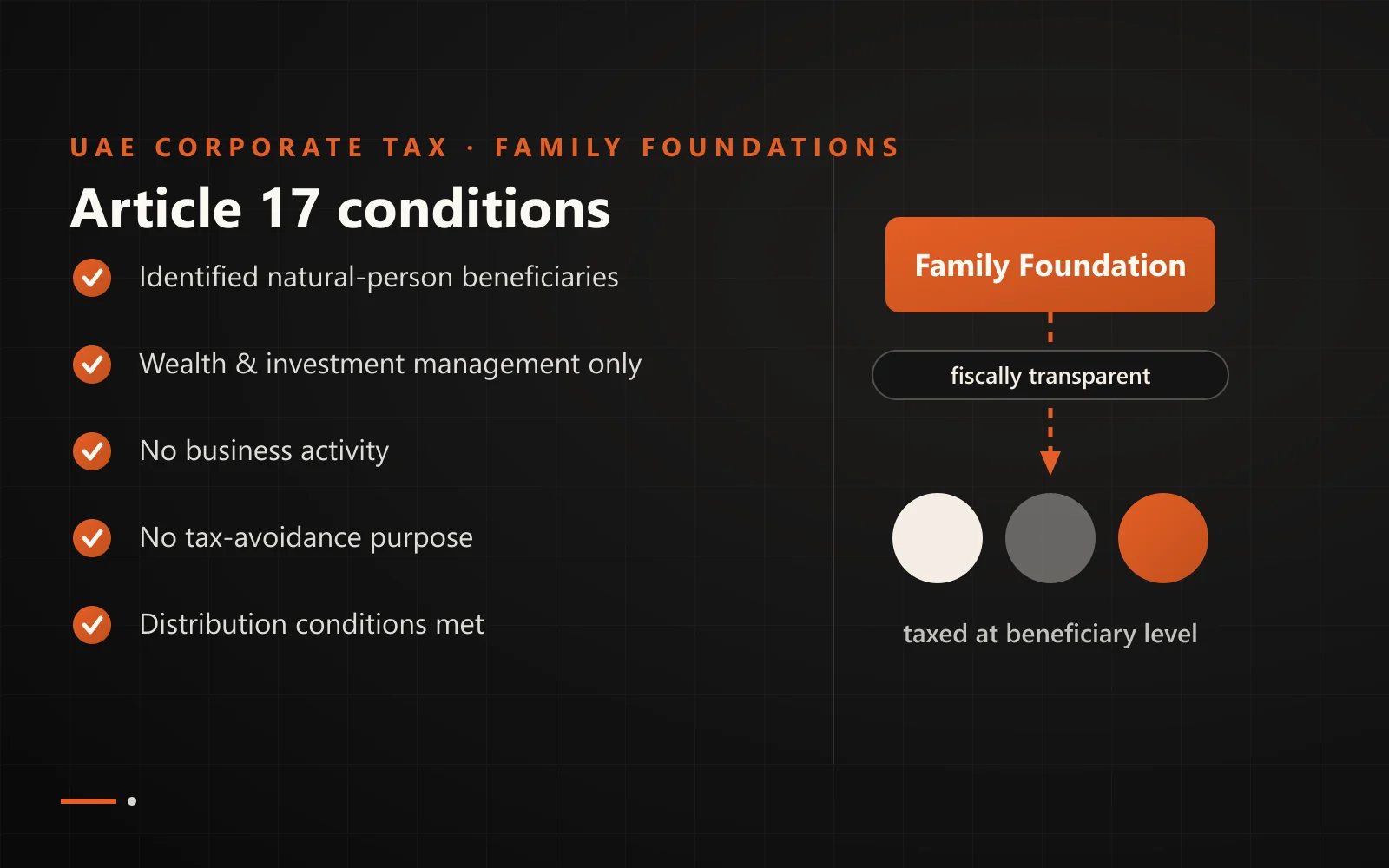
A UAE family foundation can hold and pass wealth across generations without being taxed at 9% at the foundation level. That single outcome is why family foundations have become a central tool in UAE succession planning. But the tax treatment is not automatic, it depends on meeting strict conditions continuously, and the June 2026 update to the Federal Tax Authority guidance has sharpened several of the rules.
This guide explains what a family foundation is, how it is taxed under the Corporate Tax Law, and what the fiscal transparency election actually requires. You will learn how the Article 17 conditions work, why the latest clarification on LLCs matters, how multi-tier structures keep or break their transparent status, and the practical filing and record-keeping steps families cannot skip.
By the end, you should be able to tell whether a foundation genuinely qualifies, where the common structuring traps sit, and when specialist advice is essential rather than optional.
What is a UAE family foundation?
A family foundation is a vehicle, typically a foundation or a trust, that families use to hold, manage and preserve wealth across generations. It centralises governance, separates personal wealth from operating business risk, and creates an orderly path for succession.
Under the UAE Corporate Tax Law, the concept covers foundations, trusts and similar entities established to manage and preserve family wealth rather than to run a commercial business. The distinction matters because the tax treatment is built around wealth stewardship, not trading.
Families in the UAE use these structures for asset protection, cross-border wealth management, investment holding, and structured ownership transitions between generations. The country's growth as a private wealth and family office hub is what has driven the wide use of these vehicles.
Why families choose family foundations
- Wealth preservation: protecting assets and enabling long-term continuity.
- Succession planning: creating a clear ownership transition across generations.
- Asset protection: separating personal wealth from operational business risk.
- Governance and control: centralising the management of investments and assets.
- Potential tax efficiency: access to fiscal transparency where the conditions are met.
How are family foundations defined and taxed under Corporate Tax?
The legal foundation for the treatment sits in Article 17 of Federal Decree-Law No. 47 of 2022, read together with the wider Corporate Tax framework published by the Ministry of Finance. The default position is that a foundation with separate legal personality is a juridical person and, in principle, subject to Corporate Tax at 9% on taxable income above the threshold.
The key relief is that a qualifying family foundation can apply to the FTA to be treated as a fiscally transparent Unincorporated Partnership. Where that election is approved, income is not taxed at the foundation level. Instead it is looked through to the beneficiaries, who are then assessed according to their own tax position.
This is a confirmed legal fact rather than an interpretation: the election must be applied for and approved, and it is not granted simply because a foundation exists.
Foundations with separate legal personality
These entities are generally taxable as juridical persons. They can, however, apply to be treated as an Unincorporated Partnership under Article 17, which delivers fiscal transparency if the conditions are met.
Trusts without separate legal personality
Trust structures that do not have separate legal personality are generally treated as fiscally transparent by default, which means the tax analysis happens at the beneficiary level rather than the entity level. The practical difference is that a foundation usually elects into transparency, while a trust of this kind may already sit there.
The Article 17 conditions in detail
The core conditions for a family foundation to qualify for fiscal transparency are unchanged by the 2026 update, and they must be satisfied continuously. A breach at any point during a tax period can make the entity a taxable person from the start of that period.
| Condition | Requirement |
|---|---|
| Beneficiary scope | Established for identified or identifiable natural persons, Public Benefit Entities, or a combination of both |
| Principal activity | Restricted to receiving, holding, investing, spending and managing assets, funds and family wealth |
| Business restriction | No Business or Business Activity that would be taxable if the beneficiaries carried it on directly |
| Anti-avoidance | The main or principal purpose must not be to avoid Corporate Tax |
| Public Benefit Entity distribution | Income attributable to a Public Benefit Entity must be non-taxable in its hands or distributed within a set period after the tax period end |
| Continuous compliance | A breach makes the entity a taxable person at 9% from the start of that tax period |
A useful practical point: beneficiaries do not all have to belong to the same family. The test is that they are identified or identifiable natural persons, or qualifying public benefit entities, not a single family unit.
The fiscal transparency election
The election is a formal application to the FTA. Where approved, the foundation is treated as an Unincorporated Partnership, and its assets, liabilities, income and expenses flow through to the beneficiaries. The Corporate Tax page on the FTA website is the primary reference point for the registration and application journey, and the FTA Corporate Tax FAQs address trusts and family foundations as a dedicated category.
What changed in the June 2026 CTGFF1 update?
In June 2026 the FTA released a revised edition of its Taxation of Family Foundations Corporate Tax Guide, known as CTGFF1, updating the first version issued in 2025. You can locate the current version on the FTA guides, references and public clarifications page.
The headline is that the Article 17 qualifying conditions did not change. What the update did was refine definitions, restructure the multi-tier rules, and add fresh guidance on asset transfers and family offices. SBC's detailed breakdown of these changes sits in the 2026 family foundations update analysis, and the earlier position is captured in the 2025 family foundations guide.
Why the LLC clarification matters most
The most practically important change is the confirmation that a Limited Liability Company is not a "similar entity" to a trust or foundation. Many wealth structures use LLCs as holding or operating layers, and the earlier guidance left room for a broad reading.
The clarified position is straightforward. An LLC cannot apply for fiscal transparency in its own right. To benefit from transparent treatment inside a family foundation structure, an LLC must be wholly owned by the foundation. Ownership, not resemblance, is what carries the tax treatment through the structure.
Multi-tier structures and the transparent ownership chain
Many families do not hold assets directly through a single foundation. They use holding entities and subsidiaries beneath it. The guide addresses these multi-tier structures and sets clear rules for when transparency flows down and when it stops.
A juridical person may be treated as an Unincorporated Partnership, and therefore transparent, where it is wholly owned and controlled by a family foundation, ownership runs through a fiscally transparent chain, and the Article 17 conditions remain satisfied throughout.
The concept to understand here is the uninterrupted transparent ownership chain. Each entity in the structure is assessed separately. If one entity in the chain is opaque, meaning it does not qualify for transparency, that break generally affects the transparency status of everything sitting below it.
What this looks like in practice
Consider a foundation that wholly owns a holding LLC, which in turn owns two investment LLCs. If the holding LLC is wholly owned by the foundation and the chain stays transparent, the structure can hold together. Insert a partly owned entity, or an entity that fails a condition, and the chain breaks for the entities beneath it.
This is why families should map every layer before assuming the whole structure is transparent. A single misplaced entity can undo the intended treatment for a large part of the holding.
How beneficiaries are treated
The tax outcome at the foundation level is only half the picture. What happens at the beneficiary level determines the real result.
Natural person beneficiaries
Natural person beneficiaries are generally not taxed where the income flowing to them qualifies as personal investment income or real estate investment income. This aligns with how individuals are treated more broadly under the Corporate Tax regime, where wages, personal investment income and real estate investment income sit outside the scope for natural persons.
Public benefit entities
Qualifying Public Benefit Entities remain exempt from Corporate Tax. Non-qualifying public benefit entities may still be taxable, which is why the distribution condition attached to public benefit beneficiaries needs careful handling.
Dividends and capital gains
Dividends and capital gains may qualify for exemption where the participation exemption conditions are met, which can create genuine efficiency for investment holding structures. The precise conditions for that exemption were tightened across the wider regime, as covered in SBC's review of the key Corporate Tax decisions shaping FY 2025-26.
Asset transfers into a foundation
The 2026 guide filled a gap that the first edition left open by setting out how contributions of assets by founders and settlors are treated. The important points are that the arm's length principle applies, and that there is tax neutrality when a natural person transfers personal investments or real estate investments into a foundation.
The guide also fixes the base cost of assets so it does not shift when an entity moves between transparent and opaque status. This prevents tax-driven valuation changes when a structure gains or loses its family foundation treatment.
This is a confirmed part of the updated guidance rather than a planning theory, and it gives families useful certainty when funding a structure. Where a transfer involves related parties, the arm's length analysis links directly to the broader transfer pricing framework the FTA applies to related party dealings.
Family offices and why they are usually taxable
Single Family Offices and Multi-Family Offices are addressed directly for the first time in the updated guide, and the treatment is different from the foundation itself. As a professional interpretation grounded in the guidance, a family office is generally treated as carrying on a Business Activity, which makes it taxable rather than transparent.
There is a route to a preferential outcome. A family office may reach a 0% free zone Corporate Tax rate where it is regulated by an approved authority such as the SCA, DFSA or FSRA and meets the relevant qualifying conditions. This is where the free zone regime interacts with the family foundation analysis, and where careful structuring is needed to keep the two treatments straight.
The practical takeaway is to treat the foundation and the family office as separate tax questions. The foundation may be transparent while the family office servicing it is a taxable business.
Registration, filing and record-keeping
Fiscal transparency does not remove the compliance burden, it reshapes it. A family foundation generally needs to register for Corporate Tax before applying for fiscally transparent treatment, and the wider registration and filing framework is set out on the Ministry of Finance Corporate Tax page.
Key compliance points
- Registration first: the foundation registers for Corporate Tax before the transparency application.
- Application timing: the application to be treated as an Unincorporated Partnership should be made in line with the deadlines the FTA sets, including the codified 31 December 2025 date for retrospective applications.
- Annual confirmations: the foundation and relevant entities must submit annual confirmations within the prescribed window after the tax period end to maintain fiscally transparent status.
- Multi-tier inclusion: all relevant entities in a multi-tier structure should be included in the application.
- Record retention: records should be retained for seven years and be producible on request.
A welcome simplification in the update is that fiscally transparent foreign partnerships are not required to register in the UAE, which eases compliance for cross-border wealth structures that are already transparent elsewhere.
Anti-avoidance and how it interacts with the wider regime
The anti-avoidance condition is not a formality. The main or principal purpose of the structure must not be to avoid Corporate Tax, and the FTA applies this to ensure only genuine wealth preservation structures benefit from transparency.
This condition sits alongside the general anti-abuse rule in the Corporate Tax Law and the broader procedural framework. Recent procedural changes matter here too, including the tighter timelines in Federal Decree-Law No. 17 of 2025 amending the Tax Procedures Law and the executive regulation updates in Cabinet Decision No. 17 of 2026. Families should plan on the assumption that documentation and substance will be tested.
Where a foundation holds significant assets, the audited accounts rules can also apply. SBC's guide to Ministerial Decision No. 84 of 2025 on audited financial statements explains the thresholds that can pull an entity into a mandatory audit.
Where related party rules and non-resident nexus intersect
Two further areas deserve attention because they often catch families by surprise.
First, dealings inside a family structure can involve related parties. Transfers, loans and service arrangements between connected entities and individuals may need arm's length support, and the reporting obligations are set out in SBC's guide to what businesses need to report on related party transactions and the broader UAE transfer pricing compliance guide. Identifying who is a related party is a discipline in itself, covered in how to identify related parties under UAE Corporate Tax and the companion connected persons guide.
Second, where a structure holds UAE real estate through funds, or has non-resident investors, the nexus rules can create UAE tax obligations. SBC's analysis of Cabinet Decision No. 35 of 2025 on non-resident nexus explains when a foreign investor is brought into scope through property-linked income.
Comparison: foundation versus family office versus LLC in a structure
The table below sets out how three common building blocks are treated. This is a practical summary, and the exact outcome always depends on the facts.
| Structure element | Default Corporate Tax treatment | Can it be fiscally transparent? |
|---|---|---|
| Family foundation (foundation or trust) | Potentially taxable as juridical person, or transparent if Article 17 met | Yes, by election where conditions are met |
| LLC used as a holding or operating layer | Taxable juridical person | Only if wholly owned by the foundation within a transparent chain |
| Single or Multi-Family Office | Generally taxable as a Business Activity | Not through Article 17; may reach 0% free zone rate if regulated and qualifying |
Common structuring mistakes to avoid
- Assuming transparency is automatic. It requires an application to the FTA and continuous compliance with Article 17.
- Treating an LLC as a similar entity. An LLC only benefits from transparency if wholly owned by the foundation.
- Breaking the ownership chain. An opaque entity inserted mid-structure can strip transparency from everything below it.
- Confusing the foundation with the family office. The office is usually a taxable business, even where the foundation is transparent.
- Missing annual confirmations. The transparency election lapses when a qualifying condition or filing is missed.
- Weak documentation. Governance records, transfer records and beneficiary details should be audit-ready.
- Ignoring related party pricing. Intra-structure transactions may need arm's length support.
A practical action checklist for families and advisors
- Confirm the vehicle type and whether it is a foundation, a trust, or a similar entity that genuinely qualifies.
- Test each Article 17 condition against the actual facts, not the intended design.
- Map every entity in the structure and check the transparent ownership chain layer by layer.
- Identify each beneficiary and confirm their tax position, especially any public benefit entities.
- Register the foundation for Corporate Tax before applying for fiscal transparency.
- File the transparency application within the applicable deadlines, including retrospective ones.
- Diarise the annual confirmation deadline and treat it as non-negotiable.
- Document asset transfers into the foundation on an arm's length basis and fix base cost.
- Assess any family office separately, including free zone eligibility.
- Retain records for seven years and keep governance documentation current.
When expert advice is essential
Some situations move well beyond standard structuring. Seek specialist input where the structure is multi-tier, where LLCs sit inside the ownership chain, where public benefit entities are beneficiaries, where a family office is involved, or where the foundation holds UAE real estate or has non-resident investors. These are the points where a small design error carries a large tax cost.
SBC's Corporate Tax practice and Transfer Pricing practice work together on exactly these structures, and the full range of tax services covers the surrounding compliance. Ongoing developments are tracked on the SBC insights hub.
Frequently asked questions
Can a UAE family foundation avoid Corporate Tax?
A qualifying family foundation can elect under Article 17 to be treated as a fiscally transparent Unincorporated Partnership, so its income is attributed to the beneficiaries rather than taxed at 9% at the foundation level. This is not tax avoidance. Anti-avoidance is a condition of the regime, and the structure's main purpose must not be to avoid Corporate Tax.
Is the fiscal transparency treatment automatic?
No. The foundation must register for Corporate Tax and apply to the FTA to be treated as an Unincorporated Partnership. The Article 17 conditions must then be met continuously, and annual confirmations must be filed on time to keep the status in place.
Can an LLC be a UAE family foundation?
No. The June 2026 guide confirms that an LLC is not a similar entity and cannot apply for fiscal transparency in its own right. An LLC can only benefit from a transparent family foundation structure if it is wholly owned by the foundation, and an opaque entity in the chain breaks transparency for the entities beneath it.
How are family offices taxed in the UAE?
Single and Multi-Family Offices are generally treated as carrying on a Business Activity and are therefore taxable. However, a family office may access a 0% free zone Corporate Tax rate where it is regulated by an approved authority such as the SCA, DFSA or FSRA and meets the relevant qualifying conditions.
Do beneficiaries pay tax on income from the foundation?
Natural person beneficiaries are generally not taxed where the income qualifies as personal investment income or real estate investment income. Qualifying Public Benefit Entities remain exempt, while non-qualifying public benefit entities may still be taxable.
What is the deadline to apply for family foundation status?
The guide codifies 31 December 2025 as the deadline for retrospective applications, and sets a nine-month window for the annual confirmations that maintain fiscally transparent status. Meeting these deadlines is essential because the qualifying conditions must be satisfied continuously.
How long must a family foundation keep records?
Records should be retained for seven years and be producible on request. Governance documentation, beneficiary details and asset transfer records should all be kept audit-ready.
Final takeaway
A UAE family foundation is one of the most effective tools for wealth preservation and succession, but its tax benefit rests entirely on getting the structure and the compliance right. The fiscal transparency election under Article 17 is powerful, yet it is conditional, continuous and now more precisely defined after the 2026 CTGFF1 update.
The clear next step is to review your structure against the Article 17 conditions and the transparent ownership chain, confirm every entity's status, and lock in the registration, application and annual filing timeline. If any layer involves an LLC, a family office, public benefit beneficiaries or cross-border investors, bring in specialist advice before acting. To review your position, contact the SBC team.
19/5/26 evised UAE Federal Tax Authority Service
Page Title: Revised UAE FTA Service Fees from 1 January 2026: A Complete Guide for Businesses
Meta Title: UAE FTA Service Fees 2026: What Changes and What to Do
Meta Description: A practical guide to the revised UAE Federal Tax Authority service fees from 1 January 2026, covering TRC, clarifications, APA, tax agent and vendor fees, plus budgeting and compliance steps.
Primary Keywords: UAE FTA service fees 2026, Federal Tax Authority service fees
Secondary Keywords: Cabinet Decision 174 of 2025, TRC fees UAE, APA application fee UAE, tax agent registration fee UAE, clarification request fee UAE
Slug: uae-fta-service-fees-2026