
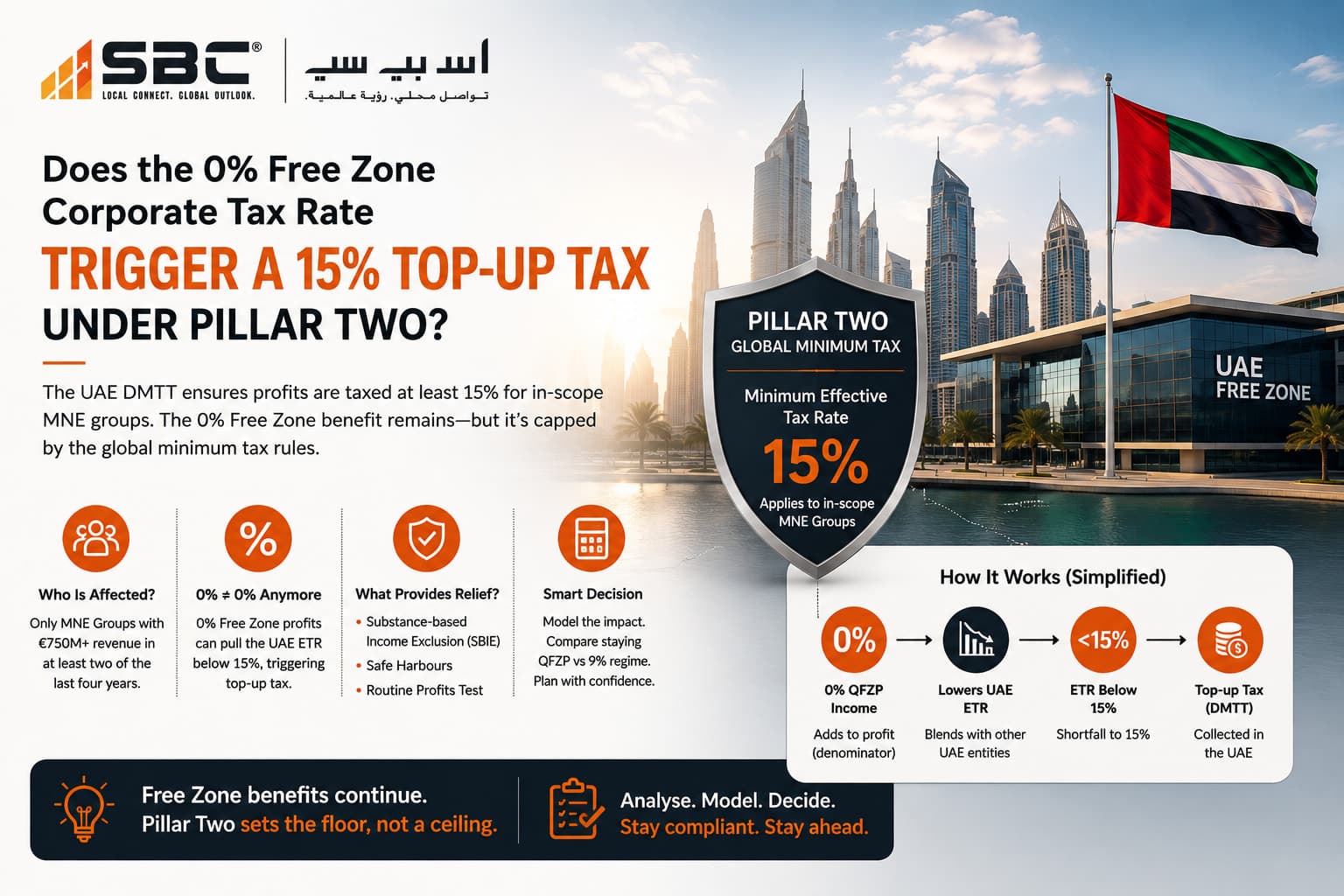
The UAE's 0% Qualifying Free Zone Person rate does not automatically create Pillar Two tax. Most UAE free-zone companies are outside Pillar Two because they do not belong to a multinational enterprise group with consolidated annual revenue of at least EUR 750 million in at least two of the four preceding fiscal years.
Where a free-zone entity is part of an in-scope group, however, its qualifying income taxed at 0% enters the UAE jurisdictional GloBE calculation. The profits of the group's UAE constituent entities are generally blended, and their adjusted covered taxes are compared with the 15% minimum rate. If the blended UAE effective tax rate is below 15%, the UAE Domestic Minimum Top-up Tax can apply to excess profit after the substance-based income exclusion.
Pillar Two therefore does not abolish the free-zone regime. It limits the effective benefit for the relatively small population of very large multinational groups, and even then the result depends on covered taxes, substance, safe harbours, elections and the group's full UAE profile.
Are all UAE free-zone companies subject to Pillar Two?
No. Two separate rulebooks must be tested.
The first is the UAE Corporate Tax free-zone regime. A legal person established in a UAE free zone may qualify for a 0% rate on qualifying income if it satisfies the conditions for a Qualifying Free Zone Person, or QFZP. Those conditions sit in the UAE Corporate Tax Law and the related Cabinet and Ministerial Decisions. The FTA Free Zone Persons Guide explains the administration of qualifying income, adequate substance, the de minimis requirement, audited financial statements and transfer-pricing compliance.
The second is Pillar Two. The UAE Ministry of Finance Top-up Tax page confirms the EUR 750 million consolidated revenue threshold and the two-out-of-four preceding-year test. Only constituent entities of an in-scope MNE group are brought into the UAE DMTT for fiscal years beginning on or after 1 January 2025, subject to exclusions and detailed rules.
This produces four common outcomes:
| UAE free-zone profile | Likely result |
|---|---|
| Standalone free-zone company | No Pillar Two because there is no MNE group; normal QFZP rules continue |
| Multinational group below EUR 750 million | No DMTT under the size threshold; normal UAE Corporate Tax and TP rules continue |
| In-scope MNE group with a UAE free-zone entity | UAE profits and covered taxes enter the jurisdictional GloBE/DMTT calculation |
| Excluded entity or special-classification case | Detailed classification is required; do not assume ordinary constituent-entity treatment |
The threshold is applied to the consolidated group, not to the UAE entity's turnover. A Dubai free-zone company with AED 20 million revenue can therefore be in scope if it belongs to a global group above the threshold, while a much larger standalone UAE business may remain outside Pillar Two.
Has Pillar Two abolished the UAE 0% free-zone rate?
No. The 0% rate remains part of the Corporate Tax regime. A QFZP must continue to satisfy all conditions, including maintaining adequate substance, deriving qualifying income, meeting the de minimis requirement, complying with the arm's-length principle and preparing the required transfer-pricing documentation.
Pillar Two is a separate top-up mechanism. Cabinet Decision No. 142 of 2024 imposes the UAE DMTT on in-scope multinational groups. It does not rewrite the QFZP rate. The economic effect can nevertheless be similar to a rate increase where low-taxed free-zone profits cause the UAE jurisdictional effective tax rate to fall below 15%.
This distinction matters for contracts, incentives and financial statements. The QFZP may still report Corporate Tax at 0% on qualifying income, while the group records a separate domestic top-up tax charge. It also matters for businesses below the Pillar Two threshold: they retain the free-zone outcome without a GloBE top-up, provided all QFZP conditions are met.
How does the UAE DMTT calculation treat free-zone income?
The UAE DMTT generally calculates an effective tax rate for the jurisdiction rather than testing each ordinary UAE entity in isolation. In simplified form:
UAE GloBE ETR = Adjusted Covered Taxes of UAE constituent entities ÷ Net UAE GloBE Income
If the result is below 15%, the percentage shortfall is the top-up tax percentage. It is then applied to excess profit, which is net GloBE income after the substance-based income exclusion, subject to additional current top-up tax and other adjustments.
This blending effect means a free-zone entity's 0% income can be partially offset by taxes of mainland UAE entities in the same jurisdictional group. Yet 9% Corporate Tax on mainland profits is also below 15%, so the blended result will often remain below the floor unless other covered taxes or GloBE adjustments materially increase the numerator.
Moving accounting profit between a mainland company and a free-zone company usually does not, by itself, take that profit outside the UAE jurisdictional calculation. It may change UAE Corporate Tax and QFZP qualification, and it must satisfy transfer pricing, but both entities' ordinary GloBE results are generally blended within the UAE.
A simple UAE free-zone Pillar Two example
Assume an in-scope group has two ordinary UAE constituent entities and, solely for illustration, no deferred-tax or other GloBE adjustments:
| Item | QFZP | Mainland entity | UAE total |
|---|---|---|---|
| GloBE income | EUR 12.0m | EUR 8.0m | EUR 20.0m |
| Adjusted covered taxes | EUR 0 | EUR 0.72m | EUR 0.72m |
| Simplified ETR | 0% | 9% | 3.6% |
The jurisdictional top-up percentage is 15% minus 3.6%, or 11.4%. If the UAE substance-based income exclusion is EUR 4 million, excess profit is EUR 16 million. The simplified top-up amount is therefore EUR 1.824 million: 11.4% multiplied by EUR 16 million.
Without the substance exclusion, the amount would be EUR 2.28 million. The EUR 4 million exclusion reduces the charge by EUR 456,000. That is why payroll and tangible assets can be commercially significant under Pillar Two, even though they do not raise the ETR itself.
This example is not a tax computation. Real calculations can include excluded dividends, equity gains or losses, stock-based compensation, tax allocation rules, deferred tax, loss elections, prior-year adjustments, permanent establishments, joint ventures and other features. It demonstrates only the interaction between 0%, 9%, blending and substance.
How does the substance-based income exclusion help free-zone groups?
The substance-based income exclusion, or SBIE, removes a formulaic return linked to eligible payroll costs and eligible tangible assets from the top-up tax base. It does not increase covered taxes or change the effective tax rate. Instead, it reduces the excess profit to which the top-up percentage applies.
This can benefit UAE manufacturing plants, distribution centres, logistics hubs and service operations with genuine employees and operating assets. A low-substance entity holding valuable rights or booking residual margin may receive much less protection because the exclusion follows qualifying payroll and assets, not revenue or accounting profit.
Data quality is critical. The group must determine which employees and independent contractors meet the GloBE definitions, where their activities are performed and which payroll costs are eligible. For assets, the group must identify the relevant carrying value, location and exclusions. A fixed-asset register organised only by legal owner may not answer where an asset is actually located and used.
The SBIE also interacts with the routine profits test under the Transitional CbCR Safe Harbour. If qualified CbCR profit before tax for the UAE does not exceed the jurisdiction's SBIE, the top-up tax may be deemed zero for the year. Substance-heavy free-zone operations should therefore calculate the exclusion during safe-harbour screening, not wait until a full computation is required.
Can safe harbours eliminate the UAE top-up tax?
Potentially, for the relevant year. The Transitional CbCR Safe Harbour may deem the UAE top-up tax to be zero if the jurisdiction meets the de minimis, simplified ETR or routine profits test using qualified data. For a UAE profile containing 0% or 9% income, the simplified ETR test may be difficult; the routine profits test can be more realistic where the local operation has substantial people and assets.
The OECD's Pillar Two implementation hub contains the safe-harbour materials and the January 2026 update, which extended the transitional CbCR relief by one year. Eligibility must be confirmed under current adopted guidance and the group's fiscal calendar.
The QDMTT Safe Harbour serves a different purpose. When the conditions are met, it generally allows a foreign parent jurisdiction to rely on the UAE domestic charge rather than calculate a second top-up on the same UAE profits. The OECD Central Record should be checked for current qualified status and conditions. It does not mean that the UAE itself waives DMTT.
Should an in-scope company elect out of QFZP status?
Not without modelling. Electing to be subject to the standard Corporate Tax regime may increase covered taxes, but a 9% headline rate remains below the 15% GloBE floor. The election can also affect future years and should be considered alongside QFZP eligibility, non-qualifying income, losses, reliefs, commercial commitments and the group's legal structure.
The comparison should be made on an after-tax, multi-year basis:
| Question | Retain QFZP status | Elect for standard regime |
|---|---|---|
| UAE Corporate Tax on qualifying income | Potentially 0% | Generally standard UAE rate, subject to the law |
| Covered taxes for GloBE | Lower unless other taxes are allocated | Higher current tax may increase the ETR |
| DMTT | Potentially higher | May reduce, but not necessarily eliminate, the shortfall to 15% |
| QFZP compliance | Conditions remain critical | QFZP benefit is not used for the election period |
| Commercial effect | May preserve free-zone positioning and other benefits | Requires evaluation of legal and commercial consequences |
In some fact patterns, paying 9% Corporate Tax simply converts part of the DMTT into ordinary Corporate Tax with little change in the total UAE tax burden. In others, losses, deferred tax or differences between the Corporate Tax and GloBE bases change the outcome. A rate comparison alone cannot answer the question.
Which current UAE free-zone rules should be checked?
The QFZP rules have been refined since the Corporate Tax regime began. The Ministry of Finance's September 2025 update on qualifying and excluded activities explains that Ministerial Decision No. 229 of 2025 replaced Ministerial Decision No. 265 of 2023 and updated aspects of qualifying commodity trading and other activities.
The legal analysis should cover the entity's beneficial recipient profile, qualifying activities, excluded activities, transactions with free-zone and non-free-zone persons, intellectual property income, de minimis calculation, adequate substance, audited statements and transfer-pricing compliance. A company that loses QFZP status can face standard Corporate Tax consequences independently of Pillar Two.
For Pillar Two interpretation, use the current Ministerial Decision No. 96 of 2026, which superseded the 2025 adoption decision. The QFZP and DMTT analyses should be documented separately and then brought together in a single financial model.
How do transfer pricing and substance affect the answer?
Every QFZP must comply with the arm's-length principle. For an in-scope MNE group, intercompany pricing also determines where GloBE income sits. A year-end service fee, distribution margin or financing charge can therefore change ordinary Corporate Tax, QFZP qualifying income and the UAE jurisdictional DMTT result at the same time.
Profit should follow a defensible functional analysis. Adding employees solely to increase the SBIE will not repair a transfer-pricing policy that is inconsistent with functions, assets and risks. Equally, leaving substantive UAE operations with an artificially low routine margin may create Corporate Tax and TP risk even if it reduces the short-term Pillar Two exposure.
The FTA Transfer Pricing Guide should be used alongside the free-zone guide. Groups need a consistent story across the local file, disclosure form, legal agreements, financial statements, CbCR and Pillar Two return.
What should UAE free-zone groups do now?
1. Confirm group-level scope
Apply the revenue test using the ultimate parent's consolidated financial statements for each of the four preceding years. Document acquisitions, disposals, mergers, demergers and short periods that may affect the test.
2. Revalidate QFZP status
Test every condition under the current law and guidance. Separate this work from Pillar Two so that a DMTT conclusion does not hide a weakness in qualifying income or substance.
3. Build the UAE jurisdictional model
Include every UAE constituent entity and permanent establishment, its GloBE income, adjusted covered taxes, deferred-tax attributes, payroll and tangible assets. Model QFZP and mainland operations together.
4. Screen safe harbours
Review qualified CbCR data, all three transitional tests and the applicable 2026 updates. Document the election and "once out, always out" consequences.
5. Complete registration and filing governance
Use the FTA's Top-up Tax guidance page and FTA Decision No. 12 of 2026 to determine local obligations and ownership. Do not assume the ultimate parent's central filing removes every UAE action.
Frequently asked questions
Is every UAE free-zone company subject to 15% tax?
No. Pillar Two generally applies only to constituent entities of MNE groups meeting the EUR 750 million consolidated revenue threshold. Smaller groups remain under the ordinary UAE Corporate Tax and QFZP rules.
Does Pillar Two cancel the QFZP 0% rate?
No. The 0% rate continues for qualifying income where all QFZP conditions are satisfied. An in-scope group may separately owe UAE DMTT because its jurisdictional GloBE ETR is below 15%.
Is the 15% minimum applied entity by entity in the UAE?
Ordinary UAE constituent entities are generally blended at jurisdiction level. The calculation can include special rules for particular entity categories, so the legal-entity map must be reviewed before relying on a simple blend.
Can 9% mainland tax offset 0% free-zone income?
It contributes adjusted covered tax to the same UAE jurisdictional numerator and can raise the blended ETR. Because 9% is itself below 15%, it may reduce rather than eliminate the top-up.
Does real substance reduce DMTT?
Yes. Eligible payroll and tangible assets generate the substance-based income exclusion, which reduces excess profit. Substance may also support the routine profits safe-harbour test, but it does not directly increase the ETR.
Should a company give up QFZP status to avoid Pillar Two?
Not automatically. The group should model ordinary Corporate Tax, covered taxes, DMTT, losses, deferred tax and multi-year consequences. A 9% election may change the form of tax without eliminating the 15% floor.
Can moving profit between UAE group companies avoid DMTT?
Usually not by itself, because the UAE entities are generally blended. The transaction can change Corporate Tax and QFZP eligibility and must be arm's length, so it may increase risk without improving the jurisdictional outcome.
Do in-scope free-zone entities have UAE registration obligations?
They can. The group should apply the current FTA registration rules to each UAE constituent entity and coordinate them with the filing-entity provisions for the Pillar Two Information Return.
Primary sources and further reading
-
UAE Ministry of Finance update on qualifying and excluded free-zone activities
-
Ministerial Decision No. 96 of 2026 - Commentary and Administrative Guidance
-
FTA Top-up Tax Guide TTGREG1 - Scope and Registration (August 2026)
-
FTA Decision No. 12 of 2026 - Registration and Deregistration Timelines
How SBC Tax Consulting can help
SBC's corporate tax and international tax teams can model how QFZP income, mainland 9% profits, blending and the substance-based income exclusion affect UAE DMTT. We revalidate Qualifying Free Zone Person conditions, screen safe harbours, and keep transfer-pricing evidence consistent with the jurisdictional calculation. Contact SBC for a fact-specific free-zone and DMTT model.
This publication is for general information only and does not constitute professional advice. Please consult your SBC advisor before acting on any matter covered here.