
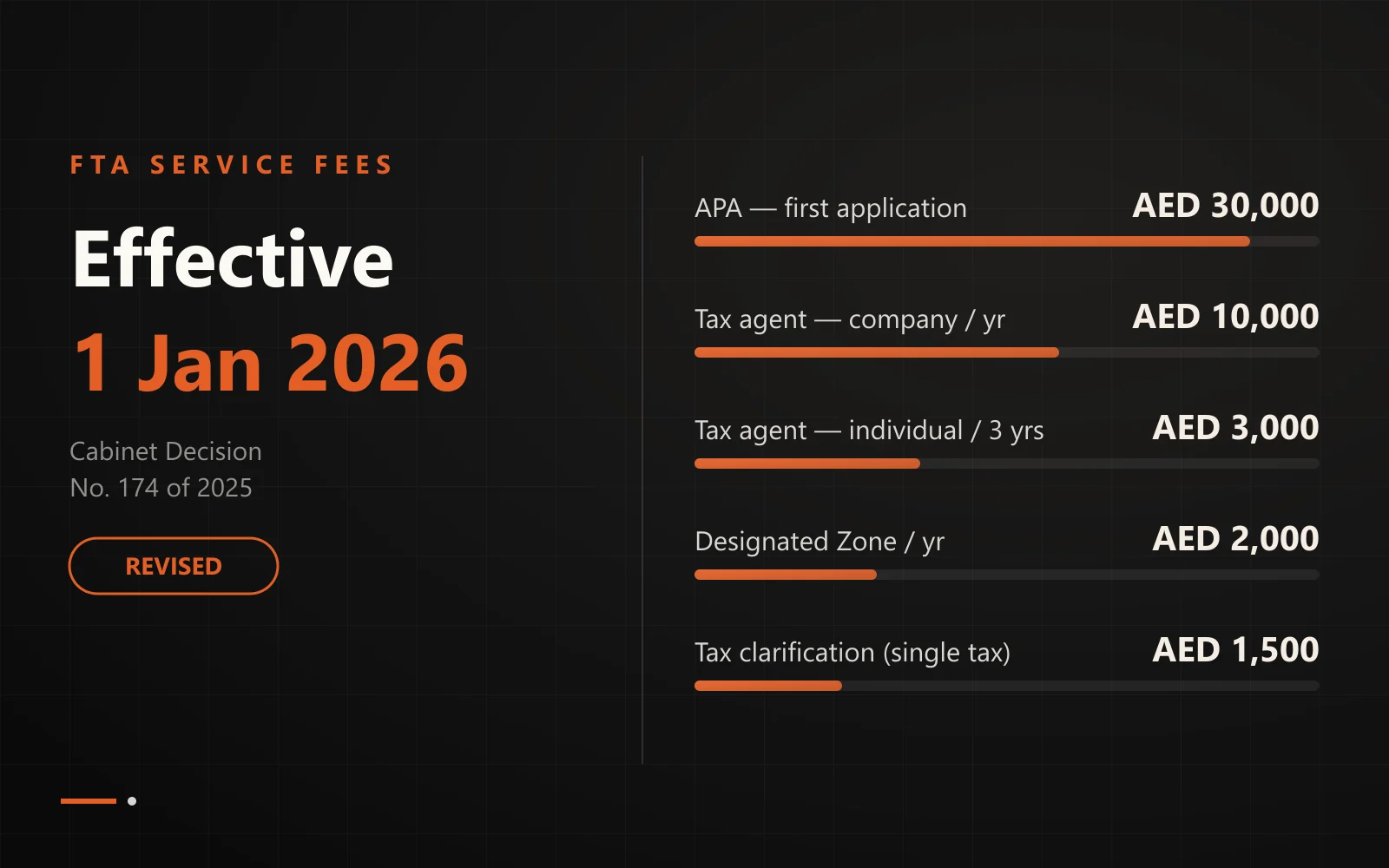
The UAE has updated the fees the Federal Tax Authority (FTA) charges for a range of administrative services, with effect from 1 January 2026. These are not new taxes and they are not penalties. They are the charges you pay when you ask the FTA to process a specific service, such as issuing a Tax Residency Certificate, answering a formal clarification request, or reviewing an Advance Pricing Agreement application.
For most UAE businesses the direct impact is modest, but the revised schedule matters for budgeting, for tax residency planning, and for anyone weighing up a transfer pricing certainty tool like an APA. Tax agents, software vendors, and free zone entities operating in designated zones will feel the changes more directly.
This guide explains what changed, who is affected, and what practical steps to take before the new fees apply. It also draws a clear line between the four things businesses often confuse: filing obligations, tax liabilities, penalties, and administrative service fees.
What actually changed on 1 January 2026?
The revised fees were introduced through Cabinet Decision No. 174 of 2025, which amends the earlier Cabinet Decision No. 65 of 2020 on FTA service fees. The changes take effect from 1 January 2026 and touch several service categories, including registrations, Tax Residency Certificate (TRC) services, Certificates of Commercial Activities, clarification requests, and Advance Pricing Agreements.
The direction of travel is consistent with the wider maturing of the UAE tax system. Since Corporate Tax was introduced under Federal Decree-Law No. 47 of 2022, the administrative machinery around registration, clarifications, and certainty tools has expanded. The revised fee schedule reflects that expansion.
It is worth stressing what these fees are not. They do not change your Corporate Tax rate, your VAT rate, or any filing deadline. They do not replace penalties for late compliance. They are simply the price of an optional or required administrative service delivered by the FTA.
Four things not to confuse: obligations, liabilities, penalties, and fees
Because these terms get mixed up in practice, here is a clean separation. Getting this right protects your budgeting and your risk assessment.
| Concept | What it is | Example |
|---|---|---|
| Filing obligation | A legal duty to submit something by a deadline | Filing a Corporate Tax return within nine months of the tax period end |
| Tax liability | The actual tax you owe on taxable income | 9% Corporate Tax on taxable income above the threshold |
| Penalty | A charge imposed for non-compliance | The administrative penalty for late Corporate Tax registration |
| Service fee | A charge to process an FTA administrative service | AED 30,000 to apply for an Advance Pricing Agreement |
A service fee is voluntary in the sense that you only pay it when you request the service. You cannot avoid a tax liability or a filing obligation the same way. The FTA Corporate Tax FAQs and the Ministry of Finance Corporate Tax page both make clear that returns must be filed and tax paid within nine months of the tax period end, regardless of any service fees.
Updated FTA registration fees
The revised registration fees mainly affect professional service providers and free zone entities rather than ordinary trading businesses. If you run a standard mainland or free zone company that is not a tax agent or software vendor, most of this table will not apply to you.
| Service | Updated fee from 1 January 2026 |
|---|---|
| Designated Zone Registration | AED 2,000 per year |
| Tax Agent Registration (Individual) | AED 3,000 for 3 years |
| Tax Agent Registration (Company) | AED 10,000 per year |
| Software Vendor Registration | AED 10,000 per year |
Tax consultancy firms and technology vendors interacting with the FTA ecosystem should build these renewal costs into their annual budgets. A tax agent company renewing yearly and a software vendor supporting e-invoicing or tax software both carry recurring charges that need planning.
Updated Tax Residency Certificate fees
Tax Residency Certificates are widely used by UAE businesses and individuals to claim treaty benefits under the UAE's Double Tax Avoidance Agreements. The revised TRC fees are set out below.
| TRC service | Updated fee from 1 January 2026 |
|---|---|
| Application fee | AED 50 |
| Electronic TRC (registrant) | AED 500 |
| Electronic TRC (legal non-registrant) | AED 1,750 |
| Electronic TRC (individual non-registrant) | AED 1,000 |
| Paper copy of TRC | AED 250 |
The pattern here is straightforward. A registrant, meaning a person already registered with the FTA for a tax, pays a lower electronic certificate fee than a non-registrant. If your business relies on TRCs each year for treaty relief, factor these costs into your planning and check whether registrant status reduces the applicable fee.
Certificates of Commercial Activities
Certificates of Commercial Activities are commonly required for regulatory and compliance purposes across various UAE jurisdictions. The revised fees are a AED 50 application fee and AED 500 for the electronic certificate. These are modest, but businesses that request them routinely should still budget for the recurring cost.
Clarification request fees
A clarification request is a formal way to ask the FTA for its position on how the law applies to a specific transaction or arrangement. Businesses use clarifications to gain certainty on VAT, Corporate Tax, Excise Tax, or transfer pricing questions before taking a position.
| Clarification type | Updated fee from 1 January 2026 |
|---|---|
| Single tax clarification | AED 1,500 |
| Multiple taxes clarification | AED 2,250 |
Clarifications sit within the framework of Article 59 of the UAE Corporate Tax Law, which lets a person apply to the FTA for a clarification on the application of the law. The fee is the price of that certainty. Weigh it against the value of removing doubt on a material position, and check the current FTA guides, references and public clarifications page first, since a published clarification may already answer your question at no cost.
Advance Pricing Agreement fees
For groups with significant related-party transactions, the Advance Pricing Agreement (APA) fees are the most commercially significant part of the revised schedule.
| APA service | Updated fee from 1 January 2026 |
|---|---|
| First-time APA application | AED 30,000 |
| APA renewal or amendment | AED 15,000 |
An APA fixes the arm's length pricing method for covered related-party transactions over a set number of future years and binds both the taxpayer and the FTA. The programme is now live on the EmaraTax portal, and SBC has covered the mechanics in detail in the guide to the EmaraTax APA programme and how to apply. The application fee is non-refundable, so the quality of the pre-filing submission matters before you commit.
APAs are increasingly relevant for multinational groups managing transfer pricing risk. If you are evaluating one, read it alongside SBC's transfer pricing compliance guide so the cost is assessed against your wider documentation obligations.
Who is affected, and how much?
The revised fees land differently depending on who you are. The table below groups the impact.
| Group | Main fees that matter | Typical impact |
|---|---|---|
| Ordinary UAE trading businesses | TRC services, occasional clarifications | Low to moderate, mostly TRC-driven |
| Multinational groups | APA fees, clarifications, TRC services | Higher where APA certainty is pursued |
| Tax consultancy firms | Tax agent registration | Recurring annual or three-year cost |
| Software vendors | Software vendor registration | Recurring annual cost |
| Free zone entities | Designated zone registration | Recurring annual cost |
| Individuals and investors | TRC services | Moderate, treaty-driven |
The key takeaway is that the fees are targeted. A typical small or medium business that files its Corporate Tax return and occasionally requests a TRC will see only a limited direct effect. A group building a transfer pricing certainty strategy, or a firm that must maintain tax agent status, will feel more.
How the fee changes fit into the wider UAE tax framework
Service fees are one piece of a larger compliance picture. To use them well, connect them to the obligations they support.
Corporate Tax registration, filing, and payment sit at the centre. Every taxable person must register and file within nine months of the tax period end, as confirmed on the FTA Corporate Tax page. Service fees do not change those deadlines, but a clarification fee, for example, may be worth paying to get certainty before you file.
Procedural rules have also tightened. The changes under Federal Decree-Law No. 17 of 2025 amending the Tax Procedures Law and the executive regulation updates in Cabinet Decision No. 17 of 2026 reshaped refund timelines, error corrections, and record retention. These interact with clarification and refund-related services, so the fee schedule should be read alongside them.
Audited accounts and transfer pricing obligations complete the picture. Whether you must keep audited financial statements is governed by Ministerial Decision No. 84 of 2025, and the broader cluster of rules for the current cycle is summarised in SBC's review of the key Corporate Tax decisions shaping FY 2025-26. None of these are service fees, but each drives the compliance activity that a service fee may support.
Strategic implications for planning
Beyond budgeting, the revised fees prompt a few strategic questions.
Tax residency certificate planning
If your business or its owners rely on TRCs to access treaty relief, the revised TRC fees should be built into your annual cost base. Consider timing and whether registrant status lowers the applicable fee. For groups issuing multiple certificates a year, the cumulative cost is worth a deliberate review rather than an ad hoc request each time.
Transfer pricing certainty and APAs
The AED 30,000 first-time APA fee is a real cost, but it should be judged against the value of removing years of transfer pricing uncertainty on high-value related-party dealings. Groups with material intercompany transactions should run a cost-benefit analysis. Start by mapping your related-party position using SBC's guides to what businesses need to report on related party transactions and how to identify related parties. Owner, director, and officer payments should be assessed separately using the connected persons guide.
Clarification requests
Before paying a clarification fee, check whether a published clarification already answers the point. Where the question is genuinely novel and the amount at stake is significant, the fee is often a sensible investment in certainty. This is a professional judgement rather than a fixed rule, and it depends on the materiality of the position.
Master File and documentation costs
For multinational groups, the APA decision sits alongside documentation obligations. Whether your group even needs a Master File is not automatic, as explained in SBC's guide to whether your multinational group actually needs a UAE Master File. Aligning APA planning with documentation planning avoids duplicated effort.
What businesses should do before 1 January 2026
The revised fees are confirmed and effective from 1 January 2026, so the practical work is preparation rather than reaction.
- Review your 2026 compliance budget and add the revised fees that apply to you.
- If you issue TRCs regularly, forecast the annual number and cost, and confirm registrant status where it lowers the fee.
- If you are weighing an APA, model the cost against the transfer pricing risk it removes, and prepare a strong pre-filing submission.
- If you are a tax agent or software vendor, diarise renewal dates and the associated fees.
- If you operate in a designated zone, budget the annual registration fee.
- Separate service fees from tax liabilities and penalties in your internal forecasting so nothing is double counted or missed.
Common mistakes to avoid
- Treating service fees as taxes or penalties. They are administrative charges for a requested service and behave differently in budgeting and risk terms.
- Assuming the fee changes alter filing deadlines. They do not. Corporate Tax returns are still due within nine months of the tax period end.
- Paying for a clarification without checking published guidance first. The answer may already exist at no cost.
- Ignoring the non-refundable nature of the APA application fee. A weak pre-filing submission can waste the fee.
- Forgetting recurring renewal fees for tax agents, software vendors, and designated zone entities, which recur annually or on a fixed cycle.
- Confusing a fee with a late registration penalty. The penalty framework, including the recent late registration penalty waiver, is a separate matter entirely.
Practical action checklist
- Identify which revised fees apply to your business, advisers, or vendors.
- Update your 2026 budget with the specific amounts from the tables above.
- Confirm TRC needs and registrant status for the year ahead.
- Decide whether an APA is worth pursuing and, if so, prepare the pre-filing case.
- Check published FTA clarifications before requesting a paid one.
- Diarise all recurring registration and renewal dates.
- Keep service fees, tax liabilities, penalties, and filing obligations clearly separated in your records.
- Align any APA or clarification work with your existing transfer pricing and documentation position.
Frequently asked questions
What are the revised UAE FTA service fees for 2026?
The revised fees, introduced by Cabinet Decision No. 174 of 2025 and effective from 1 January 2026, update charges for FTA administrative services. These include designated zone registration, tax agent and software vendor registration, Tax Residency Certificate services, Certificates of Commercial Activities, clarification requests, and Advance Pricing Agreements.
Are FTA service fees the same as Corporate Tax?
No. Corporate Tax is a tax on your taxable income, charged at 9% above the threshold. FTA service fees are administrative charges you pay to process a specific service, such as issuing a certificate or reviewing an APA application. They are entirely separate concepts.
Do the new fees change my Corporate Tax filing deadline?
No. Corporate Tax returns must still be filed, and any tax paid, within nine months of the end of the relevant tax period. Service fees do not change any filing or payment deadline.
How much does a Tax Residency Certificate cost from 2026?
The application fee is AED 50, an electronic TRC for a registrant is AED 500, an electronic TRC for a legal non-registrant is AED 1,750, an electronic TRC for an individual non-registrant is AED 1,000, and a paper copy is AED 250.
What does it cost to apply for an APA in the UAE?
A first-time Advance Pricing Agreement application costs AED 30,000, and a renewal or amendment costs AED 15,000. The application fee is non-refundable, so the quality of the pre-filing submission is important.
How much is a clarification request from the FTA?
A single tax clarification costs AED 1,500 and a clarification covering multiple taxes costs AED 2,250 from 1 January 2026.
Do ordinary small businesses need to worry about these fees?
For most standard businesses the direct impact is limited, usually confined to occasional TRC or clarification requests. The larger recurring costs mainly affect tax agents, software vendors, designated zone entities, and groups pursuing APAs.
Final takeaway
The revised FTA service fees from 1 January 2026 are a budgeting and planning matter, not a change to your core tax obligations. The practical steps are simple: identify which fees apply to you, add them to your 2026 budget, keep them clearly separate from taxes and penalties, and make deliberate decisions about optional services like clarifications and APAs.
If you want help modelling the impact, planning an APA, or aligning these fees with your wider Corporate Tax and transfer pricing position, explore SBC's Corporate Tax and Transfer Pricing services, browse the full range of tax services, read more on the SBC insights hub including the earlier FTA service fees update, or contact the SBC team.
15/6/26 UAE Corporate Tax
Page Title: UAE Corporate Tax Late Registration Penalty Waiver: A Complete Guide
Meta Title: UAE Corporate Tax Late Registration Penalty Waiver Explained
Meta Description: A practical guide to the AED 10,000 UAE Corporate Tax late registration penalty waiver, who qualifies, how the seven-month rule works, and what to do now.
Primary Keywords: UAE Corporate Tax late registration penalty waiver, AED 10,000 penalty waiver
Secondary Keywords: UAE Corporate Tax registration, seven-month tax return rule, FTA penalty refund, first tax period UAE, corporate tax filing deadline UAE
Slug: uae-corporate-tax-late-registration-penalty-waiver-guide