
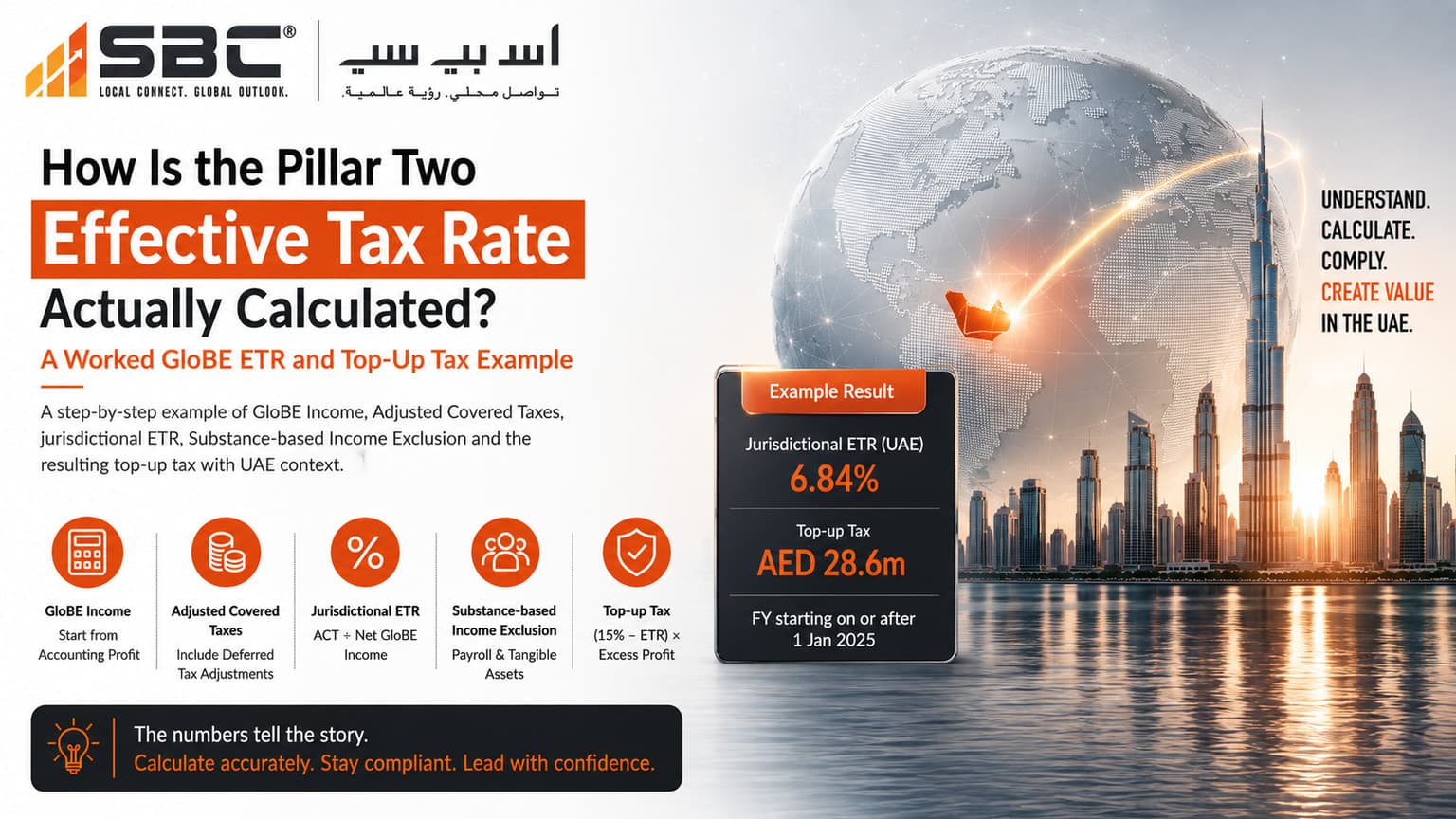
In this simplified FY2025 example, UAE Net Pillar Two Income is AED 380 million and Adjusted Covered Taxes are AED 26 million, producing a 6.84% jurisdictional ETR. After a 2025 Substance-based Income Exclusion of AED 29.60 million, the 8.16% top-up percentage applies to AED 350.40 million of Excess Profit, producing indicative UAE DMTT of AED 28.59 million.
Worked result
Net Pillar Two Income: AED 380.00 million
Adjusted Covered Taxes: AED 26.00 million
UAE GloBE ETR: 6.84%
2025 SBIE: AED 29.60 million
Excess Profit: AED 350.40 million
Indicative UAE DMTT: AED 28.59 million
What assumptions does the example use?
Assume an MNE group is within the EUR 750 million revenue threshold and has multiple UAE constituent entities. The figures below are already aggregated for the UAE jurisdiction after identifying the correct Pillar Two entity population. All amounts are in AED millions.
| Input | AED million | Assumption |
|---|---|---|
| Financial Accounting Net Income | 400.00 | Aggregate starting profit for relevant UAE constituent entities |
| Net GloBE adjustments | (20.00) | Net reduction for excluded dividends, equity items and other assumed adjustments |
| Current Covered Taxes | 22.00 | Eligible current tax expense after assumed allocation adjustments |
| Qualifying deferred-tax adjustment | 4.00 | Net amount included after GloBE deferred-tax rules |
| Eligible payroll costs | 150.00 | Payroll base for the 2025 SBIE |
| Eligible tangible assets | 200.00 | Average carrying value assumed eligible for the 2025 SBIE |
Scope of this illustration
The example assumes no GloBE loss election, additional current top-up tax, QDMTT allocation complication, prior-year true-up, tax credit recharacterisation, recapture adjustment, safe harbour or investment-entity computation. Real filings require those items to be tested.
Step 1: Calculate Net Pillar Two Income
The calculation starts from Financial Accounting Net Income or Loss determined under the applicable acceptable accounting standard. GloBE adjustments then remove or reclassify items so the denominator follows Pillar Two, not local taxable income.
| Step | AED million |
|---|---|
| Financial Accounting Net Income | 400.00 |
| Less: net GloBE adjustments | (20.00) |
| Net Pillar Two Income | 380.00 |
Typical adjustments can include excluded dividends, excluded equity gains or losses, policy-disallowed expenses, stock-based compensation elections, pension expense, asymmetric foreign-currency items and certain prior-period corrections. The classification of each adjustment should be consistent across the ETR model, P2IR and return workpapers.
Step 2: Determine Adjusted Covered Taxes
Covered Taxes generally begin with eligible taxes recorded in the financial accounts and are then adjusted for items such as taxes associated with excluded income, uncertain tax positions, cross-border allocations and deferred tax. Deferred tax is not included merely because it appears in the accounts; the GloBE recognition, limitation and recapture rules must be applied.
| Step | AED million |
|---|---|
| Current Covered Taxes | 22.00 |
| Add: qualifying deferred-tax adjustment | 4.00 |
| Adjusted Covered Taxes | 26.00 |
For modelling purposes, management should maintain a tax-by-tax ledger that distinguishes UAE Corporate Tax, taxes allocated from other jurisdictions, deferred-tax movements, non-covered levies and uncertain positions. A single "tax expense" line is not enough.
Step 3: Calculate the UAE jurisdictional ETR
ETR formula
UAE GloBE ETR = Adjusted Covered Taxes ÷ Net Pillar Two Income
AED 26.00m ÷ AED 380.00m = 6.8421%
Rounded ETR = 6.84%
The result is jurisdictional: eligible UAE income and taxes are blended across the relevant UAE constituent entities, subject to the separate computations required for categories such as investment entities, joint venture groups, minority-owned subgroups and stateless entities. An individual company's 0% or 9% position is therefore not the final ETR answer.
Step 4: Determine the top-up tax percentage
Top-up percentage
Minimum rate − UAE GloBE ETR
15.00% − 6.8421% = 8.1579%
Rounded top-up percentage = 8.16%
The top-up percentage is not yet the tax payable. It must be applied to Excess Profit after the SBIE, and the statutory calculation can require additional current top-up tax and other adjustments.
Step 5: Calculate the 2025 Substance-based Income Exclusion
The SBIE removes a formulaic return linked to eligible payroll and eligible tangible assets from the top-up tax base. For a fiscal year beginning in 2025, the transitional rates are 9.6% for eligible payroll and 7.6% for eligible tangible assets.
| SBIE component | Base | 2025 rate | Exclusion |
|---|---|---|---|
| Eligible payroll | AED 150.00m | 9.6% | AED 14.40m |
| Eligible tangible assets | AED 200.00m | 7.6% | AED 15.20m |
| Total SBIE | - | - | AED 29.60m |
The payroll and asset bases require detailed testing. Eligible employees, independent contractors, geographic location, capitalised payroll, leased assets, land, natural resources and construction assets can all require specific treatment. The SBIE is elected and calculated for the jurisdiction; it does not change the ETR numerator or denominator.
Step 6: Calculate Excess Profit
| Step | AED million |
|---|---|
| Net Pillar Two Income | 380.00 |
| Less: 2025 SBIE | (29.60) |
| Excess Profit | 350.40 |
A larger eligible payroll or tangible-asset base can reduce Excess Profit, but it does not increase the jurisdictional ETR. This distinction is important when management compares operational-substance scenarios.
Step 7: Calculate indicative UAE DMTT
Indicative DMTT
Top-up percentage × Excess Profit
8.1579% × AED 350.40m = AED 28.5882m
Indicative UAE DMTT = AED 28.59 million
The implied tax after this simplified top-up is approximately AED 54.59 million (AED 26.00 million of Adjusted Covered Taxes plus AED 28.59 million of indicative top-up tax). That is not the same as 15% of AED 380 million because the SBIE removes AED 29.60 million from the top-up tax base.
| Calculation summary | Result |
|---|---|
| Net Pillar Two Income | AED 380.00m |
| Adjusted Covered Taxes | AED 26.00m |
| ETR | 6.84% |
| Top-up percentage | 8.16% |
| SBIE | AED 29.60m |
| Excess Profit | AED 350.40m |
| Indicative UAE DMTT | AED 28.59m |
What does the example tell management?
| Change | ETR effect | Indicative DMTT effect |
|---|---|---|
| Higher qualifying Covered Taxes | Usually increases the ETR | Usually reduces the top-up percentage |
| Higher eligible payroll or tangible assets | No direct ETR change | Reduces Excess Profit through a larger SBIE |
| More excluded income | Changes the Pillar Two income denominator and related taxes | Fact-specific; can increase or decrease the result |
| Additional low-taxed UAE profit | May reduce the blended UAE ETR | Can increase the top-up base and liability |
| Safe harbour becomes available | Full GloBE ETR may not determine current-year liability | May deem top-up tax to be zero if all conditions are met |
The model should therefore be used as a bridge between tax, finance and business decisions - not only as a filing calculator. Changes in legal structure, financing, Free Zone income profile, deferred-tax accounting, headcount or asset deployment can move different parts of the calculation in different directions.
Why Free Zone and 9% entities must be modelled together
Suppose one UAE constituent entity is a Qualifying Free Zone Person with qualifying income taxed at 0%, while another mainland entity pays Corporate Tax at 9%. Pillar Two generally blends the eligible UAE income and Covered Taxes. The group cannot calculate a 15% top-up separately on the Free Zone company and call the exercise complete.
The official UAE Corporate Tax overview provides the domestic-law rate context. Those statutory rates are inputs to the wider tax profile; they are not substitutes for the GloBE income, Adjusted Covered Taxes and jurisdictional ETR computation.
The finance team should reconcile local tax positions to Pillar Two adjustments, allocate Covered Taxes to the correct entity and jurisdiction, and separately identify special entity categories. Transfer-pricing results can also move income between jurisdictions and therefore affect jurisdictional ETRs. This is why Pillar Two modelling should connect to the group's Corporate Tax and transfer-pricing workstreams.
Seven common ETR modelling errors
-
Using UAE taxable income instead of Financial Accounting Net Income adjusted under the GloBE rules.
-
Using current Corporate Tax payable as the entire Covered Taxes numerator.
-
Adding every deferred-tax movement without applying GloBE recognition, rate limitation and recapture rules.
-
Calculating ETR company by company when jurisdictional blending is required.
-
Using the wrong transitional SBIE rates - for FY2025, 9.6% applies to eligible payroll and 7.6% to eligible tangible assets.
-
Reducing the ETR denominator by the SBIE. The SBIE reduces Excess Profit; it does not change Net Pillar Two Income for the ETR calculation.
-
Failing to reconcile the final model to the P2IR, Top-up Tax Return and source ledgers.
What data should be collected for a defensible UAE calculation?
-
Entity-level trial balances and consolidation packages using the UPE accounting standard.
-
Legal ownership, permanent-establishment, JV, flow-through and minority-owned subgroup classifications.
-
Current and deferred tax by account, jurisdiction, income category and originating entity.
-
Detailed GloBE adjustment schedules with source, rationale and reviewer approval.
-
Eligible payroll by employee/contractor location and tangible-asset registers with average carrying values.
-
Elections, safe-harbour tests, prior-year attributes and transition-rule workpapers.
-
A reconciliation from the model to the P2IR and UAE Top-up Tax Return.
For the legal framework and deadlines, read SBC's UAE Pillar Two DMTT guide.
Frequently asked questions
What is the formula for the Pillar Two ETR?
The jurisdictional ETR is Adjusted Covered Taxes divided by Net Pillar Two Income. Both amounts are determined under the GloBE rules and can differ materially from local taxable income and current tax payable.
Is the Substance-based Income Exclusion deducted before calculating the ETR?
No. The SBIE is deducted after the ETR and top-up percentage are calculated. It reduces Excess Profit, which is the base to which the top-up percentage is applied.
What are the 2025 SBIE rates?
For a fiscal year beginning in 2025, the transitional rates are 9.6% of eligible payroll costs and 7.6% of the carrying value of eligible tangible assets.
Does a 9% Corporate Tax rate always create a 6% top-up?
No. Pillar Two uses a jurisdictional ETR and an adjusted income base. Deferred tax, permanent differences, jurisdictional blending, the SBIE, safe harbours and special rules can change the result.
Can a Free Zone entity be included in the UAE ETR?
Yes. A UAE constituent entity's Pillar Two income and Covered Taxes generally form part of the UAE jurisdictional calculation, subject to the rules for excluded and special entity categories.
Is AED 28.59 million the final tax payable in every similar fact pattern?
No. It is the result of the stated simplified assumptions. Additional top-up tax, adjustments, elections, safe harbours, entity categories and return-allocation rules can change the payable amount.
Is the Pillar Two ETR calculated separately for each UAE emirate?
No. The principal calculation blends relevant income and Covered Taxes at UAE jurisdiction level. Dubai, Abu Dhabi and the other emirates do not have separate country-level GloBE ETRs, although special entity categories can require separate computations under the legislation.
Primary sources and further reading
-
Ministerial Decision No. 96 of 2026 - Commentary and Administrative Guidance
-
FTA Top-up Tax Guide TTGREG1 - Scope and Registration (August 2026)
-
PwC Middle East - UAE Pillar Two calculation methodology (technical reading)
-
Deloitte Middle East - UAE Pillar Two legislation (technical reading)
How SBC Tax Consulting can help
SBC's international tax team can build or independently review a UAE ETR model and its audit trail. We take the calculation from entity-level trial balances through GloBE adjustments, Covered Tax allocation and the SBIE, reconcile the result to the P2IR and Top-up Tax Return, and test the scenarios that move the number - Free Zone income mix, deferred tax, financing and transfer pricing. Contact SBC to pressure-test your group's UAE top-up tax exposure.
This publication is for general information only and does not constitute professional advice. Please consult your SBC advisor before acting on any matter covered here.