
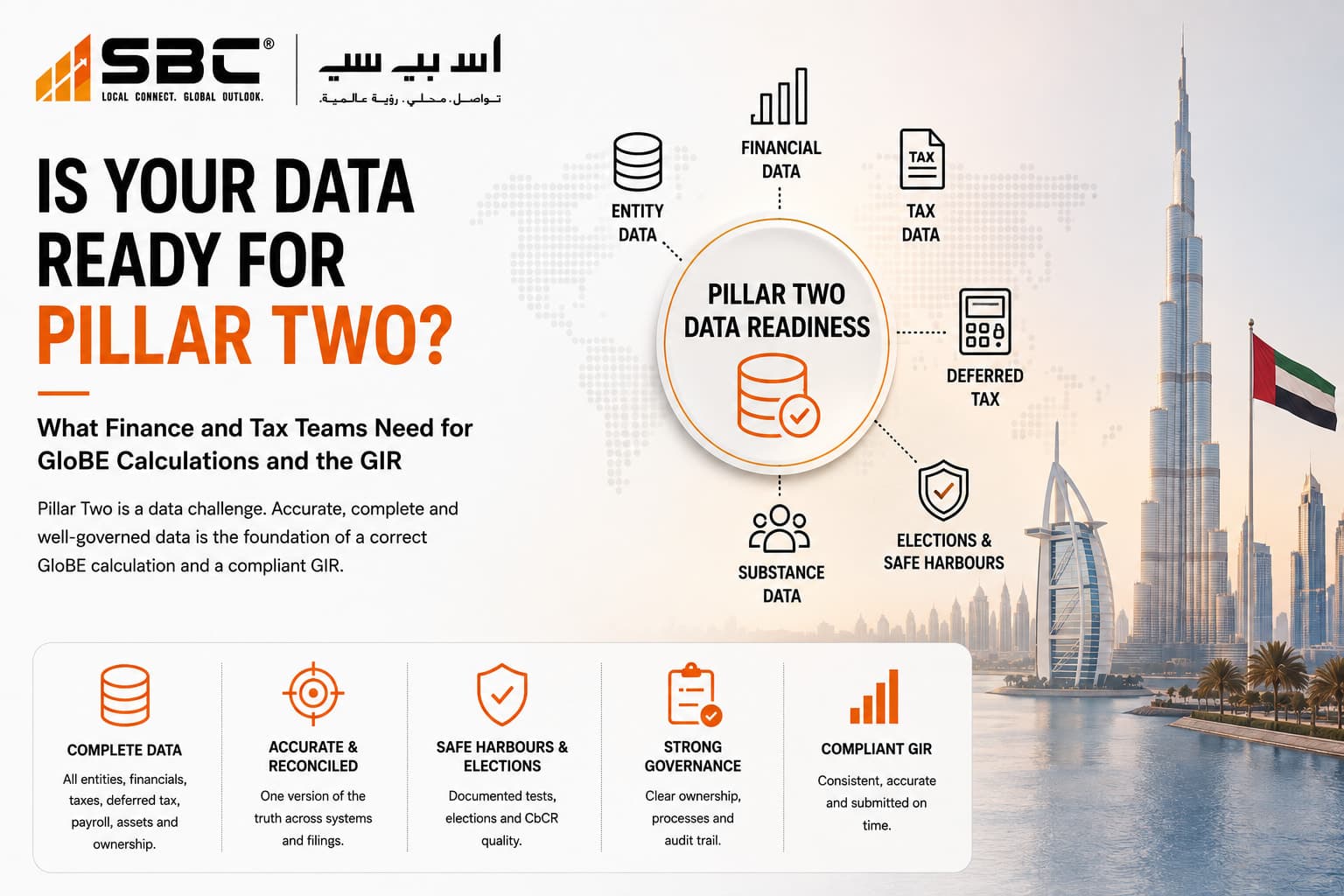
Pillar Two data readiness means being able to produce complete, traceable and reviewable inputs for the GloBE calculation and the Pillar Two Information Return at constituent-entity and jurisdiction level. A UAE in-scope group needs more than its consolidated tax rate. It needs the entity-level accounting result used for consolidation, detailed current and deferred tax, cross-border tax allocations, eligible payroll and tangible assets, ownership changes, elections, safe-harbour inputs and reconciliations to CbCR and statutory filings.
The data normally sits across the ERP, consolidation system, tax-provision platform, payroll, fixed-asset register, legal-entity database and locally managed spreadsheets. Readiness is therefore a governance and systems project, not a year-end tax worksheet. For calendar-year groups, the first UAE-relevant fiscal year has already ended; the practical priority is to run a dry calculation on FY2025 data, identify missing fields and lock a controlled reporting process before the first filing cycle.
Why is Pillar Two primarily a data challenge?
The UAE DMTT starts from financial accounting information but does not stop there. Cabinet Decision No. 142 of 2024 requires a rules-based conversion of entity accounting results into GloBE income or loss and adjusted covered taxes. The calculation then operates at jurisdiction level, incorporates deferred tax and the substance-based income exclusion, and may require elections or prior-year adjustments.
No single owner typically controls all inputs. Finance owns the chart of accounts and consolidation packages. Tax owns current and deferred tax analysis. HR owns payroll and employee location. Operations and finance share fixed-asset data. Legal or company secretarial teams maintain ownership information. The ultimate parent may own CbCR, while UAE entities hold the evidence required to defend their local result.
The Ministry of Finance Top-up Tax page confirms that the UAE regime generally covers constituent entities of MNE groups with consolidated revenue of at least EUR 750 million in at least two of the four preceding fiscal years, for fiscal years beginning on or after 1 January 2025. The first data question is therefore not "what is our ETR?" but "which entities and periods are in the calculation?"
What data does a full GloBE calculation require?
The following domains form the minimum data architecture. The exact field count depends on the group, but a full implementation commonly needs well over one hundred inputs and attributes per entity once classifications, adjustments and evidence are included.
| Data domain | Examples of required information | Typical owner |
|---|---|---|
| Group and entity master | UPE, ownership percentages, constituent-entity classification, permanent establishments, JVs, excluded entities, acquisitions and disposals | Legal, tax, consolidation |
| Financial accounting | Entity net income used for consolidation, pre-consolidation entries, intercompany results, dividends, equity gains and policy disallowances | Group finance |
| Current tax | Tax expense, current tax payable, uncertain tax positions, withholding taxes, CFC and PE tax allocation, taxes on excluded income | Tax provision team |
| Deferred tax | Opening balances, movements by attribute, reversal profile, recapture categories, valuation allowances and rate recasting | Tax and finance |
| Substance | Eligible payroll costs, employee location, eligible independent contractors, tangible-asset carrying value and location | HR, payroll, fixed assets |
| CbCR and safe harbours | Qualified revenue, profit before tax, income tax accrued, entity list, data-source evidence and test results | CbCR owner and tax |
| Elections and compliance | Annual and five-year elections, safe-harbour choices, filing entity, registration identifiers and sign-offs | Tax governance |
The source should be the data used to prepare the ultimate parent's consolidated financial statements, subject to the detailed rules. Local statutory accounts alone may use a different accounting standard, currency, period or consolidation treatment. A group needs a clear bridge rather than assuming local and consolidation numbers are interchangeable.
Which entity and ownership data should be captured first?
Build a controlled entity master before designing the calculation. It should include the legal name, tax registration number, jurisdiction, accounting period, ownership chain, consolidation method, entity type and GloBE classification. It should separately identify permanent establishments, flow-through entities, investment entities, minority-owned subgroups and joint ventures.
The master must be time-sensitive. An acquisition halfway through a fiscal year, a merger, liquidation, internal transfer or change in ownership percentage may affect scope, allocation and reporting. A static organisation chart prepared after year-end cannot always reconstruct the group accurately for the relevant period.
The FTA's current Top-up Tax guides and references should be used when mapping UAE registration and excluded-entity positions. The output should reconcile to the consolidated financial-statement perimeter and CbCR entity list. Every difference should have an owner and written reason.
What financial accounting information is usually missing?
Many groups can produce two views: consolidated group results and local statutory accounts. GloBE often needs the intermediate entity-level data used in preparing the consolidated statements before elimination entries. That view may exist only in consolidation packages or manual schedules.
Typical gaps include:
-
consolidation adjustments posted centrally without an entity tag.
-
purchase-accounting entries that are not reflected in local ledgers.
-
intercompany eliminations that obscure the gross entity result.
-
dividends, equity-accounted gains and fair-value movements combined in broad accounts.
-
branch results recorded inside a head-office ledger without a jurisdiction split.
-
year-end transfer-pricing true-ups posted after the initial tax provision.
-
local accounts with a different year-end from the ultimate parent.
The answer is a GloBE mapping layer. Each relevant account or consolidation line should map to a GloBE treatment, source system, entity, period and evidence field. Manual adjustments should have an explanation, preparer, reviewer and attachment rather than being overwritten in a final spreadsheet.
Why are current and deferred taxes especially difficult?
Adjusted covered taxes are not always the same as the income-tax expense in the entity's accounts. The group may need to allocate taxes across entities or jurisdictions, remove tax associated with excluded income, treat withholding or controlled foreign company taxes under specific allocation rules and analyse post-filing changes.
Deferred tax is even more demanding. GloBE can cap the rate used, require recapture tracking and apply transition rules to pre-existing attributes. A provision system that stores only the closing deferred-tax asset and liability by entity may be insufficient. The group may need the underlying attribute, origination year, reversal, applicable tax rate, valuation allowance and whether the item is subject to recapture.
The OECD 2026 Consolidated Commentary is the current consolidated interpretative source, and the UAE adopted the relevant materials through Ministerial Decision No. 96 of 2026. Data specifications should be version-controlled because a new guidance release can change the required treatment without changing the source ledger.
What payroll and tangible-asset data is needed for the SBIE?
The substance-based income exclusion is built from eligible payroll costs and eligible tangible assets located in the jurisdiction. A trial balance cannot normally supply all required attributes.
For payroll, the group should identify the employee or eligible contractor, employing entity, work location, period of service and eligible cost categories. Cross-border commuters, secondments, shared-service employees and costs recharged between group companies require particular attention. Legal employment and physical activity may point to different jurisdictions.
For tangible assets, capture asset class, owning entity, location, carrying value, placed-in-service date, disposals and exclusions. Leased assets and construction projects should be mapped consistently. A register that uses the invoicing company's address as the asset location can produce the wrong jurisdictional result.
These fields support both the full calculation and the routine profits test under the Transitional CbCR Safe Harbour. For UAE free-zone manufacturing, logistics or distribution operations, they may materially reduce the top-up base and should be prioritised early.
What does the Pillar Two Information Return add?
The GloBE Information Return, often called the GIR, is a standardised global disclosure of group structure, elections, safe harbours and jurisdictional calculations. The OECD GIR published in January 2025 sets out the data architecture, while the OECD GIR XML Schema supports electronic preparation and exchange.
The GIR turns calculations into structured data. Names, tax identification numbers, classifications, elections and amounts must be internally consistent and capable of validation. It also creates cross-country visibility: the same jurisdictional result can be reviewed by multiple tax administrations through the exchange framework.
In the UAE, Ministerial Decision No. 133 of 2026 identifies the entities required to file and provides for local filing arrangements, including use of a designated local entity in relevant circumstances. The Pillar Two Information Return should not be confused with the separate UAE top-up tax return. A group may need a central GIR process and a local DMTT compliance process using the same controlled dataset.
How should the GIR reconcile with other filings?
Create a formal reconciliation matrix covering:
-
consolidated financial statements and consolidation perimeter.
-
entity statutory accounts and tax provisions.
-
Country-by-Country Report revenue, profit, tax and entity list.
-
UAE Corporate Tax returns and transfer-pricing disclosure forms.
-
master files and local files.
-
the GIR and any local Pillar Two notifications.
-
the UAE DMTT return and payment calculation.
Differences may be valid because the rules use different definitions. The control objective is not to force every number to match; it is to explain every difference consistently. An unexplained mismatch in profit, tax, employee count or entity classification is an obvious risk marker.
Where do implementation gaps usually appear?
Five gaps recur.
First, groups lack entity-level accounting data on the consolidation basis. Second, deferred-tax attributes are aggregated beyond what the rules require. Third, payroll and assets are not mapped to GloBE definitions or physical location. Fourth, CbCR data has never been reconciled to the standard needed for a qualified safe harbour. Fifth, ownership and reorganisation history is split between legal, tax and consolidation records.
A sixth gap is often underestimated: governance. Teams may collect the data but have no documented cut-off, preparer, reviewer, change log or sign-off. That makes the calculation difficult to repeat and undermines the evidence even if the first-year number happens to be correct.
Spreadsheet, existing platform or dedicated Pillar Two engine?
The appropriate technology depends on scale, complexity and safe-harbour coverage.
| Approach | Appropriate when | Main risk |
|---|---|---|
| Controlled spreadsheet model | Few jurisdictions, stable entities, strong safe-harbour coverage and limited full calculations | Version control, manual error and weak workflow |
| Existing consolidation or tax-provision platform | Source data is already centralised and the vendor supports required GloBE logic and updates | Configuration may hide mapping gaps or require extensive custom fields |
| Dedicated Pillar Two engine | Many jurisdictions, complex ownership, deferred-tax tracking and recurring GIR production | A strong engine can still produce wrong results if source data and governance are weak |
The decision should follow the data-gap assessment, not precede it. Buying technology before defining the entity master, source mappings and owners can automate uncertainty. Conversely, a sprawling in-scope group should not remain on disconnected spreadsheets simply because the first year is safe-harboured.
What controls should UAE groups implement?
A defensible process includes preventive and detective controls:
-
one approved entity master with effective dates.
-
documented source-to-GloBE mappings.
-
role-based access and segregation between preparer and reviewer.
-
automated completeness checks for entities, periods and currencies.
-
validation of totals against consolidation and tax-provision systems.
-
exception reports for negative taxes, missing SBIE fields and unusual ETR movements.
-
a controlled election register.
-
sign-off by local UAE and ultimate-parent teams.
-
retention of source extracts, calculations, review comments and final submissions.
Registration is part of the control environment. FTA Decision No. 12 of 2026 addresses Top-up Tax registration and deregistration timelines. The entity master should therefore link each UAE entity to its registration status, responsible person and evidence.
A 90-day UAE Pillar Two data-readiness plan
Days 1-30: scope, ownership and gap assessment
Confirm the revenue threshold, entity perimeter and fiscal years. Appoint an executive sponsor and owners for entity, accounting, tax, payroll, asset and filing data. Inventory source systems and compare available fields with the full GloBE/GIR requirement. Screen safe harbours to prioritise jurisdictions without removing future-state fields from the design.
Days 31-60: mapping, extraction and first calculation
Build the entity master and chart-of-accounts mapping. Extract FY2025 data, calculate or estimate deferred-tax and SBIE fields, and reconcile qualified CbCR information. Run a first jurisdictional model and log every manual workaround, missing field and unresolved interpretation.
Days 61-90: controls, dry return and remediation roadmap
Assign preparers and reviewers, set cut-off dates and design exception reports. Populate a dry GIR dataset using the OECD schema structure. Reconcile it to CbCR, financial statements and local filings. Rank remediation items by filing risk, tax value and repeatability, then approve a technology and operating-model roadmap.
Frequently asked questions
How many data points does Pillar Two require?
There is no single universal number. A full calculation and GIR commonly use well over one hundred fields and attributes per entity once accounting, tax, ownership, substance, elections and evidence are included.
Can a UAE group use local statutory accounts for GloBE?
Not automatically. The starting point generally follows the accounting information used to prepare the ultimate parent's consolidated financial statements, subject to detailed rules. Local accounts require a documented bridge where the basis differs.
Does a safe harbour remove the data-readiness project?
No. It reduces current-year calculations for qualifying jurisdictions but requires qualified CbCR data and supporting evidence. The group also needs a future-state process for years or jurisdictions outside the safe harbour.
Who should own Pillar Two data?
Tax should own the rule interpretation and filing position, while finance owns much of the source data. A formal cross-functional model with named owners for HR, assets, legal entities and technology is more reliable than assigning the entire programme to one team.
Is the GIR the same as the UAE top-up tax return?
No. The GIR is the standardised Pillar Two information return. The UAE top-up tax return calculates and reports the domestic liability. They should be produced from the same controlled data but have different purposes.
Can the ultimate parent file the GIR for UAE entities?
The filing architecture depends on the applicable exchange and UAE rules. Ministerial Decision No. 133 of 2026 should be reviewed to identify the responsible entity and any designated local filing option. Do not assume central filing removes all UAE obligations.
When should a group run its first dry calculation?
Immediately if it is in scope. Calendar-year groups can now use actual FY2025 data, making a dry run far more informative than a forecast based only on headline tax rates.
What is the most common Pillar Two data error?
Using aggregated or locally defined data without a traceable bridge to the consolidation basis. This can affect the entity perimeter, GloBE income, covered taxes, SBIE and the consistency of the GIR at the same time.
Primary sources and further reading
-
Ministerial Decision No. 96 of 2026 - Commentary and Administrative Guidance
-
Ministerial Decision No. 133 of 2026 - Pillar Two Information Return
-
FTA Top-up Tax Guide TTGREG1 - Scope and Registration (August 2026)
-
FTA Decision No. 12 of 2026 - Registration and Deregistration Timelines
How SBC Tax Consulting can help
SBC's international tax team can run a data-gap assessment, dry GloBE calculation and GIR dry return against FY2025 data. We map entity, accounting, tax, deferred-tax and SBIE fields to owners and source systems, and design the controls that keep the Pillar Two Information Return reconciled to CbCR, corporate tax filings and the UAE DMTT return. Contact SBC for a scoped readiness workshop.
This publication is for general information only and does not constitute professional advice. Please consult your SBC advisor before acting on any matter covered here.