
The UAE's Domestic Minimum Top-up Tax (DMTT) is now a live compliance regime, not a future policy proposal. For large multinational groups operating through Dubai and the wider UAE, it changes how you model tax, prepare data, and file returns. Yet many groups still treat their 0% Free Zone status or 9% Corporate Tax position as the final answer. It is not.
This guide is written for UAE business owners, CFOs, finance teams, tax professionals, and accountants who need a clear, practical route to DMTT readiness. Here is what you will take away:
- What the DMTT is, who it captures, and why Dubai operations are firmly in scope.
- Why Free Zone status and the 9% rate do not settle the Pillar Two question.
- How the jurisdictional effective tax rate and top-up tax actually work.
- The registration, information return, and Top-up Tax Return deadlines you must calendar.
- A step-by-step readiness roadmap you can start now.
Throughout, we separate confirmed legal facts from professional interpretation and illustrative examples, so you know exactly where the rules end and judgment begins.
What is the UAE DMTT?
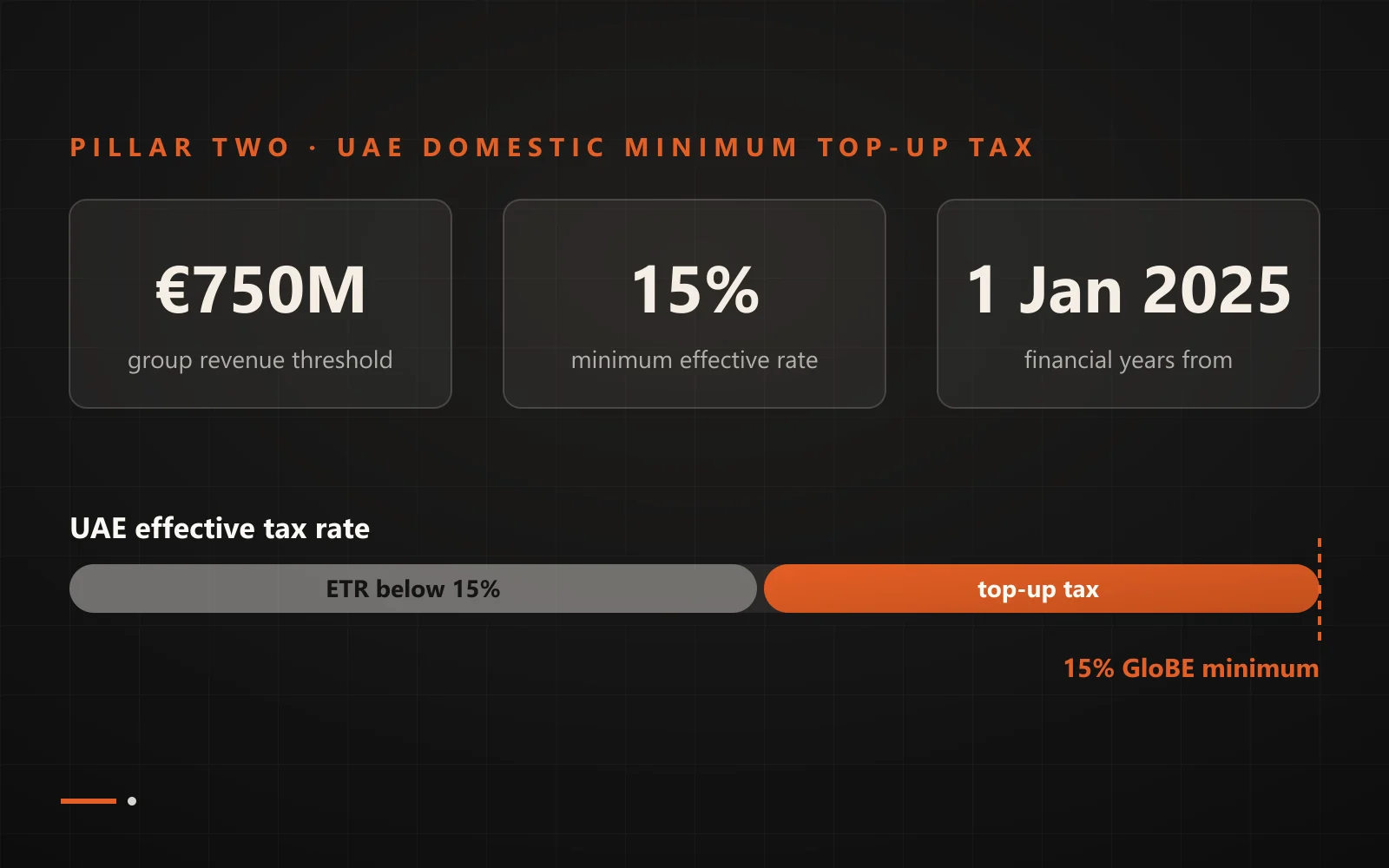
Confirmed legal fact: the UAE Domestic Minimum Top-up Tax applies to constituent entities of multinational enterprise groups with annual global revenues of EUR 750 million or more in the consolidated financial statements of the ultimate parent entity, in at least two of the four financial years immediately preceding the tested year. It is effective for financial years starting on or after 1 January 2025.
The DMTT is the UAE's domestic implementation of the OECD Pillar Two global minimum tax. The UAE Ministry of Finance Top-up Tax page confirms that the regime is closely aligned with the GloBE Model Rules, Commentary, and Administrative Guidance issued by the OECD. The OECD Global Minimum Tax page explains the underlying design: where a group's jurisdictional effective tax rate falls below 15%, a top-up brings the total tax on excess profits up to that floor.
The legal charge sits in Cabinet Decision No. 142 of 2024, which sets out the scope, computation, safe harbours, and filing framework. The interpretive detail comes from the OECD Pillar Two GloBE Model Rules and Commentary, adopted for UAE purposes through Ministerial guidance.
Professional interpretation: the DMTT is a separate regime that sits alongside ordinary UAE Corporate Tax. Being compliant with one does not make you compliant with the other. A group can file a clean Corporate Tax return and still owe UAE top-up tax.
Scope for Dubai and wider UAE operations
Confirmed legal fact: the DMTT is a federal UAE regime. Under Cabinet Decision No. 142 of 2024, the Top-up Tax applies to constituent entities located in the UAE, including those in a minority-owned subgroup, plus joint ventures and JV subsidiaries located in the UAE, and certain stateless reverse hybrid entities created under UAE law.
That reach spans all seven emirates. A Dubai mainland company, a Dubai Free Zone entity, an Abu Dhabi subsidiary, and a Sharjah branch of the same in-scope group are generally brought into one UAE jurisdictional result. The emirate or licensing authority does not create a separate country-level calculation, although specific entity categories such as JV groups and minority-owned subgroups require separate computations.
The DMTT assessment therefore applies across the group structure, including:
- Mainland companies and Free Zone entities.
- Subsidiaries, branches, and permanent establishments.
- Joint ventures, JV subsidiaries, and minority-owned entities.
Confirmed legal fact: an investment entity located in the UAE is not subject to the UAE DMTT rules, and MNE groups in the initial phase of international activity can be excluded where no Income Inclusion Rule applies to any UAE constituent entity. These carve-outs are specific and conditional, so the classification should be documented rather than assumed.
The EUR 750 million threshold
Confirmed legal fact: scope is tested at MNE-group level. The threshold is EUR 750 million or more in consolidated revenue in at least two of the four fiscal years immediately preceding the tested fiscal year. Where a fiscal year is shorter or longer than 12 months, the threshold is adjusted proportionally.
Two points often trip groups up. First, the test looks at the ultimate parent's consolidated financial statements, not the UAE entity's local revenue. A small Dubai subsidiary of a large global group can be fully in scope. Second, Cabinet Decision No. 142 of 2024 contains special rules for mergers, demergers, and newly created groups, so a corporate transaction can change the answer.
Professional interpretation: the first readiness question is not "what is our UAE tax rate?" but "does the group meet the threshold, and which entities and periods are in the calculation?" Confirm the revenue history and document the tested fiscal year before doing anything else.
Relationship with UAE Corporate Tax law
Confirmed legal fact: the UAE Corporate Tax Law, Federal Decree-Law No. 47 of 2022, determines taxable income and the ordinary Corporate Tax liability. The general structure includes 0% on taxable income up to AED 375,000 and 9% above it, with a Qualifying Free Zone Person able to access 0% on qualifying income. The UAE Ministry of Finance Corporate Tax page and the FTA Corporate Tax pages set out the wider framework.
The two regimes connect because eligible UAE Corporate Tax generally forms part of the adjusted covered taxes used in the Pillar Two effective tax rate. The FTA Corporate Tax FAQs confirm the self-assessment nature of Corporate Tax and the wider compliance environment the DMTT now sits within.
Professional interpretation: "counts as a covered tax" does not mean the Corporate Tax return figure is copied unchanged into the Pillar Two numerator. The DMTT starts from financial accounting income, applies GloBE adjustments, and recalculates aspects of deferred tax. For a fuller treatment, see SBC's guide on why 9% Corporate Tax does not simply mean a 6% top-up.
Why DMTT readiness matters now
Confirmed legal fact: the first UAE-relevant fiscal year has already ended for calendar-year groups, because the regime applies from financial years starting on or after 1 January 2025. Registration and filing channels are live, and the compliance clock is running.
Professional interpretation: this is no longer a modelling exercise you can defer. For a calendar-year group, the practical priority is to run a dry calculation on FY2025 data, identify missing fields, and lock a controlled reporting process before the first filing cycle. Groups that wait risk discovering data gaps only when the registration or return deadline is close.
Mini-summary: the tax exists, the deadlines are fixed, and the data behind every filing takes months to assemble accurately. Early action converts a compliance risk into a managed process.
Why Free Zone status does not remove exposure
Confirmed legal fact: Qualifying Free Zone Person status remains relevant for ordinary UAE Corporate Tax, but it does not switch off Pillar Two. A 0% Corporate Tax outcome on qualifying income can reduce the UAE jurisdictional GloBE effective tax rate, and jurisdictional blending may combine that result with the income and taxes of other UAE constituent entities.
This is one of the most common misunderstandings among Dubai groups. A Free Zone entity earning 0% on qualifying income is not automatically outside the DMTT. Its low-taxed profit can pull the blended UAE effective tax rate below 15%, potentially creating a top-up.
Professional interpretation: model the combined UAE population, including mainland entities taxed at 9%, qualifying and non-qualifying Free Zone income, permanent establishments, and covered deferred tax. Neither "Free Zone means zero top-up" nor "9% means a 6% top-up" is reliable. SBC's UAE Pillar Two DMTT guide works through the blending mechanics in detail.
Why 9% does not equal a simple 6% top-up
Confirmed legal fact: the 15% minimum is not applied to UAE taxable income. It is applied to a jurisdictional GloBE effective tax rate, calculated as adjusted covered taxes divided by net Pillar Two income. The numerator and denominator differ from the amounts in a UAE Corporate Tax return.
The table below shows why the two lenses diverge.
| UAE Corporate Tax lens | Pillar Two / DMTT lens |
|---|---|
| Taxable income under the Corporate Tax Law | Net Pillar Two income after GloBE adjustments |
| Current Corporate Tax liability | Adjusted covered taxes, including prescribed current and deferred tax adjustments |
| Entity or UAE tax-group filing | Jurisdictional blending, with special treatment for certain categories |
| 0% and 9% statutory rates | 15% ETR test, elections, safe harbours, and substance-based exclusion |
Professional interpretation: because permanent differences, deferred tax, exempt income, and entity classifications all affect the calculation, the UAE GloBE effective tax rate can be below 9%, close to 9%, above 9%, or even above 15%. The shortfall applied to excess profit can be smaller or larger than 6%. Only a full GloBE calculation gives a reliable answer.
How the jurisdictional ETR and top-up tax are calculated
Confirmed legal fact: Cabinet Decision No. 142 of 2024 performs the calculation for the UAE jurisdiction as a whole. The core sequence is:
- Determine the Pillar Two income or loss of each UAE constituent entity from acceptable financial accounts, then apply GloBE adjustments.
- Determine adjusted covered taxes, including current tax, deferred tax, allocation, and prior-period adjustments.
- Aggregate for the UAE and calculate the jurisdictional ETR: adjusted covered taxes divided by net Pillar Two income.
- If the ETR is below 15%, the top-up percentage is 15% minus the ETR.
- Deduct the substance-based income exclusion from net Pillar Two income to find excess profit.
- Apply the top-up percentage to excess profit, then add any additional current top-up tax.
Illustrative example: assume a Dubai-headed group has net Pillar Two income of AED 300 million across its UAE entities and adjusted covered taxes of AED 10.8 million. The jurisdictional ETR is 3.6% (10.8 divided by 300). The top-up percentage is 11.4%, not 6%. If the substance-based income exclusion is AED 30 million, excess profit is AED 270 million, and the indicative top-up is roughly AED 30.78 million. This example ignores deferred tax, exempt income, elections, and special entity rules, so treat it as a modelling illustration rather than a computation.
Substance-based income exclusion
Confirmed legal fact: the substance-based income exclusion (SBIE) reduces net Pillar Two income by a percentage of eligible payroll costs and eligible tangible assets located in the UAE. Cabinet Decision No. 142 of 2024 sets a transitional schedule of rates. For fiscal years beginning in 2025, the payroll carve-out rate is 9.6% and the tangible asset carve-out rate is 7.6%, both stepping down over time toward 5%.
Professional interpretation: genuine UAE operations reduce DMTT exposure. A Dubai group with real employees, offices, equipment, and decision-making in the country is generally better positioned than an entity with limited people and assets. The SBIE rewards operating substance, but it does not legitimise a transfer price and is not a Corporate Tax exemption.
Safe harbours
Confirmed legal fact: Cabinet Decision No. 142 of 2024 incorporates OECD-aligned safe harbours. The Transitional CbCR Safe Harbour can deem the UAE top-up tax to be zero for a year where one of three tests is met using qualified Country-by-Country Reporting data: the de minimis test, the simplified effective tax rate test, or the routine profits test. The QDMTT Safe Harbour allows a foreign parent to rely on the UAE domestic computation instead of recalculating UAE profits.
Confirmed legal fact: a zero top-up result under a safe harbour does not remove the obligation to register where the entity is otherwise subject to the regime.
Professional interpretation: safe harbours buy time and reduce calculations; they do not remove the compliance architecture. The transitional relief also carries a "once out, always out" risk for a jurisdiction, so the first-year decision requires care. SBC's UAE Pillar Two safe harbours guide sets out the tests and the evidence you should retain.
Qualified status and the OECD central record
Confirmed legal fact: for the UAE DMTT to benefit from the QDMTT Safe Harbour in other jurisdictions, and for qualified status generally, the rules go through an OECD Inclusive Framework peer review process. The Ministry of Finance notes the UAE has designed its variations to preserve safe harbour status. Qualified status and effective dates are recorded on the OECD Central Record.
Professional interpretation: the Central Record updates on a rolling basis, so a group's qualified-status map across jurisdictions is a moving target. Keep a dated snapshot of the relevant entries with each filing, so a later status change cannot be read back onto a position that was correct when taken.
Data readiness
Professional interpretation: DMTT is primarily a cross-functional data programme, not a year-end worksheet. The calculation starts from financial accounting information but requires far more: entity-level accounting results on the consolidation basis, detailed current and deferred tax, eligible payroll and tangible assets, ownership changes, elections, and reconciliations to CbCR and statutory filings.
The data usually sits across the ERP, consolidation system, tax-provision platform, payroll, fixed-asset register, and legal-entity database. No single owner controls all of it. A defensible process assigns clear ownership across finance, tax, HR, and legal.
| Data domain | Examples | Typical owner |
|---|---|---|
| Entity and ownership | UPE, ownership chain, entity classification, PEs, JVs | Legal, tax |
| Financial accounting | Entity net income used for consolidation, intercompany results | Group finance |
| Current and deferred tax | Tax expense, deferred tax by attribute, recapture categories | Tax provision team |
| Substance | Eligible payroll, employee location, tangible-asset value and location | HR, payroll, fixed assets |
| CbCR and safe harbours | Qualified revenue, profit before tax, tax accrued, test results | CbCR owner and tax |
SBC's UAE Pillar Two data readiness checklist maps these fields to owners and source systems and sets out a practical 90-day plan.
Transfer pricing alignment
Confirmed legal fact: cross-border transactions between constituent entities must be recorded consistently and at arm's length under both Article 34 of the UAE Corporate Tax Law and the GloBE rules. The arm's length principle is set out in the OECD transfer pricing framework and the OECD Transfer Pricing Guidelines 2022.
Why does this matter for DMTT? Transfer pricing decides where group profit is recorded, and Pillar Two tests the tax on that profit in each jurisdiction. A policy or year-end true-up can move GloBE income into or out of the UAE, change the effective tax rate, and create or reduce top-up tax.
Professional interpretation: where UAE entities earn significant profit but hold limited substance, or where their functional profile does not match actual conduct, this creates both transfer pricing and Pillar Two concerns. Keep intercompany agreements, transfer pricing policies, functional analyses, and the Pillar Two model telling one consistent story. SBC's analysis of transfer pricing and the UAE DMTT result works through how a true-up changes the outcome.
Registration, P2IR, and Top-up Tax Return deadlines
Confirmed legal fact: the compliance calendar has three distinct milestones with different owners and dates. Treating them as one deadline is a common control failure. The table below illustrates the position for a calendar-year group whose first in-scope year ended 31 December 2025.
| Obligation | General rule | FY2025 calendar-year illustration |
|---|---|---|
| Top-up Tax registration | Within 7 months after the end of the first fiscal year in scope; transitional rule where that year ended before 30 April 2026 | 30 November 2026 |
| Pillar Two Information Return or foreign-filer notification | No later than 15 months after the last day of the reporting fiscal year (Article 15.4) | 31 March 2027 |
| First Top-up Tax Return and payment | 15 months after year-end, extended to 18 months for the transition year (Article 8.1.2) | 30 June 2027 |
Confirmed legal fact: under Article 15.4 of Cabinet Decision No. 142 of 2024, the Pillar Two Information Return carries a 15-month deadline, while Article 8.1.2 gives the first Top-up Tax Return an 18-month period in the transition year. For a 31 December year-end, that makes the information return due three months before the first Top-up Tax Return.
Professional interpretation: do not import the 18-month extension into the information return deadline. SBC's UAE Pillar Two compliance calendar sets out how the dates interact, and the UAE Pillar Two registration guide covers the EmaraTax registration mechanics. The filing population and routes are explained in SBC's UAE Pillar Two Information Return guide.
DLE versus DDFE
Confirmed legal fact: the Designated Local Entity and the Domestic Designated Filing Entity perform different functions under Cabinet Decision No. 142 of 2024 and related decisions.
| Role | Primary responsibility | What to remember |
|---|---|---|
| Designated Local Entity (DLE) | Files one Pillar Two Information Return, or the foreign-filer notification, for represented UAE entities | This is an information-reporting role |
| Domestic Designated Filing Entity (DDFE) | Registers represented domestic group members, files the Top-up Tax Return, and pays the UAE top-up tax | Separate DDFEs may be needed for a domestic main group and a domestic JV group |
Professional interpretation: one UAE entity can hold both appointments if properly authorised, but the roles are legally distinct. Governance documents and EmaraTax authorisations should use the correct role name and reflect who has payment authority.
Governance and controls
A defensible DMTT process needs clear ownership and repeatable controls. Confirmed legal fact: Cabinet Decision No. 142 of 2024 requires registration of entities subject to the tax and of a Domestic Designated Filing Entity, and applies the general anti-abuse rule, clarifications, and assessment provisions of the Corporate Tax Law.
Professional interpretation: strong governance typically includes:
- One approved entity master with effective dates and GloBE classifications.
- Documented source-to-GloBE mappings and a controlled election register.
- Segregation between preparer and reviewer, with sign-off by UAE and parent teams.
- A clear responsibility matrix for the P2IR, Top-up Tax Return, payment, and notifications.
- Intercompany arrangements for allocating any DMTT liability, especially where JVs or minority shareholders are involved.
- A dated Central Record snapshot and retained evidence for every filing.
Common mistakes to avoid
- Assuming Free Zone 0% income sits outside the DMTT analysis.
- Treating the top-up as a flat 6% on top of 9%.
- Calendaring one deadline for registration, the information return, and the tax return.
- Assuming a safe harbour or nil top-up removes registration and reporting duties.
- Using the Corporate Tax entity list without testing Pillar Two entity classifications.
- Waiting for final global calculations before identifying missing UAE source data.
- Letting the transfer pricing file and the Pillar Two model describe the same transaction differently.
- Reading the OECD Central Record once and never re-checking it.
A practical readiness roadmap for Dubai-based MNEs
Step 1: Confirm scope and map entities
Confirm the EUR 750 million revenue history and document the tested fiscal year. Build a complete UAE Pillar Two entity map covering mainland companies, Free Zone entities, branches, permanent establishments, JVs, and minority-owned subgroups.
Step 2: Assess data availability
Check whether the financial, tax, payroll, asset, and intercompany data needed for a GloBE calculation is available and traceable to the consolidation basis. Log every gap, missing field, and manual workaround.
Step 3: Run a dry FY2025 model
Calculate the jurisdictional ETR and SBIE, then bridge from local ledgers to the consolidation package. Model exposure under different scenarios, including current operations, increased UAE substance, and any restructuring options.
Step 4: Test safe harbours
Screen the Transitional CbCR tests using qualified data and preserve the supporting workpapers. Document the "once out, always out" decision before the return is submitted.
Step 5: Decide registration and filing roles
Select the entity-by-entity or DDFE registration approach, appoint any DLE, and secure written authorisations. Calendar the transitional 30 November 2026 registration date where it applies.
Step 6: Set governance and a recurring close
Assign owners for data, calculations, filing, payment, and notifications. Design a recurring close process for deferred tax, covered-tax allocations, and review evidence, and refresh the plan after any acquisition, disposal, or restructuring.
Frequently asked questions
Does DMTT apply to every company in Dubai?
No. Confirmed legal fact: the DMTT targets UAE constituent entities of MNE groups meeting the EUR 750 million consolidated revenue threshold in at least two of the four preceding fiscal years. Smaller and purely domestic groups are generally outside the core scope, subject to the precise definitions.
Do Free Zone companies escape the DMTT because of the 0% rate?
No. Qualifying Free Zone Person status remains relevant for ordinary Corporate Tax, but a 0% outcome can lower the UAE jurisdictional effective tax rate and contribute to a top-up when the group is in scope.
Is the UAE DMTT just an extra 6% on the 9% Corporate Tax?
No. The top-up percentage is 15% minus the actual UAE jurisdictional GloBE effective tax rate, which uses adjusted covered taxes and net Pillar Two income. The result can be higher or lower than 6% and is applied only to excess profit after the substance-based income exclusion.
When is the first DMTT registration deadline for a calendar-year group?
Confirmed legal fact: where the first in-scope fiscal year ended on 31 December 2025, the transitional rule generally sets 30 November 2026 as the registration deadline. The information return is generally due 31 March 2027, and the first Top-up Tax Return and payment 30 June 2027.
Does the UAE apply an Income Inclusion Rule?
Confirmed legal fact: the Ministry of Finance states the UAE has implemented the DMTT and has not introduced an Income Inclusion Rule at this stage, while it continues to monitor developments. A UAE-headquartered group can still face IIR or UTPR exposure through foreign parents or subsidiaries.
Can one UAE entity handle everything for the group?
Potentially. A properly appointed DDFE can register, file the Top-up Tax Return, and pay for the relevant domestic group, while a DLE can file the information return for represented UAE entities. The roles are distinct and must be authorised correctly.
If a safe harbour makes our top-up zero, are we done?
No. Registration and reporting obligations can still apply, and you must retain evidence that the safe-harbour conditions were met.
Conclusion
DMTT readiness in Dubai is a governance and data challenge as much as a tax one. The regime applies from financial years starting on or after 1 January 2025 under Cabinet Decision No. 142 of 2024, it reaches Free Zone and mainland entities alike, and it tests a jurisdictional 15% floor that no single entity rate can answer.
Start now: confirm scope, map every UAE entity, run a dry FY2025 calculation, test safe harbours on qualified data, and calendar the separate registration, information return, and Top-up Tax Return deadlines. Then lock in governance so the process repeats cleanly each year.
To pressure-test your group's position, explore SBC's Corporate Tax and Transfer Pricing services, browse more analysis in the insights hub and full range of services, or contact the SBC team for a readiness review tailored to your Dubai and UAE footprint.
1/7/26 Pillar Two Updates June 2026
Page Title: Pillar Two Updates June 2026: What UAE and Gulf Groups Must Know
Meta Title: Pillar Two Updates June 2026: UAE and Gulf Guide
Meta Description: A practical breakdown of June 2026 Pillar Two developments, from the OECD GIR XML guidance to filing relief, and what they mean for UAE DMTT compliance.
Primary Keywords: Pillar Two updates June 2026, UAE global minimum tax
Secondary Keywords: GIR XML Schema guidance, Side-by-Side package, UAE DMTT, GloBE Information Return, Pillar Two filing deadlines, QDMTT
Slug: pillar-two-updates-june-2026-uae-gulf-guide