
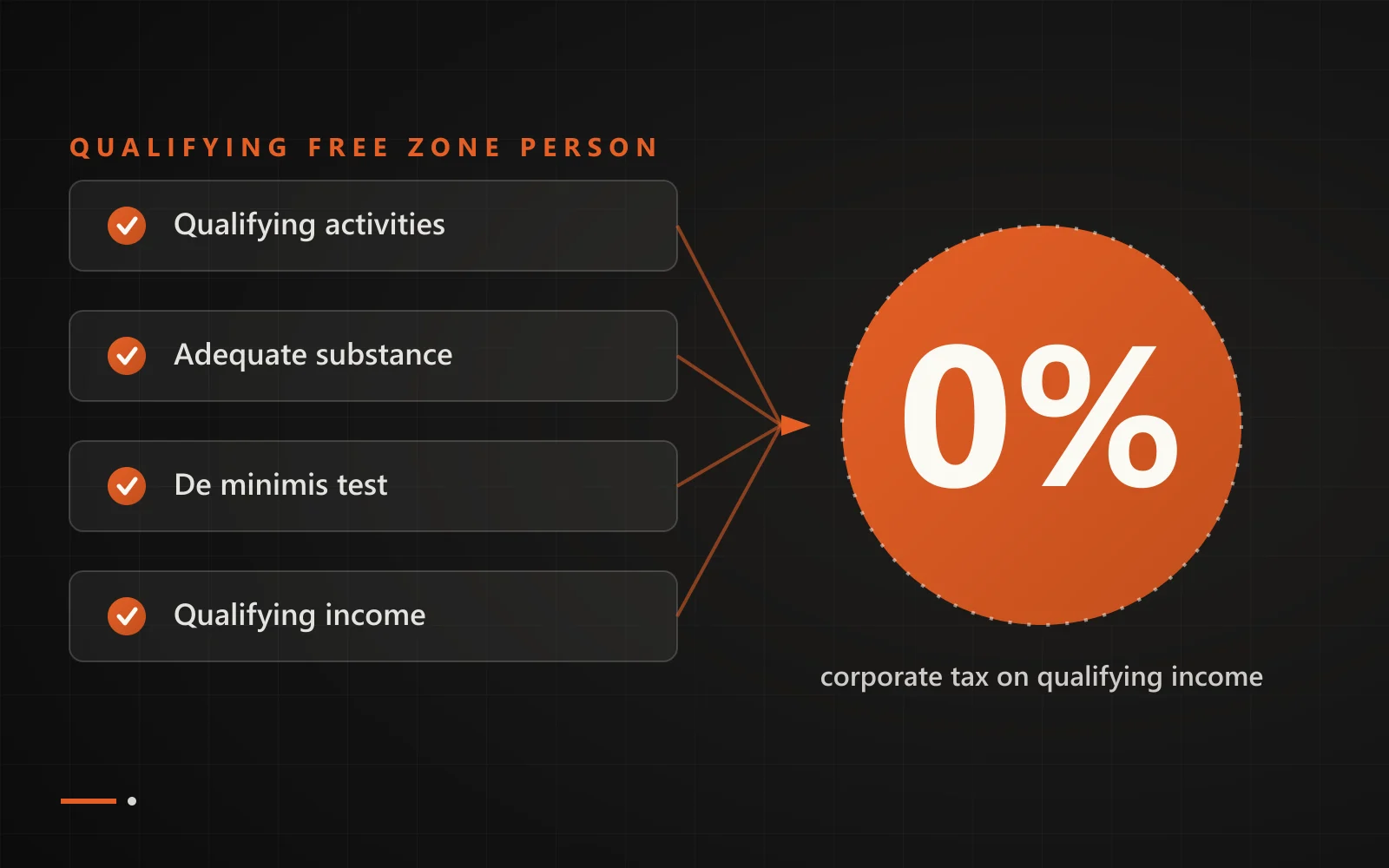
Many free zone businesses assume the 0% Corporate Tax rate is automatic. It is not. The 0% rate applies only to a Qualifying Free Zone Person (QFZP) that earns Qualifying Income and satisfies a set of strict, ongoing conditions. Miss one condition, and the benefit can be lost, sometimes for the current period and several periods after.
This guide explains what Qualifying Income actually means, how a company becomes and stays a QFZP, and where businesses most often trip up. You will find clear definitions, a comparison table, worked examples, common mistakes, and a direct-answer FAQ built for finance leaders and tax professionals.
A quick note on sourcing: this article stands on its own. The referenced SBC topic page was used only as a subject and style guide, and the analysis below is written independently around the current UAE Corporate Tax framework.
Quick takeaways:
- The 0% rate is conditional, not a default for any company inside a free zone.
- Qualifying Income depends on who you transact with and what activity you perform.
- Failing the de minimis test or substance rules can cost QFZP status.
- Transfer pricing and arm's length pricing apply even at a 0% rate.
What is a Qualifying Free Zone Person?
A Qualifying Free Zone Person is a free zone entity that meets specific conditions under the UAE Corporate Tax regime and therefore qualifies for a 0% Corporate Tax rate on its Qualifying Income. Income that does not qualify is taxed at the standard 9% rate.
Being registered in a free zone does not, by itself, make a company a QFZP. The status is a technical test that must be met and maintained each tax period.
To be a QFZP, a Free Zone Person must generally:
- Maintain adequate substance in the UAE.
- Derive Qualifying Income as defined in the relevant Cabinet Decision.
- Not have elected to be subject to the standard Corporate Tax rate.
- Comply with the arm's length principle and transfer pricing documentation requirements.
- Meet the de minimis requirements for non-qualifying revenue.
- Prepare audited financial statements.
If any condition fails in a tax period, the entity generally loses QFZP status for that period and, in many cases, for the following four tax periods. This is one of the most consequential features of the regime and a key reason to monitor conditions continuously.
The legal framework behind the free zone regime
The free zone Corporate Tax rules sit inside the wider regime introduced by Federal Decree-Law No. 47 of 2022 on the Taxation of Corporations and Businesses. The core mechanics for free zones are set out in Article 18 (Qualifying Free Zone Person) and Article 3 (the applicable rates).
The detail that matters most in practice lives in the Cabinet Decisions and Ministerial Decisions that define Qualifying Income, qualifying and excluded activities, de minimis thresholds, and substance. The most relevant instruments are Cabinet Decision No. 100 of 2023 on Qualifying Income and Ministerial Decision No. 265 of 2023 on qualifying and excluded activities, both accessible through the FTA's Corporate Tax legislation library and the Ministry of Finance Corporate Tax pages.
The two authorities to know are the UAE Federal Tax Authority, which administers and enforces Corporate Tax, and the UAE Ministry of Finance, which issues policy and the underlying legislation. Where this article states a rule, it reflects the legislation. Where it offers interpretation or examples, that is professional commentary and should be tested against your own facts.
How does the 0% Corporate Tax rate work for free zones?
Here is the direct answer: a QFZP pays 0% Corporate Tax on its Qualifying Income and 9% on its Taxable Income that is not Qualifying Income. There is no tax-free threshold applied separately to the qualifying portion, because that income is already taxed at 0%.
So the entity does not choose a single blended rate. Instead, income is split into two buckets:
- Qualifying Income: taxed at 0%.
- Non-qualifying Taxable Income: taxed at 9%.
The design goal is to preserve the historical free zone incentive for genuine international and intra-free-zone business, while bringing mainland-facing and other non-qualifying income into the standard tax net. Detail on the applicable rates is available through the FTA's Corporate Tax rates guidance.
What does Qualifying Income really mean?
Qualifying Income is the category of income that benefits from the 0% rate. Broadly, it falls into three groups:
- Income from transactions with other Free Zone Persons, except income from excluded activities.
- Income from transactions with non-free-zone persons, but only in respect of qualifying activities.
- Income that satisfies the de minimis requirements, along with certain income from qualifying intellectual property.
The key insight is that Qualifying Income depends on two questions working together: who is the counterparty, and what is the activity? A transaction with another Free Zone Person is generally qualifying unless it is an excluded activity. A transaction with a mainland or foreign customer is only qualifying if it is a listed qualifying activity.
The "Beneficial Recipient" condition
For transactions with another Free Zone Person to be Qualifying Income, that other person must be the Beneficial Recipient of the goods or services. In plain terms, the counterparty must actually use or benefit from what is supplied, rather than simply passing it on. This prevents free zone status being used as a conduit.
Qualifying activities and excluded activities
The list of qualifying and excluded activities is set out in Ministerial Decision No. 265 of 2023, available through the FTA's guides and references library. Understanding the split is central to protecting the 0% rate.
| Category | Examples (illustrative, not exhaustive) | Corporate Tax treatment |
|---|---|---|
| Qualifying activities | Manufacturing and processing of goods, holding of shares and securities for investment, ownership and operation of ships, fund and wealth management services (subject to conditions), headquarter services to related parties, treasury and financing services to related parties, logistics services, distribution of goods in or from a Designated Zone | Can generate Qualifying Income at 0% |
| Excluded activities | Transactions with natural persons (with limited exceptions), certain banking, insurance, finance and leasing activities, ownership or exploitation of immovable property other than commercial property in a free zone transacted with other free zone persons | Generally cannot be Qualifying Income and count toward non-qualifying revenue |
Two practical points matter here. First, several qualifying activities apply only to transactions with related parties (for example headquarter, treasury, and financing services). Second, an activity that is both a qualifying activity and an excluded activity is treated as an excluded activity, so the exclusion wins.
What is excluded income?
Income from excluded activities is not Qualifying Income, even if the counterparty is another Free Zone Person. Common categories of excluded income include:
- Income from transactions with natural persons, subject to specific exceptions.
- Income from certain regulated financial services, banking, and insurance activities.
- Income from immovable property, other than commercial property located in a free zone where the transaction is with another Free Zone Person.
- Income attributable to a domestic or foreign permanent establishment of the QFZP.
Excluded income is important for two reasons. It is taxed at 9%, and it also counts toward the non-qualifying revenue used in the de minimis test, which can put the entire QFZP status at risk if it grows too large.
How does the de minimis rule work?
The de minimis rule gives a QFZP a small allowance for non-qualifying revenue without losing status. The requirement is met where non-qualifying revenue in a tax period does not exceed the lower of:
- 5% of total revenue, or
- AED 5,000,000.
If non-qualifying revenue breaches either limit, the de minimis requirement fails, and the entity loses QFZP status for that tax period and the following four tax periods. This is set out in Cabinet Decision No. 100 of 2023, accessible via the FTA's Corporate Tax legislation library.
A simple de minimis example
Assume a QFZP has total revenue of AED 60,000,000, of which AED 2,000,000 is non-qualifying.
- 5% of total revenue is AED 3,000,000.
- The lower of AED 3,000,000 and AED 5,000,000 is AED 3,000,000.
- Non-qualifying revenue of AED 2,000,000 is within the AED 3,000,000 limit, so the de minimis test is met.
Now assume total revenue stays at AED 60,000,000 but non-qualifying revenue rises to AED 4,000,000. That exceeds the AED 3,000,000 threshold, the de minimis test fails, and QFZP status is lost for the period and the next four periods. Note that certain revenue, such as income attributable to a permanent establishment or immovable property, is excluded from this calculation and taxed separately.
What are the substance requirements?
A QFZP must maintain adequate substance in the UAE. This means the core income-generating activities (CIGAs) for its qualifying activities must be carried out in a free zone, with adequate resources behind them.
In practice, adequate substance is tested through:
- Adequate qualified employees performing the core activities.
- Adequate operating expenditure incurred in the free zone.
- Adequate physical assets located in the free zone.
Activities may be outsourced to a related party or a third party in a free zone, provided the QFZP maintains adequate supervision and control over the outsourced activity. Substance is assessed by reference to the nature and level of activity, so a holding company and a manufacturer will not need the same footprint.
How do related parties and connected persons affect QFZP status?
Related parties and connected persons matter for two reasons: the definition of certain qualifying activities, and pricing.
Related parties typically include entities linked through ownership or control (broadly a 50% or greater link, or common control). Several qualifying activities, such as headquarter, treasury, and financing services, only produce Qualifying Income when supplied to related parties. So the identity of your counterparty can decide whether income qualifies at all.
Connected persons are, broadly, owners of the taxable person, their directors or officers, and their related parties. Payments to connected persons must meet arm's length and specific deductibility conditions to be deductible.
For definitions and application, the FTA's Corporate Tax guides and references provide the detail, and the general framework flows from Federal Decree-Law No. 47 of 2022.
Transfer pricing implications for free zone entities
A 0% rate does not switch off transfer pricing. A QFZP must comply with the arm's length principle and maintain transfer pricing documentation. This is an explicit QFZP condition, not an optional extra.
The reason is straightforward. If a QFZP could shift profit into the 0% bucket by mispricing transactions with related parties, the regime would be open to abuse. The arm's length principle keeps intra-group pricing honest across the qualifying and non-qualifying split.
The UAE rules follow the OECD Transfer Pricing Guidelines and the arm's length standard reflected in the OECD's work on transfer pricing. Depending on thresholds, a QFZP may need to maintain a master file and local file and file a disclosure form with its return. Practical documentation is especially important where a free zone entity transacts with a mainland "sister" company, because that is where the qualifying analysis and the pricing analysis meet.
Practical business examples
The following scenarios are illustrative and simplified. Real outcomes depend on the full facts and ongoing compliance.
Example 1: Free zone manufacturer selling internationally. A company in a Designated Zone manufactures goods and sells them to overseas distributors. Manufacturing and processing is a qualifying activity, so this income is generally Qualifying Income taxed at 0%, provided substance and other conditions are met.
Example 2: Free zone company selling to a mainland retailer. A free zone trader sells goods directly to a UAE mainland customer that is not in a free zone. Unless this falls within a specific qualifying activity (for example distribution from a Designated Zone under the applicable conditions), the income is likely non-qualifying and taxed at 9%, and it counts toward the de minimis test.
Example 3: Free zone headquarter services. A free zone entity provides management and administrative headquarter services to group companies. Because headquarter services to related parties is a qualifying activity, the income can be Qualifying Income, subject to arm's length pricing and documentation.
Example 4: Rental income from an office to a mainland tenant. Income from immovable property that is not commercial property in a free zone, or that is let to a non-free-zone tenant, is generally excluded income taxed at 9%, and may need to be assessed separately from the de minimis calculation.
Common mistakes and challenges
Experience shows the same issues recurring across free zone businesses.
- Assuming 0% is automatic. Free zone registration alone does not confer QFZP status.
- Ignoring the counterparty. Selling to mainland or natural persons often produces non-qualifying income.
- Underestimating the de minimis math. Non-qualifying revenue creeps up and breaches the lower of 5% or AED 5,000,000.
- Weak substance. Thin staffing, minimal local spend, or activities run from outside the free zone undermine the claim.
- Treating transfer pricing as optional. Arm's length pricing and documentation are QFZP conditions.
- Overlooking permanent establishment income. PE income is excluded and taxed separately.
- Missing the audited accounts requirement. A QFZP must prepare audited financial statements.
- Forgetting the excluded-wins rule. An activity that is both qualifying and excluded is treated as excluded.
Practical recommendations
These are practical steps rather than legal requirements, and the right approach depends on your structure and ongoing compliance.
- Map revenue by counterparty and activity. Tag every stream as qualifying, excluded, or non-qualifying, then reconcile to the accounts.
- Run the de minimis test continuously. Monitor non-qualifying revenue during the year, not at year-end.
- Document substance. Keep evidence of employees, spend, assets, and CIGAs performed in the free zone.
- Build the transfer pricing file early. Prepare arm's length support and documentation before the return is due.
- Review mainland-facing transactions. These are the most common source of non-qualifying income.
- Confirm audited accounts are in hand. Treat the audit as a QFZP prerequisite.
- Reassess after any structural change. New activities, entities, or customers can shift your qualifying position.
Frequently asked questions
Is the 0% Corporate Tax rate automatic for free zone companies?
No. The 0% rate applies only to a Qualifying Free Zone Person that earns Qualifying Income and meets all conditions, including adequate substance, de minimis compliance, arm's length pricing, transfer pricing documentation, and audited financial statements. Registration in a free zone alone is not enough.
What is the difference between qualifying income and non-qualifying income?
Qualifying Income is taxed at 0% and generally covers transactions with other Free Zone Persons (except excluded activities) and qualifying activities with non-free-zone persons. Non-qualifying income, including income from excluded activities, is taxed at 9% and counts toward the de minimis test.
What happens if a QFZP fails the de minimis test?
If non-qualifying revenue exceeds the lower of 5% of total revenue or AED 5,000,000, the de minimis requirement fails. The entity then loses QFZP status for that tax period and the following four tax periods, so all its Taxable Income is taxed at the standard rate for that time.
Do free zone companies need transfer pricing documentation?
Yes. Complying with the arm's length principle and maintaining transfer pricing documentation is an explicit QFZP condition. Depending on thresholds, this can include a master file, a local file, and a disclosure form filed with the Corporate Tax return.
Can a QFZP sell to mainland UAE and keep the 0% rate?
Only in limited cases. Income from transactions with mainland (non-free-zone) persons is Qualifying Income only where it relates to a listed qualifying activity. Other mainland-facing income is generally non-qualifying, taxed at 9%, and included in the de minimis calculation.
Does income from immovable property qualify?
Generally no. Income from immovable property is excluded, except for income from commercial property located in a free zone where the transaction is with another Free Zone Person. Other property income is taxed at 9% and assessed separately.
Can a QFZP choose to be taxed at the standard rate?
Yes. A Free Zone Person may elect to be subject to the standard Corporate Tax rate. Making that election means it is no longer a QFZP for the relevant periods, which can simplify compliance for businesses whose income is largely non-qualifying.
Conclusion
The free zone 0% rate is valuable, but it is conditional and fact-driven. Qualifying Income turns on who you transact with and what you do, and the benefit only holds when substance, de minimis limits, arm's length pricing, documentation, and audited accounts all line up in the same period. One failed condition can remove the benefit for the period and four periods after.
The practical next step is to map your revenue by counterparty and activity, run the de minimis test throughout the year, and make sure your substance and transfer pricing evidence would stand up to review. If your position is unclear, especially where free zone and mainland entities transact with each other, get a technical assessment before you file rather than after.
Internal links (verified from the SBC website)
| Page Title | URL | Anchor Text | Reason for Relevance |
|---|---|---|---|
| Corporate Tax | https://sbcllc.ae/services/corporate-tax | UAE Corporate Tax advisory | Core service page for QFZP eligibility and Corporate Tax compliance |
| Transfer Pricing | https://sbcllc.ae/services/transfer-pricing | transfer pricing documentation | QFZP status requires arm's length pricing and documentation |
| Audit & Dispute Resolution | https://sbcllc.ae/services/audit-disputes | audit and dispute support | Supports FTA reviews, clarifications, and dispute defense on QFZP positions |
| International Tax | https://sbcllc.ae/services/international-tax | international tax structuring | Relevant to cross-border free zone transactions and BEPS considerations |
| Insights | https://sbcllc.ae/insights | more UAE tax insights | Hub of related analysis for topical authority |
| Services | https://sbcllc.ae/services | full range of services | Overview of all advisory practices |
| Contact | https://sbcllc.ae/contact | contact our team | Conversion path for a QFZP assessment |
| Free Zone Qualifying Income (topic article) | https://sbcllc.ae/insights/free-zone-tax-regimes-under-uae-corporate-tax-what-qualifying-income-really-means | related free zone article | Directly related existing article on QFZP qualifying income |
Note on other requested internal pages: dedicated Accounting, Auditing, and Tax Compliance service pages could not be verified from the available SBC site content. A VAT Advisory page (https://sbcllc.ae/services/vat-advisory), an Anti-Money Laundering page (https://sbcllc.ae/services/anti-money-laundering), and an About page (https://sbcllc.ae/about) were visible in the source but are not directly relevant to this topic, so they were not linked. Please complete manual verification before publishing any page not confirmed above.
References and sources
- UAE Federal Tax Authority, Corporate Tax: https://tax.gov.ae/en/taxes/corporate.tax.aspx
- UAE Federal Tax Authority, homepage: https://tax.gov.ae/en/
- UAE Federal Tax Authority, legislation library: https://tax.gov.ae/en/legislation/
- UAE Federal Tax Authority, decrees: https://tax.gov.ae/en/legislation/decrees.aspx
- UAE Federal Tax Authority, guides and references: https://tax.gov.ae/en/legislation/guides.and.references.aspx
- UAE Ministry of Finance, homepage: https://mof.gov.ae/
- UAE Ministry of Finance, Corporate Tax: https://mof.gov.ae/corporate-tax/
- OECD, Transfer Pricing: https://www.oecd.org/en/topics/sub-issues/transfer-pricing.html
Key legal instruments referenced: Federal Decree-Law No. 47 of 2022 (Articles 3 and 18), Cabinet Decision No. 100 of 2023 on Qualifying Income, and Ministerial Decision No. 265 of 2023 on qualifying and excluded activities. Please verify each URL and confirm the latest version of every decision before publication, as official portals and legal instruments are periodically updated.
This publication is for general information only and does not constitute professional advice. Outcomes depend on the specific facts and on ongoing compliance with all QFZP conditions, so please consult a qualified advisor before acting.
8/2/2025 UAE Ministry of Finance Pillar
Page Title: UAE Ministry of Finance Pillar Two Guidance 2025: A Practical Guide
Meta Title: UAE Pillar Two Guidance 2025: GloBE, QDMTT and STTR Explained
Meta Description: Understand the UAE Ministry of Finance Pillar Two Guidance 2025, the 15% global minimum tax, QDMTT, IIR, UTPR, STTR, Free Zone impact, and compliance duties for MNE groups.
Primary Keywords: UAE Pillar Two guidance, UAE global minimum tax, UAE QDMTT, GloBE Rules UAE
Secondary Keywords: Ministry of Finance Pillar Two UAE, 15% minimum effective tax rate, Subject to Tax Rule UAE, Free Zone Pillar Two, GloBE Information Return, BEPS Pillar Two UAE
Slug: uae-ministry-of-finance-pillar-two-guidance-2025