
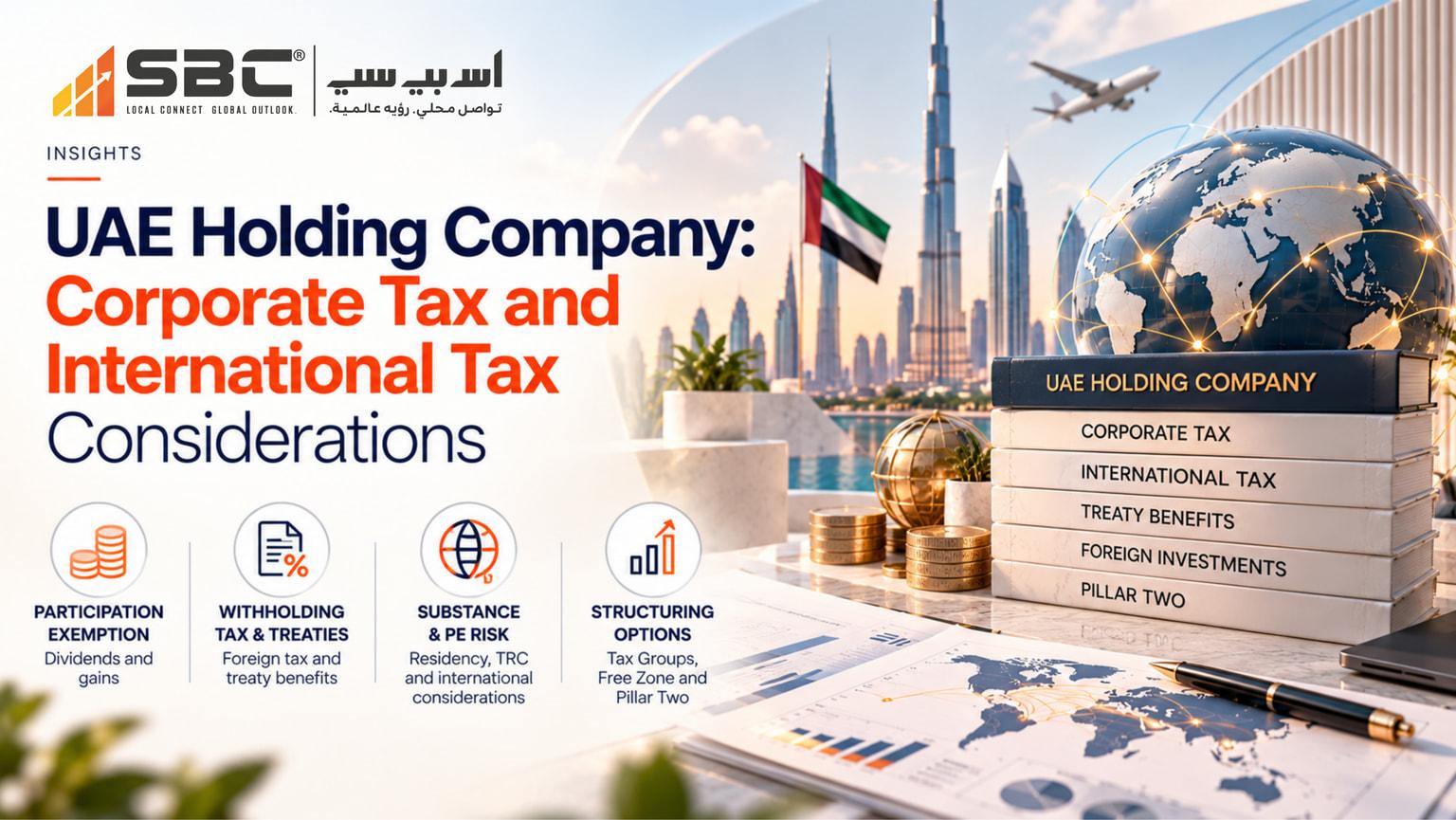
Direct answer: A UAE holding company is taxed under UAE Corporate Tax like any other company: qualifying dividends and gains from shareholdings can be exempt under the Participation Exemption, while interest, fees and rent are taxable. For overseas investments the result also depends on foreign corporate tax and withholding tax, the treaty between the UAE and the investee's country, the holding company's residence evidence (usually a Tax Residency Certificate), Permanent Establishment and substance risks, transfer pricing and, for large groups, Pillar Two.
Why the UAE is used as a holding location, and what that does not guarantee
The UAE attracts holding companies for good reasons: a 9% headline Corporate Tax rate, an exemption regime for qualifying dividends and gains, no withholding tax on dividends paid out, a wide treaty network and business infrastructure. Many groups arrive with the assumption that, because the UAE taxes lightly, the group's overseas income will also be taxed lightly. That is only half the story. The investee's country taxes its profits and may withhold tax on what it pays to the UAE, and whether a treaty reduces that withholding depends on the holding company's treaty entitlement.
This article looks at the UAE holding company through both lenses. The UAE basics, including a worked example, are in UAE Corporate Tax for Investment Holding Companies, and the exemption conditions are in UAE Participation Exemption: How Can UAE Companies Structure Overseas Investments. Here the focus is on the international layer. The primary sources are Federal Decree-Law No. 47 of 2022 and the FTA's Taxation of Foreign Source Income guide.
Typical UAE holding structures
| Structure | Typical use | Main tax questions |
|---|---|---|
| UAE company holding foreign subsidiaries | Regional or global holding platform | Participation Exemption, foreign withholding tax, treaty access, substance |
| UAE company holding UAE subsidiaries | Domestic group holding | Dividend exemption, Tax Group, intra-group pricing |
| UAE mainland holdco above a Free Zone operating company | Separating investments from operations | QFZP status of the operating company, dividends, Tax Group limits |
| Free Zone holding company | Holding shares for investment | QFZP conditions, Qualifying Activity, substance, de minimis |
| UAE company with foreign branches | Direct operations abroad | Foreign PE exemption or credit, branch accounts, treaty PE |
The UAE side in brief
-
Dividends from UAE resident companies are exempt under Article 22.
-
Dividends and gains from qualifying foreign participations are exempt under Article 23, subject to the conditions: at least 5% ownership or AED 4 million cost, a 12-month holding period, the investee being subject to tax at least at 9%, entitlement to profits and liquidation proceeds, and, for Related Party investees, the asset test.
-
Interest, management fees and rent are taxable at 0% to AED 375,000 and 9% above, with related-party items at arm's length.
-
Costs of earning exempt income are not deductible.
-
A UAE Resident Person is taxed on worldwide income, so non-exempt foreign income is in the base, with a Foreign Tax Credit for qualifying foreign tax.
The 2024 amendment, Ministerial Decision No. 302 of 2024, changed the Participation Exemption rules from 1 January 2025. See the Ministry of Finance announcement and the KPMG summary.
The international layer, step by step
1. Foreign corporate tax in the investee's country
The foreign subsidiary pays tax on its profits in its own country. That is a cost to the group whatever the UAE position. It also affects the subject-to-tax condition. A subsidiary in a country with a low or no corporate tax may not satisfy the Participation Exemption's requirement for tax of at least 9%, and the exemption would then not be available unless a deeming rule applies.
2. Foreign withholding tax on payments to the UAE
Many countries withhold tax on dividends, interest and royalties paid to non-residents. The UAE does not tax outbound dividends, but the UAE holding company is on the receiving end of other countries' rules. That is where the real cost often arises, as I explain for payments in UAE Withholding Tax on Cross-Border Payments.
3. Treaty access
A treaty can reduce foreign withholding tax and set the rules for permanent establishments. To claim it, the UAE holding company usually needs to show it is a UAE resident under the treaty, normally with a Tax Residency Certificate from the FTA. The Ministry of Finance publishes the agreements on its double taxation agreements page and its treaty dashboard. The FTA's tax certificates service explains how to apply. Remember that a TRC covers a stated period of up to 12 months, cannot be issued for a future period and does not guarantee a treaty benefit. The residence concepts are set out in UAE Tax Residency for Companies and Individuals.
4. Anti-abuse rules and beneficial ownership
Treaties increasingly include anti-abuse clauses. The principal purpose test, described in the OECD's BEPS Action 6 report, denies a treaty benefit where obtaining it was one of the principal purposes of an arrangement, unless granting it is in line with the treaty's object and purpose. Beneficial ownership conditions in the dividend, interest and royalty articles ask who really receives and controls the income. A UAE holding company that is a pure conduit, with no staff, no decisions and no commercial reason for its location, is exposed. The structure of the OECD Model Tax Convention is a helpful reference, but the actual treaty text decides.
5. Foreign Tax Credit versus exemption
If a dividend is exempt, no Foreign Tax Credit is available on the withholding tax it suffered. If it is taxable, for example because the shareholding is below the thresholds, the credit is limited to the UAE tax on that income, is calculated income by income and cannot be carried forward. The mechanics are in UAE Foreign Tax Credit.
6. Permanent Establishment abroad
A holding company whose staff negotiate contracts, manage assets or run activities in another country can create a PE there under the domestic law or the treaty. A UAE holding company that elects the Foreign Permanent Establishment exemption must meet the conditions, including foreign tax of at least 9% on the PE, and the election covers all qualifying foreign PEs. Where the exemption is not elected, the PE's profits are in the UAE tax base with a credit for foreign tax.
7. Residence of foreign subsidiaries
A foreign subsidiary that is effectively managed and controlled from the UAE can become a UAE Resident Person, and may also be resident abroad under local law. If the group runs its foreign subsidiaries' key decisions from a UAE head office, review that risk. See UAE Tax Residency for Companies.
8. Transfer pricing
Loans, guarantees, management fees, royalties and cost allocations between the UAE holding company and its subsidiaries must be at arm's length in both countries. The UAE applies the arm's length principle in Article 34, and the foreign country will apply its own rules. Without aligned documentation, there is a risk of double taxation.
9. Pillar Two
A UAE holding company that is part of a multinational group with consolidated revenue of at least EUR 750 million may be a Constituent Entity within the UAE Domestic Minimum Top-up Tax, introduced for fiscal years starting on or after 1 January 2025. The FTA's August 2026 Scope and Registration Guide explains registration. Excluded Entity and Investment Entity classifications may apply to some holding entities, and they must be self-assessed independently of Corporate Tax status. See UAE Pillar Two and Free Zones for the interaction.
A worked scenario (hypothetical)
A UAE mainland holding company owns 100% of three operating subsidiaries and receives a dividend from each.
| Subsidiary | Country facts | UAE analysis | Foreign cost |
|---|---|---|---|
| A | Corporate tax 25%. 10% dividend withholding tax under domestic law, 5% under the treaty | Participation Exemption available if conditions are met. No Foreign Tax Credit | 5% withholding if the treaty is claimed, 10% otherwise. Reclaim any excess |
| B | Corporate tax 20%. No dividend withholding tax | Exempt if conditions are met | Subsidiary's own tax only |
| C | Corporate tax 5%, with no relevant deeming rule | Fails the subject-to-tax condition. The dividend is taxable, subject to the credit rules | Local tax and any withholding, partly creditable up to the cap |
The lesson is that the same UAE holding company has three different outcomes. Planning therefore starts with the investee's country, not the UAE.
Mainland or Free Zone holding company
| Factor | Mainland holding company | Free Zone holding company |
|---|---|---|
| Dividends and gains | Participation Exemption if conditions are met | Participation Exemption, or Qualifying Income if QFZP |
| Interest and fees | Taxable, with 0% band up to AED 375,000 | May not be Qualifying Income. Taxed at 9% as non-qualifying income if QFZP |
| Substance | Governance and accounting records | Real substance in the Free Zone for QFZP |
| Tax Group | Possible | Not for a QFZP |
| Compliance | Standard | Adds audit, de minimis and QFZP monitoring |
Holding shares for investment is a Qualifying Activity under Ministerial Decision No. 229 of 2025, but the other QFZP conditions must also be met. The details are in the FTA's Free Zone Persons guide.
Substance: the common thread
Almost every international risk above is mitigated or magnified by substance. Where the holding company has real directors who take real decisions, accounting records, adequate staff for its activities and a commercial rationale for being in the UAE, treaty claims, residence certificates and Participation Exemption positions are far easier to defend. Where it has only a licence and a bank account, they are not. Document the rationale for the structure at the time it is set up, not afterwards.
Documents that support treaty and exemption claims
When a foreign payer, a foreign tax authority or the FTA asks questions, the speed and quality of the answer depends on what was filed when the investment was made. For each foreign shareholding I would hold a standing file containing:
-
The share purchase or subscription agreement and the evidence of the acquisition cost and date.
-
The register of members or equivalent showing the percentage held and the rights to profits and liquidation proceeds.
-
Evidence of the investee's tax status and rate in its country, such as its latest tax return or an advisor's confirmation of the headline rate.
-
The treaty analysis, including the relevant articles, the withholding rate and any beneficial ownership or anti-abuse conditions.
-
The TRC and the foreign claim forms submitted for each payment.
-
The board minute approving the investment, recording the commercial rationale.
-
Dividend declarations, bank evidence of receipt and foreign withholding tax certificates.
Disposals and restructuring
Exits and reorganisations are where holding structures are tested. Before selling a subsidiary or moving shares within the group, check:
-
Whether the Participation Exemption conditions will still be met at the date of sale, including the holding period.
-
The foreign tax cost of the disposal, including any treaty protection for capital gains.
-
Whether the transaction triggers any relief or restriction under the UAE's restructuring and group rules.
-
The effect on any Foreign PE election or on losses previously used, because the FTA's rules restrict the Participation Exemption where a Foreign PE with previously used losses is later incorporated.
-
Whether the new structure still gives the same treaty access and substance.
Allow time for these points before signing. A restructuring that looks neutral in the UAE can be expensive abroad.
Compliance framework
-
Corporate Tax registration and return, within nine months of the end of the Tax Period.
-
Financial statements and accounting records, with audit where required.
-
Transfer pricing documentation for significant related-party transactions and the related disclosures.
-
Foreign income register by country and income type, with foreign tax evidence.
-
Treaty claim documents, including the TRC.
-
Tax Group documents, if a Tax Group is formed.
-
Free Zone records and audit, where applicable.
-
Pillar Two registration and filings, where in scope.
Common mistakes
-
Assuming that UAE tax outcomes also determine the foreign tax outcome.
-
Failing to obtain a TRC before foreign dividends are paid.
-
Not testing the subject-to-tax condition for investees in low-tax countries.
-
Claiming a Foreign Tax Credit on exempt dividends.
-
Ignoring beneficial ownership and substance when relying on treaties.
-
Letting staff create foreign PEs without analysis.
-
Running foreign subsidiaries from the UAE without considering residence.
-
Using a Free Zone holding company without checking QFZP conditions.
A checklist before using a UAE holding company
-
List the countries and the investees' expected tax status.
-
Check each treaty and the foreign withholding rates.
-
Map the Participation Exemption conditions for each shareholding.
-
Decide on mainland or Free Zone and test QFZP conditions if relevant.
-
Plan the substance: people, decisions, premises, records.
-
Prepare transfer pricing for loans and fees.
-
Plan the TRC application.
-
Check Pillar Two scope.
-
Document the commercial rationale and keep it updated.
To discuss a holding structure, contact SBC's International Tax practice. The FTA's Corporate Tax guides and references and the Ministry of Finance Corporate Tax hub are the best places to follow new developments.
Frequently asked questions
How is a UAE holding company taxed?
Like any UAE company: 0% on Taxable Income up to AED 375,000 and 9% above, after exemptions. Dividends from UAE companies are exempt, and qualifying dividends and gains from shareholdings can be exempt under the Participation Exemption. Interest, fees and rent are generally taxable.
Are dividends from foreign subsidiaries taxable in the UAE?
Not if the Participation Exemption conditions are met. Otherwise they are taxable, with a possible Foreign Tax Credit for foreign withholding tax, limited to the UAE tax on that income.
Can a UAE holding company use double tax treaties?
Yes, if it is a UAE resident under the treaty and meets the treaty's conditions. A TRC is the usual evidence. Treaties vary, and anti-abuse and beneficial ownership rules may apply.
Does a UAE holding company pay withholding tax on dividends it distributes?
No. The UAE does not deduct tax from dividends paid to shareholders. The rate under the withholding tax framework is currently 0%.
What happens if the foreign subsidiary is in a low-tax country?
The subject-to-tax condition for the Participation Exemption may not be met, so dividends and gains could be taxable in the UAE, unless a deeming rule applies. Check the investee's tax status before investing.
Can a UAE holding company create a permanent establishment abroad?
Yes. If it carries on business through a fixed place, an agent or other presence in another country, that country may tax the profits. The UAE treatment depends on whether the Foreign PE exemption is elected.
Does a UAE holding company need substance?
Yes, as a practical matter. Substance supports residence, treaty claims, the Participation Exemption and anti-abuse defences. A Free Zone holding company that wants QFZP status must meet specific substance conditions in the Free Zone.
Can a UAE holding company form a Tax Group?
With eligible UAE subsidiaries, if it holds at least 95% of their capital, voting rights, profits and net assets and the other conditions are met. QFZPs cannot be members.
Is a UAE holding company in scope of Pillar Two?
Only if it is a Constituent Entity of a group with consolidated revenue of at least EUR 750 million in two of the four preceding fiscal years. Excluded Entity rules may apply in some cases.
What documents support a UAE holding company's tax position?
Ownership and acquisition records, dividend statements, foreign tax certificates, the TRC, treaty claim forms, transfer pricing files, board minutes and evidence of substance.
This publication is for general information only and does not constitute professional advice. Please consult your SBC advisor before acting on any matter covered here.