
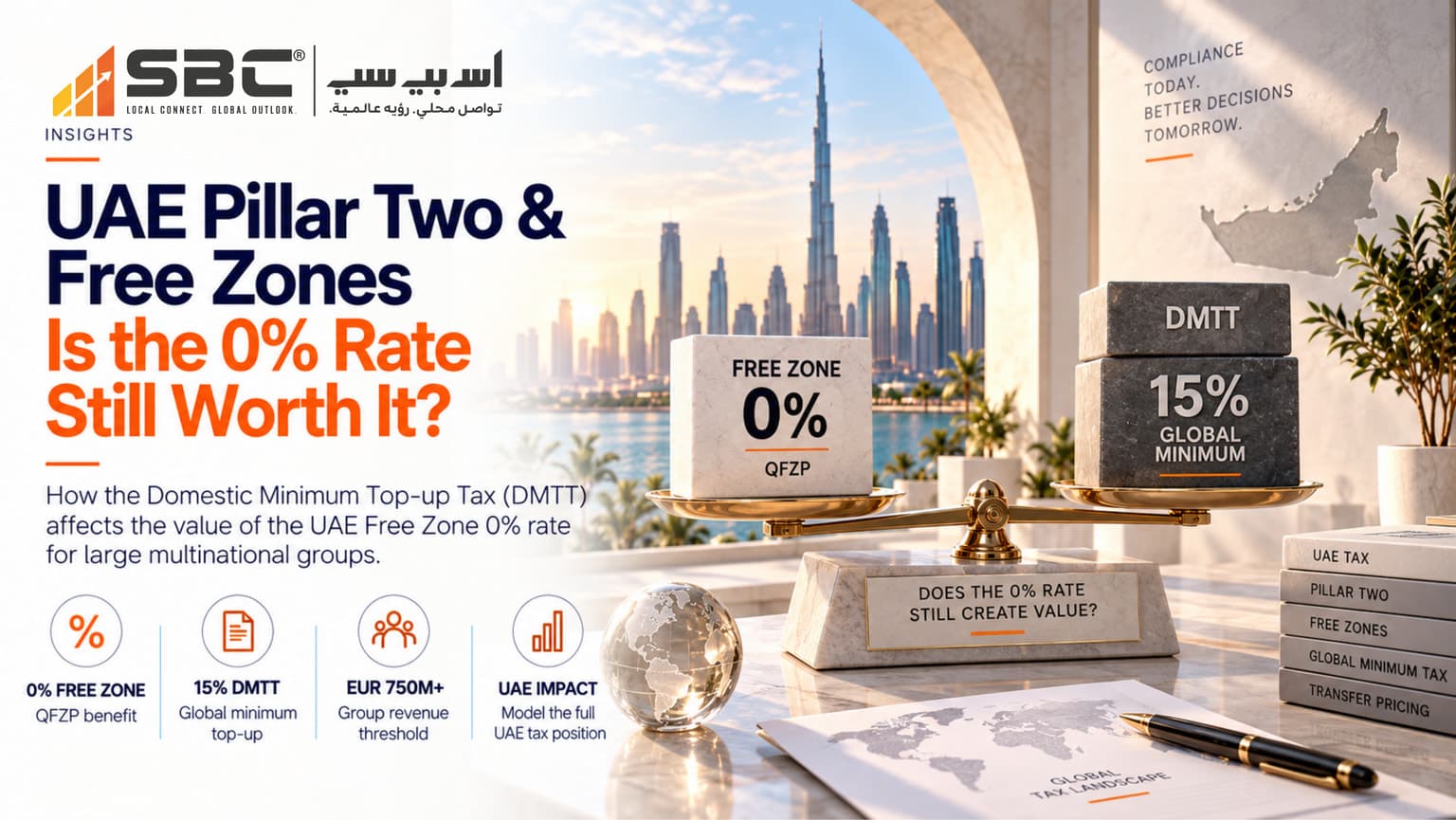
Direct answer: Pillar Two does not remove the 0% Corporate Tax rate for a Qualifying Free Zone Person, but for a multinational group with consolidated revenue of at least EUR 750 million it can remove most of the group-level benefit. The UAE Domestic Minimum Top-up Tax (DMTT) tops up the group's UAE effective tax rate towards 15%, calculated under GloBE rules. For groups below the threshold, the 0% rate keeps its full value.
The question every large group now asks
For years, the headline of the UAE Free Zone regime was simple: qualify, and your qualifying profits are taxed at 0%. Boards of multinational groups used that headline to compare the UAE with other locations. Since 2025 the headline is no longer enough, because a second regime now sits underneath it.
I get the same question from group CFOs: "Does the global minimum tax make our Free Zone structure pointless?" The short answer is no, but the long answer matters, because the value of the 0% rate for an in-scope group is now measured differently. This article explains the economics. For the mechanics of scope, registration and filing, see UAE Pillar Two and Free Zones: QFZP 0% Corporate Tax vs the 15% Global Minimum. For the QFZP conditions themselves, see Qualifying Free Zone Person: UAE QFZP Conditions, Compliance and the 0% Corporate Tax Rate.
Two regimes at two levels
The first step is to keep three layers apart.
| Layer | Level | What it does |
|---|---|---|
| Ordinary UAE Corporate Tax | The entity | Taxes Taxable Income at 0% to AED 375,000 and 9% above, or at 0% on a QFZP's Qualifying Income |
| UAE Domestic Minimum Top-up Tax (DMTT) | The UAE jurisdiction for an in-scope MNE group | Adds a top-up where the group's UAE effective tax rate, computed under GloBE rules, is below 15% |
| OECD GloBE Rules | The global framework | The model on which the DMTT is based. See the OECD Model Rules |
The Free Zone 0% rate is an entity-level outcome decided under Federal Decree-Law No. 47 of 2022 and Cabinet Decision No. 100 of 2023. Pillar Two is a group-level mechanism. The DMTT was enabled by Federal Decree-Law No. 60 of 2023 and given effect by Cabinet Decision No. 142 of 2024 for fiscal years starting on or after 1 January 2025. A group can be perfectly compliant under one regime and still have obligations under the other.
Who is in scope
The DMTT applies to Constituent Entities of multinational enterprise groups whose consolidated revenue is at least EUR 750 million in at least two of the four fiscal years immediately before the year being tested. The test is at group level, using the consolidated financial statements. The revenue of a single UAE subsidiary is not the test. Qualifying Free Zone Persons are not carved out of the DMTT, and registration is required even where the top-up is expected to be nil.
The Ministry of Finance's Top-up Tax page is the primary source, and the FTA's August 2026 Scope and Registration Guide (TTGREG1) explains the mechanics.
How the top-up works, in plain terms
The DMTT computes an effective tax rate for the UAE as a whole, by pooling all the group's UAE Constituent Entities.
-
Compute GloBE income for the UAE entities. This starts from the group's consolidated accounting profit and applies GloBE adjustments. It is not the same as UAE Taxable Income.
-
Compute covered taxes, including UAE Corporate Tax and any relevant adjustments.
-
Divide covered taxes by GloBE income to get the UAE effective tax rate.
-
If the rate is below 15%, compute the top-up percentage, which is 15% minus the effective rate.
-
Apply it to excess profit, which is GloBE income less the substance-based income exclusion (SBIE), a carve-out based on payroll and tangible assets in the UAE.
-
Pay the DMTT in the UAE.
Because Free Zone profits taxed at 0% contribute no covered tax, they pull the UAE effective rate down. Mainland profits taxed at 9% pull it up. The result is a blend.
A worked example (hypothetical and simplified)
Take an in-scope group with UAE profits as follows. The numbers ignore deferred taxes, other GloBE adjustments and safe harbours, and are illustrative only.
| Item | AED million |
|---|---|
| GloBE income of Free Zone QFZP (all Qualifying Income, taxed at 0%) | 400 |
| GloBE income of mainland entity (taxed at 9%) | 100 |
| Total UAE GloBE income | 500 |
| Corporate Tax paid (0 + 9) | 9 |
| UAE effective tax rate (9 ÷ 500) | 1.8% |
| Top-up percentage (15% − 1.8%) | 13.2% |
| Assumed SBIE (payroll and tangible assets) | 40 |
| Excess profit (500 − 40) | 460 |
| DMTT (13.2% × 460) | 60.72 |
| Total UAE tax: Corporate Tax plus DMTT | 69.72 |
Compare two alternatives with the same profits.
-
No Free Zone, all profits taxed at 9%. Corporate Tax is 9% × 500 = AED 45 million. The effective rate is 9%, the top-up percentage is 6%, and the DMTT is 6% × 460 = AED 27.6 million. Total UAE tax is AED 72.6 million.
-
Group below the EUR 750 million threshold. No DMTT. Tax is AED 9 million with the Free Zone structure and AED 45 million without it, a saving of AED 36 million a year.
What the example shows. For the in-scope group, the Free Zone 0% saves about AED 2.88 million compared with a fully taxed structure (AED 72.6 million against AED 69.72 million). The group pays roughly 15% of its excess profit in the UAE either way. For the group below the threshold, the benefit is the full AED 36 million. In other words, the 0% rate is still valuable, but for large groups its value shifts from "tax saved" to "profit protected by the SBIE", "where the tax is paid" and "when it is paid".
Why the 0% rate still has value for an in-scope group
-
The SBIE. Profit equal to a return on payroll and tangible assets in the UAE is excluded from the top-up base. A Free Zone entity with genuine staff and assets benefits most.
-
Collection in the UAE. The DMTT has been recognised by the OECD as a qualified domestic top-up tax with transitional status. The Ministry of Finance announcement says that top-up calculations need not be repeated in other jurisdictions for UAE entities, so the top-up is collected in the UAE, not by a parent country. The UAE has not adopted an Income Inclusion Rule or Undertaxed Profits Rule.
-
Cash flow and timing. Corporate Tax is paid by the entity within the normal deadline. The top-up is assessed and settled through the group-level process, on a different timetable.
-
Safe harbours and de minimis rules. The UAE rules include transitional safe harbours and exclusions that can reduce or remove the top-up in some years. Registration is still required.
-
Groups below the threshold. For them nothing has changed. Growth towards the threshold should be monitored, because the test looks back over four years.
-
Non-tax benefits. Customs, licensing, ownership and location advantages of Free Zones are unaffected.
What changes in planning
For an in-scope group, the question is no longer "can this entity get 0%?" The better question is: "What is the combined UAE Corporate Tax and DMTT outcome for the whole UAE jurisdiction?" That has several practical consequences.
-
Model the whole UAE footprint, not individual entities. A 0% Free Zone entity and a 9% mainland entity are pooled.
-
Substance becomes more valuable. Payroll and tangible assets drive the SBIE as well as the QFZP substance condition.
-
Transfer pricing matters twice. The same pricing decisions affect QFZP conditions and the GloBE profit allocation.
-
Profit location decisions change. The UAE remains attractive, but the advantage over other 15% jurisdictions narrows for in-scope groups. Models should compare the post-top-up result.
-
Compliance cost rises. In-scope groups need GloBE data, consolidation support and Pillar Two filings in addition to Corporate Tax returns.
-
Group structure should be reviewed around the revenue threshold, particularly for acquisitions and fast-growing businesses.
Compliance in outline
An in-scope entity must register with the FTA for Top-up Tax, generally within seven months of the end of the first in-scope fiscal year, with a transitional deadline of 30 November 2026 for fiscal years ending before 30 April 2026. The Simmons & Simmons analysis of the August 2026 guides summarises the registration and filing rules, including Ministerial Decision No. 133 of 2026 on which UAE entities file the Pillar Two Information Return. The FTA's Excluded Entities guide explains which entities sit outside the charge. I deal with these points in the companion article.
Three situations, three answers
The right conclusion depends on where the group sits relative to the threshold.
-
Clearly below EUR 750 million and not growing towards it. The QFZP regime works exactly as before. Spend your effort on keeping the QFZP conditions, not on Pillar Two modelling. Keep a note of the group revenue each year so the position is evidenced.
-
Approaching the threshold. Because the test looks back over four fiscal years and requires the threshold in two of them, a group can cross it with little warning after an acquisition or a strong year. Build a forecast of consolidated revenue, decide who owns the Pillar Two readiness plan, and make sure the entity-level data you would need, such as payroll, tangible assets and covered taxes, can actually be produced.
-
Already in scope. The planning exercise is the one in the worked example: pool the UAE entities, estimate the effective rate and the SBIE, and compare the result with other locations after top-up. The decision on whether to expand Free Zone activity should be taken on that basis.
In all three cases the QFZP conditions still have to be met in their own right. A Free Zone entity that loses QFZP status becomes taxable under the standard regime, which raises its covered taxes and may reduce the top-up, but at a cost in Corporate Tax that is generally greater than any saving in DMTT. Do not treat Pillar Two as a reason to relax QFZP controls.
Reporting timelines to plan for
After registration, in-scope entities have to file a Pillar Two Information Return. Commentary on the UAE rules indicates that the return is generally due 15 months after the end of the fiscal year, extended to 18 months for the first (transition) year, and that Ministerial Decision No. 133 of 2026 identifies which UAE entities must file and allows a Designated Local Entity to file on their behalf. The decision is on the Ministry of Finance website as Ministerial Decision No. 133 of 2026. Confirm the deadlines against the FTA's current guide before you rely on them. A late registration can attract an AED 10,000 penalty for each entity that should have been registered, according to the FTA's August 2026 guide.
Common misconceptions
-
"Pillar Two abolishes the Free Zone 0% rate." It does not. The entity-level rate remains.
-
"Every QFZP now pays 15%." Only in-scope groups can be charged, and the DMTT applies to excess profit after the SBIE, based on the UAE effective rate, not as a flat 15% on every dirham.
-
"Our UAE entity has AED 3 billion of revenue, so we are in scope." The test is the group's consolidated revenue in EUR 750 million terms, over at least two of the four prior fiscal years.
-
"The UAE parent's country will collect the top-up." The UAE collects it through the DMTT. It has not adopted the IIR or UTPR.
-
"The SBIE saves us automatically." It applies only to the extent of qualifying payroll and tangible assets, under the rules.
-
"We have a safe harbour, so we do not need to register." Registration is required even where the top-up is expected to be nil.
A checklist for advisers and CFOs
-
Confirm whether the group meets the EUR 750 million test.
-
Map all UAE entities, including joint ventures and Free Zone branches.
-
Identify QFZP status and Qualifying Income for each Free Zone entity.
-
Compute a preliminary GloBE effective tax rate for the UAE.
-
Estimate the SBIE using payroll and tangible assets.
-
Check eligibility for safe harbours and exclusions.
-
Decide the filing architecture, such as a Designated Local Entity.
-
Calendar registration and return deadlines.
-
Document the commercial rationale for the structure.
If you would like help modelling the effect on your group, speak to SBC's International Tax team or Corporate Tax team. The FTA's Corporate Tax guides and references and the Ministry of Finance Corporate Tax hub are the best places to track new guidance. For protection of QFZP status, see How to Protect QFZP Status.
Frequently asked questions
Does Pillar Two remove the UAE Free Zone 0% rate?
No. A QFZP still pays 0% Corporate Tax on Qualifying Income. For an in-scope multinational group, the UAE Domestic Minimum Top-up Tax may add a group-level top-up if the UAE effective tax rate is below 15%.
Which groups are in scope of the UAE DMTT?
Multinational groups with consolidated revenue of at least EUR 750 million in at least two of the four fiscal years immediately preceding the year tested, for fiscal years starting on or after 1 January 2025. The test is at group level.
Does the 0% rate still have value if my group is in scope?
Yes, though its value changes. The substance-based income exclusion, the collection of the top-up in the UAE, timing benefits and non-tax Free Zone advantages remain, but the tax saving compared with a fully taxed structure can be much smaller.
Will my group pay 15% on all its UAE profit?
Not necessarily. The DMTT is computed from the UAE jurisdictional effective rate under GloBE rules and applies to excess profit after the substance-based income exclusion. The result depends on the blend of 0% and 9% profit and on other adjustments.
Does the UAE apply the Income Inclusion Rule or Undertaxed Profits Rule?
No. The UAE has implemented the DMTT only. Because the DMTT has qualified status, other jurisdictions are not required to compute a separate top-up on the same UAE profits.
Are Qualifying Free Zone Persons excluded from the DMTT?
No. QFZPs are within the DMTT if they are Constituent Entities of an in-scope group. Their QFZP status does not by itself exclude them, although Excluded Entity rules may apply to certain entities.
Do I need to register for Top-up Tax if I expect no top-up?
Yes. The FTA's guide says registration is required even where a safe harbour or other relief means the Top-up Tax is nil, and it is independent of Corporate Tax status.
What is the substance-based income exclusion?
An exclusion from the top-up base equal to a return on payroll and tangible assets in the jurisdiction. Entities with real staff and assets in the UAE benefit from it.
What if my group is below the EUR 750 million threshold?
Pillar Two does not apply. The QFZP regime continues to provide its full benefit, subject to meeting its conditions. Monitor group revenue each year because the test looks back over four fiscal years.
How should a group decide whether to use a Free Zone structure now?
Model the combined Corporate Tax and DMTT result for the whole UAE footprint, compare it with alternative locations after top-up, test the substance you can actually maintain and weigh the compliance cost. Do not decide on the headline rate alone.
This publication is for general information only and does not constitute professional advice. Please consult your SBC advisor before acting on any matter covered here.