
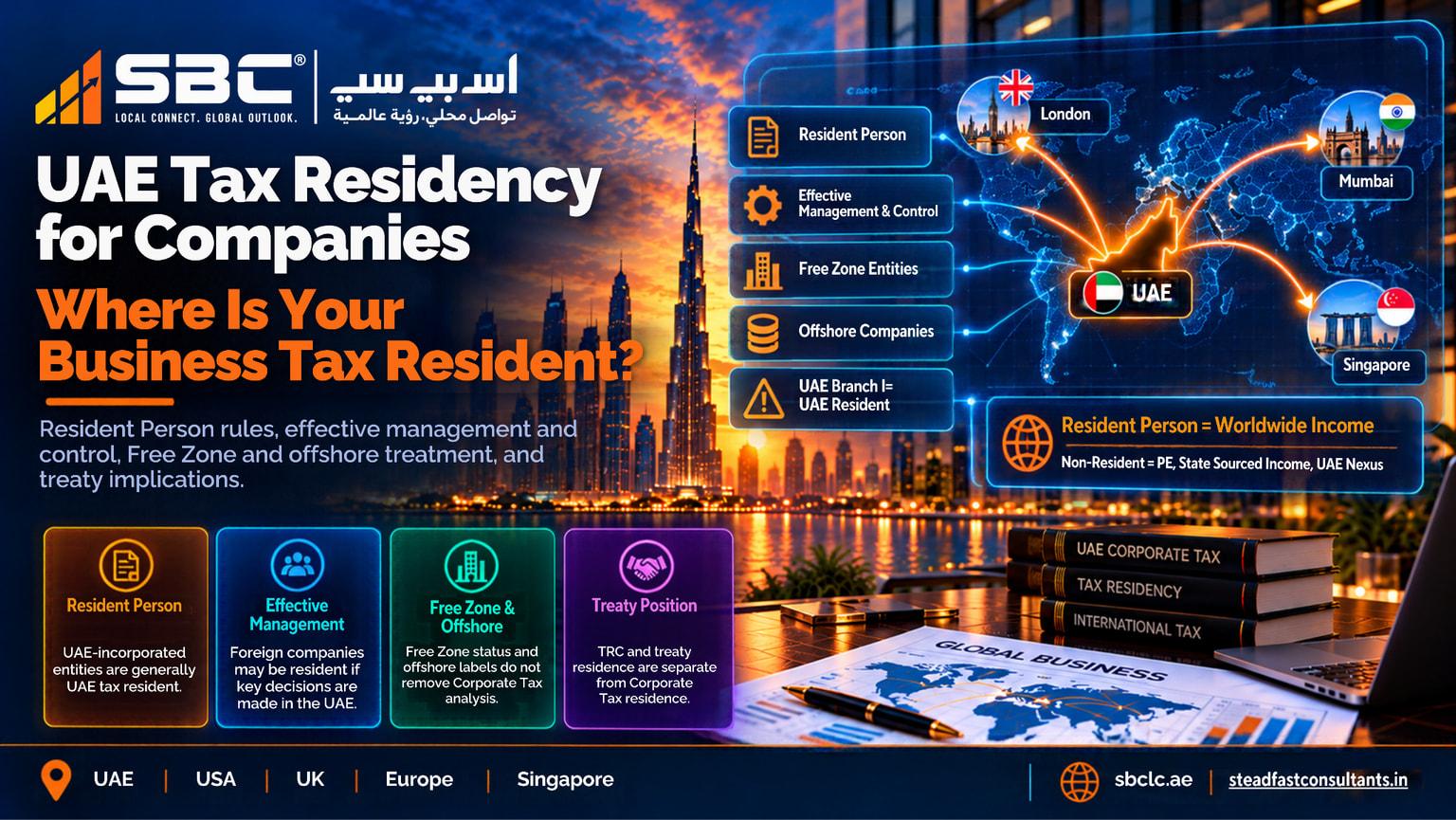
Direct answer: A company incorporated or otherwise established in the UAE is generally a Resident Person for UAE Corporate Tax. A company incorporated abroad can also be a UAE Resident Person if it is effectively managed and controlled in the UAE. Residence for Corporate Tax, residence under a double tax treaty and a Tax Residency Certificate (TRC) are separate concepts and must be analysed separately.
Why residence is the first question to settle
When a new client asks me where its group is tax resident, I usually find that the legal answer and the commercial assumption do not match. The legal structure may say "UAE", while the people actually running the business sit in London, Mumbai or Singapore. Or the paperwork may say "British Virgin Islands" while the CEO and CFO take every key decision from Dubai.
Residence matters because it decides the width of a company's tax base. Under Federal Decree-Law No. 47 of 2022, a juridical person that is a Resident Person is taxed on its worldwide income, subject to exemptions and reliefs. A Non-Resident Person is taxed only on income attributable to a UAE Permanent Establishment, State Sourced Income and income connected with a UAE nexus. Getting residence wrong therefore changes how much income is in the UAE tax base, which reliefs are available and whether the company can rely on a treaty.
This article is about company residence for UAE Corporate Tax. The Tax Residency Certificate process, individuals' tests and treaty tie-breakers are covered in UAE Tax Residency for Companies and Individuals: Residence, TRCs and Treaty Position. The official starting point is the Ministry of Finance Corporate Tax hub.
Who is a Resident Person?
Article 11 of the Corporate Tax Law treats a juridical person as a Resident Person if it is:
-
Incorporated, established or otherwise recognised under UAE legislation, including a UAE Free Zone entity; or
-
Incorporated, established or otherwise recognised under foreign legislation, but effectively managed and controlled in the UAE.
The first limb is mechanical. If the company is a UAE legal person, it is a Resident Person, regardless of where its shareholders, directors or customers are. A company with little UAE activity is therefore still a Resident Person for Corporate Tax purposes.
The second limb is a question of fact and substance, and it is where most disputes arise.
Offshore companies, Free Zone companies and branches
Three structures cause regular confusion.
-
Free Zone companies. A Free Zone is UAE territory. A company incorporated in a Free Zone is a UAE juridical person and so a Resident Person. Whether it also qualifies as a Qualifying Free Zone Person, and so is taxed at 0% on Qualifying Income, is a separate assessment under the Free Zone Persons guide.
-
"Offshore" companies. The word does not mean "outside the UAE tax system". A UAE-incorporated offshore entity is still a UAE juridical person and its Corporate Tax position must be worked out under the normal rules.
-
UAE branches of foreign companies. A branch is not a separate legal entity. It is part of the foreign company and may be a Permanent Establishment of it. A UAE branch does not, by itself, make the foreign head office a UAE Resident Person.
Effective management and control: the substance test
For a foreign-incorporated company, the question is where it is effectively managed and controlled. The FTA describes this as the place where the key management and commercial decisions necessary to conduct the business as a whole are, in substance, made.
Examples of such decisions include:
-
Strategic policy and business direction.
-
Major investments, acquisitions and disposals.
-
Significant financing and treasury decisions.
-
Appointment and oversight of senior management.
-
Use of profits and declaration of dividends.
Some practical principles from the FTA's approach and from experience:
-
Substance beats form. The test looks at who actually makes the decision, not only who is formally authorised to.
-
Directors do not need to be UAE residents for effective management and control to be in the UAE, and non-resident directors do not rule it out.
-
The location of board meetings is relevant but not decisive. A meeting in Dubai that only ratifies decisions already made elsewhere carries less weight than the underlying decision process. Conversely, a meeting held abroad does not prevent UAE management where the real decision-makers are in the UAE.
-
Several jurisdictions may be involved. The question is where key decisions are regularly and predominantly made in the relevant Tax Period.
-
A UAE bank account, UAE customers or a UAE-based director are not enough on their own.
The FTA guidance asks you to identify who substantially makes the key decisions, as opposed to who merely formalises them. The DLA Piper summary of the FTA's tax residency guide is a helpful secondary read, but the FTA's own materials in the Corporate Tax guides and references library remain the authority.
Why holding companies deserve extra attention
A holding or investment company often has no large workforce. Its real activity is deciding what to buy, sell, finance and distribute. That makes the location of those decision-makers the central fact. A foreign holding company whose investment committee meets in Abu Dhabi, and whose senior executives live in the UAE, is a candidate for UAE residence even if its legal seat is elsewhere.
Four combinations of incorporation and management
| Incorporation | Where it is managed | Corporate Tax residence | Comment |
|---|---|---|---|
| UAE | UAE | UAE Resident Person | The simple case |
| UAE | Outside the UAE | UAE Resident Person | Incorporation alone makes it resident. Another country may also treat it as resident, so check the treaty |
| Outside the UAE | UAE | Likely UAE Resident Person | Effective management and control in the UAE brings it into residence |
| Outside the UAE | Outside the UAE | Non-Resident Person | Subject to UAE tax only through a PE, State Sourced Income or nexus |
Four concepts people confuse
The most useful discipline I can recommend is to keep four ideas separate in every residence memo.
| Concept | What it is | Governed by |
|---|---|---|
| Corporate Tax registration | Registration with the FTA as a Taxable Person | Corporate Tax Law and FTA registration rules |
| Resident Person status | Domestic classification for Corporate Tax | Article 11 of the Corporate Tax Law |
| Tax Resident status and TRC | Domestic tax residence and the FTA certificate that evidences it | Cabinet Decision No. 85 of 2022 |
| Treaty residence | Residence for a specific double tax treaty | The treaty text and its tie-breaker |
Being registered does not prove treaty residence. Being a Resident Person does not automatically make the company a treaty resident of the UAE for every treaty. A TRC is evidence of residence for a stated period and purpose. It does not create residence.
Cabinet Decision No. 85 of 2022 sets the tests for domestic tax residence and the TRC. For a company, the test is similar: it is a Tax Resident if it is established, formed or recognised in the UAE, or is effectively managed and controlled in the UAE. The FTA's tax certificates service sets out the application requirements, which include proof of effective management and control where that is the basis of the claim.
Dual residence and the treaty tie-breaker
A UAE-incorporated holding company may be a UAE Resident Person, yet its directors and senior managers may take their key decisions in another country. That country may also claim the company as resident under its own domestic law.
Where the UAE has a treaty with that country, the treaty determines which state is treated as the company's residence for treaty purposes. Many treaties resolve dual residence of companies by reference to place of effective management, but some use other mechanisms, such as mutual agreement between the tax authorities. The wording of each treaty controls. The Ministry of Finance publishes the texts through its double taxation agreements page, and the OECD Model Tax Convention gives the framework most treaties are built on.
The practical lesson is that a UAE company with management abroad should not assume the UAE is the only taxing jurisdiction, and a company with all management in the UAE should not assume that a UAE licence settles its position elsewhere.
Two illustrative cases
Case A: UAE company, overseas management. XYZ Holdings Ltd is incorporated in the UAE. It has a licence, a registered office, a bank account and a Corporate Tax registration. Its shareholders and senior executives are overseas, and major investment decisions are consistently taken outside the UAE. For UAE Corporate Tax, XYZ is a Resident Person because of its UAE incorporation. If the facts also create residence in another country, the treaty must be examined, and XYZ should take advice on that country's rules.
Case B: Foreign company, UAE management. ABC Investments Ltd is incorporated overseas. Its CEO and CFO live in Dubai, its investment committee meets in Dubai, and it takes all acquisition, financing and dividend decisions there. ABC should assess whether it is a UAE Resident Person through effective management and control. If it is, it must register, and its worldwide income is in the UAE tax base, with the usual exemptions and reliefs.
What follows from being a Resident Person
If a company is a UAE Resident Person, the consequences include:
-
Worldwide taxation. Foreign income is in scope unless an exemption applies. See UAE Corporate Tax and Foreign Source Income.
-
Access to UAE reliefs. The Participation Exemption, the Foreign Permanent Establishment exemption and foreign tax credits are available, subject to their conditions.
-
Registration and filing. The company must register through the FTA's registration service, file returns and keep records.
-
Possible treaty access. Residence is a precondition to treaty benefits, though not a guarantee of them.
If a foreign company is a UAE Resident Person only because of its management, the first question is whether it knew. Many groups discover the issue during a due diligence or a banking review, long after the first Tax Period has ended.
Evidence that supports (or rebuts) UAE residence
The best position is one where the legal structure, the actual decision-making and the documents all tell the same story. I would build the evidence file around these items:
-
Board minutes and resolutions, with dates, locations, attendees and the reasoning recorded.
-
Strategic papers and investment committee materials showing who prepared and who approved them.
-
The physical location of directors and senior managers at the time of key decisions, supported by travel records.
-
Delegations of authority and signing mandates.
-
Correspondence on major decisions, showing who initiated and who decided.
-
Financial decision records, including dividend and treasury approvals.
-
Corporate governance documents and board calendars.
-
Evidence of the commercial reality behind formal resolutions.
A resolution stating that a decision was taken in the UAE is weak evidence if the surrounding emails show that the decision was agreed elsewhere. Auditors and tax authorities read the whole file.
Governance habits that reduce risk
-
Decide deliberately where the board is meant to meet and where key decisions are meant to be made, and align the practice to the plan.
-
Make sure directors who are meant to decide actually have the information and authority to do so.
-
Avoid back-dated or formulaic minutes. Record real discussion.
-
Where management is genuinely dispersed, record why the majority of key decisions are made in a particular place.
-
Review the position when senior executives relocate, when a new CEO or CFO is appointed, or when the group changes its operating model.
Common misconceptions
-
"A UAE company with no UAE activity is not tax resident." For Corporate Tax, UAE incorporation generally makes the company a Resident Person.
-
"A Free Zone company is outside UAE Corporate Tax." It is within the regime and may benefit from 0% only on Qualifying Income if it meets all QFZP conditions.
-
"A foreign company with a UAE branch is a UAE tax resident." The branch may be a PE, which is a different consequence.
-
"A TRC proves we are resident for every treaty." It is evidence of UAE residence for the stated period and purpose.
-
"Board meetings in Dubai make us resident." They may be relevant but the substance of decision-making matters more.
-
"Corporate Tax registration is the same as tax residency." It is not.
A practical checklist
-
Confirm the place and legal basis of incorporation for each entity.
-
Map where directors, senior managers and key decision-makers actually work.
-
Identify the key decisions made in the Tax Period and who took them.
-
Review whether any other country may treat the entity as resident and read the relevant treaty.
-
Decide whether to register, and whether a TRC is needed for a treaty or banking purpose.
-
Document the conclusion in a short residence memo that separates domestic residence, foreign residence and treaty residence.
-
Review the position on any change of management, structure or location, using the FTA's Corporate Tax FAQs for current administrative points.
If you would like the analysis reviewed, speak to SBC's Corporate Tax team or International Tax team. For a view on whether a foreign company is in the UAE tax net at all, see UAE Corporate Tax for Foreign Companies.
Frequently asked questions
Who is a UAE Resident Person for Corporate Tax?
A juridical person incorporated, established or otherwise recognised under UAE legislation is a Resident Person. So is a company incorporated abroad that is effectively managed and controlled in the UAE. Natural persons are treated differently and are covered in a separate article.
Can a foreign company become UAE tax resident?
Yes. If a company incorporated outside the UAE is effectively managed and controlled in the UAE, it is a Resident Person. The test looks at where key management and commercial decisions are actually made, not at the place of incorporation.
Does a UAE branch make a foreign company a UAE Resident Person?
No, not by itself. A branch is part of the foreign company and may be a Permanent Establishment, so profits attributable to it are taxable in the UAE. The foreign company becomes a Resident Person only if it is effectively managed and controlled in the UAE.
Are Free Zone and offshore companies UAE tax residents?
A company incorporated in a UAE Free Zone, or a UAE offshore entity, is a UAE juridical person and is generally a Resident Person. Whether a Free Zone company benefits from the 0% rate is a separate question that depends on Qualifying Free Zone Person status.
Is UAE Corporate Tax residence the same as treaty residence?
No. Corporate Tax residence is a domestic concept. Treaty residence is determined under the specific double tax treaty, including its tie-breaker rule for dual residents. Being a UAE Resident Person does not automatically make a company a UAE treaty resident for every treaty.
Is a Tax Residency Certificate mandatory for every UAE company?
No. A TRC is an FTA certificate that evidences UAE tax residence for a stated period and purpose. It is commonly needed to support a treaty claim or to satisfy a foreign payer or bank. It is not required for Corporate Tax registration or filing.
How long must a company exist before applying for a TRC?
The FTA's requirements generally expect a juridical person to have been established for at least 12 months, and a TRC cannot be issued for a future period. Check the FTA's current requirements on its tax certificates page before applying.
Does a UAE bank account or UAE customers make a foreign company UAE resident?
No. They are background facts. The test is where the key management and commercial decisions are really made.
What evidence shows where a company is effectively managed and controlled?
Board minutes, strategic and investment papers, the location of directors and senior managers when decisions are taken, delegations of authority, correspondence on major decisions and financial decision records. The evidence should be consistent with the commercial reality.
This publication is for general information only and does not constitute professional advice. Please consult your SBC advisor before acting on any matter covered here.