
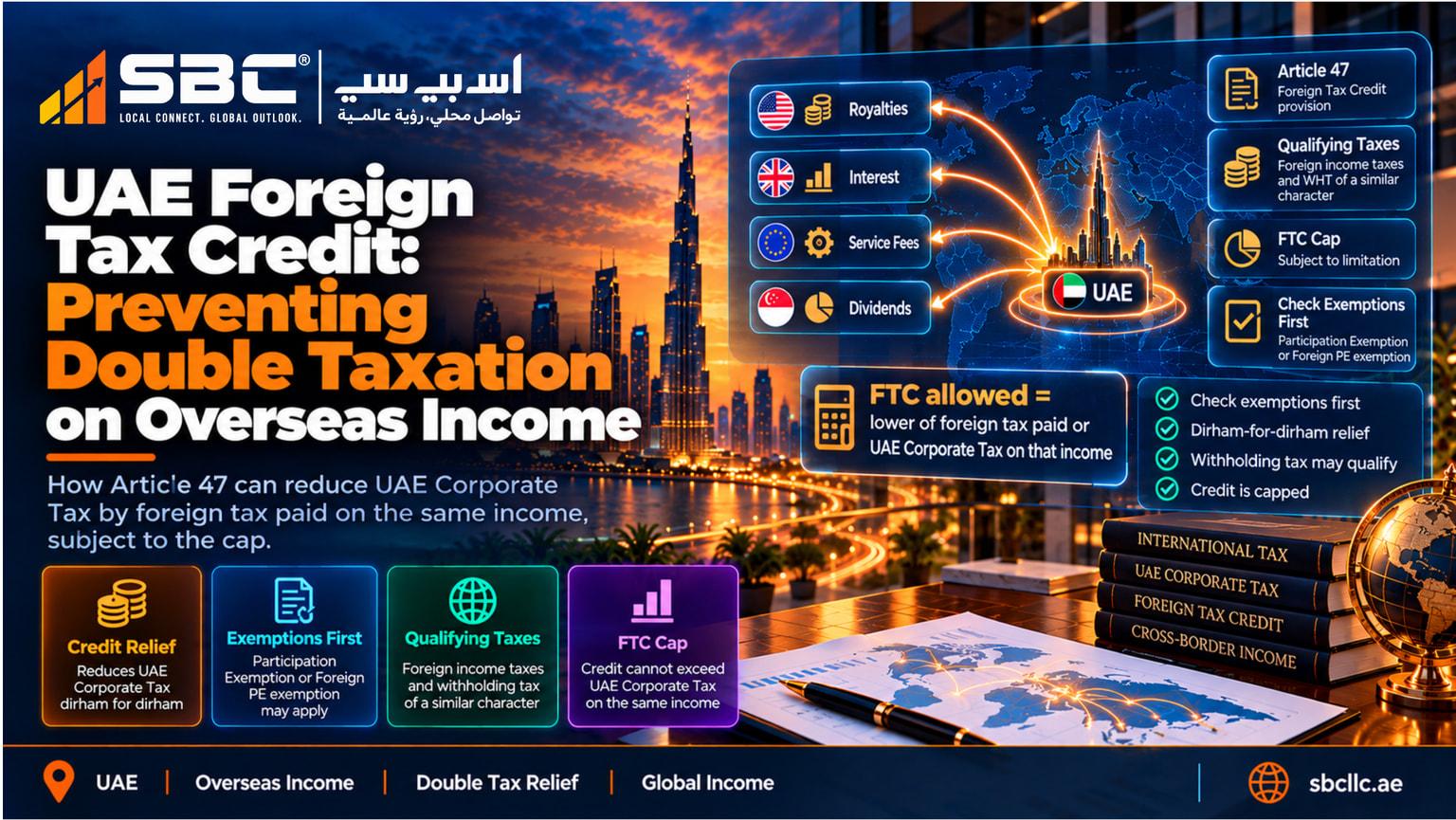
Direct answer: The UAE Foreign Tax Credit (FTC) under Article 47 of the Corporate Tax Law reduces the UAE Corporate Tax payable on foreign income by the foreign income tax paid on that same income, up to the UAE tax attributable to it. It is a credit, not a deduction. It is calculated income by income, cannot be carried forward, carried back or refunded, and is not available on exempt income or where no UAE tax is payable.
Why the FTC deserves more attention than it gets
Foreign tax credits are the part of international tax where small errors compound. A UAE company that receives royalties, interest or service fees from abroad often finds that tax has been withheld at source. The finance team books the net receipt, assumes "the UAE will give credit" and moves on. Then, at return time, the credit turns out to be capped, unavailable or unsupported.
This article walks through the rules in the order I apply them: whether relief should come from an exemption instead, who can claim, which taxes qualify, how the cap works with numbers, when tax counts as paid, what happens with refunds and what evidence to hold. The primary source is the FTA's Taxation of Foreign Source Income guide (CTGFSI1), read with Article 47 of Federal Decree-Law No. 47 of 2022.
Step zero: check whether an exemption applies first
A UAE Resident Person is taxed on worldwide income (see the Ministry of Finance Corporate Tax hub for the framework). Before the FTC even arises, two exemptions may remove the income from the tax base.
-
The Participation Exemption for qualifying dividends and gains from a Participating Interest.
-
The Foreign Permanent Establishment exemption, by election, for qualifying foreign branches.
If an exemption applies, the income is excluded and no UAE tax arises on it, so there is nothing to credit. The FTC applies only to the foreign income that remains taxable. The Corporate Tax General Guide gives the wider context, and DLA Piper's article on credit versus Foreign PE exemption is a useful secondary read. I compare the routes in UAE Foreign Source Income: Exemptions, Foreign Branches and the UAE Corporate Tax Treatment and UAE Corporate Tax Position on Foreign Branches.
What the Foreign Tax Credit is
A Foreign Tax Credit allows a Taxable Person to deduct tax paid under the laws of a foreign jurisdiction from the UAE Corporate Tax due on the same income. Three features define it.
-
It is a credit. It reduces the tax bill dirham for dirham, which makes it more valuable than a deduction from taxable income.
-
It is unilateral. It applies even if the UAE has no double tax treaty with the other country.
-
It is limited. It can never exceed the UAE Corporate Tax due on the relevant foreign income.
Who can claim the FTC?
Foreign income is taxable, and so creditable, for three types of Taxable Person.
-
Resident juridical persons. For example a UAE LLC or PJSC.
-
Resident natural persons, to the extent the foreign income relates to a UAE business or business activity and their turnover exceeds AED 1 million in the calendar year.
-
Non-resident persons with a UAE Permanent Establishment, where the foreign income is attributable to that PE.
A non-resident without a UAE PE cannot claim an FTC, because its foreign income is not within UAE tax in the first place.
Which foreign taxes qualify?
A foreign tax qualifies only if it is of a similar character to UAE Corporate Tax. All three conditions must be met.
-
It is imposed by and payable to the government of a foreign jurisdiction, whether federal or state level.
-
Payment is compulsory and enforceable under that jurisdiction's tax laws.
-
It is imposed on profit or net income. Foreign withholding tax is deemed to meet this requirement.
The FTA guide adds helpful clarifications. The name of the tax, whether it sits in a separate statute and the method of collection do not matter. A tax collected by withholding is still creditable if it is a tax on business income. A tax with income and non-income components, such as Saudi Arabian corporate Zakat, can be treated as similar to Corporate Tax where it is predominantly a tax on income.
The following do not qualify:
-
Consumption taxes such as VAT, GST and sales tax.
-
Customs duty, excise tax and other import duties.
-
Transaction taxes such as stamp duty and capital duty.
-
Property taxes and wealth taxes that do not depend on income.
-
Estate and inheritance taxes.
-
Interest, fines and penalties paid to a foreign tax authority.
When is foreign tax "paid"?
Tax counts as paid if it has been remitted to the foreign authority, or has accrued to it as a committed amount that is not yet paid. It does not count as paid where:
-
The liability is contingent or not yet formally accrued, for example a higher assessment that is under challenge with no final decision.
-
The amount has been refunded or confirmed as refundable.
How the cap works
The credit is the lower of two amounts.
-
The foreign tax actually paid on the foreign income, converted into dirhams.
-
The UAE Corporate Tax due on that foreign income.
Because UAE tax is on net income, the foreign income is first reduced by the expenses economically linked to it. That matters when the other country taxes gross, as with withholding tax.
Because the UAE has two rates (0% and 9%), the UAE tax on the foreign income is calculated on a weighted-average basis:
UAE tax on foreign income = X × Y ÷ Z
-
X is the Corporate Tax due on total Taxable Income before any credit.
-
Y is the relevant net foreign source income.
-
Z is total Taxable Income.
Example 1: credit within the cap
Company A has total Taxable Income of AED 10 million, including AED 1 million of net interest from Country X. It paid AED 50,000 of withholding tax in Country X.
-
Tax on AED 10 million: (10,000,000 − 375,000) × 9% = AED 866,250.
-
UAE tax on the foreign interest: 866,250 × 1,000,000 ÷ 10,000,000 = AED 86,625.
-
Credit: the lower of AED 50,000 and AED 86,625, which is AED 50,000.
-
Tax payable: 866,250 − 50,000 = AED 816,250.
Example 2: credit capped
Company A has no other income. It earns AED 1 million of royalties from Country X, with AED 100,000 withheld there, and incurred AED 200,000 of expenses to earn them.
-
Taxable Income: 1,000,000 − 200,000 = AED 800,000.
-
Tax: (800,000 − 375,000) × 9% = AED 38,250.
-
Credit: the lower of AED 100,000 and AED 38,250, which is AED 38,250.
-
Tax payable: nil. The unused AED 61,750 is forfeited.
The income-by-income rule
The credit is limited to the UAE tax on the "relevant" income, so it is calculated separately for each foreign income source. Excess credit on one source cannot be used against the UAE tax on another.
Example 3. Company A has two foreign income streams and no other income.
| Source | Net foreign income (AED) | Foreign tax (AED) | UAE tax on that income (AED) | Credit allowed (AED) |
|---|---|---|---|---|
| Interest from Country X | 100,000 | 1,000 | 3,375 | 1,000 |
| Royalties from Country Y | 500,000 | 50,000 | 16,875 | 16,875 |
| Total | 600,000 | 51,000 | 20,250 | 17,875 |
Total UAE tax is (600,000 − 375,000) × 9% = AED 20,250, so tax payable is 20,250 − 17,875 = AED 2,375. The unused AED 33,125 on the Country Y royalties is lost. It cannot be used against the AED 2,375 of UAE tax that remains payable on the Country X interest.
No carry-forward, no carry-back, no refund
Any unused credit is forfeited. It cannot be carried forward or back, refunded or deducted from taxable profit. This is the main commercial reason to push for treaty relief at source or to reclaim excess foreign tax from the foreign authority, instead of relying on the UAE credit.
When no credit is available
-
Exempt income, such as qualifying participation dividends or the income of an elected Foreign PE.
-
Small Business Relief, where the election means no Corporate Tax is payable.
-
Qualifying Income of a Qualifying Free Zone Person that is taxed at 0%.
-
A loss position. Where overall Taxable Income is negative, no tax is payable, so there is nothing to credit and the foreign tax is lost.
-
Non-qualifying levies, such as VAT, customs duties and stamp duty.
On the Free Zone point, Cabinet Decision No. 100 of 2023 and the FTA's Free Zone Persons guide explain which income is Qualifying Income.
Timing: which Tax Period gets the credit?
UAE and foreign tax periods often do not line up. The FTA applies a symmetrical approach: the foreign tax follows the foreign income. The credit is claimed in the Tax Period in which that income is included in UAE Taxable Income, even if the foreign tax is actually paid in a later period.
Example. A UAE company on an accrual basis declares a foreign dividend receivable in 2024, and the foreign tax is withheld when the dividend is paid in March 2025. The dividend is not exempt. The company claims the credit in its 2024 return, because the income is included in 2024 Taxable Income. It must still hold proof of the later payment if the FTA asks.
For taxpayers on the cash basis, income and credit are recognised when the income is received and the tax is remitted.
If a gain is taxed abroad on an accrual basis but taxed in the UAE only when realised, the foreign tax on that gain is creditable in the UAE only in the later period when the gain enters UAE Taxable Income.
Refunds and adjustments
-
Foreign tax is later refunded. The credit is reduced. If this increases UAE Corporate Tax payable by more than AED 10,000, a Voluntary Disclosure must be filed with the FTA within 20 business days of becoming aware of the refund. If the increase is AED 10,000 or less, the claim is corrected in the earlier of the next return due for a previous Tax Period or the return for the period in which the refund occurs.
-
Foreign tax is later increased. A higher credit may be available. The taxpayer can file a Voluntary Disclosure with a refund application, and the FTA will assess it.
These rules come from Cabinet Decision No. 74 of 2023 as described in the FTA guide.
Double tax treaties and the FTC
The Article 47 credit applies whether or not a treaty exists. Where a treaty does apply, three points matter.
-
Treaty prevails. Under Article 66 of the Corporate Tax Law, a treaty prevails to the extent it is inconsistent with the domestic law. A treaty may provide exemption instead of credit, tax sparing or relief for taxes that are not on net income.
-
Treaty rate caps the credit. If a treaty limits the foreign withholding tax to, for example, 5%, the credit is limited to that treaty rate, assuming the income is not exempt.
-
Reclaim the excess abroad. If more tax was withheld than the treaty allows, the excess should be reclaimed from the foreign authority. The UAE credit does not compensate for it.
The Ministry of Finance's double taxation agreements page lists the treaties, and the OECD Model Tax Convention shows the standard structure. For the step-by-step treaty review, see UAE Double Tax Treaties.
Evidence required
The FTA guide expects records that show:
-
The foreign income in the foreign currency, and the exchange rate used to convert it.
-
The financial year in which the income was derived.
-
The nature and amount of the foreign tax.
-
The date the tax was paid.
-
Whether the tax is an advance instalment, withholding tax or final payment.
Acceptable proof of payment includes:
-
An official receipt from the foreign tax authority.
-
For withholding tax, a certificate of deduction issued by the foreign authority.
-
A copy of the foreign tax return with the income and tax calculations.
-
A letter from the foreign authority confirming that all tax for the income year has been paid.
Documents not in Arabic or English need a certified translation. Remittance advices alone are weak evidence. Retain the contract and invoices that link the tax to the specific income, and the working showing how expenses were allocated.
Common mistakes
-
Claiming a credit on exempt dividends.
-
Claiming VAT, customs duty, stamp duty or other non-income levies.
-
Claiming more than the UAE tax attributable to the foreign income.
-
Netting excess credit from one country against income from another.
-
Assuming unused credit carries forward.
-
Relying on remittance advices instead of official certificates.
-
Not reclaiming excess withholding tax above the treaty rate.
-
Missing the Voluntary Disclosure deadline after a foreign tax refund.
-
Claiming in the wrong Tax Period.
-
Forgetting that a loss position forfeits the credit.
Pre-claim checklist
-
Confirm the income is taxable in the UAE and not exempt.
-
Confirm the foreign levy qualifies and has been paid or accrued.
-
Compute net foreign income after economically linked expenses.
-
Compute UAE tax on that income using the weighted-average formula.
-
Apply the lower-of test, income by income.
-
Check the treaty rate and reclaim any excess abroad.
-
Match the claim to the right Tax Period.
-
Assemble the evidence pack.
The FTA's Determination of Taxable Income guide and its Corporate Tax guides and references are worth checking for new material. For help preparing a claim, speak to SBC's International Tax practice or Corporate Tax practice. For the foundation topic, see UAE Corporate Tax and Foreign Source Income.
Frequently asked questions
What is the UAE Foreign Tax Credit?
It is a credit against UAE Corporate Tax for qualifying foreign tax paid on foreign income that remains taxable in the UAE. It is governed by Article 47 of the Corporate Tax Law and limited to the UAE Corporate Tax attributable to that income.
Who can claim a Foreign Tax Credit in the UAE?
Resident juridical persons, resident natural persons for foreign income related to a UAE business with turnover above AED 1 million, and non-residents with a UAE Permanent Establishment for foreign income attributable to that PE.
Which foreign taxes qualify for the credit?
Taxes imposed by a foreign government that are compulsory, enforceable and levied on profit or net income. Foreign withholding tax is treated as meeting the net income requirement. VAT, customs duty, stamp duty, payroll taxes, property and wealth taxes and penalties do not qualify.
Is the Foreign Tax Credit a deduction or a credit?
A credit. It reduces the UAE Corporate Tax payable directly. It is not deducted from Taxable Income, and an unused credit cannot be deducted either.
Can I carry forward an unused Foreign Tax Credit?
No. Unused credit cannot be carried forward, carried back or refunded. It is forfeited.
What does the income-by-income rule mean?
The credit is computed separately for each foreign income source. Excess credit on one source cannot be set against the UAE tax on another source or country.
Can I claim a credit on foreign withholding tax on exempt dividends?
No. Where dividends are exempt under the Participation Exemption, no UAE tax arises on them, so there is no credit. The foreign withholding tax is a cost, unless it can be reclaimed abroad.
Is a Foreign Tax Credit available if my company made a loss?
No. If Taxable Income is negative, no Corporate Tax is payable, so the credit cannot be used and is forfeited.
In which Tax Period do I claim the credit?
In the Tax Period in which the foreign income is included in UAE Taxable Income, even if the foreign tax is paid in a later period. Cash-basis taxpayers claim when the income is received and the tax remitted.
What if the foreign country refunds the tax later?
The credit is reduced. If UAE tax payable rises by more than AED 10,000, file a Voluntary Disclosure within 20 business days of becoming aware of the refund. For AED 10,000 or less, correct the claim in the earlier of the next return due for a previous Tax Period or the return for the period in which the refund occurs.
Do I need a treaty to claim the credit?
No. The Article 47 credit applies whether or not the UAE has a treaty with the other country. If a treaty exists, it may cap the foreign tax or provide a different relief method, and it prevails to the extent of any inconsistency.
This publication is for general information only and does not constitute professional advice. Please consult your SBC advisor before acting on any matter covered here.