
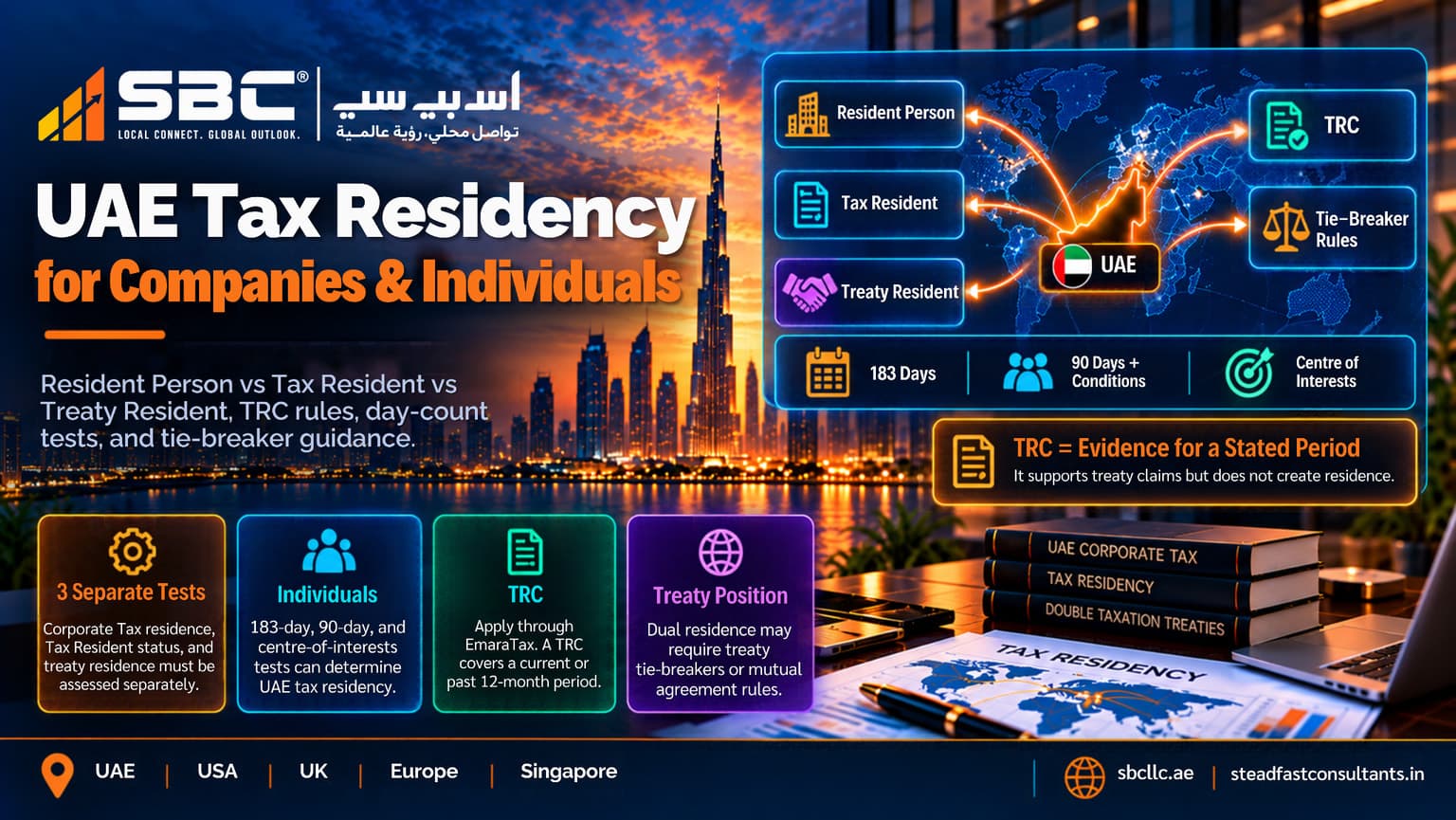
Direct answer: UAE tax residency is not one test. A person can be a Resident Person for Corporate Tax, a Tax Resident under Cabinet Decision No. 85 of 2022 (the test used for a Tax Residency Certificate), and a treaty resident under a specific double tax treaty, and each must be assessed separately. Companies are resident mainly through UAE establishment or effective management and control. Individuals are resident through day counts or centre-of-interests tests.
Why three tests, not one
Clients often tell me, "I have a UAE visa and a Corporate Tax number, so I must be tax resident." That sentence mixes up at least three legal concepts. Each has its own source, its own consequence and its own evidence.
-
Resident Person is a Corporate Tax classification. It decides whether a person is taxed on worldwide or UAE-linked income under Federal Decree-Law No. 47 of 2022.
-
Tax Resident is the domestic residence status under Cabinet Decision No. 85 of 2022. It is the basis on which the Federal Tax Authority (FTA) issues a Tax Residency Certificate (TRC).
-
Treaty resident is the status under a particular double tax agreement. It decides whether, and how, the treaty applies.
The tests are related but not identical. A person can pass one and fail another. The Ministry of Finance Corporate Tax hub and the UAE Legislation portal hold the primary texts. This article sets out each, explains how a TRC is obtained and used, and shows how to deal with dual residence. For the company-specific test of effective management and control, see UAE Tax Residency for Companies: Where Is Your Business Tax Resident?.
Concept 1: Resident Person for Corporate Tax
A Taxable Person under the Corporate Tax Law is either a Resident Person or a Non-Resident Person. The classification determines the scope of tax.
Juridical persons. A company is a Resident Person if it is incorporated, established or otherwise recognised under UAE legislation, or if it is incorporated abroad but effectively managed and controlled in the UAE. A Resident Person that is a juridical person is taxed on its worldwide income.
Natural persons. An individual is a Resident Person for Corporate Tax only if they conduct a business or business activity in the UAE and their turnover from it exceeds AED 1 million in a Gregorian calendar year, as set out in Cabinet Decision No. 49 of 2023. Wages, personal investment income and real estate investment income that does not require a licence are excluded from that test. The FTA's Taxation of Foreign Source Income guide explains with worked examples.
Non-Resident Persons. These are generally taxed only on income attributable to a UAE Permanent Establishment, State Sourced Income or income linked to a UAE nexus.
This is the concept that governs whether a Corporate Tax return is needed. It says nothing, on its own, about treaty benefits.
Concept 2: Tax Resident under Cabinet Decision No. 85 of 2022
Cabinet Decision No. 85 of 2022, in force from 1 March 2023, sets out who is a UAE Tax Resident for the purposes of the TRC and other tax uses. A person who is a Tax Resident can apply to the FTA for a certificate.
Companies
A juridical person is a Tax Resident if it is established, formed or recognised in the UAE, or if it is effectively managed and controlled in the UAE. Certain government and exempt entities are treated as Tax Residents by law or on approval.
Individuals
An individual is a Tax Resident if they meet at least one of three tests.
-
183 days. They have been physically present in the UAE for 183 days or more within the relevant 12 consecutive months. The days need not be consecutive.
-
90 days with conditions. They have been present for 90 days or more within the relevant 12 months and are a UAE national, hold a valid UAE residence permit, or are a GCC national, and also have a permanent place of residence in the UAE or carry on a job or business in the UAE.
-
Centre of interests. Their main place of residence and the centre of their financial and personal interests are in the UAE. The detailed conditions are in Ministerial Decision guidance and the FTA's published guide.
Days spent in the UAE because of exceptional circumstances, such as medical emergencies, force majeure or travel restrictions, may be disregarded if the person can evidence them.
Note that the individual tests differ from the Corporate Tax Resident Person test. An individual can be a Tax Resident under Cabinet Decision No. 85 yet have no Corporate Tax obligation, for example an employee with only salary income. The reverse can also happen.
Concept 3: Treaty residence
Domestic residence is only the starting point for treaty purposes. The UAE's treaties, which the Ministry of Finance publishes on its double taxation agreements page, each contain a residence article. It normally says that a person is resident if they are liable to tax in that state by reason of domicile, residence, place of management or similar criteria.
Where a treaty refers to residence "under the laws of the UAE", the FTA's guidance says the Cabinet Decision No. 85 criteria are used to decide whether the person is a UAE resident for treaty purposes. Some treaties add their own conditions, so the specific text matters.
When two countries both claim you: tie-breakers
If both the UAE and another state treat a person as resident, the treaty's tie-breaker decides. The usual patterns are as follows. Always confirm against the actual treaty text, because treaties differ, and the structure of the OECD Model Tax Convention is only a general guide.
Companies. Many treaties allocate dual-resident companies to the state of place of effective management. Others require the tax authorities to agree through the mutual agreement procedure, or deny treaty benefits in some circumstances.
Individuals. The standard sequence is:
-
Where the individual has a permanent home available.
-
If there is a home in both states, where the centre of vital interests (personal and economic ties) is.
-
If that cannot be determined, where the individual has a habitual abode.
-
If that does not decide it, nationality.
-
If it still does not, the competent authorities decide by mutual agreement.
The Tax Residency Certificate (TRC)
A TRC is a certificate issued by the FTA confirming that a person is a UAE Tax Resident for a stated period. It is used to claim treaty benefits, to satisfy foreign withholding agents and, often, to satisfy banks.
Practical rules to know
-
Apply through EmaraTax. Both juridical and natural persons apply online, after creating an account. See the FTA's tax certificates service page.
-
A TRC covers a 12-month period. It cannot cover more than 12 months and cannot be issued for a future period, because the FTA cannot certify that a person will remain resident.
-
It relates to the current or a past period. Juridical persons apply by reference to their financial year, and individuals by reference to the calendar year.
-
New companies face a waiting period. A newly established juridical person generally has to have existed for 12 months before it applies. Check the current requirement on the FTA page.
-
Documents depend on the case. For companies they typically include the licence, lease, incorporation documents and, where relevant, a written statement and evidence of effective management and control in the UAE. For individuals they typically include passport and residence documents and evidence of days or interests.
-
Fees apply. The amount is set by Cabinet Decision.
What a TRC is not
A TRC is evidence for a stated period and purpose. It is not a guarantee that a treaty benefit will be granted. The foreign tax authority will apply its own procedures, check the treaty conditions and may ask for more evidence. It also does not create residence that does not otherwise exist.
Residency and worldwide income
A UAE Resident Person that is a juridical person is taxed on its worldwide income, which is a point many groups underestimate. Reliefs exist, but none is automatic.
-
The Participation Exemption for qualifying dividends and gains.
-
The Foreign Permanent Establishment exemption by election, for qualifying foreign branches.
-
The Foreign Tax Credit for foreign tax on income that remains taxable in the UAE.
-
Treaty relief, where it applies.
I discuss these in UAE Corporate Tax and Foreign Source Income and in UAE Foreign Tax Credit: Preventing Double Taxation on Overseas Income.
Free Zone companies
A Free Zone company is a UAE juridical person and so a Resident Person and a Tax Resident. Qualifying Free Zone Person status, which decides whether it is taxed at 0% on Qualifying Income, is a separate assessment under the FTA's Free Zone Persons guide. Residence and QFZP status answer different questions.
Summary comparison
| Question | Resident Person | Tax Resident (TRC) | Treaty resident |
|---|---|---|---|
| Legal source | Corporate Tax Law, Article 11 | Cabinet Decision No. 85 of 2022 | The specific double tax treaty |
| Purpose | Defines the scope of Corporate Tax | Basis for a TRC and domestic residence status | Decides treaty benefits and dual-residence conflicts |
| Company test | UAE-established, or foreign but effectively managed and controlled in the UAE | UAE-established, or effectively managed and controlled in the UAE | Treaty residence article and tie-breaker |
| Individual test | Business in the UAE with turnover above AED 1 million | 183 days, 90 days with conditions, or centre of interests | Treaty residence article and tie-breaker |
| Evidence | Registration, accounts, governance records | TRC from the FTA | TRC plus any treaty-specific documents |
Governance and evidence
Residence is a facts question, so evidence matters.
For companies: board minutes, strategic papers, the location of directors and officers, delegations of authority and financial decision records. A governance file that says the same thing as the commercial reality is the strongest position.
For individuals: travel logs or passport stamps and e-gate records to prove days, tenancy or ownership documents, employment contracts, bank statements, utility bills, school records for children and evidence of family ties.
Practical scenarios
| Scenario | Observation |
|---|---|
| A founder lives in the UAE for 200 days a year and runs a UAE company | Likely a Tax Resident under the 183-day test. Corporate Tax status for the individual depends on whether they conduct a business above AED 1 million turnover |
| An employee holds a UAE residence permit and has a UAE home but spent 100 days in the UAE | May meet the 90-day test if the conditions are satisfied. Evidence of home and employment will be needed |
| A UAE company is run from Europe | A UAE Resident Person by incorporation. The other country may claim residence, so the treaty tie-breaker needs to be reviewed |
| A foreign company with all key decision-makers in Dubai | May be a UAE Resident Person and Tax Resident through effective management and control |
| A new company wants a TRC to claim a treaty rate on dividends | May need to wait for the minimum period and should check the treaty conditions first |
Common mistakes
-
Treating a UAE visa, licence or Corporate Tax registration as proof of tax residency.
-
Assuming a TRC guarantees treaty relief.
-
Applying for a TRC for a future period.
-
Counting days without reliable travel records.
-
Using the OECD Model's tie-breaker wording without checking the specific treaty.
-
Forgetting that a UAE-incorporated company managed abroad may be resident elsewhere too.
-
Treating individual and company residence as the same analysis. Where an owner or executive moves between countries, coordinate the two but keep them legally distinct.
A practical checklist
-
Identify the person (company or individual) and the Tax Period.
-
Apply the Corporate Tax Resident Person test.
-
Apply the Cabinet Decision No. 85 test.
-
Check the other jurisdiction's residence rules.
-
Read the treaty residence article and tie-breaker.
-
Decide whether a TRC is needed, and for which period and purpose.
-
Prepare the evidence file and apply through EmaraTax.
-
Review the position whenever management, travel patterns or structure change.
The FTA's Corporate Tax FAQs and guides and references should be checked for updates. For help with a TRC application or a treaty claim, contact SBC or read about SBC's International Tax practice.
Frequently asked questions
What is the difference between a Resident Person and a Tax Resident in the UAE?
A Resident Person is a Corporate Tax classification under the Corporate Tax Law and decides the scope of Corporate Tax. A Tax Resident is a person who meets the residence tests in Cabinet Decision No. 85 of 2022 and can apply for a TRC. They overlap but are tested separately.
How many days do I need to spend in the UAE to be a tax resident?
An individual is a Tax Resident if they have been physically present for 183 days or more in the relevant 12 consecutive months. A lower threshold of 90 days can apply if they are a UAE national, hold a valid residence permit or are a GCC national, and also have a permanent place of residence or a job or business in the UAE.
Can I be a UAE Tax Resident through something other than days?
Yes. An individual whose main place of residence and centre of financial and personal interests are in the UAE can also qualify, subject to the detailed conditions in the FTA's guidance.
What is a Tax Residency Certificate?
A TRC is a certificate issued by the FTA confirming that a person is a UAE Tax Resident for a stated period. It is commonly used to claim treaty benefits or to satisfy foreign payers and banks.
How do I apply for a TRC?
Apply through the FTA's EmaraTax portal using the tax certificates service. You must specify the period, which cannot exceed 12 months or be in the future, and supply documents appropriate to your case.
Does a TRC guarantee that I will get treaty benefits?
No. The foreign tax authority applies its own procedures, and the treaty may have extra conditions such as beneficial ownership or anti-abuse tests. A TRC is evidence of residence, not an entitlement to relief.
How does a treaty decide residence when two countries claim me?
The treaty's tie-breaker applies. For individuals it usually runs through permanent home, centre of vital interests, habitual abode and nationality. For companies it is often place of effective management, though some treaties use mutual agreement. The treaty text controls.
Is a UAE Free Zone company a tax resident?
Yes. It is a UAE juridical person and so a Resident Person and a Tax Resident. Whether it is taxed at 0% on Qualifying Income depends on separate Qualifying Free Zone Person conditions.
Is a natural person who works for a salary a Resident Person for Corporate Tax?
Generally no. An individual is a Resident Person for Corporate Tax only if they conduct a business or business activity in the UAE with turnover above AED 1 million in a calendar year. Wages are outside Corporate Tax. Such a person can still be a Tax Resident under Cabinet Decision No. 85.
Can a company be resident in more than one country?
Yes. A company can be a UAE Resident Person by incorporation while another country treats it as resident because of management or other factors. The applicable double tax treaty, if there is one, resolves which state is treated as the residence for treaty purposes.
This publication is for general information only and does not constitute professional advice. Please consult your SBC advisor before acting on any matter covered here.