
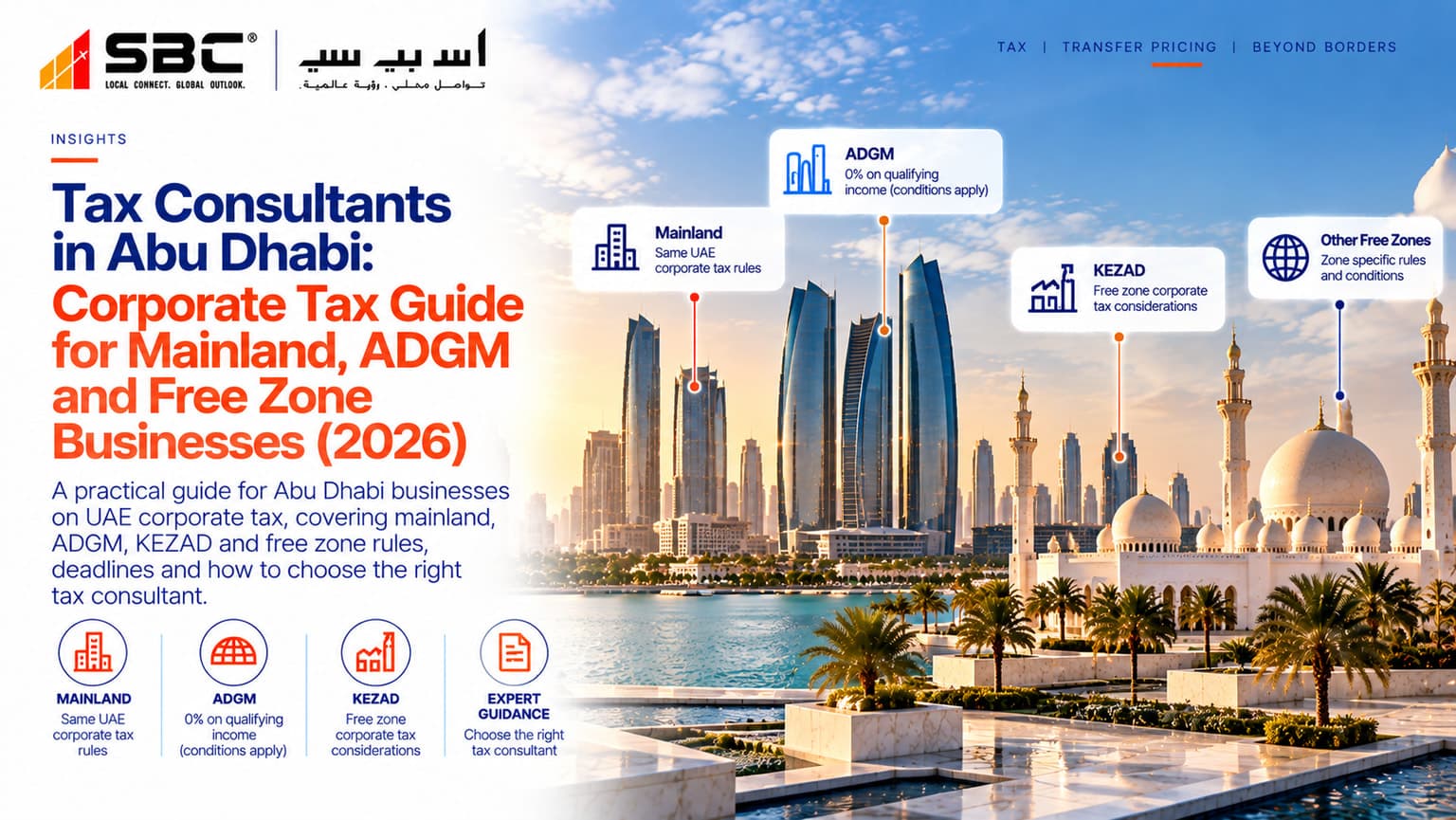
Last reviewed: 30 October 2026. Prepared by the corporate tax team at SBC UAE.
Direct answer: Abu Dhabi businesses pay the same federal UAE corporate tax as the rest of the country: 0% on taxable income up to AED 375,000 and 9% above that. Returns are filed with the Federal Tax Authority (FTA) within nine months of the end of each tax period. What differs in Abu Dhabi is the business landscape. There is ADGM's financial free zone, there are industrial and logistics zones such as KEZAD, and there is a large group of government-linked and energy businesses. A good tax consultant in Abu Dhabi is registered with the FTA as a tax agent and understands the zone and sector you operate in. They give you a written scope and name the people doing your work.
Quick answers
Is corporate tax different in Abu Dhabi? No. The same federal law, rates and deadlines apply in every emirate.
Do ADGM and KEZAD companies pay corporate tax? Yes. They pay 0% only on qualifying income, and only if they meet every Qualifying Free Zone Person condition.
Are government-owned companies exempt? Not automatically. Exemption depends on the entity and the activity.
How do I check an adviser? Look them up on the FTA's list of registered tax agents.
Can a Dubai-based consultant serve Abu Dhabi? Yes. Corporate tax is federal and filed online through EmaraTax.
In short: how SBC serves Abu Dhabi businesses
SBC LLC (sbcllc.ae) is a tax advisory firm headquartered at Al Nasr Plaza, Oud Metha, Dubai, about 90 minutes by road from Abu Dhabi city. It advises Abu Dhabi clients on UAE corporate tax, transfer pricing, international tax, VAT and FTA audits through virtual meetings, secure document exchange and on-site visits where needed. Engagements are partner-led and run by Chartered Accountants. SBC is part of the Kreston Global network.
Is corporate tax different in Abu Dhabi?
No. UAE corporate tax is federal. It applies under Federal Decree-Law No. 47 of 2022 in every emirate, with the same rates, deadlines and penalties, and it is administered by the FTA through EmaraTax. The Abu Dhabi corporate tax rate is therefore the federal rate:
| Taxable income | Rate |
|---|---|
| Up to AED 375,000 | 0% |
| Above AED 375,000 | 9% |
| Qualifying income of a Qualifying Free Zone Person | 0% |
| In-scope multinational groups (domestic minimum top-up tax) | Effective 15% |
What changes in Abu Dhabi is how the rules apply to the structures common there. The sections below cover the main ones.
Corporate tax for Abu Dhabi mainland companies
Mainland businesses are licensed by the Abu Dhabi Department of Economic Development (ADDED). Since 6 June 2024, Abu Dhabi has issued a Unified Economic License with a single reference number across the mainland and free zones. Mainland companies are taxed at the standard rates. They must register within three months of incorporation if incorporated on or after 1 March 2024, and file and pay within nine months of their year end.
Points that often need advice for Abu Dhabi mainland groups:
-
Related party transactions with sister companies in free zones or abroad, which must be at arm's length.
-
Tax groups, where a parent owns at least 95% of its UAE subsidiaries and wants to file one return.
-
Small Business Relief for businesses with revenue up to AED 3 million, available for tax periods ending on or before 31 December 2029 (Khaleej Times).
Corporate tax for ADGM entities
Abu Dhabi Global Market (ADGM) is a financial free zone with its own civil and commercial laws and regulator. Federal corporate tax still applies to ADGM entities. An ADGM entity can benefit from the 0% rate only if it qualifies as a Qualifying Free Zone Person. That means it must have adequate substance in the free zone, earn qualifying income, meet the de minimis test, comply with transfer pricing rules and prepare audited financial statements.
Common issues for ADGM businesses include:
-
Fund managers and holding companies, where the mix of qualifying and non-qualifying income must be tested carefully.
-
Regulated financial services, where some activities, such as banking and many insurance activities, are excluded activities that cannot earn qualifying income.
-
Substance, because a 0% rate requires real people and decision-making in the free zone.
-
Group transactions with mainland entities, which are usually non-qualifying and taxed at 9%.
The FTA's Free Zone Persons guide explains the conditions with examples. For audits, the ADGM Registration Authority has confirmed that ADGM registered auditors may audit the financial statements of ADGM taxable persons for corporate tax purposes.
Corporate tax for KEZAD, Khalifa Port and other Abu Dhabi free zones
Abu Dhabi has several free zones serving industry, logistics, clean technology and media, including KEZAD, the Khalifa Port free trade zone, Abu Dhabi Airports Free Zone, Masdar City Free Zone and twofour54.
| Zone | Typical businesses | Corporate tax points to watch |
|---|---|---|
| ADGM | Financial services, funds, holding companies | Qualifying activities, substance, mainland transactions |
| KEZAD and Khalifa Port free trade zone | Manufacturing, logistics, trading | Designated Zone rules for goods, distribution conditions |
| Abu Dhabi Airports Free Zone | Logistics and trading | Designated Zone rules, qualifying income tests |
| Masdar City Free Zone | Clean technology, research, start-ups | R&D tax credit, losses, qualifying income |
| twofour54 | Media and content | Licensing of intellectual property, customer location |
Some Abu Dhabi areas are Designated Zones for VAT purposes. The FTA's list has included the Free Trade Zone of Khalifa Port, Abu Dhabi Airport Free Zone and Khalifa Industrial Zone (Gulf News). The FTA's Designated Zones VAT guide explains how these zones work and where the current list is published. Confirm your zone's current status before relying on it. This matters for corporate tax too. From tax periods starting on or after 1 January 2026, FTA Decision No. 6 of 2026 requires Qualifying Free Zone Persons that distribute goods in or from a Designated Zone to obtain an agreed-upon procedures report from an independent auditor (Deloitte summary).
For research-led companies in Masdar City and elsewhere, the R&D tax credit applies to tax periods beginning on or after 1 January 2026, subject to pre-approval from the Emirates Research and Development Council (Deloitte summary).
Government-linked and energy businesses in Abu Dhabi
Abu Dhabi has many government-owned and government-linked businesses, and a large energy sector. The corporate tax law has specific rules for both.
-
Government entities are exempt.
-
Government controlled entities can be exempt for their mandated activities if they are listed in a Cabinet Decision. Their other activities, and their subsidiaries, may be taxable.
-
Extractive and non-extractive natural resource businesses can be exempt from federal corporate tax if they meet the conditions in the law, including being subject to emirate-level taxation.
-
Suppliers, contractors and joint ventures working with these entities are normally taxable at the standard rates.
-
Wholly government-owned UAE companies may still have registration duties. Exemption should be confirmed in writing.
These distinctions are where Abu Dhabi groups most often need specialist advice. A wrong assumption about exemption can mean missed registration, missed returns and penalties.
Worked example: an Abu Dhabi group with mixed entities
An Abu Dhabi family group has three UAE companies: a mainland trading company licensed by ADDED, a KEZAD manufacturing company, and an ADGM holding company that owns both. The figures are illustrative.
| Entity | Profit (AED) | Likely treatment | Key question |
|---|---|---|---|
| Mainland trading company | 3,000,000 | 9% above AED 375,000 | Are purchases from the KEZAD company priced at arm's length? |
| KEZAD manufacturer | 2,000,000 | 0% if it is a Qualifying Free Zone Person | Are sales to the mainland company qualifying income? |
| ADGM holding company | 1,500,000 of dividends from its UAE subsidiaries | Dividends from UAE resident companies are exempt | Does it earn other income, such as management fees, that is taxable? |
The mainland company's tax is 9% of AED 2,625,000, which is AED 236,250. Two points matter in practice. First, sales by the KEZAD company to its mainland sister company are generally not qualifying income. If they exceed the de minimis limit, the KEZAD company can lose the 0% regime altogether. Second, the price between the two companies must be at arm's length, or the FTA can adjust it. A tax group is not available here, because a Qualifying Free Zone Person cannot join one. These are exactly the questions an experienced corporate tax consultant should raise in the first meeting.
Preparing for your first meeting with a tax consultant
-
Trade licences for every entity, whether ADDED, ADGM, KEZAD or another zone.
-
Memoranda and articles of association, and a group structure chart.
-
Latest financial statements, audited where available.
-
A list of transactions between group companies and with owners.
-
Your corporate tax registration numbers and EmaraTax access.
-
Any FTA correspondence, including penalties or queries.
-
Details of government ownership or exemption claims, if relevant.
With these in hand, a good adviser can give you a clear view of your exposure in a single meeting, and a realistic plan and fee for fixing any gaps before your next filing deadline.
How to choose tax consultants in Abu Dhabi
Step 1: Verify FTA registration
Ask for the tax agent registration numbers of the firm and the individual who will sign your return. Check them on the FTA's list of registered tax agents, which you can filter to Abu Dhabi and to agents with corporate tax experience. The FTA's tax agent requirements include a relevant degree, at least three years of recent experience, fluency in Arabic and English, an FTA exam and professional indemnity insurance.
Step 2: Check knowledge of your zone and sector
Ask how corporate tax applies to your licence, whether that is ADDED mainland, ADGM, KEZAD or another zone, and to your sector. An adviser who has worked with ADGM funds or KEZAD manufacturers will raise the right issues early.
Step 3: Ask questions with checkable answers
-
"Can our free zone entity be a Qualifying Free Zone Person, and what is the de minimis limit?" Expect the lower of 5% of revenue or AED 5 million.
-
"Are we exempt as a government controlled entity, or only for some activities?" Expect a careful answer that refers to the Cabinet Decision listing.
-
"Do our related party transactions need a transfer pricing disclosure?" Expect questions about transaction values.
-
"If we registered late, how do we have the penalty waived?" Expect filing the first return within seven months of the end of the first tax period.
Step 4: Agree scope and fees in writing
The engagement letter should state the entities and periods covered, whether the firm files as your agent, your deliverables, fees and exclusions, and support for FTA queries.
Corporate tax and VAT: why Abu Dhabi businesses should review them together
Corporate tax and VAT are separate taxes, but the same transactions drive both. This is especially true in Abu Dhabi's Designated Zones and in groups with free zone and mainland companies. Goods moving between a Designated Zone and the mainland have VAT consequences. The same flows decide whether a free zone company's income is qualifying for corporate tax. Inter-company charges must be invoiced correctly for VAT and priced at arm's length for corporate tax. An adviser who looks at both together can spot mismatches before the FTA does. Examples include revenue in the corporate tax return that does not reconcile to VAT returns, or related party charges that appear in one filing and not the other. When you interview tax consultants in Abu Dhabi, ask how they reconcile VAT returns to the corporate tax return. It is a simple question that reveals how thorough their process is.
Red flags
-
No FTA tax agent number, or one not on the FTA list.
-
Promises of a guaranteed 0% rate.
-
Claims of special access to government bodies.
-
Assuming a government-linked business is automatically exempt.
-
No written scope or unclear fees.
-
Self-published "top 10" lists with no criteria.
Do you need a tax consultant near me in Abu Dhabi?
Google's local results for "tax consultant near me" show firms with offices close to you. Google says it ranks these results by relevance, distance and prominence (Google Business Profile Help). Proximity helps for face-to-face meetings, but corporate tax work is largely digital. Registration and returns are filed on EmaraTax, and documents are exchanged securely online. Many Abu Dhabi businesses work with advisers based in Dubai or elsewhere in the UAE. Choose on expertise, responsiveness and fit, then agree how and where you will meet.
Key deadlines and penalties for Abu Dhabi businesses
| Obligation | Rule |
|---|---|
| Registration for a new company | Within 3 months of incorporation |
| Return and payment | 9 months after the end of the tax period |
| Late registration | AED 10,000, waivable if the first return is filed within 7 months |
| Late payment | 14% a year, accrued monthly, from 14 April 2026 (PwC) |
| Records | Keep for 7 years |
For the full picture, read our complete guide to corporate tax in UAE. The UAE government's corporate tax overview and the FTA's corporate tax page are the official references.
How SBC supports Abu Dhabi clients
-
Corporate tax registration and returns for mainland, ADGM and free zone entities. See SBC's corporate tax services.
-
Qualifying Free Zone Person reviews, testing qualifying income, substance and the de minimis limit.
-
Transfer pricing for transactions between Abu Dhabi entities, free zone companies and foreign affiliates, through SBC's transfer pricing services.
-
Pillar Two for large groups. See our guide to the UAE Pillar Two information return.
-
FTA audit and dispute support.
If you are comparing advisers in Dubai as well, our guide to choosing a corporate tax consultant in Dubai sets out a full scorecard. To discuss your Abu Dhabi business, contact SBC on +971 58 606 0939 or at info@sbcllc.ae, or visit SBC UAE.
UAE corporate tax calendar: the next 12 months
| Date | What is due | Who it affects |
|---|---|---|
| Within 3 months of incorporation | Corporate tax registration | Every new UAE and free zone company |
| 31 December 2026 | Return and payment | Financial years ended 31 March 2026 |
| 31 March 2027 | Registration | Resident individuals whose 2026 business turnover exceeded AED 1 million |
| 31 March 2027 | Return and payment | Financial years ended 30 June 2026 |
| 30 June 2027 | Return and payment | Financial years ended 30 September 2026 |
| 31 July 2027 | Last date to file the first return and have the late registration penalty waived | Businesses whose first tax period ended 31 December 2026 |
| 30 September 2027 | Return and payment | Financial years ended 31 December 2026, including individuals in business |
| 30 October 2027 | Agreed-upon procedures report under FTA Decision No. 6 of 2026 | Qualifying Free Zone Persons distributing goods in or from a Designated Zone, with a 31 December 2026 year end |
Official UAE corporate tax resources
Bookmark these official sources. A good adviser will use them too and will not ask you to rely on unofficial summaries.
| Resource | What you will find |
|---|---|
| Ministry of Finance corporate tax page | Policy, legislation and links to related taxes |
| Federal Decree-Law No. 47 of 2022 with amendments (MoF, January 2026 consolidated version) | The full corporate tax law |
| Ministry of Finance corporate tax FAQs | Official answers to common questions |
| FTA corporate tax page | Guides, decisions and public clarifications |
| EmaraTax portal | Registration, returns and payments |
| FTA list of registered tax agents | Check any adviser before you appoint them |
| FTA tax agent requirements | What a registered tax agent must have |
| Ministry of Finance top-up tax page | The 15% domestic minimum top-up tax for large groups |
| UAE double taxation agreements | Treaty network for cross-border businesses |
| ADGM Registration Authority | Company registration and filings in ADGM |
| Abu Dhabi Unified Economic License announcement (ADDED) | How Abu Dhabi licences are now registered |
Frequently asked questions
What is the corporate tax rate in Abu Dhabi?
The same as the rest of the UAE: 0% on taxable income up to AED 375,000 and 9% above that. Qualifying Free Zone Persons pay 0% on qualifying income.
Do ADGM companies pay UAE corporate tax?
Yes. ADGM entities are subject to federal corporate tax. They pay 0% on qualifying income only if they meet all the Qualifying Free Zone Person conditions.
Are Abu Dhabi government-owned companies exempt from corporate tax?
Government entities are exempt. Government controlled entities are exempt only for mandated activities and only if listed in a Cabinet Decision. Their other activities and subsidiaries may be taxable.
Do KEZAD companies pay corporate tax?
Yes, they are taxable persons. They pay 0% on qualifying income if they meet the Qualifying Free Zone Person conditions, and distributors in Designated Zones face additional reporting from 2026.
Who are the best tax consultants in Abu Dhabi?
There is no official ranking. The best fit is FTA-registered, experienced with your zone and sector, transparent on scope and fees, and able to name the team. Compare firms on the same criteria.
Can a Dubai-based tax consultant handle my Abu Dhabi company?
Yes. Corporate tax is federal and filed online through EmaraTax, so a Dubai-based firm can serve Abu Dhabi businesses fully, with meetings in person or online.
When must an Abu Dhabi company register for corporate tax?
A company incorporated on or after 1 March 2024 must register within three months of incorporation. Earlier companies had deadlines in 2024 based on their licence month.
Does SBC work with Abu Dhabi businesses?
SBC is based in Dubai and advises businesses across the UAE, including Abu Dhabi, on corporate tax, transfer pricing, international tax and FTA audits.
This publication is for general information only and does not constitute professional advice. Please consult your SBC advisor before acting on any matter covered here.