
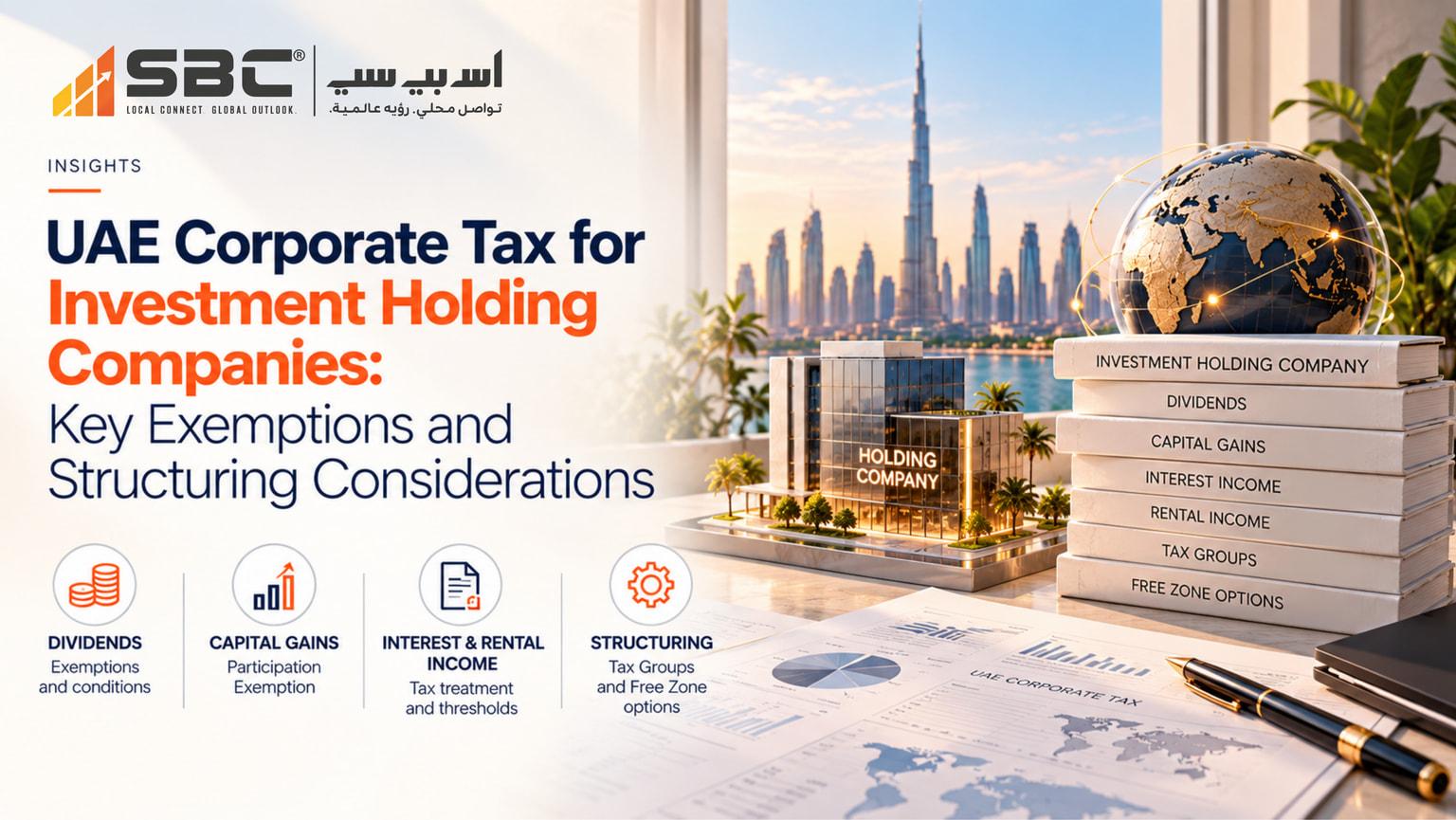
Direct answer: A UAE investment holding company is a Taxable Person. It is not exempt merely because it holds investments. Dividends from UAE resident companies are exempt under Article 22, qualifying dividends and gains from shareholdings are exempt under the Participation Exemption in Article 23 if the conditions are met, and other income such as interest and rent is generally taxable at 0% up to AED 375,000 and 9% above. Each income stream must be analysed separately.
Why "holding company" is not a tax status
When families and groups set up a UAE holding company, the usual instruction is "keep it simple and keep it tax free". The UAE can give a very favourable result for a well-built holding structure, but the result comes from specific provisions applied to specific income, not from the label.
A holding company may receive dividends from UAE subsidiaries, dividends and gains from foreign subsidiaries, interest on shareholder loans, management fees, rent and returns on listed securities. Each of these has a different treatment. I have seen holding companies that assumed everything was exempt and discovered, at return time, that the interest and rental income were not. I have also seen holding companies that paid tax on dividends they were entitled to exclude. This article sets out the treatment of each stream, the main exemptions and the structuring questions to settle before investing.
The legal basis is Federal Decree-Law No. 47 of 2022, with the implementing decisions listed on the Ministry of Finance Corporate Tax hub. The FTA's Taxation of Foreign Source Income guide is the best practical reference for foreign investments.
Is an investment holding company subject to Corporate Tax?
A company incorporated or established in the UAE is a Resident Person and, if not an Exempt Person, a Taxable Person. A holding company does not fall within the Exempt Person categories merely because it holds shares. Exempt Persons are specific categories, such as government entities and qualifying investment funds. A holding company must register, file a return and keep records like any other Taxable Person.
A holding company's tax position depends on:
-
The type of income received.
-
The nature of the underlying investment.
-
Ownership percentage, acquisition cost and holding period.
-
The residence and tax status of the investee.
-
Related-party arrangements with the investee.
-
The holding company's own location, whether mainland or Free Zone.
Income stream by income stream
| Income | Usual treatment | What to check |
|---|---|---|
| Dividends from a UAE resident company | Exempt under Article 22 without conditions | Distribution is a genuine dividend or profit distribution |
| Dividends from a foreign company | Exempt under the Participation Exemption if the conditions are met. Otherwise taxable | Ownership, holding period, tax in the investee's country, profit entitlement, asset test |
| Gain on sale of shares | Exempt if the shares are a qualifying Participating Interest. Otherwise taxable | Conditions at the time of sale, including the holding period |
| Interest on loans to subsidiaries | Taxable. Interest must be at arm's length | Transfer pricing support, interest deduction limits on the borrower side |
| Interest on bank deposits | Taxable | Allocation of related costs |
| Rental income from investment property | Taxable for a company | Whether any Free Zone or other special rule applies |
| Management or service fees from subsidiaries | Taxable. Must be at arm's length | Substance of the services, transfer pricing documentation |
| Fair value gains on investments | Generally taxable, depending on the accounting basis and elections | Whether the realisation basis election has been made |
| Foreign exchange and impairment on a participation | Dealt with under the participation rules. The FTA's stated view is that fair value gains and losses are not covered but impairment is | Accounting basis for the investment |
The exempt income does not give rise to deductions. Costs incurred to earn exempt income, such as the cost of acquiring a Participating Interest, are not deductible. Exempt income still counts toward revenue thresholds, as the FTA's guide shows for the cash-basis limit.
The Participation Exemption in brief
Article 23 exempts income from a Participating Interest. The main conditions, as set out in the Corporate Tax Law and Ministerial Decision No. 116 of 2023 as amended by Ministerial Decision No. 302 of 2024, are:
-
Ownership. At least 5% of the shares or capital of the investee, or an acquisition cost of at least AED 4 million, which since the 2024 amendment replaces the 5% threshold across the ownership, profit and liquidation tests.
-
Holding period. The interest is held, or intended to be held, for an uninterrupted period of at least 12 months.
-
Subject to tax. The investee is subject to Corporate Tax or a tax of a similar character, at a rate of at least 9%, in its jurisdiction. There are rules deeming the condition to be met in certain cases, such as UAE resident investees and certain holding company participations.
-
Entitlement. The interest carries rights to at least 5% of profits and liquidation proceeds (or the AED 4 million alternative).
-
Asset test. No more than 50% of the investee's assets may consist of interests that would not qualify if held directly. From 1 January 2025, the Ministerial Decision limits this test to Related Party investees.
The exemption covers dividends and other profit distributions and gains or losses on disposal. A loss realised on liquidation of a Participation is not covered. The KPMG summary of the 2024 amendment and the Ministry of Finance announcement describe the changes. I deal with each test in UAE Participation Exemption: How Can UAE Companies Structure Overseas Investments. The FTA's private clarifications to May 2026, summarised by Simmons & Simmons, state the FTA's view that fair value gains and losses on a participation are outside the exemption, while impairment gains and losses are within it. That affects holding companies that account for investments at fair value.
An illustration
A UAE mainland holding company has the following income in a Tax Period (hypothetical figures).
| Item | AED |
|---|---|
| Dividend from a 100% UAE subsidiary | 20,000,000 |
| Dividend from a 30% foreign associate that meets the Participation Exemption conditions | 15,000,000 |
| Interest on an arm's length loan to a subsidiary | 3,000,000 |
| Rental income | 2,000,000 |
| Direct costs of earning the interest and rent | 1,200,000 |
-
The two dividends are exempt (AED 35 million), along with the expenses of earning them.
-
Taxable Income is interest AED 3 million plus rent AED 2 million minus costs AED 1.2 million, which is AED 3.8 million.
-
Corporate Tax is (3,800,000 − 375,000) × 9% = AED 308,250.
The same company, had it failed the foreign associate's subject-to-tax condition, would have had a further AED 15 million of taxable dividend, with a possible Foreign Tax Credit for any foreign withholding tax. See UAE Foreign Tax Credit.
Related-party transactions and transfer pricing
Holding companies often charge management fees, lend to subsidiaries, give guarantees and share costs. All such transactions with Related Parties and Connected Persons must be at arm's length (Article 34), and significant ones need documentation. Three specific points:
-
Management fees need substance. A fee for services that the holding company does not actually perform, or that the subsidiary does not need, is vulnerable.
-
Interest rates should be supported. Use a benchmark that reflects the borrower's credit standing, currency and tenor.
-
Participation Exemption does not remove transfer pricing duties. The exemption covers the investment income. Other related-party flows remain subject to the rules.
Tax Groups
A UAE parent can form a Tax Group with eligible UAE subsidiaries, so that the group is treated as one Taxable Person. The conditions in Article 40 and Ministerial Decision No. 301 of 2024 include:
-
The parent and subsidiaries are UAE resident juridical persons.
-
The parent holds at least 95% of the share capital and voting rights of each subsidiary and is entitled to at least 95% of its profits and net assets, directly or indirectly.
-
The same financial year and accounting standards.
-
Neither the parent nor any subsidiary is an Exempt Person or a Qualifying Free Zone Person.
The conditions must be met continuously. Foreign entities cannot join, and members are jointly liable for the group's tax. A Tax Group consolidates the members' results and eliminates intra-group transactions, which can simplify compliance, but it removes the separate treatment of each member. The Ministry's Corporate Tax FAQ explains the basics.
Free Zone holding companies
A holding company in a Free Zone is a Free Zone Person and may be a Qualifying Free Zone Person. The holding of shares and other securities for investment purposes is a Qualifying Activity under Ministerial Decision No. 229 of 2025, so income from it can be Qualifying Income at 0% if the other QFZP conditions are met. Those include adequate substance in the Free Zone, arm's length transactions, audited financial statements and non-qualifying revenue within the de minimis limit. The FTA's private clarifications say that selling shares within 12 months does not automatically disqualify a QFZP holding shares for investment, if it can show it intended to hold them for at least 12 months.
The Free Zone route is not automatically better. Interest, management fees and rental income may not be Qualifying Income. A QFZP cannot join a Tax Group. And the substance expectations are real. Compare the result with a mainland holding company using the Participation Exemption before choosing. For the QFZP conditions, see UAE Free Zone Corporate Tax: QFZP Eligibility, and the FTA's Free Zone Persons guide.
Foreign investments
A UAE holding company with foreign investments should look at both sets of tax rules.
-
Foreign tax. Corporate tax in the investee's country, and withholding tax on dividends, interest and royalties paid to the UAE.
-
Treaty relief. A treaty may reduce foreign withholding tax. See UAE Double Tax Treaties and the Ministry of Finance's double taxation agreements page.
-
Foreign tax credit. Available only on income that stays taxable in the UAE. There is no credit on exempt dividends.
-
Foreign PE risk. Staff and activities abroad can create a PE.
The wider international analysis is in UAE Holding Company: Corporate Tax and International Tax Considerations.
Distributions to shareholders
A holding company eventually passes profits up to its owners, so the other end of the chain matters too.
-
No UAE withholding tax on dividends. A UAE company pays dividends to its shareholders in full, whether they are residents or non-residents. The withholding tax framework in Article 45 is set at 0%.
-
Individual shareholders. A natural person who receives dividends as a personal investment, without carrying on a business in the UAE, is outside Corporate Tax on that income. Wages, personal investment income and qualifying real estate investment income are excluded from the AED 1 million turnover test, as the FTA's foreign source income guide explains.
-
Corporate shareholders. A UAE corporate shareholder receives the dividend exempt under Article 22 if it is a Resident Person. A foreign corporate shareholder is taxed under its own country's rules, and its treaty position depends on the specific agreement.
-
Documentation. Record the declaration, the profits it is paid from and the legal basis for the distribution. A payment that is not a genuine profit distribution, or that is not on arm's length terms with a related party, can be recharacterised.
Exit planning
Exits are where holding structures are tested. Before disposing of a subsidiary or an investment, I would work through four points.
-
Re-test the Participation Exemption conditions at the date of sale, including the holding period, the ownership level and the investee's tax status. A shareholding that has fallen below the threshold or has been held for less than 12 months may not qualify. Treat an actual 12-month holding as the safe position.
-
Check the foreign tax cost. The investee's country may tax the gain, subject to treaty protection.
-
Look at the structure. A sale of the shares of an intermediate holding company may produce a different result from a sale of the underlying business.
-
Prepare the evidence. Acquisition documents, cost records, board approvals and valuation support will all be requested in a review.
Liquidation is a separate case. Gains on liquidation proceeds may be dealt with under the participation rules, but a loss realised on the liquidation of a Participation is not covered by the exemption, so plan the route of an exit with that in mind.
Structuring considerations before you invest
-
What income will arise? Dividends, gains, interest, fees or rent, and in what proportions.
-
Which investments will qualify as Participating Interests? Check ownership, acquisition cost and holding period at the outset.
-
What is the investee's tax status? The subject-to-tax condition needs evidence.
-
How will the investment be funded? Equity, loan or both, and at what arm's length rate.
-
Where should the holding company sit? Mainland or Free Zone, and with what substance.
-
Will you need a Tax Group? Consider eligibility and joint liability.
-
What is the exit route? Test the exemption conditions before a sale, and consider foreign tax on disposal.
-
How will the company be governed? Keep board minutes, investment approvals and accounting records.
-
Does the group fall in Pillar Two scope? Large groups should check the UAE Domestic Minimum Top-up Tax. See UAE Pillar Two and Free Zones.
Compliance basics
A holding company must register for Corporate Tax through the FTA's registration service and file a return within nine months of the end of its Tax Period. It must prepare IFRS or IFRS for SMEs accounts, and a taxpayer whose revenue exceeds AED 50 million needs audited financial statements, with exempt income counted in revenue. Keep ownership records, acquisition dates, dividend statements, foreign tax documents and transfer pricing support. The FTA's Determination of Taxable Income guide explains the computation.
Common mistakes
-
Treating the "holding company" label as a tax exemption.
-
Assuming interest and rental income are exempt.
-
Claiming the Participation Exemption without evidence for the subject-to-tax condition.
-
Selling a participation before the holding period is satisfied.
-
Deducting costs of earning exempt income.
-
Neglecting transfer pricing for loans and management fees.
-
Choosing a Free Zone holding company without testing QFZP conditions and substance.
-
Overlooking foreign withholding tax and treaty relief.
If you would like a review of a holding structure, speak to SBC's Corporate Tax practice or International Tax practice. The FTA's Corporate Tax guides and references should be checked for updates.
Frequently asked questions
Is an investment holding company subject to UAE Corporate Tax?
Yes. A UAE-incorporated holding company is a Taxable Person unless it falls within a specific Exempt Person category, which a holding company does not by virtue of its activity. It must register, file and keep records.
Are dividends received by a UAE holding company taxable?
Dividends from UAE resident companies are exempt under Article 22. Dividends from foreign companies are exempt if the Participation Exemption conditions are met, and otherwise taxable.
What is the UAE Participation Exemption?
An exemption under Article 23 for income from a Participating Interest, covering dividends and gains or losses on disposal, if conditions on ownership, holding period, subject-to-tax status, entitlement and the asset test are met.
Do capital gains on shares qualify for the Participation Exemption?
Yes, if the shares are a qualifying Participating Interest and the conditions are met. Test the conditions, including the holding period, before the sale.
Is interest income exempt for a holding company?
No. Interest on loans to subsidiaries or on deposits is generally taxable and must be at arm's length for related-party loans.
Can a Free Zone holding company get 0%?
Possibly. Holding shares for investment is a Qualifying Activity, but the entity must meet every QFZP condition, and income such as interest, fees and rent may not be Qualifying Income.
Can a holding company form a Tax Group?
Yes, with eligible UAE subsidiaries, if the parent holds at least 95% of their capital, voting rights, profits and net assets, and the entities share a financial year and accounting standards. A QFZP cannot be a member.
Are costs of acquiring a participation deductible?
No. Costs incurred to earn exempt income, including the cost of acquiring a Participating Interest, are not deductible.
Does the Participation Exemption remove transfer pricing obligations?
No. It applies to qualifying participation income only. Other related-party transactions, such as loans and management fees, remain subject to the arm's length rules.
Is foreign withholding tax on exempt dividends creditable?
No. A Foreign Tax Credit is limited to the UAE tax on the relevant income, and exempt dividends produce no UAE tax. The foreign tax is a cost unless reclaimed under a treaty.
This publication is for general information only and does not constitute professional advice. Please consult your SBC advisor before acting on any matter covered here.