
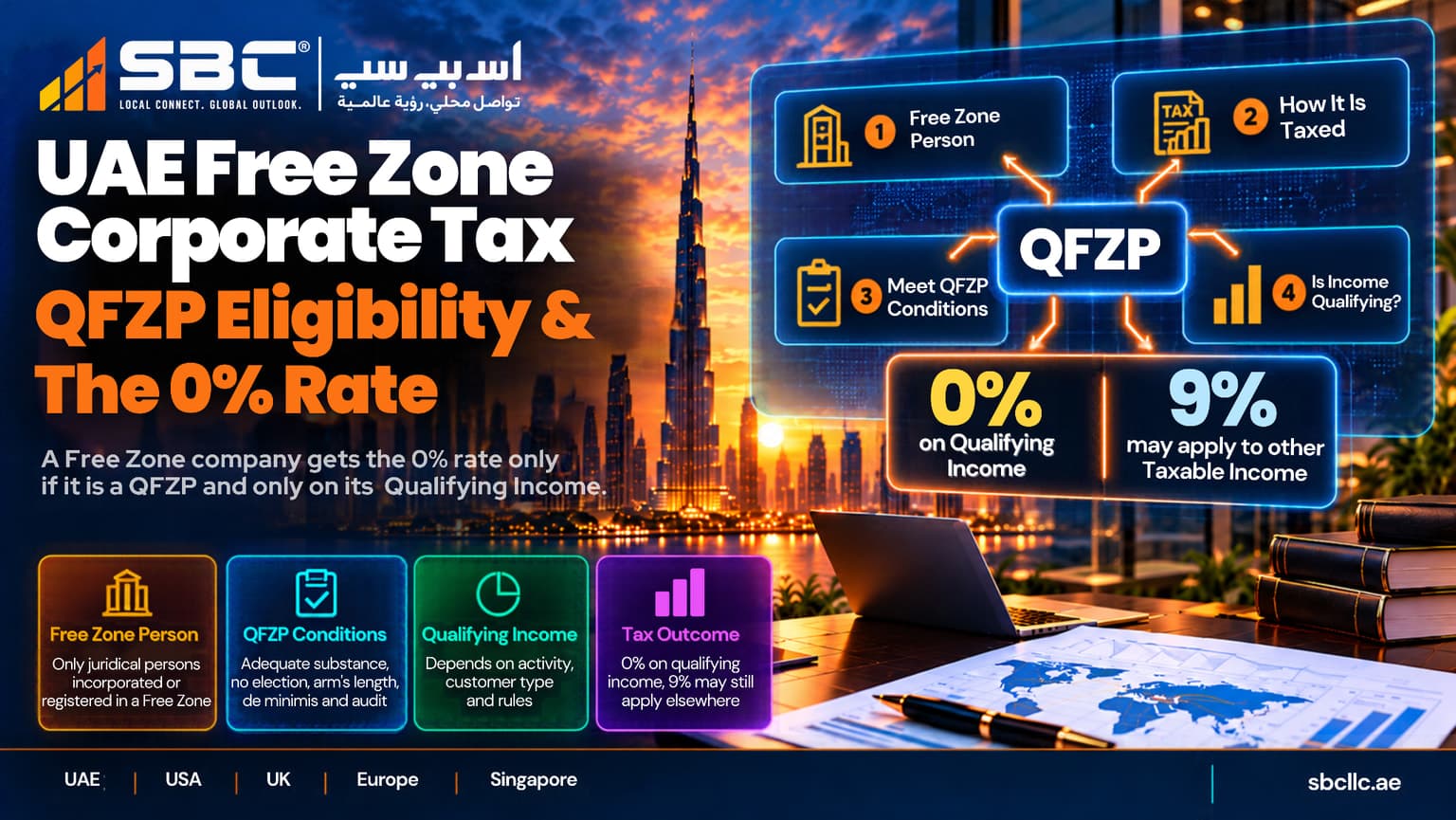
Direct answer: A UAE Free Zone company qualifies for the 0% Corporate Tax rate only if it is a Qualifying Free Zone Person (QFZP) and only on its Qualifying Income. To qualify it must maintain adequate substance in the Free Zone, earn Qualifying Income, keep non-qualifying revenue within the de minimis limit (the lower of 5% of revenue or AED 5 million), price related-party transactions at arm's length, prepare audited financial statements and not elect to be taxed normally. All other Taxable Income is taxed at 9%.
Why eligibility is where most Free Zone companies go wrong
Before Corporate Tax, a Free Zone licence was largely a question of setup, visas and customs. Since Tax Periods began on or after 1 June 2023, the licence also raises a tax question that most founders were never asked when they incorporated: does the business earn the kind of income, from the kind of customers, with the kind of presence in the Free Zone, that the law rewards with 0%?
The honest answer for a good number of Free Zone companies is "partly" or "not yet". A consultancy that bills overseas clients, a trading company that sells to mainland customers and a restaurant that serves walk-in customers all fall on the wrong side of the line for at least part of their revenue. A manufacturer exporting from a Free Zone, a holding company that holds shares for investment and a company selling goods to other Free Zone companies may be on the right side of it.
This article explains the eligibility rules in the order I work through them with clients. It sits alongside Qualifying Free Zone Person: UAE QFZP Conditions, Compliance and the 0% Corporate Tax Rate, which covers the compliance routine. The legal basis is Article 18 of Federal Decree-Law No. 47 of 2022, Cabinet Decision No. 100 of 2023 and Ministerial Decision No. 229 of 2025. The FTA's Free Zone Persons guide explains how they apply.
Step 1: Are you a Free Zone Person?
A Free Zone Person is a juridical person incorporated, established or otherwise registered in a Free Zone, including a branch of a foreign or mainland company registered in a Free Zone. A Free Zone is a defined geographic area within the UAE specified by Cabinet Decision for Corporate Tax purposes.
-
Only juridical persons qualify. A natural person or an unincorporated partnership cannot be a Free Zone Person.
-
Incorporation or registration is what counts. A company incorporated elsewhere does not become a Free Zone Person because its management sits in a Free Zone.
-
Not every zone is the same. A Designated Zone is a Free Zone that is also designated under the VAT law. It matters for the distribution activity, which must take place in or from a Designated Zone.
-
Check the zone's status. The Free Zone authority can confirm whether your area is treated as a Free Zone or Designated Zone for Corporate Tax.
Being a Free Zone Person puts you within UAE Corporate Tax. It does not, on its own, produce any particular rate. A Free Zone company is also a UAE Resident Person, as explained in UAE Tax Residency for Companies.
Step 2: How a Free Zone Person is taxed
| Position | Rate | Comment |
|---|---|---|
| QFZP: Qualifying Income | 0% | Only if all conditions are met in the Tax Period |
| QFZP: Taxable Income that is not Qualifying Income | 9% | No 0% band up to AED 375,000 |
| Free Zone Person that is not a QFZP | 0% on Taxable Income up to AED 375,000 and 9% above | Standard regime |
| Free Zone Person that elected the standard regime | Standard rates | The election applies for the Tax Period and the following four |
The 0% rate is therefore a feature of the income and the taxpayer together. A QFZP can have 0% income and 9% income in the same year.
Step 3: Meet the QFZP conditions
A Free Zone Person is treated as a QFZP unless a condition is not met or it elects out. The conditions I test are:
-
Adequate substance in the Free Zone or Designated Zone.
-
Qualifying Income.
-
No election for the standard regime.
-
Arm's length compliance for related-party and connected-person transactions.
-
Non-qualifying revenue within the de minimis limit.
-
Audited financial statements, in line with Ministerial Decision No. 84 of 2025.
-
Any other condition the Minister prescribes.
Each is tested every Tax Period. The FTA's guide also confirms that a start-up that has not yet earned revenue is not disqualified for failing to earn Qualifying Income, provided it earns no non-qualifying revenue and meets the other conditions.
Step 4: Is your income Qualifying Income?
Qualifying Income depends on who the customer is and what you do. There are four categories.
-
Transactions with Free Zone Persons, except Excluded Activities, where the Free Zone Person is the Beneficial Recipient.
-
Transactions with Non-Free Zone Persons, only for Qualifying Activities that are not Excluded Activities.
-
Qualifying Intellectual Property income (patents and copyrighted software, not trademarks), calculated under a Ministerial Decision.
-
Any other income, if the de minimis requirements are met.
A Non-Free Zone Person includes mainland customers and customers abroad. This is why a Free Zone consultancy invoicing overseas clients is not automatically earning Qualifying Income: if consultancy is not a listed Qualifying Activity, income from Non-Free Zone customers is non-qualifying revenue.
The Beneficial Recipient test
Sales to another Free Zone company qualify only if that company is the Beneficial Recipient, which means it has the right to use and enjoy the goods or services and has no contractual or legal obligation to supply them to another person. If a Free Zone intermediary buys from you only to resell to a mainland or foreign customer on a back-to-back basis, the revenue is likely to be non-qualifying. Check contracts and flows, not just the counterparty's licence.
Qualifying Activities
The list in Ministerial Decision No. 229 of 2025, which replaced Ministerial Decision No. 265 of 2023 from 1 June 2023, includes:
-
Manufacturing of goods or materials, and processing of goods or materials.
-
Trading of qualifying commodities.
-
Holding of shares and other securities for investment purposes.
-
Ownership, management and operation of ships.
-
Reinsurance services.
-
Fund management services and wealth and investment management services.
-
Headquarter services to Related Parties.
-
Treasury and financing services to Related Parties or for the person's own account.
-
Financing and leasing of aircraft.
-
Distribution of goods or materials in or from a Designated Zone.
-
Logistics services.
-
Ancillary activities that support these activities.
Each activity has its own conditions. The PwC, KPMG and Deloitte summaries of the 2025 Decision are helpful, but the Decision itself is the authority.
Excluded Activities
Revenue from Excluded Activities is non-qualifying revenue whoever the customer is. They include:
-
Transactions with natural persons, subject to limited exceptions in the Decision.
-
Banking activities.
-
Insurance activities, other than specified reinsurance and captive arrangements.
-
Finance and leasing, other than the qualifying treasury, financing and aircraft activities.
-
Ownership or exploitation of immovable property, other than specified Free Zone commercial property transactions with other Free Zone Persons.
Distribution needs extra care
Distribution qualifies only when conducted in or from a Designated Zone. A sales office in a Free Zone that is not a Designated Zone, combined with a warehouse in a Designated Zone, risks failing the test. From Tax Periods starting on or after 1 January 2026, FTA Decision No. 6 of 2026 also requires an Agreed-Upon Procedures report from an independent auditor for QFZPs claiming this activity. See the Deloitte alert.
Step 5: Stay within the de minimis limit
The de minimis requirement is met if non-qualifying revenue in the Tax Period does not exceed the lower of 5% of total revenue and AED 5 million. If it does, the Free Zone Person is not a QFZP for that Tax Period and the following four. Revenue attributable to a Domestic or Foreign PE and certain Free Zone property and non-qualifying IP revenue is left out of the calculation. A Free Zone trading company with AED 7.3 million of revenue and AED 500,000 of non-qualifying revenue exceeds its AED 365,000 limit (5% of AED 7.3 million) and fails.
Monitor the ratio during the year. The de minimis rule is a safety margin for incidental revenue. It is not a business model.
Step 6: Prove substance
You must carry out your core income-generating activities in the Free Zone (or Designated Zone) and have adequate assets, qualified full-time employees and operating expenditure there, in proportion to each activity.
-
Outsourcing of core activities is allowed only to a person in a Free Zone (or Designated Zone), with adequate supervision. A narrow exception allows R&D for Qualifying Intellectual Property to be outsourced more widely.
-
There is no fixed headcount. The test depends on the nature and scale of the activity.
-
A registered address is not substance. Flexi-desks with no staff doing the work will struggle.
The FTA's private clarifications to May 2026 say that substance is assessed per Qualifying Activity, taking account of the QFZP's presence across all the Free Zones it uses. See the Alvarez & Marsal summary.
Step 7: Mainland activity and PEs
A QFZP can operate outside its Free Zone, but a presence on the mainland can be a Domestic PE. Income attributable to a Domestic or Foreign PE is not Qualifying Income and is taxed at 9%. A mainland branch, a mainland showroom or sales teams based on the mainland are the usual triggers. See Permanent Establishment in the UAE.
Six practical examples
| Business | Typical analysis |
|---|---|
| Free Zone manufacturer exporting products to overseas distributors | Manufacturing is a Qualifying Activity. Sales to Non-Free Zone Persons are Qualifying Income if conditions are met |
| Free Zone consultancy invoicing overseas and mainland clients | Consultancy is not a listed Qualifying Activity, so income from Non-Free Zone customers is non-qualifying. De minimis is likely to be breached |
| Free Zone café selling to walk-in customers | Sales to natural persons are generally an Excluded Activity. Non-qualifying revenue |
| Free Zone holding company holding shares for investment | Holding shares for investment is a Qualifying Activity, subject to conditions and substance |
| Free Zone company selling goods to another Free Zone company that resells them onshore | The buyer may not be the Beneficial Recipient. Revenue may be non-qualifying |
| Free Zone company with a mainland branch | Branch income is attributable to a Domestic PE and taxed at 9% |
Electing to be taxed under the standard regime
A Free Zone Person can choose not to be a QFZP. The election is made in the Corporate Tax return, and per the FTA's guide it applies for the Tax Period concerned and the following four Tax Periods. It can make sense where a business knows that most of its revenue comes from mainland customers for non-qualifying activities, or where it wants standard-regime features, such as the 0% band on the first AED 375,000, without the risk of an unplanned loss of status. It should not be made casually. Model the position over five years, compare the tax cost with the compliance cost of maintaining QFZP status, and record the reasoning. A Free Zone Person that wants to join a Tax Group must not be a QFZP, because Article 40 of the Corporate Tax Law excludes QFZPs from Tax Groups, so group structuring can itself drive the decision.
Tax is not the only Free Zone benefit
Free Zone status also affects customs, VAT (through Designated Zone treatment), licensing, ownership and employment. These benefits come from separate laws and are not lost merely because a company is not a QFZP. When you decide whether the QFZP regime is worth the compliance effort, weigh the tax saving against the cost of substance, audited accounts, transfer pricing support and monitoring, as well as against the non-tax reasons for being in the zone.
Registration and filing
A QFZP is a Taxable Person and must register for Corporate Tax and file a return, even though much of its income may be taxed at 0%. The return asks for details on Qualifying Income, revenue, substance and compliance with QFZP conditions. The FTA's registration service explains how to register, and returns are generally due nine months after the end of the Tax Period.
Common mistakes
-
Assuming that the 0% rate comes with the licence.
-
Treating all Free Zone to Free Zone sales as qualifying without checking the Beneficial Recipient.
-
Relying on the licence activity list instead of the Qualifying Activities list.
-
Outsourcing core activities to mainland vendors.
-
Assuming that audited accounts are needed only above AED 50 million of revenue.
-
Checking the de minimis ratio only at year end.
-
Overlooking the Designated Zone requirement for distribution.
-
Forgetting PE income.
A short eligibility checklist
-
Confirm the entity is a juridical Free Zone Person in a recognised Free Zone.
-
Map each revenue stream by customer type and activity.
-
Check Qualifying and Excluded Activities against Ministerial Decision No. 229 of 2025.
-
Test the Beneficial Recipient for Free Zone customers.
-
Calculate the de minimis position.
-
Document substance: people, assets and expenditure in the zone.
-
Prepare transfer pricing support and audited financial statements.
-
Review PE risk and, for large groups, Pillar Two.
To check your own position, speak to SBC's Corporate Tax team. The FTA's Corporate Tax guides and references and FAQs are the best places to check for new guidance. Risks around losing status are covered in How Can a UAE Free Zone Business Lose QFZP Status and how to avoid them in How to Protect QFZP Status.
Frequently asked questions
Does every Free Zone company get 0% Corporate Tax?
No. Only a Qualifying Free Zone Person gets 0%, and only on Qualifying Income. A Free Zone Person that does not qualify is taxed under the standard regime, and a QFZP's non-qualifying Taxable Income is taxed at 9%.
What is a Qualifying Free Zone Person?
A Free Zone Person that meets the Article 18 conditions in the Tax Period: adequate substance, Qualifying Income, no election for the standard regime, arm's length transactions, audited financial statements and non-qualifying revenue within the de minimis limit.
Does selling only to other Free Zone companies guarantee Qualifying Income?
No. The counterparty must be the Beneficial Recipient of the goods or services, and the income must not come from an Excluded Activity. A Free Zone intermediary that passes goods or services on to someone else is not a Beneficial Recipient.
Can a Free Zone company sell to mainland or overseas customers?
Yes, but income from Non-Free Zone customers is Qualifying Income only if it comes from a Qualifying Activity that is not an Excluded Activity. Other such revenue counts toward the de minimis limit.
Can a Free Zone entity outsource its core activities anywhere in the UAE?
No. Core activities can be outsourced only to a person in a Free Zone (or Designated Zone where required), with adequate supervision. A narrow exception allows research and development for Qualifying Intellectual Property to be outsourced more widely.
Do Free Zone companies need audited financial statements?
Yes. QFZPs must prepare and maintain audited financial statements, regardless of revenue, under Ministerial Decision No. 84 of 2025 as referenced in Ministerial Decision No. 229 of 2025.
What happens if I lose QFZP status?
You are not a QFZP from the beginning of that Tax Period and for the following four Tax Periods. During that time you are taxed under the standard regime and 0% on Qualifying Income is not available.
What is the de minimis threshold?
Non-qualifying revenue must not exceed the lower of 5% of total revenue and AED 5 million in the Tax Period.
Does a Free Zone café or retail shop qualify for 0%?
Generally no for sales to natural persons, because transactions with natural persons are an Excluded Activity, subject to limited exceptions. The revenue is non-qualifying and counts toward the de minimis limit.
Does Free Zone status remove permanent establishment risk?
No. A mainland branch or other presence can be a Domestic PE. Income attributable to a PE is not Qualifying Income and is taxed at 9%.
This publication is for general information only and does not constitute professional advice. Please consult your SBC advisor before acting on any matter covered here.