
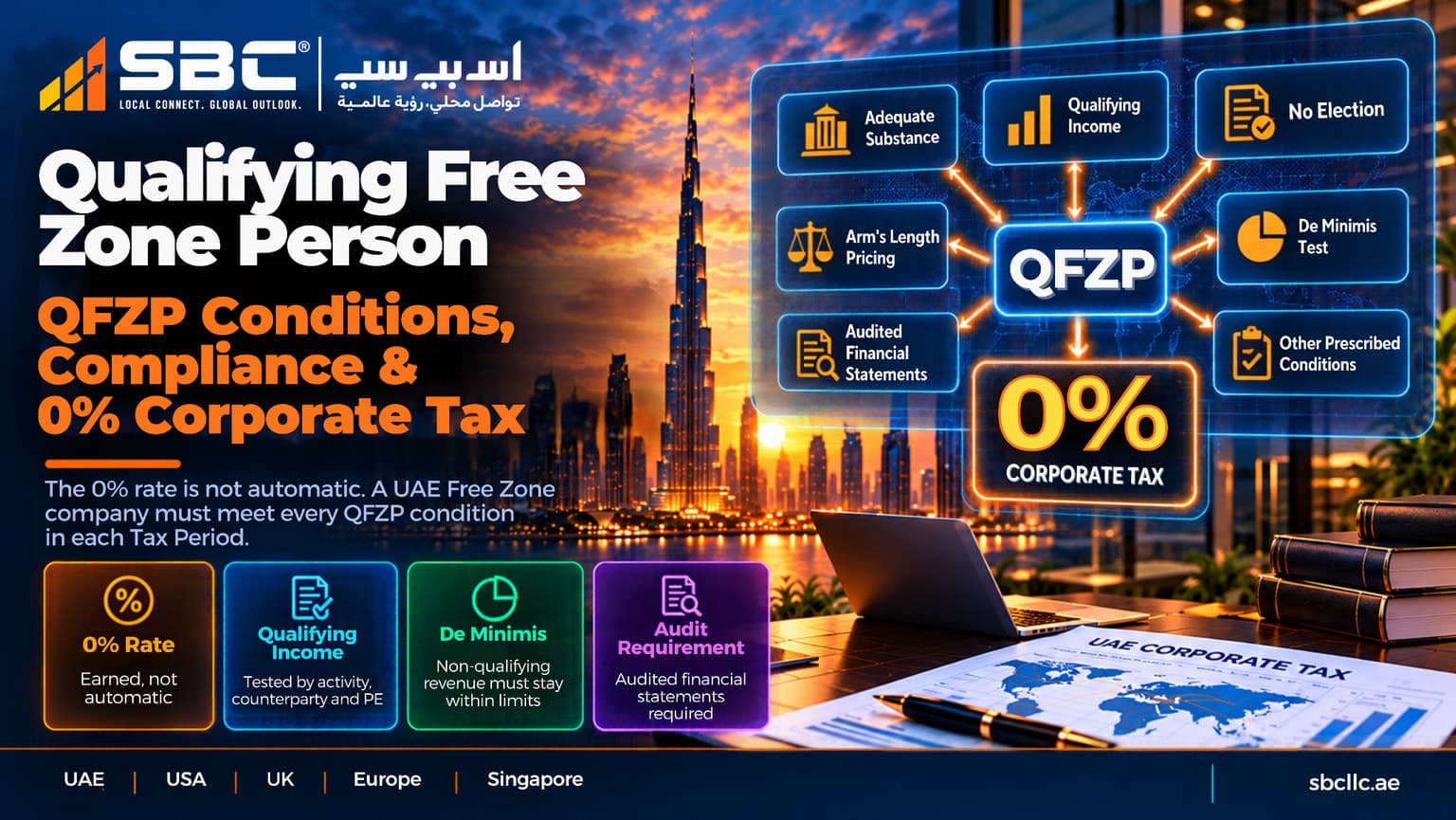
Direct answer: A UAE Free Zone company does not automatically pay 0% Corporate Tax. It must be a Qualifying Free Zone Person (QFZP), which means it must meet every condition in Article 18 of the Corporate Tax Law in each Tax Period (adequate substance, Qualifying Income, no election for the standard regime, arm's length pricing, audited financial statements and the de minimis limit on non-qualifying revenue). The 0% rate then applies only to Qualifying Income. If a condition fails, QFZP status is lost for that Tax Period and the following four.
The 0% rate is earned, not granted
Many of the Free Zone companies I am asked to review share one assumption: that the trade licence carries the tax rate with it. It does not. A licence makes a company a Free Zone Person. Whether it is also a Qualifying Free Zone Person, and what share of its income is taxed at 0%, depends on facts that change every year: who the customers are, what the staff actually do, how related-party transactions are priced and how much revenue falls outside the qualifying categories.
The framework comes from Federal Decree-Law No. 47 of 2022, Cabinet Decision No. 100 of 2023, Ministerial Decision No. 229 of 2025 on Qualifying and Excluded Activities, and the FTA's Free Zone Persons guide (CTGFZP1). This article is the overview. It explains each condition, the 2025 and 2026 developments that matter, and the compliance routine I recommend. The companion articles go deeper on eligibility, protecting QFZP status and how status is lost.
Three layers that must not be confused
| Layer | What it means | Consequence |
|---|---|---|
| Free Zone Person | A juridical person incorporated, established or registered in a Free Zone, including a Free Zone branch of a foreign or mainland company | Within UAE Corporate Tax. No particular rate is guaranteed |
| Qualifying Free Zone Person | A Free Zone Person that meets all Article 18 conditions in the Tax Period and has not elected to be taxed normally | Eligible for 0% on Qualifying Income |
| Qualifying Income | Income in the categories set by Cabinet Decision No. 100 of 2023 | Taxed at 0% for a QFZP. All other Taxable Income is taxed at 9% |
Three consequences follow. Only juridical persons can be Free Zone Persons, so a natural person or an unincorporated partnership cannot be one. A company incorporated outside a Free Zone does not become a Free Zone Person merely because it is managed from one. And a QFZP's Taxable Income that is not Qualifying Income is taxed at 9% from the first dirham. The AED 375,000 band at 0% does not apply to it.
The conditions a QFZP must meet
The FTA treats a Free Zone Person as a QFZP unless a condition is not met or the person elects to be taxed under the standard regime. In practice, I test seven items.
-
Adequate substance. The entity must carry out its core income-generating activities in a Free Zone (or a Designated Zone where required), with adequate assets, qualified full-time employees and operating expenditure for each activity.
-
Qualifying Income. The entity must derive Qualifying Income. A start-up that has not yet earned revenue is not disqualified for that reason alone, provided it earns no non-qualifying revenue and meets the other conditions.
-
No election. The entity must not have elected to be subject to Corporate Tax at the standard rates. An election applies for the Tax Period and the following four.
-
Arm's length pricing. Transactions with Related Parties and Connected Persons must comply with Article 34 of the Corporate Tax Law and the related documentation rules.
-
De minimis. Non-qualifying revenue must stay within the limit explained below.
-
Audited financial statements. A QFZP must prepare and maintain audited financial statements. Ministerial Decision No. 229 of 2025 refers to Ministerial Decision No. 84 of 2025 for this purpose. The AED 50 million revenue threshold that governs audits for other taxpayers does not apply.
-
Any other prescribed condition. The Minister may prescribe further conditions, and FTA procedures can add compliance steps for particular activities, as the 2026 distribution rules show.
Qualifying Income: four categories
Article 3 of Cabinet Decision No. 100 of 2023 treats the following as Qualifying Income, provided the income is not attributable to a Domestic or Foreign Permanent Establishment and is not income from immovable property that falls outside the exceptions:
-
Income from transactions with another Free Zone Person, except income from Excluded Activities. The other Free Zone Person must be the Beneficial Recipient of the goods or services.
-
Income from transactions with a Non-Free Zone Person, but only for Qualifying Activities that are not Excluded Activities.
-
Income from the ownership or exploitation of Qualifying Intellectual Property, calculated under a Ministerial Decision (patents and copyrighted software qualify, trademarks do not).
-
Any other income, provided the de minimis requirements are satisfied.
The Beneficial Recipient test matters in chains of entities. A Free Zone counterparty is a Beneficial Recipient only if it has the right to use and enjoy the goods or services and has no contractual or legal obligation to supply them on to someone else. A Free Zone intermediary that simply passes goods through to a mainland or foreign customer does not meet the test.
Always map revenue at transaction level. The sequence I use is: revenue, activity, counterparty, location, PE analysis, then Qualifying Income. A customer's location in a Free Zone does not, by itself, make a transaction qualifying.
Qualifying and Excluded Activities after Ministerial Decision No. 229 of 2025
Ministerial Decision No. 229 of 2025 was issued in August 2025, repealed Ministerial Decision No. 265 of 2023 and applies from 1 June 2023. It matters for returns already filed, and the PwC alert on the new decisions and the KPMG summary describe the changes. In short:
-
Trading of qualifying commodities was widened, with related rules on price reporting agencies in Ministerial Decision No. 230 of 2025.
-
Treasury and financing services now cover services to Related Parties or for the QFZP's own account.
-
The audited financial statements requirement is tied to Ministerial Decision No. 84 of 2025.
The Qualifying Activities include manufacturing and processing, trading of qualifying commodities, holding shares and other securities for investment purposes, ship ownership and operation, reinsurance, fund and wealth management, headquarter services, treasury and financing, aircraft financing and leasing, distribution of goods or materials in or from a Designated Zone, logistics services and ancillary activities. Excluded Activities include transactions with natural persons (subject to limited exceptions), banking, insurance (other than specified reinsurance and captive activities), most financing and leasing, and ownership or exploitation of immovable property other than specified Free Zone commercial property transactions. Read the Decision itself for the conditions attached to each.
Because the Decision applies retroactively, check any position you took on commodity trading, treasury or distribution in earlier returns and consider whether a correction is needed.
The de minimis requirement
A QFZP may earn some non-qualifying revenue without losing its status. Under Cabinet Decision No. 100 of 2023, the de minimis requirement is met where non-qualifying revenue in the Tax Period does not exceed the percentage of total revenue, or the amount, specified by the Minister, whichever is lower. The current figures are 5% of total revenue or AED 5 million, whichever is lower.
Non-qualifying revenue is revenue from Excluded Activities, from non-Qualifying Activities with Non-Free Zone Persons, and from transactions with a Free Zone Person that is not the Beneficial Recipient. Certain revenue is left out of both the numerator and the denominator, including revenue attributable to a Domestic or Foreign PE, revenue from specified Free Zone immovable property transactions, and revenue from intellectual property other than Qualifying IP income.
| Example | Total revenue | Non-qualifying revenue | Limit (lower of 5% and AED 5m) | Result |
|---|---|---|---|---|
| A | AED 7.3 million | AED 500,000 | AED 365,000 | Fails (6.85%) |
| B | AED 40 million | AED 1.5 million | AED 2 million | Passes |
| C | AED 200 million | AED 8 million | AED 5 million | Fails, because the AED 5 million cap is lower than 5% |
Example C is the one that surprises large companies. Above AED 100 million of revenue, the AED 5 million cap, not the 5% ratio, is the binding limit.
There is one technical point that needs care. On its face, Article 3(1)(d) of Cabinet Decision No. 100 treats "any other income" as Qualifying Income where the de minimis requirements are met, which suggests that non-qualifying revenue within the limit is also taxed at 0%. Some commentary takes a more cautious view and treats it as taxable at 9%. Until you have checked the FTA's guide and the Corporate Tax return instructions for your facts, model both outcomes and do not plan around the lower tax result.
Substance, outsourcing and multiple Free Zones
Article 8 of Cabinet Decision No. 100 of 2023 requires a QFZP to carry out its core income-generating activities in a Free Zone or Designated Zone and to have adequate assets, qualified full-time employees and operating expenditure for each activity. Core income-generating activities are the significant functions that drive business value, not mainly support work.
Outsourcing is allowed only within narrow limits.
-
Core activities may be outsourced to another person in a Free Zone (or Designated Zone, where required), provided the QFZP adequately supervises the work.
-
Only research and development for Qualifying Intellectual Property can be outsourced more widely, to any person in the UAE and to unrelated persons outside it, again with adequate supervision.
-
Outsourcing core activities to a mainland provider does not, as a general rule, preserve substance.
The FTA's private clarifications to May 2026, summarised in this Alvarez & Marsal alert and in the Simmons & Simmons note, add that substance is assessed separately for each Qualifying Activity, aggregating the QFZP's presence across the Free Zones where it operates, and that a QFZP's Free Zone branches are assessed together with the legal entity. Private clarifications are fact-specific and are not binding on other taxpayers, so treat them as a signal of FTA thinking, not a rule.
Transfer pricing and documentation
Arm's length pricing is a condition of QFZP status, not only a separate compliance duty. The FTA's private clarification summary says that where related-party transactions were not recorded at arm's length in the financial statements, QFZP status is not lost automatically if an appropriate transfer pricing adjustment is made in the Corporate Tax return. That is helpful, but it is not a free pass. A downward adjustment needs a rationale, an arm's length analysis with benchmarking, a reconciliation between the financial statements and the return, and disclosure in the return, as the FTA's public clarification CTP011 of July 2026 sets out. Prepare the analysis before the return is filed.
Audited accounts and the 2026 rule for Designated Zone distributors
Every QFZP needs audited financial statements. From Tax Periods starting on or after 1 January 2026, FTA Decision No. 6 of 2026 adds a further step for QFZPs that claim the Qualifying Activity of distributing goods or materials in or from a Designated Zone. They must obtain an Agreed-Upon Procedures (AUP) report from an independent UAE-licensed auditor, prepared under ISRS 4400, covering matters such as evidence that customers are resellers and that goods enter the UAE through the Designated Zone. The report is due within 30 days after the return filing deadline unless the FTA specifies otherwise. The Deloitte and PwC alerts explain the procedures. The Decision does not apply to every Free Zone company, only to this activity.
Permanent Establishments and immovable property
Income attributable to a Domestic PE (a presence in mainland UAE) or a Foreign PE is not Qualifying Income and is taxed at 9% under Cabinet Decision No. 100 of 2023. PE income is also left out of the de minimis calculation, and the PE is treated as a separate and independent person for this purpose. A mainland branch, a mainland showroom or employees working on the mainland can all raise the question. See Permanent Establishment in the UAE for the tests.
Income from Free Zone immovable property is also tightly limited. Commercial property transactions with other Free Zone Persons can qualify, but other property income is taxed at 9%.
If the group is large: Pillar Two
A QFZP that belongs to a multinational group with consolidated revenue of at least EUR 750 million may also be within the UAE Domestic Minimum Top-up Tax, introduced by Cabinet Decision No. 142 of 2024 for fiscal years starting on or after 1 January 2025. That is a separate regime. It does not change the QFZP's Corporate Tax rate, but it can add a group-level top-up. I cover the interaction in UAE free zones and Pillar Two top-up tax.
Consequences of failing a condition
If a QFZP fails a condition, it is not a QFZP from the beginning of that Tax Period and for the following four Tax Periods. During that time, its Taxable Income is taxed under the standard regime and the 0% Qualifying Income treatment is unavailable. Because the exclusion runs for five periods, monitoring and early remediation matter more than any single year's saving.
A compliance routine that works
QFZP status is best treated as a control framework, not a tax rate. I recommend the following rhythm.
-
At the start of each Tax Period: confirm the licence activities, the Qualifying Activities relied on, the substance plan and the expected revenue mix.
-
Monthly or quarterly: run the de minimis calculation, review new customers and contracts, and check headcount, payroll and local expenditure against the plan.
-
When anything changes: reassess after new products, new related-party flows, mainland activity, a foreign branch, outsourcing changes or senior staff moves.
-
Before the return: prepare the revenue matrix, reconcile it to the ledger, finalise transfer pricing support and the audit, and sign off QFZP status formally.
-
After the return: keep the evidence file for the required period and diarise any follow-up, such as an AUP report.
The QFZP health check
-
Has any new activity or revenue stream been introduced?
-
Has each significant revenue stream been mapped to Qualifying Income categories and activities?
-
Is non-qualifying revenue approaching the de minimis limit?
-
Do people, assets and expenditure in the Free Zone still match the activities that earn the income?
-
Are all related-party transactions at arm's length and documented?
-
Have mainland or overseas activities created a PE?
-
Is the group within the Pillar Two scope?
Common errors
-
Treating the licence activity list as the same as the Qualifying Activities list.
-
Ignoring the Beneficial Recipient test for Free Zone to Free Zone sales.
-
Testing the de minimis ratio only at year end.
-
Assuming the 5% ratio is the limit for large companies when the AED 5 million cap is lower.
-
Outsourcing core activities to mainland providers.
-
Forgetting that audited accounts are required regardless of revenue.
-
Missing the 2026 AUP requirement for Designated Zone distribution.
-
Overlooking PE income, which is taxed at 9% and is outside the 0% regime.
If you would like your QFZP position reviewed, contact SBC's Corporate Tax practice. For updates, use the FTA's Corporate Tax guides and references and the Ministry of Finance Corporate Tax hub.
Frequently asked questions
Does a Free Zone company automatically get 0% Corporate Tax?
No. It must qualify as a Qualifying Free Zone Person and meet every condition in each Tax Period. Even then, 0% applies only to Qualifying Income. Other Taxable Income is taxed at 9%.
What are the main QFZP conditions?
Adequate substance in the Free Zone, Qualifying Income, no election to be taxed under the standard regime, arm's length transactions with Related Parties, audited financial statements, and non-qualifying revenue within the de minimis limit.
What is the de minimis limit for non-qualifying revenue?
Non-qualifying revenue must not exceed the lower of 5% of total revenue or AED 5 million in the Tax Period. For companies with revenue above AED 100 million, the AED 5 million cap is the binding limit.
Is QFZP status a one-time test?
No. It is tested every Tax Period. If a QFZP fails a condition, it loses status from the beginning of that Tax Period and for the following four Tax Periods.
Can a Free Zone company sell to mainland customers and keep the 0% rate?
Possibly. A customer's location is not the test. The question is whether the income is Qualifying Income, which depends on the activity and counterparty, and whether non-qualifying revenue stays within the de minimis limit.
Do Free Zone companies need audited financial statements?
Yes. A QFZP must prepare and maintain audited financial statements regardless of its revenue, in line with Ministerial Decision No. 84 of 2025 as referred to in Ministerial Decision No. 229 of 2025.
Can a QFZP outsource its core activities?
Only to a person in a Free Zone (or Designated Zone where required), and with adequate supervision. Research and development for Qualifying Intellectual Property can be outsourced more widely. Outsourcing to mainland providers does not generally preserve substance.
What did FTA Decision No. 6 of 2026 change?
For Tax Periods starting on or after 1 January 2026, QFZPs claiming the Qualifying Activity of distribution in or from a Designated Zone must obtain an Agreed-Upon Procedures report from an independent auditor. It does not apply to other Free Zone activities.
Does a transfer pricing error automatically cost a QFZP its status?
Not automatically. The FTA's private clarification summary says status is not lost if the arm's length outcome is reached through an appropriate adjustment in the return. The adjustment must be documented and disclosed.
Does Pillar Two change the 0% rate for QFZPs?
No. Pillar Two is a separate group-level regime. A QFZP in an in-scope group still pays 0% Corporate Tax on Qualifying Income, but the group may owe a UAE Domestic Minimum Top-up Tax.
This publication is for general information only and does not constitute professional advice. Please consult your SBC advisor before acting on any matter covered here.