
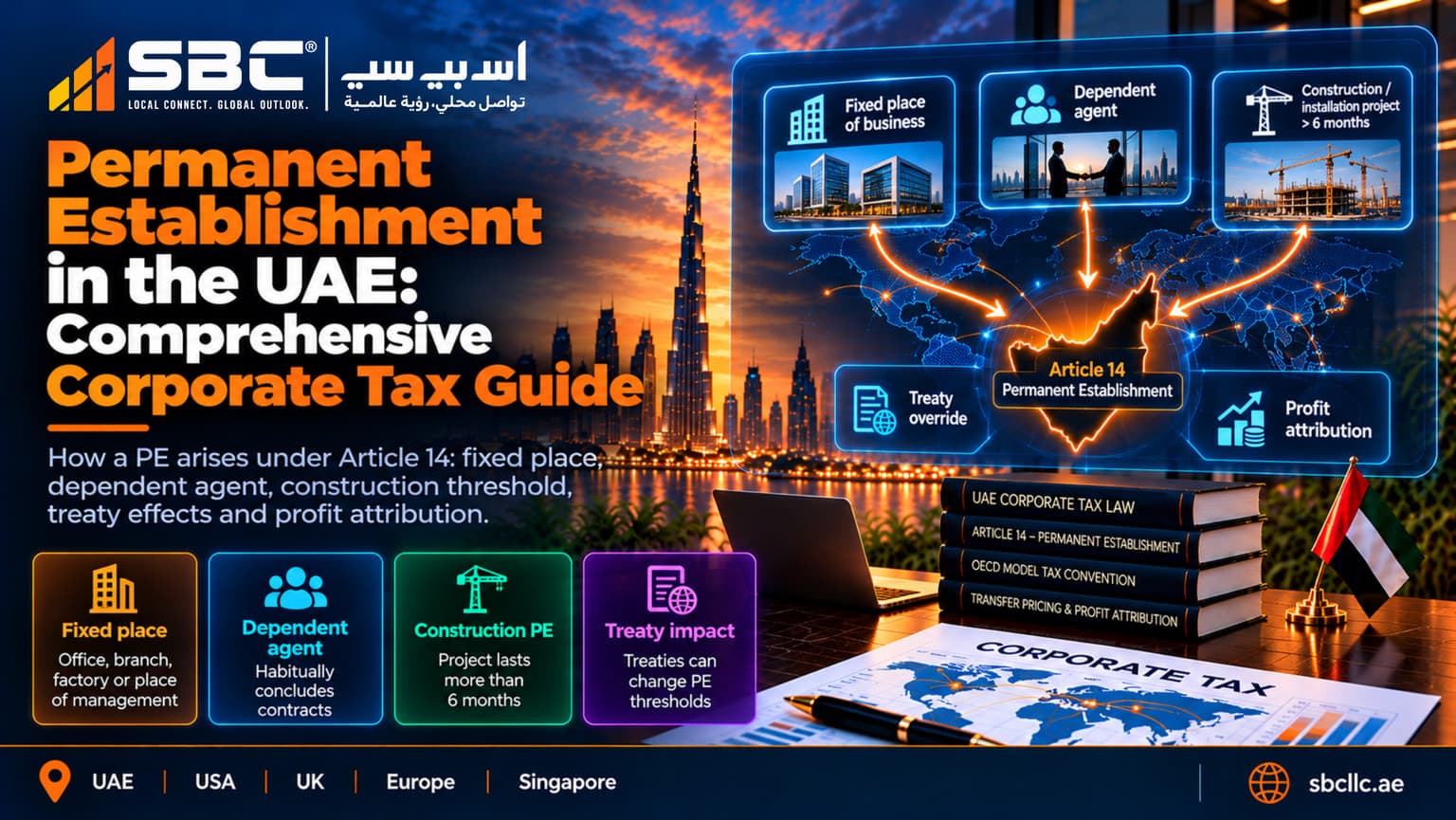
Direct answer: Under Article 14 of the UAE Corporate Tax Law, a Permanent Establishment (PE) is a sufficient business presence that brings profits into the UAE tax net. In the UAE it arises mainly through a fixed place of business, a dependent agent who habitually concludes contracts, or a building or installation project lasting more than six months. A double tax treaty can change these thresholds, and the PE's profits are taxed as if it were a separate, independent business.
Why PE is the issue that decides most cross-border cases
If I had to pick one concept that decides more cross-border Corporate Tax outcomes than any other, it would be Permanent Establishment. Residence decides how widely a company is taxed (see UAE Tax Residency for Companies). Source decides whether a particular payment is UAE-related. PE decides whether a foreign business that is otherwise outside the UAE tax net has done enough in the UAE to be taxed on its profits there.
The rules are set out in Federal Decree-Law No. 47 of 2022 and explained in the FTA's Permanent Establishment guidance. This article covers the UAE definition, the exclusions, the treaty overlay, profit attribution, the position of Free Zone entities and the evidence that matters in a review.
Three different PE situations
The word "PE" is used for three different situations in UAE practice. Mixing them up is a common source of bad advice.
| Situation | Who is affected | What it means |
|---|---|---|
| UAE PE of a non-resident | A foreign company operating in the UAE | The foreign company is taxable on income attributable to the UAE PE and must register |
| Foreign PE of a UAE resident | A UAE company with a branch or presence abroad | The foreign PE's profits are in the UAE tax base unless the Foreign PE exemption is elected and its conditions are met |
| Domestic PE of a Qualifying Free Zone Person | A Free Zone company with a mainland presence | Income attributable to the Domestic PE is not Qualifying Income and is taxed at 9% |
Each uses the same Article 14 concepts, read in the relevant context, but the consequences are different.
The UAE PE definition: three routes
1. Fixed place of business
A non-resident has a PE where it has a fixed or permanent place in the UAE through which its business, or part of it, is carried on. Typical examples are an office, branch, factory, workshop or place of management.
Four elements need to be present:
-
A place of business. Premises, facilities or equipment used for the business.
-
Fixedness. The place has a degree of permanence, both in location and in duration. A brief or occasional visit does not usually qualify, although a recurring presence at the same location can.
-
At the disposal of the enterprise. The foreign company has the right to use the space, even if it does not own or lease it formally.
-
Business carried on through it. The place is used for the company's own business activities, not merely something incidental.
A UAE branch of a foreign company is the clearest case. It is not a separate legal entity and it operates from a fixed place, so it will normally be a PE of the foreign company.
2. Dependent agent
A PE can arise without any premises if a person acts in the UAE on behalf of the non-resident and habitually concludes contracts, or habitually plays the principal role leading to their conclusion, on terms that are routinely agreed without material modification by the non-resident.
The key words are "habitually" and "on behalf of". A one-off introduction is not enough. A salesperson who regularly agrees pricing and signs, or who negotiates all the key terms so that head office simply rubber-stamps them, is the pattern to watch.
3. Building site, construction or installation project
A building site, construction, assembly or installation project, or connected supervisory activity, is a PE where it continues for more than six months, either alone or together with connected sites, projects or activities.
The words "together with connected projects" matter. Splitting a contract into several short projects will not necessarily avoid the threshold if the projects are commercially and geographically connected.
What does not create a PE
Several arrangements are specifically carved out.
-
Preparatory or auxiliary activities. Storing, displaying or delivering goods, maintaining stock only for another business to process, purchasing goods, or collecting information are typical examples. The carve-out applies only where the activity really is preparatory or auxiliary to the business as a whole. A warehouse that is central to the distribution model is not.
-
Independent agents. A broker, commission agent or other agent acting in the ordinary course of its own business, for several clients and with its own commercial risk, does not normally create a PE.
-
A UAE subsidiary. Owning a UAE company does not by itself give the foreign parent a PE. The subsidiary is a separate taxpayer. A PE can arise only if the parent is in substance carrying on its own business through the subsidiary's premises or people.
On related-party agents, I would not assume independence just because the agent is a separate legal entity. Where an agent works almost exclusively for one group company, follows detailed instructions and bears little risk, a tax authority is likely to question its independence. Document the commercial reality: who sets prices, who bears inventory and credit risk, who the agent's other clients are and how it is remunerated.
How treaties change the PE analysis
Under Article 66 of the Corporate Tax Law, a double tax treaty prevails to the extent it is inconsistent with the domestic provisions. The treaty's PE article, and the business profits article that goes with it, must therefore be read alongside Article 14.
Most treaties follow the structure of the OECD Model Tax Convention, but the details differ. Typical variations include:
-
A longer threshold for building sites and installation projects, often 12 months rather than six.
-
A different test for dependent agents.
-
Specific exclusions, or in some treaties a service PE provision that has no counterpart in domestic law.
-
Anti-fragmentation language that prevents splitting activities to stay within the preparatory or auxiliary exception.
The Ministry of Finance publishes the agreements on its double taxation agreements page. Never assume the OECD wording applies. Read the actual treaty with the relevant country, and take the company's residence under that treaty into account. I look at the broader treaty framework in UAE Double Tax Treaties: How Can UAE Businesses Reduce International Tax Exposure?.
Illustration. A foreign contractor runs a 10-month installation project in the UAE. Under domestic law the six-month threshold is exceeded, so a PE would exist. If the contractor is resident in a country whose treaty with the UAE sets a 12-month threshold, and the treaty conditions are met, the treaty can prevent a PE from arising. The conclusion depends on the treaty text, how the project is counted and whether the contractor is entitled to treaty benefits.
How PE profits are attributed
A PE is taxed only on the profits attributable to it, not on the whole business of the foreign company. The Corporate Tax Law treats the PE as a separate and independent person for this purpose. The approach is similar in concept to the OECD's treatment of a PE as a separate enterprise.
In practice, attribution requires five steps:
-
Identify the functions performed in the UAE, particularly the significant people functions: who negotiates, who takes key decisions, who manages risk.
-
Identify the assets used by the PE and the risks it bears.
-
Identify dealings between the PE and the rest of the enterprise, such as services, financing, use of intangibles and sales of goods.
-
Price those dealings at arm's length, with reference to the Corporate Tax Law's transfer pricing rules where they apply.
-
Compute taxable profit after allowable deductions, starting from accounts prepared under IFRS or IFRS for SMEs. The FTA's Determination of Taxable Income guide explains the mechanics.
A frequent weakness is that no one has prepared separate accounts for the PE. Without them, the attribution is hard to defend. Keep a ledger or reporting package for the PE, a note of the allocation keys used for shared costs, and a short functional analysis.
Free Zone entities and PE
Free Zone status does not remove PE risk. Three points are worth keeping straight.
-
A foreign company's branch registered in a Free Zone is a Free Zone Person under the Corporate Tax Law. Whether it is a Qualifying Free Zone Person is a separate assessment.
-
Income attributable to a Domestic PE or a Foreign PE of a Qualifying Free Zone Person is not Qualifying Income. Under Cabinet Decision No. 100 of 2023, it is taxed at 9%, without the AED 375,000 band at 0%. A mainland branch of a Free Zone company is the usual example of a Domestic PE.
-
Profits a Qualifying Free Zone Person earns through a foreign PE are foreign source income. The FTA's Taxation of Foreign Source Income guide confirms this, which matters for foreign tax credit analysis.
The FTA's Free Zone Persons guide is the main reference.
When a UAE company has a PE abroad
A UAE Resident Person that operates through a branch or other presence overseas has a Foreign PE. By default its profits and losses are included in UAE Taxable Income, with a foreign tax credit available for foreign tax paid.
Alternatively, the company can elect the Foreign PE exemption under Article 24. Broadly, the election disregards the income and associated expenditure of qualifying Foreign PEs, including their losses and any related foreign tax credits. It applies to all Foreign PEs that qualify, and a Foreign PE qualifies only if it is subject to Corporate Tax or a similar tax at a rate of not less than 9% in its jurisdiction. If PE losses have previously been used against other UAE profits, the election is not available until those losses have been recovered by later PE profits.
Ministerial Decision No. 302 of 2024, effective for Tax Periods starting on or after 1 January 2025, refined these rules. See the Ministry of Finance announcement and this KPMG summary. The full analysis is in UAE Corporate Tax Position on Foreign Branches.
Registration and compliance when a PE exists
If a non-resident has a UAE PE, it is a Taxable Person and must register for Corporate Tax through the FTA's registration service, file a return and pay any tax due within nine months of the end of the Tax Period. The FTA's guidance on basis of taxation for non-residents explains how non-residents are brought into the regime.
Where the position is uncertain, I recommend preparing the PE analysis and an indicative attribution before a return is due, rather than trying to reconstruct the facts afterwards. If a PE is "reasonably arguable", the cost of preparing a profit attribution file is small compared with the cost of an unsupported position.
Illustrative scenarios
| Scenario | Likely analysis |
|---|---|
| A foreign manufacturer stores goods in a UAE warehouse that it controls, then delivers them to local customers | Possibly preparatory or auxiliary if limited to storage and delivery. If the warehouse supports a wider distribution business, a fixed place PE is more likely |
| A foreign supplier's related UAE company habitually negotiates and signs contracts in the supplier's name | Dependent agent PE is likely. Independence of the related party would need strong evidence |
| A foreign engineering firm runs three connected installation sites in the UAE over eight months in total | Domestic six-month threshold likely exceeded. Check treaty threshold and connection between projects |
| A foreign consultancy sends staff to the UAE for a series of short visits to deliver one engagement | Depends on the pattern, location and duration. A treaty service PE clause may be relevant |
| A Free Zone company opens a mainland showroom | Domestic PE of a Free Zone Person. Income attributable to it is taxed at 9% and is not Qualifying Income |
Common mistakes
-
Treating "no office" as "no PE" without checking agent activity.
-
Assuming a related-party agent is independent without evidence.
-
Ignoring connected projects when counting the six months for a building or installation site.
-
Relying on the OECD treaty wording instead of the actual UAE treaty.
-
Assuming Free Zone status protects against PE exposure.
-
Not preparing separate accounts or a functional analysis for the PE.
-
Making the Foreign PE exemption election without modelling the effect on losses and foreign tax credits.
-
Failing to update the analysis when staff, contracts or premises change.
A decision framework for practitioners
-
Identify the enterprise, the jurisdictions involved and the Tax Period.
-
Map every premises, employee, agent, project and piece of equipment in the UAE (or abroad, for a Foreign PE).
-
Apply the domestic Article 14 tests: fixed place, dependent agent, construction.
-
Test the exclusions: preparatory or auxiliary activities and independent agents.
-
Check the applicable treaty for different thresholds, exclusions and anti-abuse wording.
-
If a PE exists or is reasonably arguable, prepare the profit attribution file.
-
Consider registration, filing and any Free Zone consequences.
-
Retain contemporaneous evidence and set triggers for review.
Records that support a PE conclusion
-
Contract files showing who negotiates, approves and signs.
-
Agency agreements and evidence of independence or dependence.
-
Lease and premises records, with a description of how each site is used.
-
Employee, secondee and contractor records, plus travel and day-count logs.
-
Project documents, timelines and site records for construction and installation work.
-
Board minutes and delegations of authority.
-
Separate ledgers, allocation keys and the functional analysis for profit attribution.
-
Written treaty analysis where a treaty is relied on.
The FTA's Corporate Tax guides and references should be checked for new guidance. For a review of a specific structure, speak to SBC's International Tax practice or SBC's Corporate Tax practice. If the question starts with whether an overseas company is in scope at all, begin with UAE Corporate Tax for Foreign Companies.
Frequently asked questions
What is a Permanent Establishment under UAE Corporate Tax?
A PE is a business presence in the UAE that is sufficient to make a non-resident's profits attributable to that presence taxable in the UAE. Under Article 14 it can arise through a fixed place of business, a dependent agent who habitually concludes contracts, or a building or installation project lasting more than six months.
Does a UAE branch create a Permanent Establishment?
Generally yes. A branch is not a separate legal entity. It is an extension of the foreign company, operating from a fixed place, and so is normally a PE of that company. The profits attributable to the branch are taxable in the UAE.
How long does a construction project need to last to create a PE in the UAE?
Under UAE domestic law, a building site, construction, assembly or installation project, or related supervisory activity, creates a PE when it lasts more than six months, alone or together with connected projects. Many treaties set a longer period, such as 12 months, so check the relevant treaty.
Can a UAE subsidiary create a PE for its foreign parent?
Not by itself. A subsidiary is a separate legal and tax entity. A PE can arise only if the parent carries on its own business through the subsidiary's premises, or if the subsidiary acts as a dependent agent that habitually concludes contracts for the parent.
What activities do not create a PE?
Preparatory or auxiliary activities, such as storing, displaying or delivering goods, purchasing goods or collecting information, do not create a PE, provided they remain genuinely preparatory or auxiliary. An independent agent acting in the ordinary course of its own business also does not normally create one.
How are profits attributed to a UAE PE?
The PE is treated as a separate and independent person. Its functions, assets and risks are analysed, dealings with the rest of the enterprise are priced at arm's length, and taxable profit is computed from separate accounts. Good documentation of the functional analysis is essential.
Does Free Zone status remove PE risk?
No. A foreign company's Free Zone branch is a Free Zone Person, and a Qualifying Free Zone Person with a mainland presence can have a Domestic PE. Income attributable to a Domestic PE or Foreign PE is not Qualifying Income and is taxed at 9%.
Do treaties override the UAE PE rules?
Yes, to the extent of any inconsistency. Under Article 66, treaty provisions prevail. A treaty may set higher thresholds or different agent tests, so the specific treaty and the taxpayer's treaty residence must be checked.
What is the Foreign PE exemption?
It is an election under Article 24 for UAE Resident Persons to disregard the income and associated expenditure of qualifying Foreign PEs. The Foreign PE must be subject to tax at a rate of at least 9%, the election covers all qualifying Foreign PEs, and it removes PE losses and related foreign tax credits from the UAE computation.
When should a non-resident register for Corporate Tax because of a PE?
A non-resident with a UAE PE is a Taxable Person and must register. The FTA's registration service and self-assessment questionnaire set out the process, so document your analysis early instead of waiting for the return deadline.
This publication is for general information only and does not constitute professional advice. Please consult your SBC advisor before acting on any matter covered here.