
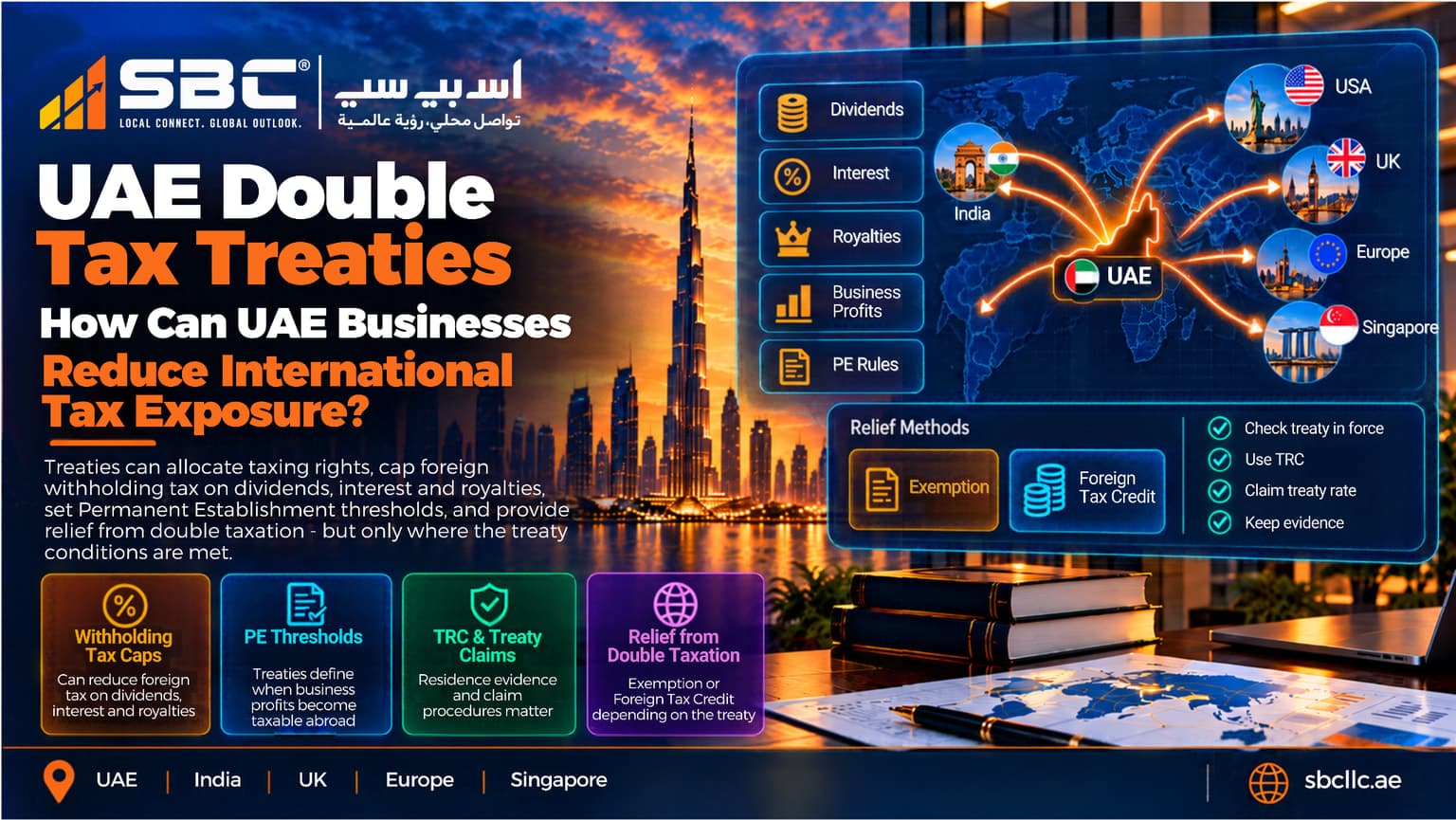
Direct answer: A UAE double tax treaty can reduce international tax exposure by allocating taxing rights between the UAE and another country, capping foreign withholding tax on dividends, interest and royalties, setting Permanent Establishment thresholds and providing a method of relief from double taxation. It is not an automatic exemption. The outcome depends on the specific treaty, the taxpayer's residence, the type of income, the conditions for claiming and any anti-abuse rules.
Treaties are a tool, not a shortcut
Most UAE businesses discover treaties when something has gone wrong: a foreign customer withholds 20% on a royalty, or a tax authority overseas asks for a residency certificate nobody has. By then the commercial contract is signed and the options are narrower.
The better approach is to treat the treaty network as part of the planning for any cross-border activity. This article explains how UAE treaties work, how they fit with UAE Corporate Tax rules, and the practical steps to apply them correctly. It is not a substitute for reading the specific treaty. The Ministry of Finance publishes the agreements on its double taxation agreements page and through an International Treaties Dashboard that lets you filter by country and download the full texts.
What is a double tax treaty?
A double tax treaty (also called a double taxation agreement or DTA) is a bilateral agreement that allocates taxing rights over specified types of income and provides ways to relieve double taxation. Treaties commonly cover business profits, dividends, interest, royalties, capital gains, employment income and Permanent Establishment.
Two points are fundamental.
-
A treaty works alongside domestic law. Domestic law decides the initial tax position. The treaty then restricts or allocates taxing rights where its conditions are met.
-
A treaty prevails over inconsistent domestic law. Article 66 of Federal Decree-Law No. 47 of 2022 provides that treaty provisions prevail to the extent of any inconsistency with the Corporate Tax Law.
The UAE has signed well over 140 double tax agreements according to Ministry of Finance announcements, so the network is wide. Always check the dashboard for the current status of a specific treaty. Many newer treaties follow BEPS-era standards, including anti-abuse provisions, but treaties differ, and you cannot safely transpose the terms of one onto another.
How a treaty is applied: a seven-step review
A practical treaty review follows a fixed sequence.
-
Confirm that a treaty is in force between the UAE and the other country, and that it covers the tax in question.
-
Establish the taxpayer's residence under UAE domestic law and under the treaty's residence article.
-
Identify the type of income and the treaty article that deals with it.
-
Decide which country has the primary taxing right, and whether the source country may tax at all, or only up to a stated rate.
-
Check conditions and limits, such as beneficial ownership, minimum holding periods and anti-abuse clauses.
-
Identify the relief method the treaty prescribes for the residence country, exemption or credit.
-
Follow the procedure in the source country to claim the treaty rate, and keep the evidence.
UAE residence and treaty benefits
To claim treaty benefits as a UAE resident, a business must first establish that it is resident under the treaty's residence article. A UAE Tax Residency Certificate (TRC) issued by the FTA is the usual evidence. The FTA's tax certificates service page sets out how to apply.
Several points are often misunderstood.
-
Being incorporated or registered in the UAE does not by itself guarantee every treaty benefit.
-
A TRC covers a stated period of up to 12 months and cannot be issued for a future period.
-
A TRC is evidence of residence. It is not an automatic grant of treaty relief, and the foreign authority may apply its own procedures and ask for more.
-
Where a treaty refers to residence under the laws of the UAE, the FTA's guidance indicates that the tests in Cabinet Decision No. 85 of 2022 apply.
The three layers (Corporate Tax residence, domestic Tax Resident status and treaty residence) are separated in UAE Tax Residency for Companies and Individuals.
Treaties and withholding tax on income coming into the UAE
For most UAE businesses, the practical value of a treaty is on income received from abroad. A foreign payer's country may apply withholding tax on dividends, interest, royalties or service fees. The treaty typically caps that tax at a stated rate, or removes it, for a qualifying resident.
Illustration (hypothetical rates). A UAE company receives AED 1,000,000 of royalties from a customer in Country X. Country X's domestic withholding rate on royalties is 20%, and its treaty with the UAE caps the rate at 10%.
-
Without a treaty claim, AED 200,000 is withheld.
-
With a valid treaty claim, AED 100,000 is withheld.
-
If AED 200,000 was withheld before the treaty claim was made, the excess AED 100,000 should be reclaimed from Country X's tax authority.
The UAE Foreign Tax Credit cannot make up for foreign tax above the treaty rate. The FTA's guidance states that where a treaty caps the source country's rate, the UAE credit is limited to that rate, so the excess should be reclaimed abroad. See UAE Foreign Tax Credit for the credit mechanics.
Practical documents usually include the TRC, a contract and invoices that support the classification of the payment, and the foreign country's own treaty claim form.
Dividends, interest and royalties: classification matters
-
Dividends. A treaty may cap the source country's tax. Separately, the UAE Participation Exemption may exempt qualifying dividends from UAE Corporate Tax. These are different regimes. A treaty can reduce foreign withholding tax even where the UAE income is exempt.
-
Interest. The treaty may limit source taxation or exempt certain interest. In the UAE, the receipt is then analysed under the Corporate Tax rules, including any foreign tax credit.
-
Royalties. The definition of "royalty" varies between treaties, and the label on an invoice is not decisive. Review the contractual rights, the nature of the payment and the treaty article. A software licence, a service fee and a sale of goods can look similar on paper but be treated differently.
Business profits and Permanent Establishment
Treaties generally say that the business profits of a resident enterprise are taxable only in its home state, unless it carries on business in the other state through a Permanent Establishment. If it does, that other state may tax the profits attributable to the PE.
The PE definition is therefore critical for UAE businesses expanding abroad. Depending on the treaty, a PE may arise through a fixed place of business, a dependent agent, a building or installation site, and in some treaties a services PE. The thresholds and exclusions are treaty-specific. Before sending staff abroad, opening an office or negotiating contracts in another country, review the treaty's PE article.
The same logic works in reverse for foreign businesses in the UAE. Under UAE domestic law, a building or installation project creates a PE after more than six months, but many treaties extend that to 12 months. I discuss the domestic rules and the treaty overlay in Permanent Establishment in the UAE.
Treaty relief, exemptions and credits: four mechanisms
Four mechanisms reduce international tax exposure, and they are often confused.
| Mechanism | Source | What it does | Key point |
|---|---|---|---|
| Treaty relief | The specific treaty | Allocates taxing rights, caps foreign withholding tax, sets PE thresholds, provides a relief method | Must be claimed and evidenced, and is subject to treaty conditions |
| Foreign Tax Credit | Article 47 of the Corporate Tax Law | Credits foreign tax against UAE tax on income that stays taxable | Capped at the UAE tax on that income. No carry-forward |
| Participation Exemption | Article 23 | Exempts qualifying dividends and gains from UAE tax | Domestic exemption, separate from treaties |
| Foreign PE exemption | Article 24 | By election, excludes the income of qualifying foreign branches | Branch must be taxed at 9% or more. Removes losses and credits |
A treaty may itself prescribe the exemption method or the credit method for the UAE as the residence country. Where it does, it prevails over inconsistent domestic rules. For the domestic exemptions, see UAE Foreign Source Income: Exemptions, Foreign Branches and the UAE Corporate Tax Treatment, and for the broader foreign income framework, the FTA's Taxation of Foreign Source Income guide.
Typical structures and the questions they raise
| Structure | Questions to ask |
|---|---|
| UAE parent with a foreign subsidiary | Foreign withholding on dividends, treaty cap, Participation Exemption conditions, the subsidiary's local tax position |
| UAE company with a foreign branch | Treaty PE definition, profit attribution, foreign tax rate, Foreign PE exemption or credit |
| UAE holding company with overseas investments | Dividend and disposal taxation abroad, treaty rates, Participation Exemption, substance |
| UAE company providing services overseas | Source-country rules, whether staff travel creates a PE, any treaty service PE clause |
| UAE company receiving interest or royalties | Classification of the income, withholding rate, treaty article, beneficial ownership |
Anti-abuse: treaty shopping, PPT and beneficial ownership
Treaties are not available to anyone who sets up an entity in a convenient jurisdiction. Modern treaties commonly include anti-abuse provisions.
-
Principal purpose test (PPT). Under the approach in the OECD's BEPS Action 6 report, a treaty benefit is denied if obtaining it was one of the principal purposes of an arrangement, unless granting it would be in line with the object and purpose of the treaty. The OECD's report, Preventing the Granting of Treaty Benefits in Inappropriate Circumstances, describes the rule.
-
Limitation on benefits (LOB). Some treaties limit benefits to defined categories of qualifying residents.
-
Beneficial ownership. Articles on dividends, interest and royalties often require that the recipient be the beneficial owner of the income. A foreign payer may ask for evidence of who actually receives and controls the income, and what the recipient does with it.
Whether any of these apply depends on the treaty wording. Never assume provisions found in one treaty exist in another. A UAE holding company with real management, real decision-making and a commercial reason for its location is in a stronger position than a company with a registered address and a bank account only. The structure of the OECD Model Tax Convention is a useful reference for how these clauses are generally framed.
Transfer pricing and dispute resolution
Cross-border transactions between related parties must be at arm's length under the UAE's transfer pricing rules, and treaties often include a clause that supports corresponding adjustments. Many treaties also include a mutual agreement procedure that allows the competent authorities of the two countries to resolve disputes about residence, PE or the application of the treaty. If double taxation arises despite the treaty, check whether this procedure is available and what time limits apply.
Large multinational groups should also consider the UAE's separate Domestic Minimum Top-up Tax rules. The FTA's Corporate Tax guides and references list the current guidance.
How UAE businesses can legitimately reduce international tax exposure
Legitimate planning begins with understanding where tax may arise, not with assuming a treaty will eliminate it. I would follow this sequence.
-
Identify the countries involved and the nature of each transaction.
-
Confirm the UAE company's residence and decide whether a TRC is needed.
-
Read the current treaty and locate the relevant articles.
-
Determine the source country's taxing rights under its domestic law and the treaty.
-
Check the withholding rate and the procedure and timing for claiming the treaty rate.
-
Assess whether activities could create a PE abroad.
-
Determine the UAE Corporate Tax treatment of the income.
-
Choose among the Foreign Tax Credit, the Participation Exemption, the Foreign PE exemption or treaty relief.
-
Review transfer pricing and related-party requirements.
-
Keep contracts, tax certificates, evidence of tax paid and residence evidence.
Aggressive arrangements designed mainly to obtain treaty benefits without meeting the conditions create significant risk. Substance and commercial purpose are the best protection.
Common mistakes
-
Treating a treaty as an automatic exemption.
-
Assuming the OECD Model wording applies to a given UAE treaty.
-
Not obtaining a TRC before the foreign payment is made, then discovering the withholding agent will not apply the treaty rate.
-
Over-withheld foreign tax that is never reclaimed.
-
Ignoring PE exposure before sending staff abroad.
-
Mixing up the Participation Exemption (domestic) with treaty relief.
-
Failing to test anti-abuse clauses and beneficial ownership.
-
Forgetting that a treaty can create better relief than domestic law, and not claiming it.
A short checklist before a cross-border project
-
Is there a treaty in force and has the text been read?
-
Is the UAE entity a resident under the treaty, with a TRC in hand?
-
What is the withholding rate and has the claim procedure been planned?
-
Will anyone work abroad long enough to create a PE?
-
Which domestic relief applies in the UAE: exemption, credit or both?
-
Are related-party terms at arm's length?
-
Is the evidence file ready?
For a review of a specific structure, speak to SBC's International Tax team or Corporate Tax team. If you are paying overseas parties from the UAE, see UAE Withholding Tax on Cross-Border Payments. The Ministry of Finance Corporate Tax hub and the UAE Legislation portal carry the primary texts.
Frequently asked questions
What is a UAE double tax treaty?
A bilateral agreement between the UAE and another country that allocates taxing rights over income, caps or removes certain withholding taxes and provides a method of relieving double taxation. Treaties prevail over inconsistent domestic law under Article 66 of the Corporate Tax Law.
How does a double tax treaty reduce international tax exposure?
By limiting the source country's right to tax certain income, capping foreign withholding tax, setting Permanent Establishment thresholds and prescribing relief from double taxation. The reduction is available only if the treaty's conditions are met and the claim is properly made.
Does the UAE have double tax treaties with many countries?
Yes. According to Ministry of Finance announcements the UAE has signed well over 140 double tax agreements. The Ministry's treaty dashboard shows the current list and lets you download the full texts.
How do I know whether a UAE treaty applies to my company?
Check that a treaty with the relevant country is in force, that your company is resident under the treaty's residence article, and that the income and the activity fall within the treaty's scope. Then read the relevant article and any conditions.
What is a UAE Tax Residency Certificate and why do I need one?
A TRC is an FTA certificate that evidences UAE tax residence for a stated period. Foreign tax authorities and payers usually ask for it before applying a treaty rate. It does not itself guarantee that a treaty benefit will be granted.
Does a UAE company automatically qualify for treaty benefits?
No. It must be resident under the treaty, meet the conditions of the relevant article, such as beneficial ownership, and satisfy any anti-abuse provisions. Incorporation or registration in the UAE alone is not enough.
Can a treaty reduce foreign withholding tax on dividends, interest and royalties?
Often yes. Treaties commonly cap the source country's tax at a stated rate or remove it for a qualifying resident. The rate and conditions differ by treaty and by type of income, and the claim must be made under the foreign country's procedures.
What is the difference between treaty relief and the Foreign Tax Credit?
Treaty relief limits or allocates taxing rights, often at source. The Foreign Tax Credit is a UAE domestic credit against UAE tax on foreign income that remains taxable. The credit is capped at the UAE tax on that income and does not cover foreign tax above a treaty rate.
How does the Participation Exemption interact with a treaty?
They are separate. The Participation Exemption is a UAE domestic exemption for qualifying dividends and gains. A treaty may still reduce foreign withholding tax on the same dividend even though the UAE income is exempt.
What is the principal purpose test?
An anti-abuse rule that denies a treaty benefit where obtaining it was one of the principal purposes of an arrangement, unless granting it would accord with the object and purpose of the treaty. Whether a treaty contains it depends on its wording.
Should every UAE business review treaties before expanding overseas?
Yes. A review before staff travel, contracts are signed or investments are made identifies PE risk, withholding tax cost and the documents you will need. It is much harder to fix these issues afterwards.
This publication is for general information only and does not constitute professional advice. Please consult your SBC advisor before acting on any matter covered here.