
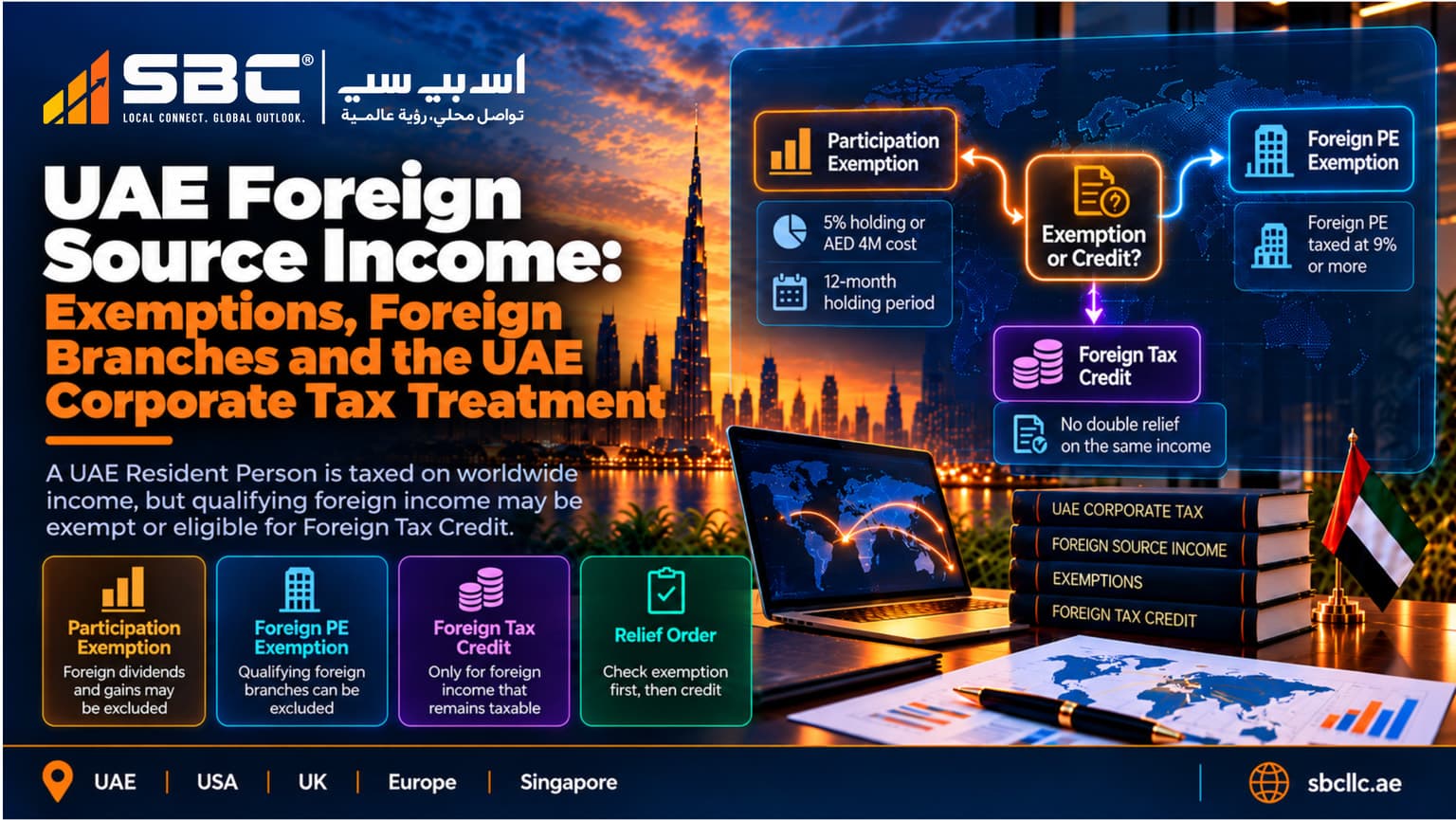
Direct answer: A UAE Resident Person is taxed on worldwide income, but foreign income can be removed from the tax base by the Participation Exemption (qualifying foreign dividends and gains) or by electing the Foreign Permanent Establishment exemption (qualifying foreign branches taxed at 9% or more abroad). Income that is not exempt stays taxable and may qualify for a Foreign Tax Credit. An exemption and a credit cannot both apply to the same income.
Exemption or credit: the decision that shapes the result
The first article in this series, UAE Corporate Tax and Foreign Source Income, explains that a UAE company is in principle taxed on its overseas income. This article goes one level deeper: which foreign income can be taken out of the base, on what conditions, and how that choice interacts with the Foreign Tax Credit.
The relief logic works in a fixed order, and it is worth stating plainly because many computations get it backwards.
-
First decide whether the income is exempt (Participation Exemption or Foreign PE exemption). If it is, it is excluded from Taxable Income, along with its related expenditure.
-
Only income that remains taxable can attract a Foreign Tax Credit.
-
Where a double tax treaty gives a different method of relief, such as exemption instead of credit, the treaty prevails over inconsistent domestic rules under Article 66 of the Corporate Tax Law.
The primary source is the FTA's Taxation of Foreign Source Income guide, read with Federal Decree-Law No. 47 of 2022 and the implementing decisions listed on the Ministry of Finance Corporate Tax hub.
What is, and is not, foreign source income
Foreign source income is income that originates outside the UAE. The FTA guide lists examples such as foreign dividends, gains on foreign shares, interest, royalties, sales and services outside the UAE, income from foreign property and the profits or losses of a Foreign Permanent Establishment.
Two boundaries are worth repeating because they cause errors.
-
State Sourced Income is not foreign source income even where a foreign element exists.
-
Income derived from a Free Zone Person is not foreign source income, because a Free Zone is UAE territory. By contrast, profits that a Qualifying Free Zone Person earns through a Foreign PE are foreign source income.
Exemption 1: the Participation Exemption
What it does
Article 23 of the Corporate Tax Law exempts certain income from a Participating Interest, which is a significant shareholding in a juridical person. The exemption covers dividends and other profit distributions, and gains or losses on disposing of the Participating Interest.
Key conditions
The conditions are set by Article 23 and the implementing Ministerial Decision. They include:
-
Ownership. At least 5% of the shares or capital, or an acquisition cost of at least AED 4 million.
-
Holding period. The interest is held, or intended to be held, for a continuous period of at least 12 months.
-
Minimum tax abroad. The investee is subject to Corporate Tax or a tax of a similar character at a minimum rate in its own jurisdiction.
-
Further tests. The Article and the current Ministerial Decision contain additional conditions, including anti-avoidance provisions. The Ministry of Finance's December 2024 announcement describes the changes that apply from 1 January 2025.
Consequences
-
The qualifying income is excluded from Taxable Income.
-
Expenditure incurred to earn it, such as the cost of acquiring the interest, is not deductible.
-
No Foreign Tax Credit is available on exempt income, even where foreign withholding tax was deducted. The FTA guide gives a worked example of a wholly owned subsidiary whose dividend is exempt, and the withholding tax suffered is simply a cost.
-
Revenue from exempt income still counts when testing revenue thresholds, for instance the AED 3 million cash-basis limit.
A trap with branches that are incorporated
If a Foreign PE has produced tax losses that were used against other UAE profits, and the PE is later incorporated as a company, dividends or income from that new company cannot benefit from the Participation Exemption until the previously used losses have been recouped. This anti-abuse rule was clarified by Ministerial Decision No. 302 of 2024.
Exemption 2: the Foreign Permanent Establishment exemption
What it does
Article 24 allows a Resident Person to elect to disregard the income and associated expenditure of its Foreign Permanent Establishments when computing Taxable Income. A Foreign PE is a place of business or other presence outside the UAE that would be a PE under Article 14 if the activity were carried on in the UAE.
Conditions
-
Minimum foreign tax. The Foreign PE must be subject to Corporate Tax or a tax of a similar character at a rate of not less than 9% under the law of the jurisdiction where it is located. Ministerial Decision No. 302 of 2024 calls such a PE a Qualifying Foreign PE (see this KPMG summary of the decision).
-
All or none. An election applies to all of the Resident Person's Foreign PEs that meet the conditions. You cannot elect for one branch and not another.
-
Previously used losses. If losses of the Foreign PE have already been set against other UAE profits, the election is not allowed until those losses have been recovered by later profits of the Foreign PE.
Consequences
-
The income and expenditure of the Foreign PE are excluded from UAE Taxable Income.
-
Losses of the Foreign PE are also excluded, so they cannot reduce UAE profits.
-
Foreign Tax Credits relating to the Foreign PE are not available.
-
The Foreign PE is treated as a separate and independent person, and as a Related Party of the head office. Transactions between them must therefore be at arm's length.
-
The repatriation of the PE's profits to head office is not a taxable event, because the head office and PE are the same legal person.
The full analysis of branches, dealings, losses and the choice of regime is in UAE Corporate Tax Position on Foreign Branches. For the PE concept itself, see Permanent Establishment in the UAE.
Free Zone entities and foreign branches
A Qualifying Free Zone Person (QFZP) is taxed at 0% on Qualifying Income and 9% on other income. Under Cabinet Decision No. 100 of 2023, income attributable to a Domestic PE or a Foreign PE is not Qualifying Income and is taxed at 9%, without the AED 375,000 band at 0%.
The practical point is that Free Zone status does not turn foreign branch profits into 0% income. Before relying on any exemption or election in a Free Zone structure, read the FTA's Free Zone Persons guide and confirm how the election interacts with QFZP status in your facts.
Small Business Relief and other situations with no tax payable
A Foreign Tax Credit cannot exceed the UAE Corporate Tax due on the foreign income. So where no tax is payable, there is nothing to credit. The FTA guide lists these cases:
-
Exempt income.
-
A taxpayer that elects Small Business Relief, where the relief applies.
-
Qualifying Income of a QFZP taxed at 0%.
-
A loss position for the Tax Period.
In each case the foreign tax is a cost, unless the foreign country or a treaty offers a refund.
Comparing the three relief routes
| Feature | Participation Exemption | Foreign PE exemption | Foreign Tax Credit |
|---|---|---|---|
| Legal basis | Article 23 and implementing decision | Article 24 and implementing decision | Article 47 |
| Applies to | Dividends and gains on qualifying shareholdings | Income of qualifying foreign branches | Foreign tax on income that stays taxable |
| Election needed | No, applies if conditions are met | Yes, an election | No, but a claim in the return |
| Minimum foreign tax | Yes, a minimum in the investee's jurisdiction | Yes, 9% or more | Not a condition, but credit is limited to the UAE tax on that income |
| Treatment of losses | Losses on disposal excluded | PE losses excluded | Not relevant |
| Foreign Tax Credit available | No | No | Yes, within the cap |
| Main documents | Ownership and holding evidence, investee's tax status | PE accounts, foreign returns, evidence of tax rate | Withholding certificates, foreign returns, payment proof |
Choosing between the Foreign PE exemption and the Foreign Tax Credit
For a foreign branch the choice is between electing the exemption and keeping the branch in the UAE computation and claiming a credit. DLA Piper's published analysis, Foreign Tax Credit vs Foreign Permanent Establishment Exemption, gives a clear example, summarised below.
A UAE company has total Taxable Income of AED 10 million, including AED 1 million from a Foreign PE taxed abroad at 20% (AED 200,000 of foreign tax).
-
With the exemption elected: UAE Taxable Income is AED 9 million, so tax is (9,000,000 − 375,000) × 9% = AED 776,250.
-
Without the election: tax on AED 10 million is AED 866,250. The credit is limited to the UAE tax on the PE income, 866,250 × 1,000,000 / 10,000,000 = AED 86,625, even though AED 200,000 was paid abroad. Tax payable is AED 779,625.
The exemption is slightly better in this case (a difference of AED 3,375), and under the credit route AED 113,375 of the foreign tax is lost because of the cap. The comparison would reverse if the PE made losses, because the election removes the losses from the UAE computation.
General guidance on when each route tends to work better:
-
Branch taxed at 9% or more and profitable: the exemption is usually simpler and often cheaper.
-
Branch taxed below 9%: it does not qualify for the exemption, so the credit is the route.
-
Loss-making branch: electing the exemption removes the losses, so consider not electing.
-
Passive income taxed abroad, such as interest: the credit applies, not the exemption.
-
Missing branch accounts or foreign returns: the documentation burden of either route should be weighed.
-
Treaty exemption: where the treaty exempts the PE income, the treaty relief prevails.
The election consequences, especially for losses, mean it should be modelled over several years before it is made.
Timing and accounting points
-
Recognition. Foreign income is included in the Tax Period in which it is recognised under IFRS (or IFRS for SMEs), or when received if the cash basis is validly used.
-
Currency. Convert at Central Bank of the UAE rates and use the method consistently.
-
Net basis. Taxable foreign income is net of economically linked expenditure.
-
Symmetry for credits. Foreign tax is treated as paid in the Tax Period when the related income is included in UAE Taxable Income, which helps where the UAE and the foreign country have different periods.
The FTA's Determination of Taxable Income guide is the practical reference for these mechanics.
Common pitfalls
-
Treating foreign withholding tax on exempt dividends as creditable.
-
Electing the Foreign PE exemption for one branch and assuming other branches are unaffected.
-
Making the election without modelling the loss and credit effect.
-
Ignoring the 9% foreign rate test, or relying on a headline statutory rate rather than the tax actually imposed on the branch's profits.
-
Forgetting that loss-making branches lose their UAE loss relief once the election is made.
-
Treating a Foreign PE of a Free Zone company as Qualifying Income.
-
Not keeping separate accounts for the foreign branch.
-
Failing to consider a treaty that provides exemption or a different relief method.
A practical checklist
-
List every foreign income stream by country and type.
-
Separate dividends and gains from branch profits.
-
Test the Participation Exemption conditions for each shareholding.
-
For each branch, confirm the foreign tax rate and any previously used losses.
-
Model the Foreign PE election over several years against the credit route.
-
Check the treaty for each country.
-
Document the analysis, the election and the evidence before filing.
If you need help applying these rules to your structure, speak to SBC's International Tax practice or Corporate Tax practice. The FTA's Corporate Tax guides and references and the Ministry of Finance's double taxation agreements page should be checked for current material.
Frequently asked questions
What foreign income is exempt from UAE Corporate Tax?
Qualifying dividends, profit distributions and gains from a Participating Interest are exempt under the Participation Exemption, and the income of qualifying Foreign Permanent Establishments is exempt if the Resident Person makes the Foreign PE election. Both have conditions. Other foreign income is taxable.
What are the main conditions for the Participation Exemption?
Among others, a shareholding of at least 5% (or an acquisition cost of at least AED 4 million), a holding period of at least 12 months, and a minimum level of tax in the investee's jurisdiction. Additional conditions are in Article 23 and the current Ministerial Decision.
Can I claim a Foreign Tax Credit on exempt dividends?
No. A Foreign Tax Credit is limited to the UAE tax payable on the relevant income, and exempt income produces no UAE tax. Foreign withholding tax on exempt dividends is therefore a cost, unless it can be reclaimed abroad under a treaty.
What is the Foreign Permanent Establishment exemption?
It is an election under Article 24 for a UAE Resident Person to disregard the income and expenditure of its qualifying Foreign PEs. The Foreign PE must be subject to tax of at least 9% in its jurisdiction. The election applies to all qualifying Foreign PEs.
Can I elect the Foreign PE exemption for only one branch?
No. If the election is made, it applies to all Foreign PEs that meet the conditions. A branch that does not meet the 9% test is not exempted and remains in the UAE computation.
What happens to foreign branch losses if I elect the exemption?
They are excluded from UAE Taxable Income, so they cannot reduce UAE profits. Conversely, if branch losses were already used against other UAE profits, the election is not allowed until they are recovered by later branch profits.
Is a foreign branch taxable in the UAE if I do not elect the exemption?
Yes. The branch is part of the same legal person as the UAE head office, so its profits and losses are in the UAE Taxable Income. A Foreign Tax Credit may be available for foreign tax paid on the branch profits, within the credit cap.
Does Free Zone status exempt foreign branch profits?
No. Income attributable to a Domestic PE or Foreign PE of a Qualifying Free Zone Person is not Qualifying Income and is taxed at 9%. Check the FTA's Free Zone Persons guide before relying on any election.
Which is better, the Foreign PE exemption or the Foreign Tax Credit?
It depends on the foreign tax rate, whether the branch is profitable, the treatment of losses and the available documents. As a general rule, a profitable branch taxed at 9% or more often suits the exemption, while a loss-making branch or one taxed below 9% usually does not. Model both before deciding.
Can a double tax treaty change the exemption analysis?
Yes. Under Article 66, a treaty prevails to the extent it is inconsistent with the Corporate Tax Law. A treaty may exempt branch income or provide a different relief method, so review the specific treaty.
This publication is for general information only and does not constitute professional advice. Please consult your SBC advisor before acting on any matter covered here.