
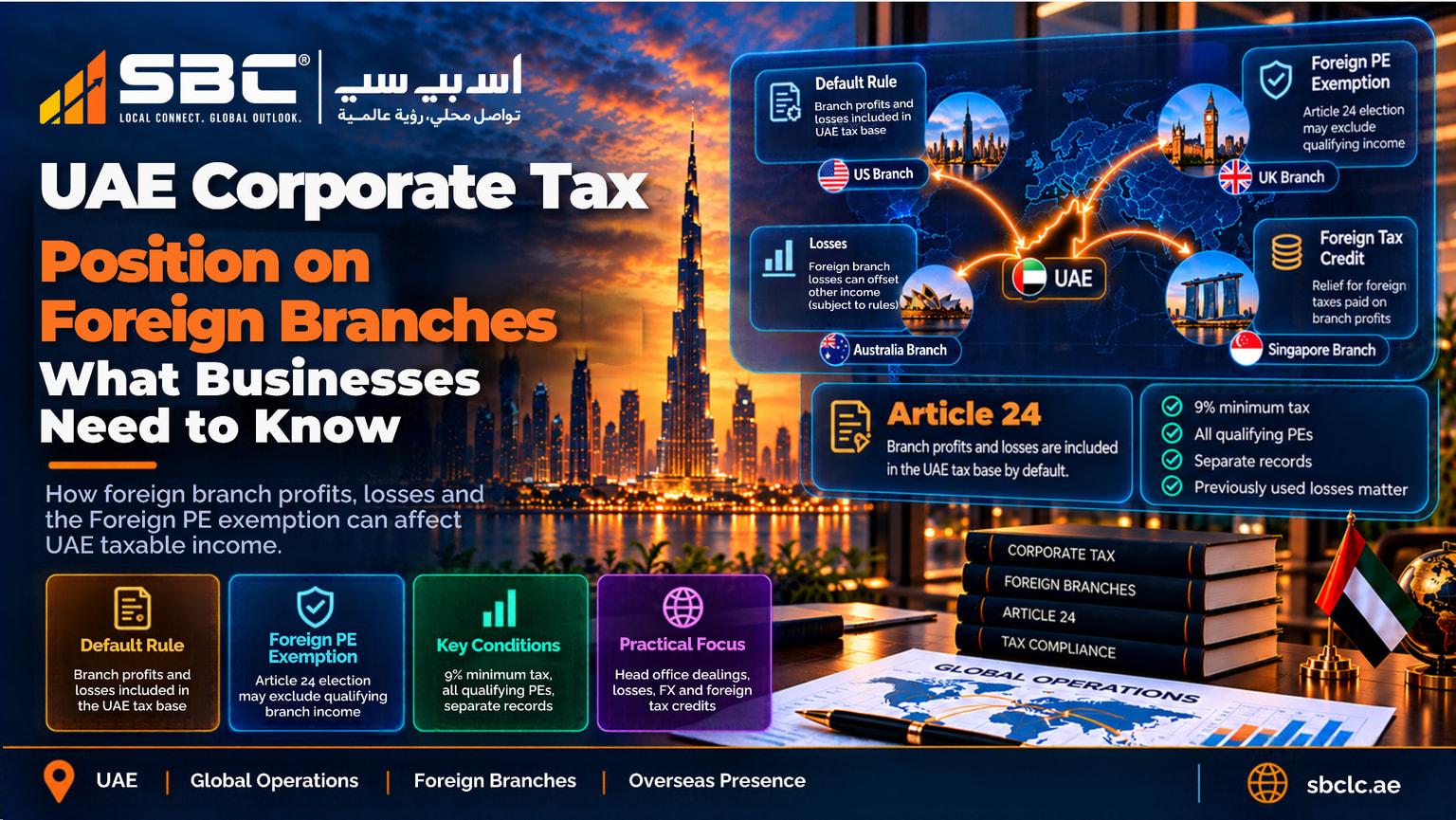
Direct answer: A foreign branch is not a separate legal entity. It is part of the same legal person as its UAE head office, so the branch's profits and losses are included in the UAE company's Taxable Income by default. A UAE Resident Person can instead elect the Foreign Permanent Establishment exemption under Article 24, which removes the income, expenditure and losses of qualifying foreign branches (those taxed abroad at 9% or more), and with them any foreign tax credit.
Why branches deserve their own analysis
Most UAE groups that expand overseas start with a branch, because it is quick to register and avoids setting up a separate company. The tax result, however, is very different from a subsidiary, and in my experience the differences are rarely explained to the board at the time of the decision.
This article sets out the UAE Corporate Tax treatment of a foreign branch: the default rule, the Foreign PE exemption and its conditions, the position on losses, how dealings with head office are handled, and how to choose between exemption and credit. The primary sources are Federal Decree-Law No. 47 of 2022 and the FTA's Taxation of Foreign Source Income guide.
Branch or subsidiary: why the legal form matters
A branch has no separate legal personality. A subsidiary is a separate company incorporated in the foreign country.
| Feature | Foreign branch | Foreign subsidiary |
|---|---|---|
| Legal status | Part of the UAE company | Separate legal entity |
| UAE tax treatment | Included in the UAE company's Taxable Income by default, unless the Foreign PE exemption is elected and its conditions are met | Separate taxpayer. Dividends and gains may be exempt under the Participation Exemption |
| Losses | Can reduce UAE profits by default | Stay in the subsidiary |
| Foreign tax | Branch profits taxed abroad, often with local branch rules | Subsidiary taxed on its own profits, with dividend withholding tax on distributions |
| Liability | The UAE company is directly liable | Generally limited to the subsidiary |
| Relief route | Foreign PE exemption or foreign tax credit | Participation Exemption or foreign tax credit |
Neither is better in all cases. A branch can be tax-efficient for start-up losses, while a subsidiary can provide a clean Participation Exemption route for profits. The right answer turns on the foreign country's tax rate, treaty, expected profitability and liability concerns.
The default rule: branch results are in the UAE tax base
A UAE Resident Person that is a juridical person is taxed on worldwide income. A branch is part of that person, so:
-
Branch profits increase UAE Taxable Income.
-
Branch losses can reduce UAE Taxable Income, subject to the general loss rules in the Corporate Tax Law.
-
Foreign tax paid on the branch profits may be creditable against UAE Corporate Tax, up to the UAE tax attributable to that income.
-
Expenses must be economically linked to the branch income to be taken into account in the net foreign income.
The branch's profits are computed under the same accounting standards, IFRS or IFRS for SMEs, and converted into dirhams at Central Bank of the UAE rates.
The Foreign Permanent Establishment exemption (Article 24)
What qualifies as a Foreign PE
A Foreign PE is a place of business or other form of presence outside the UAE of a Resident Person that would meet the conditions of a Permanent Establishment under Article 14 if the activity were carried on in the UAE. That generally captures a branch, office or other fixed place abroad.
Conditions
-
9% minimum tax. The Foreign PE must be subject to Corporate Tax or a tax of a similar character at a rate of not less than 9% under the law of the jurisdiction where it is located. Ministerial Decision No. 302 of 2024, effective for Tax Periods starting on or after 1 January 2025, defines a Qualifying Foreign PE on that basis. If the PE is not taxed at that level, its income is not eligible. See the Ministry of Finance announcement and the KPMG summary.
-
All qualifying PEs. If the Resident Person makes the election, it applies to all of its Foreign PEs that meet the conditions. You cannot choose branch by branch.
-
Previously used losses. If losses of the Foreign PE were already offset against other profits, such as head office profits, the election is not permitted until those losses have been fully recovered by later taxable income of that Foreign PE.
-
Separate records. The Resident Person must be able to compute the PE's income and expenditure as if it were a separate person, which in practice means separate accounts.
I would also check the current FTA guidance on how the election is made in the return and whether it can be changed in later periods, because administrative practice has been developing. Do not assume you can revisit it freely.
Effects of the election
-
The income and associated expenditure of the Foreign PE are disregarded in computing UAE Taxable Income.
-
The Foreign PE's losses are also disregarded.
-
Foreign tax credits relating to the Foreign PE are not available, because the income is no longer taxable in the UAE.
-
The Foreign PE is treated as a separate and independent person for the computation, and as a Related Party of the head office.
Dealings between head office and branch
This is the area where I most often see confusion. The answer is different depending on whether the exemption is elected.
| Situation | Treatment of head office and branch dealings |
|---|---|
| No election (branch in the UAE computation) | Head office and branch are one taxpayer, so internal movements of funds are not taxable events in the UAE. Items that affect timing, currency or the foreign tax position still need to be recorded and explained |
| Foreign PE exemption elected | The Foreign PE is a separate person and a Related Party of the head office, so transactions between them must be at arm's length under the transfer pricing rules. Without that, the profit that benefits from the exemption cannot be reliably determined |
The FTA guide confirms that where the exemption applies, a transfer of an asset to the Foreign PE from another group company must be priced at arm's length. It also confirms that a repatriation of surplus funds from the branch to head office is the receipt of the company's own funds and is ignored, whether or not an election has been made.
Practical points that deserve attention:
-
Asset transfers. A transfer to or from a branch can cause a disposal in the foreign country and a taxable gain or loss there.
-
Funding and interest. Document how funds flow between head office and branch, and keep the allocation of financing costs consistent with the accounts.
-
Intercompany balances. Reconcile balances between the two offices so that income and expenditure are recognised once.
-
Timing differences. Local GAAP, foreign tax rules and IFRS may recognise items at different times.
-
Currency. Branch results may be in a foreign currency and must be converted consistently.
Branch losses
The treatment of losses is one of the most important points in the whole analysis, and the one most often left out of board papers.
-
Without the election, branch losses can reduce UAE profits. That is a real advantage in the start-up phase.
-
With the election, branch losses are excluded and cannot reduce UAE profits.
-
If losses were previously used against UAE profits, the election is deferred until the branch has recovered them.
-
If the branch is later incorporated, dividends or income from the new company cannot benefit from the Participation Exemption until the previously used losses have been recouped. This is an anti-abuse rule that Ministerial Decision No. 302 of 2024 reinforces.
Illustration. A UAE company has Taxable Income of AED 11 million before taking account of a branch that made a loss of AED 1 million.
-
No election: Taxable Income is AED 10 million. Tax is (10,000,000 − 375,000) × 9% = AED 866,250.
-
Election made: the loss is disregarded, so Taxable Income is AED 11 million. Tax is (11,000,000 − 375,000) × 9% = AED 956,250.
The election costs AED 90,000 in that year because the loss is ignored. The longer-term effect depends on whether the loss can be carried forward in the foreign country and at what rate it will be used.
Foreign tax credit versus exemption
If the exemption is not elected, or is not available, branch profits stay in the UAE computation and the Foreign Tax Credit under Article 47 can relieve double taxation. The credit is:
-
A credit against UAE tax, not a deduction.
-
Limited to the UAE tax attributable to the branch income.
-
Calculated income by income, so excess credit on one stream cannot be used against another.
-
Not carried forward, carried back or refunded.
The full mechanics are in UAE Foreign Tax Credit: Preventing Double Taxation on Overseas Income. A comparison of both routes with a worked example is in UAE Foreign Source Income: Exemptions, Foreign Branches and the UAE Corporate Tax Treatment.
The choice comes down to five factors:
-
The foreign tax rate on branch profits and whether it reaches 9%.
-
Whether the branch is profitable or loss-making, now and over the next few years.
-
How the foreign country treats and carries forward losses.
-
The documentation available: separate accounts, foreign returns, certificates.
-
Whether a treaty offers an exemption method.
Double tax treaties and foreign branches
A foreign branch is usually also a Permanent Establishment under the applicable treaty, and the treaty decides which country may tax the branch profits. Treaties differ. Some give the branch country the right to tax, with the UAE then relieving double taxation by exemption or credit, and some allocate rights differently depending on the activity.
Under Article 66 of the Corporate Tax Law, a treaty prevails to the extent it is inconsistent with the domestic law. A treaty can therefore reinforce the exemption, provide a relief method that domestic law does not, or set a different PE threshold in the foreign country. The Ministry of Finance publishes the agreements on its double taxation agreements page. I would not assume that treaty wording follows the OECD Model Tax Convention exactly. See also UAE Double Tax Treaties.
Free Zone companies with foreign branches
A Qualifying Free Zone Person with a foreign branch should note that income attributable to a Foreign PE is not Qualifying Income. Under Cabinet Decision No. 100 of 2023 it is taxed at 9%. The FTA's Free Zone Persons guide is the right reference, and any election should be tested against QFZP status before it is made.
Cessation and restructuring
Branch decisions are rarely permanent. Before closing, selling or converting a branch into a subsidiary, model:
-
The foreign tax on disposal of branch assets and any exit charges.
-
The UAE treatment of any gain or loss and of any previously used losses.
-
The effect on the Foreign PE election, if one is in place.
-
The Participation Exemption position of a new subsidiary, taking the recoupment rule into account.
-
Treaty relief and withholding tax on later distributions.
Compliance and evidence
-
Maintain separate books or a branch reporting pack that can stand alone.
-
Keep the foreign tax returns, assessments and payment evidence for each period.
-
Keep evidence of the foreign tax rate actually suffered, not just the statutory rate.
-
Record the currency conversion method and rates.
-
Document the exemption-or-credit decision, the modelling behind it and the approval.
-
Keep head office and branch dealings schedules.
-
Prepare transfer pricing support where the exemption makes the branch a Related Party.
The FTA's Determination of Taxable Income guide and its Corporate Tax guides and references are good places to check current positions.
Common mistakes
-
Treating a foreign branch as outside UAE tax because it is "foreign".
-
Making the Foreign PE election without modelling losses and credits.
-
Assuming one branch can be exempt while others are not.
-
Relying on the foreign statutory rate instead of the tax actually imposed on the branch's profits.
-
Forgetting that the election removes foreign tax credits for the exempt branch.
-
Ignoring transfer pricing for dealings once the branch is a separate person.
-
Not keeping separate accounts or foreign tax evidence.
-
Overlooking the effect of branch incorporation on previously used losses.
A practical checklist
-
Confirm the branch is a Foreign PE under Article 14 principles and under the foreign law and treaty.
-
Establish the effective foreign tax rate on branch profits.
-
Check whether any losses have already been used against UAE profits.
-
Model the exemption against the credit route for several years.
-
Review the treaty.
-
Prepare separate accounts and a dealings schedule.
-
Record the decision and the evidence.
-
Reassess when the foreign rate, the branch's profitability or the structure changes.
If you would like a second opinion on a branch structure, speak to SBC's International Tax team or Corporate Tax team. For the PE concept, see Permanent Establishment in the UAE.
Frequently asked questions
Are foreign branch profits taxable in the UAE?
Yes, by default. A foreign branch is part of the UAE company, so its profits are included in UAE Taxable Income unless the Foreign PE exemption is elected and its conditions are met. A Foreign Tax Credit may relieve double taxation if the exemption is not used.
What is the Foreign Permanent Establishment exemption?
An election under Article 24 for a UAE Resident Person to disregard the income, expenditure and losses of its qualifying Foreign PEs when computing Taxable Income. It also excludes foreign tax credits for that PE.
What conditions apply to the Foreign PE exemption?
The Foreign PE must be subject to tax of at least 9% in its jurisdiction. The election applies to all qualifying Foreign PEs, and it is not allowed until losses previously used against other UAE profits have been recouped by the PE's later profits.
Can I elect the exemption for only one branch?
No. If you elect, the exemption applies to all Foreign PEs that meet the conditions. A branch that does not meet the 9% test remains in the UAE computation.
What happens to branch losses?
Without the election, they can reduce UAE profits. With the election, they are disregarded. If losses have already been used against UAE profits, the election is deferred until they are recovered.
Do transactions between head office and branch need to be at arm's length?
If the exemption is elected, yes, because the Foreign PE is treated as a separate person and a Related Party of the head office. If it is not elected, head office and branch are one taxpayer, and internal movements of funds are not taxable events, although the records must still be clear.
Can I claim a foreign tax credit for branch tax?
Yes, if the branch profits are in the UAE computation, that is if the exemption is not elected or does not apply. The credit is limited to the UAE tax on the branch income, is calculated income by income, and cannot be carried forward.
Is it better to use a branch or a subsidiary?
It depends on the foreign tax rate, expected profits or losses, treaty position and liability concerns. A branch can use start-up losses against UAE profits when the exemption is not elected. A subsidiary can allow the Participation Exemption to apply to dividends and gains.
Does a double tax treaty affect foreign branch taxation?
Yes. A treaty may allocate taxing rights over the branch profits, provide an exemption or credit method, and set the PE threshold in the foreign country. Treaty provisions prevail over inconsistent domestic law under Article 66.
Does a Free Zone company with a foreign branch pay 0% on branch profits?
No. Income attributable to a Foreign PE is not Qualifying Income and is taxed at 9%. Check the Free Zone guidance before relying on any election.
This publication is for general information only and does not constitute professional advice. Please consult your SBC advisor before acting on any matter covered here.