
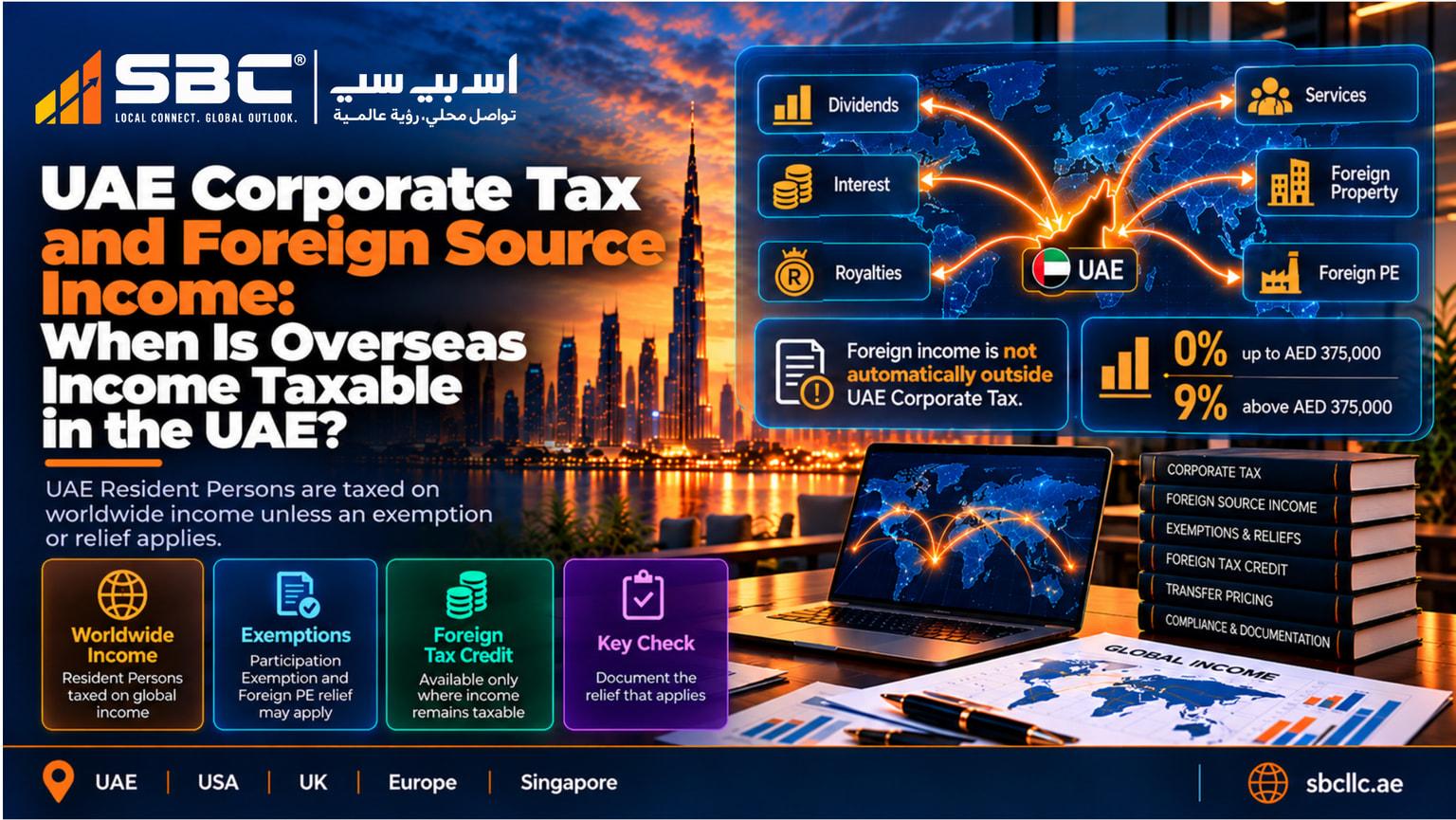
Direct answer: Overseas income is not automatically outside UAE Corporate Tax. A UAE company that is a Resident Person is taxed on its worldwide income, including foreign source income, unless an exemption such as the Participation Exemption or the Foreign Permanent Establishment exemption applies. Non-residents are taxed on foreign source income only if it is attributable to a UAE Permanent Establishment. Foreign tax paid on income that remains taxable can give rise to a Foreign Tax Credit.
The most expensive myth in UAE tax
"The UAE is a tax-free jurisdiction, so our overseas income is outside the net." I have heard some version of that sentence from founders, CFOs and even auditors. It is wrong, and since Corporate Tax started for Tax Periods beginning on or after 1 June 2023, the error has real cost.
A UAE company with a customer base in Europe, a subsidiary in India or an investment portfolio abroad is in the UAE tax base for that income by default. The question is not "is foreign income taxed?" but "which relief applies, and have we documented it?"
The FTA's Taxation of Foreign Source Income guide (CTGFSI1) is the primary reference. This article summarises it in practical terms and points to the other places the rules come from, including Federal Decree-Law No. 47 of 2022.
What is foreign source income?
The Corporate Tax Law does not define "foreign source income" directly. It defines State Sourced Income in Article 13. Foreign source income is broadly the opposite: income that originates outside the UAE, whether from activities performed, assets located, capital invested, rights used or services performed or benefited from abroad.
The FTA guide gives these examples:
-
Dividends and other profit distributions from foreign companies.
-
Income from disposing of shares in a foreign company.
-
Interest on loans or deposits outside the UAE.
-
Income from selling goods or providing services outside the UAE.
-
Income from movable or immovable property outside the UAE.
-
Royalties for the use of intellectual property outside the UAE.
-
Profits or losses of a Foreign Permanent Establishment of a Resident Person.
Two boundaries matter.
-
State Sourced Income is never foreign source income, even if it has a foreign element.
-
Income derived from a Free Zone Person is not foreign source income. A Free Zone is part of UAE territory, so income from a Free Zone Person is either income from a Resident Person or income of a non-resident attributable to a UAE PE.
Qualifying Free Zone Persons and foreign PEs
This is the point that confuses Free Zone groups most, so it is worth separating clearly.
-
Income from a Domestic PE of a Qualifying Free Zone Person (a mainland presence) is not foreign source income.
-
Income or profits a Qualifying Free Zone Person earns through a Foreign PE (a presence outside the UAE) is foreign source income.
Separately, income attributable to a Domestic PE or Foreign PE is not Qualifying Income under Cabinet Decision No. 100 of 2023 and is taxed at 9%. QFZP status therefore does not turn foreign PE profits into tax-free income. The FTA's Free Zone Persons guide deals with the wider rules.
Who is taxed on foreign source income?
The answer depends on residence and legal form.
| Taxpayer | Taxed on foreign source income? |
|---|---|
| Resident juridical person (for example a UAE LLC or PJSC) | Yes. Taxed on worldwide income unless an exemption applies |
| Resident natural person | Only foreign income that relates to a business or business activity conducted in the UAE, and only if turnover from it exceeds AED 1 million in a calendar year. Wages, personal investment income and qualifying real estate investment income are excluded |
| Non-resident juridical person with a UAE PE | Only foreign income attributable to the UAE PE |
| Non-resident without a UAE PE | No. It is taxed only on State Sourced Income or UAE nexus income |
A natural person who runs a wholly separate business abroad, with its own staff, assets and bank accounts, is not taxed in the UAE on that business. The guide's examples show how the AED 1 million threshold is measured and why unrelated overseas businesses are not combined with the UAE one.
Double tax treaties can alter the outcome. Under Article 66 of the Corporate Tax Law, a treaty prevails over inconsistent domestic rules. The Ministry of Finance publishes the agreements on its double taxation agreements page. See UAE Double Tax Treaties for how a treaty is applied step by step.
When is foreign source income taxable?
Foreign source income is included in the Taxable Income of the Tax Period in which it is recognised under the applicable accounting basis. A few points need attention.
-
Tax Period. For a company, this is generally the 12-month period for which it prepares financial statements.
-
Accounting standards. Financial statements must be prepared under IFRS, or IFRS for SMEs where revenue does not exceed AED 50 million.
-
Accrual basis is the default. Income is recognised when earned, even if the cash arrives later.
-
Cash basis is limited. It is available where revenue does not exceed AED 3 million, or in exceptional circumstances with FTA approval. Revenue for that test is calculated worldwide, so a company cannot exclude its foreign revenue to stay under the limit.
-
Exempt income stays out. Income covered by the Participation Exemption or an elected Foreign PE exemption is not included in Taxable Income.
The FTA's Determination of Taxable Income guide covers the mechanics of the computation.
How foreign source income is taxed
There is no separate rate for foreign income. It is aggregated with other income and taxed at the standard rates: 0% on Taxable Income up to AED 375,000 and 9% above that.
The practical steps are:
-
Start with accounting profit from the financial statements.
-
Identify the foreign income streams and the expenses economically linked to them.
-
Exclude exempt income and its related expenditure, such as qualifying participation dividends and gains and the income of an elected Foreign PE.
-
Aggregate the rest. Foreign income and costs are combined with domestic ones. Foreign losses can reduce UAE profits, unless they relate to exempt income or to a Foreign PE covered by the election.
-
Convert to AED. Foreign currency amounts must be converted at Central Bank of the UAE rates: spot rates where reasonable, otherwise monthly or annual averages. Use the method consistently and keep a record of the choice.
-
Apply the tax rates to the total Taxable Income.
-
Deduct any Foreign Tax Credit that is available.
Tax is charged on a net basis. That matters when the other country has taxed the income gross, for example through withholding tax. The UAE computation is still on income less allowable expenses, and the credit is limited to the UAE tax on the net foreign income.
Reliefs that prevent double taxation
Three mechanisms matter most. They work differently and should not be confused.
-
Participation Exemption (Article 23). It exempts qualifying dividends and capital gains from a Participating Interest. Among the conditions are a minimum ownership of 5% of the shares (or an acquisition cost of at least AED 4 million), a 12-month holding period and a minimum level of tax in the investee's jurisdiction. If the exemption applies, no foreign tax credit is available on that income.
-
Foreign Permanent Establishment exemption (Article 24). By election, the income and associated expenditure of qualifying Foreign PEs are excluded. The Foreign PE must be subject to tax at a rate of not less than 9%, the election covers all qualifying Foreign PEs, and it also removes PE losses and related foreign tax credits from the UAE computation.
-
Foreign Tax Credit (Article 47). Where foreign income remains taxable in the UAE, foreign tax on that income reduces the UAE tax, up to the UAE tax attributable to that income. Unused credit is lost.
The detailed rules, including recent changes under Ministerial Decision No. 302 of 2024, are described in the Ministry of Finance announcement. I deal with them in depth in UAE Foreign Source Income: Exemptions, Foreign Branches and the UAE Corporate Tax Treatment and UAE Foreign Tax Credit.
How common foreign income streams are treated
| Income | Usual UAE Corporate Tax treatment | What to check |
|---|---|---|
| Dividends from a foreign subsidiary | Exempt if the Participation Exemption conditions are met. Otherwise taxable, with a possible foreign tax credit | Ownership, holding period, tax rate in the investee's jurisdiction, other conditions |
| Gain on sale of foreign shares | Exempt if it qualifies under the Participation Exemption. Otherwise taxable | Same conditions as for dividends |
| Interest from a foreign borrower | Taxable. Foreign withholding tax may be creditable | Treaty rate, withholding certificate, expenses linked to the income |
| Royalties from abroad | Taxable. Foreign withholding tax may be creditable | Classification of the payment and treaty article |
| Fees for services performed abroad | Taxable, subject to a treaty | Source rules abroad and whether the UAE company has created a foreign PE |
| Rent on foreign property | Taxable for a Resident juridical person | Local tax paid and creditability |
| Profits of a foreign branch | Taxable unless the Foreign PE exemption is elected and its conditions are met | Foreign tax rate of at least 9%, losses previously used, election consequences |
A worked example
This example follows the structure of one in the FTA guide. Company A is incorporated and resident in the UAE and has total Taxable Income of AED 10 million for the Tax Period. Of that, AED 1 million is net interest income from Country X, on which AED 50,000 of withholding tax was paid in Country X.
-
UAE Corporate Tax on AED 10 million: (10,000,000 − 375,000) × 9% = AED 866,250.
-
UAE tax attributable to the foreign interest: 866,250 × 1,000,000 / 10,000,000 = AED 86,625.
-
Foreign Tax Credit is the lower of the foreign tax paid (AED 50,000) and the UAE tax on the foreign income (AED 86,625), so AED 50,000.
-
Corporate Tax payable: 866,250 − 50,000 = AED 816,250.
If the foreign tax had been AED 100,000, the credit would have been capped at AED 86,625, and the excess could not be carried forward.
Build a foreign income register
A UAE business with overseas activity should maintain a register by country and income type. At a minimum it should record:
-
The payer or investee, country and income type.
-
Gross income and the expenses economically linked to it.
-
Foreign tax paid, with the supporting certificate or receipt.
-
The treaty position and any treaty rate.
-
The exemption analysis: Participation Exemption, Foreign PE election or none.
-
The currency conversion method and rates used.
-
The UAE tax calculation and any credit claimed.
The register should agree to the financial statements and the Corporate Tax return.
Common pitfalls
-
Assuming foreign income is exempt because the UAE has no personal income tax.
-
Confusing income derived from a Free Zone Person (not foreign source income) with income derived by a QFZP through a foreign PE (foreign source income).
-
Allocating expenses badly, so that net foreign income is overstated or the credit cap is miscalculated.
-
Treating a foreign tax credit as a deduction. It is a credit against UAE tax.
-
Expecting to carry forward an unused credit.
-
Making a Foreign PE election without modelling losses and credits.
-
Ignoring currency conversion rules and inconsistent methods across periods.
-
Overlooking a treaty that allocates taxing rights or provides a different relief method.
A practical checklist
-
Confirm the taxpayer's residence status for the Tax Period.
-
Identify each foreign income stream and its source.
-
Test whether any stream is State Sourced Income or Free Zone income.
-
Test the Participation Exemption and Foreign PE exemption conditions.
-
Compute net foreign source income and convert it to AED.
-
Compute the Foreign Tax Credit income by income.
-
Check the relevant treaty.
-
Keep the evidence and reconcile to the return.
The FTA's Corporate Tax guides and references, the Corporate Tax General Guide and the Ministry of Finance Corporate Tax hub are the best places to check for updates. For a review of your own foreign income position, see SBC's Corporate Tax practice. Residence is the gateway question, and I cover it in UAE Tax Residency for Companies.
Frequently asked questions
Is foreign income taxable in the UAE?
For a UAE Resident Person that is a company, yes. Resident juridical persons are taxed on worldwide income unless an exemption applies, such as the Participation Exemption or the Foreign Permanent Establishment exemption. Foreign tax paid on income that remains taxable can give a Foreign Tax Credit.
What counts as foreign source income?
Income that arises from activities, assets, rights or capital outside the UAE, such as foreign dividends, interest, royalties, sales and services outside the UAE, foreign property income and profits of a Foreign PE. State Sourced Income and income derived from a Free Zone Person are not foreign source income.
Are foreign dividends taxable in the UAE?
They are exempt if the Participation Exemption conditions are met. Otherwise they are taxable and included in Taxable Income, with a possible Foreign Tax Credit for foreign withholding tax. If the exemption applies, there is no credit.
Is the income of a Free Zone company foreign source income?
Income derived from a Free Zone Person is UAE-related, not foreign source income. However, profits that a Qualifying Free Zone Person earns through a Foreign PE are foreign source income, and are not Qualifying Income.
Are individuals taxed on overseas income in the UAE?
Only a natural person who conducts a business or business activity in the UAE with turnover above AED 1 million is in scope, and then only for foreign income that relates to that UAE business. Salary, personal investment income and qualifying real estate investment income are outside Corporate Tax.
Are non-residents taxed on foreign income in the UAE?
Only if the foreign income is attributable to a UAE Permanent Establishment. A non-resident without a UAE PE is taxed only on State Sourced Income or income linked to a UAE nexus.
When is foreign income taxed: when earned or when received?
Under the accrual basis, which is the default, when it is earned and recognised in the financial statements. The cash basis is available only where revenue does not exceed AED 3 million, or in exceptional cases with FTA approval.
How is foreign income converted into dirhams?
Using Central Bank of the UAE exchange rates: spot rates where reasonable, otherwise monthly or yearly average rates. The method should be used consistently across the Tax Period, and the reason for it recorded.
Can foreign losses offset UAE profits?
Generally yes, since income and costs from all sources are aggregated. The exceptions are losses relating to exempt income and losses of a Foreign PE where the Foreign PE exemption election has been made.
What is the Foreign Tax Credit?
A credit against UAE Corporate Tax for qualifying foreign tax on foreign income that remains taxable in the UAE. It is limited to the UAE tax attributable to that income, is calculated income by income, and any excess is lost.
This publication is for general information only and does not constitute professional advice. Please consult your SBC advisor before acting on any matter covered here.