
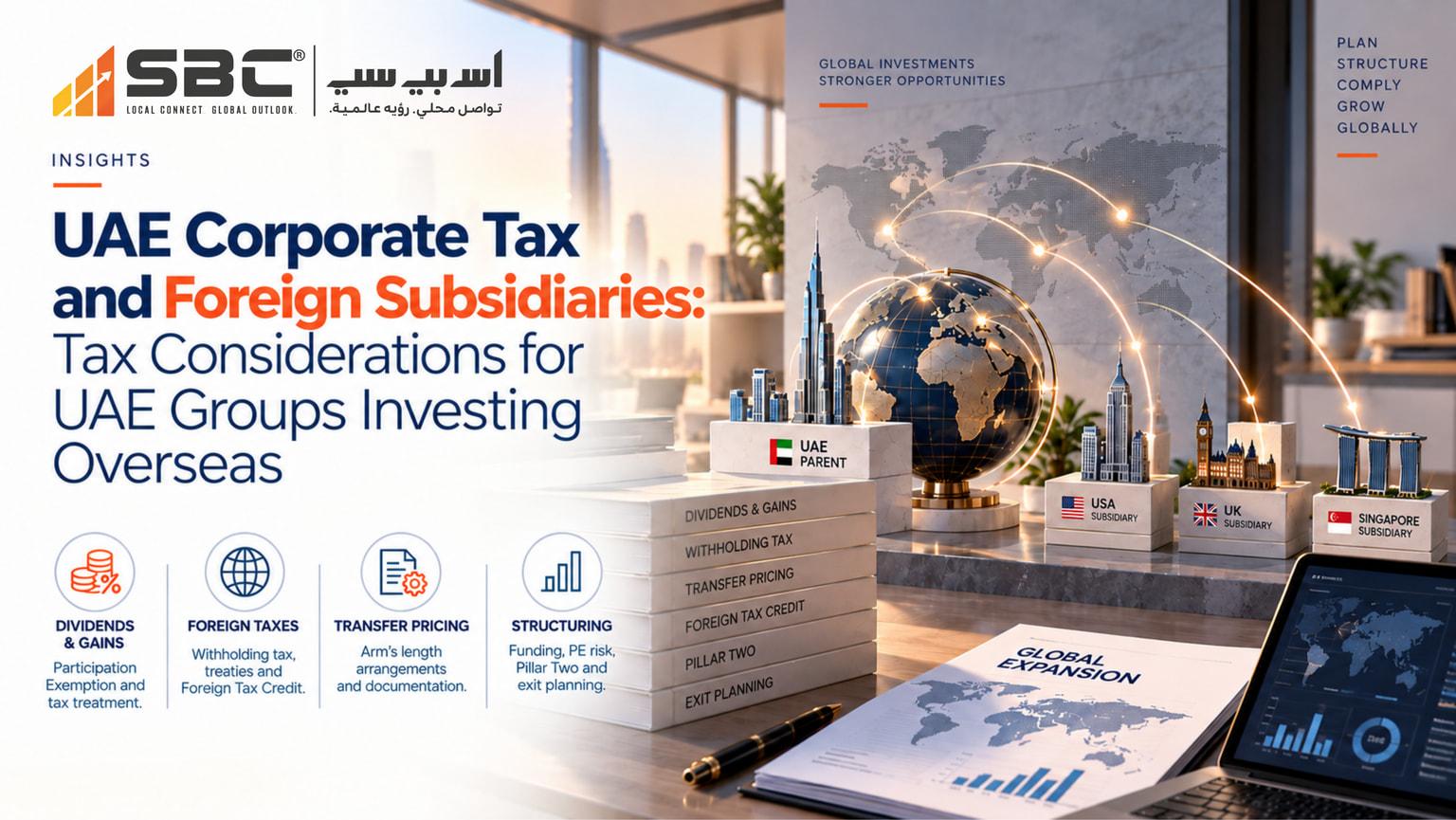
Direct answer: A foreign subsidiary is a separate legal entity and a separate taxpayer. A UAE parent is therefore not taxed in the UAE on the subsidiary's profits, only on what it receives from it: dividends (exempt under the Participation Exemption if the conditions are met), interest, management fees and royalties (taxable, at arm's length) and gains on sale (exempt if the shares qualify). Foreign withholding tax, treaty relief, the Foreign Tax Credit, transfer pricing, residence and Permanent Establishment risks, and Pillar Two for large groups all need to be planned from the start.
Plan the whole life of the investment
When a UAE group decides to set up or acquire a subsidiary overseas, the tax discussion tends to focus on the corporate tax rate in the target country. That is important, but it is only one part of the picture. The group's tax result depends on how the investment is funded, what flows back to the UAE, how those flows are taxed abroad and in the UAE, whether relief is available, how the arrangements are priced and documented, and what happens when the group eventually sells.
This article follows those stages in order. It builds on UAE Participation Exemption: How Can UAE Companies Structure Overseas Investments, which covers the exemption conditions in detail, and on UAE Holding Company: Corporate Tax and International Tax Considerations. The principal sources are Federal Decree-Law No. 47 of 2022 and the FTA's Taxation of Foreign Source Income guide.
What is a foreign subsidiary, and how does it differ from a branch?
A foreign subsidiary is a company incorporated or established outside the UAE and owned or controlled by a UAE company. It has its own legal personality and is taxed under its own country's rules. A foreign branch, by contrast, is part of the UAE company.
| Feature | Foreign subsidiary | Foreign branch |
|---|---|---|
| Legal status | Separate company | Part of the UAE company |
| UAE taxation of its profits | Not taxed in the UAE as earned. The UAE parent is taxed on what it receives | Included in the UAE company's Taxable Income unless the Foreign PE exemption is elected |
| Losses | Remain in the subsidiary | Can reduce UAE profits by default |
| Dividends or profit transfers | Dividends, exempt if the Participation Exemption applies | Transfers of own funds, ignored for tax |
| Relief route | Participation Exemption or Foreign Tax Credit | Foreign PE exemption or Foreign Tax Credit |
| Transfer pricing | Related Party transactions at arm's length | Arm's length applies if the Foreign PE exemption is elected |
The UAE does not have a controlled foreign company regime, so it does not attribute a foreign subsidiary's undistributed profits to the UAE parent. That is a significant difference from many other countries, but it does not stop the foreign country's own rules from applying. For the branch alternative, see UAE Corporate Tax Position on Foreign Branches.
Stage 1: Funding the subsidiary
The way a subsidiary is funded affects the UAE and the foreign tax result.
| Funding | UAE parent | Foreign subsidiary |
|---|---|---|
| Equity | No interest income. Returns come as dividends, exempt if conditions are met | No deduction for returns on equity |
| Shareholder loan | Interest is taxable income of the UAE parent and must be at arm's length | Interest is usually deductible, subject to the foreign country's limits and withholding tax |
| Guarantee or credit support | A guarantee fee may be due from the subsidiary, at arm's length | May be deductible, subject to local rules |
| Mixed | Combination of the above | Combination of the above |
A few practical points:
-
Price loans at arm's length. Use a benchmark that reflects the subsidiary's credit standing, currency and tenor. Related-party interest must meet Article 34.
-
Check the foreign country's limits. Thin capitalisation or interest limitation rules may restrict the subsidiary's deduction and affect the economics of debt.
-
Consider foreign withholding tax on interest. A treaty may reduce it. The UAE interest income remains taxable, with a Foreign Tax Credit for qualifying foreign tax, capped at the UAE tax on that income.
-
Document the commercial rationale. Agreements, board approvals and calculations should be signed before funds move.
-
Consider the Participation Exemption thresholds. Equity should be structured so that ownership, acquisition cost and entitlement meet the conditions from the outset.
Stage 2: Operating flows between parent and subsidiary
Beyond dividends, a UAE parent and its subsidiary usually exchange services, intellectual property and cost allocations.
-
Management and service fees. Taxable income of the UAE parent. They must reflect services actually performed, at arm's length. The foreign country may restrict deductions or withhold tax on them.
-
Royalties. Taxable in the UAE. Foreign withholding tax and treaty treatment depend on the classification of the payment.
-
Cost sharing and shared services. Allocation keys should be documented and applied consistently.
-
Goods. Intragroup sales and purchases need arm's length pricing in both countries.
The Participation Exemption does not remove transfer pricing duties for these flows. A parent and its overseas subsidiary are normally Related Parties, so significant transactions need documentation and disclosure in the Corporate Tax return. Aligned documentation matters, because a mismatch between the two countries' positions can produce double taxation.
Stage 3: Dividends from the subsidiary
Dividends and other profit distributions are exempt under the Participation Exemption if the conditions are met. They include a minimum interest (5% or AED 4 million cost), an uninterrupted 12-month holding period (held or intended), the subsidiary being subject to tax of at least 9%, entitlement to at least 5% of profits and liquidation proceeds and, for Related Party subsidiaries, the asset test. Since 1 January 2025, Ministerial Decision No. 302 of 2024 applies the AED 4 million alternative across all ownership-based tests and limits the asset test to Related Party investees. See the KPMG summary.
If the conditions are not met, the dividend is taxable income. The Foreign Tax Credit then applies to foreign withholding tax on the dividend, limited to the UAE tax on that income. The FTA's guide describes the credit by reference to tax paid on the income itself, such as withholding tax, and does not describe a credit for the subsidiary's own corporate tax on the underlying profits.
A worked comparison (hypothetical and simplified)
A foreign subsidiary earns profit of 100 and pays corporate tax of 20 in its country, leaving 80. It pays an 80 dividend to its UAE parent, and the foreign country withholds 5% (4) under the treaty.
| Participation Exemption applies | Exemption does not apply | |
|---|---|---|
| Foreign corporate tax | 20 | 20 |
| Foreign withholding tax | 4 | 4 |
| UAE tax on the dividend at 9% (ignoring the 0% band) | 0 | 7.2 |
| Foreign Tax Credit (lower of 4 and 7.2) | 0 | (4.0) |
| Net UAE tax | 0 | 3.2 |
| Total tax on the 100 of profit | 24 | 27.2 |
The comparison shows why the exemption is valuable even before considering the size of a gain on sale. It also shows that withholding tax is a real cost when the exemption applies, which is why treaty claims and reclaims matter. The credit mechanics are in UAE Foreign Tax Credit.
Stage 4: Foreign withholding tax and treaties
The foreign country may withhold tax on dividends, interest, royalties and fees paid to the UAE. A treaty may reduce those rates. The Ministry of Finance publishes the agreements on its double taxation agreements page, and the structure of most treaties follows the OECD Model Tax Convention, though each treaty differs. To claim treaty relief, the UAE parent usually needs a Tax Residency Certificate. The FTA's tax certificates service explains how to apply. Obtain it before the first payment, and reclaim any excess withholding promptly, because the UAE credit cannot make up for tax withheld above the treaty rate. See UAE Double Tax Treaties.
Stage 5: Residence and Permanent Establishment risks
Two risks are specific to groups run from the UAE.
-
The subsidiary becoming UAE resident. A company incorporated abroad is a UAE Resident Person if it is effectively managed and controlled in the UAE. If the group's UAE head office takes the key management and commercial decisions of the foreign subsidiary, it should assess whether the subsidiary has become UAE resident, and whether it is also resident abroad under local law, in which case a treaty tie-breaker may apply. See UAE Tax Residency for Companies. The subsidiary's board should be real, informed and empowered.
-
A PE of the UAE parent in the foreign country. If UAE employees habitually negotiate and conclude contracts for the parent in the foreign country, or the parent has a fixed place of business there, it may have a PE under local law or the treaty. That brings profits into foreign tax and, in the UAE, into the Foreign PE analysis.
Stage 6: Pillar Two
If the UAE parent belongs to a multinational group with consolidated revenue of at least EUR 750 million in two of the four preceding fiscal years, the UAE Domestic Minimum Top-up Tax may apply to the UAE entities, and the group's foreign subsidiaries will have their own Pillar Two position in their countries. The FTA's August 2026 Scope and Registration Guide explains registration. A foreign subsidiary's profit does not generally enter the UAE jurisdictional calculation, but the group-level data and compliance process should be coordinated.
Stage 7: Exit
When the group sells or liquidates a foreign subsidiary, the questions are:
-
Is the gain exempt in the UAE? Re-test the Participation Exemption conditions at the date of sale, including an actual 12-month holding.
-
What is the foreign tax cost? The subsidiary's country may tax the gain, subject to the treaty.
-
What about losses? A loss on liquidation of a Participation is not covered by the exemption. Fair value gains and losses are outside it according to the FTA's private clarification summary to May 2026, while impairment gains and losses are within it. The Simmons & Simmons note on the clarifications explains.
-
Are there restructuring consequences? Moving shares within the group may trigger foreign taxes or affect treaty access.
-
Can the proceeds be repatriated tax efficiently? Consider dividends, capital reductions and loan repayments in turn.
Acquiring an existing foreign company
Many groups enter a market by buying a business, not by setting up a new subsidiary. That adds several points to the usual review.
-
The clock starts at acquisition. The 12-month holding period and the acquisition cost for the AED 4 million alternative are measured from the date the UAE company acquires the interest. Record the date and the cost, including directly attributable acquisition costs only to the extent they form part of the cost under the accounting standards.
-
Inherited exposures. The target's historic tax liabilities, open audits and incentive regimes stay with the company. A tax holiday that lowers the foreign rate may affect the subject-to-tax analysis, so test it as part of due diligence.
-
Treaty access. If the target's country has a treaty with the UAE, check at the outset whether the new ownership structure supports treaty claims, including beneficial ownership and substance conditions.
-
Existing related-party arrangements. Contracts between the target and its former group may need to be re-papered at arm's length under the new ownership.
-
Funding the acquisition. If the UAE parent borrows externally to buy the shares, the interest costs are costs of earning exempt income to the extent the shares produce exempt income, so confirm the deductibility analysis before relying on the interest as a deduction.
-
Post-acquisition restructuring. Mergers, transfers of shares and conversions can trigger foreign taxes and may interact with UAE restructuring reliefs. Plan them before completion, not after.
What the UAE return needs from you
The UAE Corporate Tax return asks for information about exempt income, related-party transactions and foreign tax credits, and the FTA can request the working papers. For each foreign subsidiary I would prepare a short return file with:
-
A condition-by-condition Participation Exemption workpaper with the supporting evidence.
-
The dividend and gain schedules, reconciled to the accounts and to the foreign income register.
-
The Related Party schedule, with pricing support and any disclosure forms.
-
The Foreign Tax Credit calculation for any foreign income that remains taxable, calculated income by income, with the foreign tax certificates.
-
The currency conversion method and rates used, applied consistently through the Tax Period.
-
A note of any positions that rely on private FTA clarifications, with the date and the clarification relied on, because those are fact-specific.
A return file prepared in this way, at the same time as the return, is far easier to defend than one rebuilt from emails when a question arrives.
Build a foreign-income register
A UAE group with overseas subsidiaries should maintain a register by country and income type that records:
-
The subsidiary and country.
-
The type of flow: dividend, interest, fee, royalty or gain.
-
Gross amount and economically linked costs.
-
Foreign tax paid, with certificates.
-
Treaty rate and claim status.
-
The Participation Exemption analysis for each shareholding.
-
Transfer pricing support and disclosure status.
-
Currency conversion method and the UAE tax computation.
The register should reconcile to the financial statements and the Corporate Tax return. The FTA's Determination of Taxable Income guide explains the computation.
What to review before investing overseas
-
The target country's corporate tax rate, incentives and withholding taxes.
-
The treaty with the UAE.
-
The Participation Exemption conditions for the planned shareholding.
-
The funding mix and interest limitation rules.
-
Transfer pricing for expected intragroup flows.
-
Residence and PE risks from how the group will be managed.
-
Pillar Two scope.
-
The exit route and its tax cost.
-
The Corporate Tax return treatment and documentation.
Common mistakes
-
Assuming a foreign subsidiary's income is automatically outside UAE tax.
-
Assuming all dividends are exempt without testing the conditions.
-
Overlooking foreign withholding tax and treaty claims.
-
Claiming a Foreign Tax Credit on exempt income.
-
Pricing intercompany loans and fees without a benchmark.
-
Running foreign subsidiaries from the UAE without a residence review.
-
Selling before the holding period is satisfied.
-
Not keeping a foreign-income register.
If you would like help structuring or reviewing an overseas investment, contact SBC's International Tax practice. The FTA's Corporate Tax guides and references, FAQs and the Ministry of Finance Corporate Tax hub are the right places to follow new guidance. For the holding company perspective, see UAE Corporate Tax for Investment Holding Companies.
Frequently asked questions
Is a foreign subsidiary subject to UAE Corporate Tax?
Not as such. A foreign subsidiary is a separate taxpayer under its own country's law. The UAE parent is taxed only on what it receives from it, such as dividends, interest, fees and gains, subject to exemptions.
Are all dividends from foreign subsidiaries exempt in the UAE?
No. They are exempt only if the Participation Exemption conditions are met. Otherwise they are taxable, with a Foreign Tax Credit available for foreign withholding tax, within the cap.
Do gains on selling a foreign subsidiary qualify for exemption?
Yes, if the shares are a qualifying Participating Interest and the conditions are met at the date of sale, including the holding period. Test them before signing.
Is interest from a foreign subsidiary taxable?
Yes. Interest on a shareholder loan is taxable income of the UAE parent and must be at arm's length. Foreign withholding tax may be creditable, within the cap.
Can I claim a Foreign Tax Credit on foreign withholding tax on exempt dividends?
No. If the dividend is exempt, there is no UAE tax on it, so there is nothing to credit. The withholding tax is a cost unless it can be reclaimed under a treaty.
What is the difference between a foreign subsidiary and a foreign branch for UAE tax?
A subsidiary is a separate taxpayer and the UAE parent is taxed on distributions. A branch is part of the UAE company, so its profits and losses are included unless the Foreign PE exemption is elected.
Does transfer pricing apply between a UAE parent and its foreign subsidiary?
Yes. They are normally Related Parties, so loans, fees, royalties, guarantees and cost allocations must be at arm's length and documented, in addition to the foreign country's rules.
Could my foreign subsidiary become UAE tax resident?
Yes, if it is effectively managed and controlled in the UAE. Review where its key management and commercial decisions are made, and whether it is also resident in its own country.
Does the UAE have a controlled foreign company regime?
No. The UAE does not attribute a foreign subsidiary's undistributed profits to the UAE parent. Other countries' CFC rules may still apply to their own taxpayers.
Is a UAE parent of a foreign subsidiary affected by Pillar Two?
Possibly, if the group has consolidated revenue of at least EUR 750 million in two of the four preceding fiscal years. In that case the UAE entities may be within the DMTT, and the group needs to coordinate its Pillar Two compliance.
This publication is for general information only and does not constitute professional advice. Please consult your SBC advisor before acting on any matter covered here.