
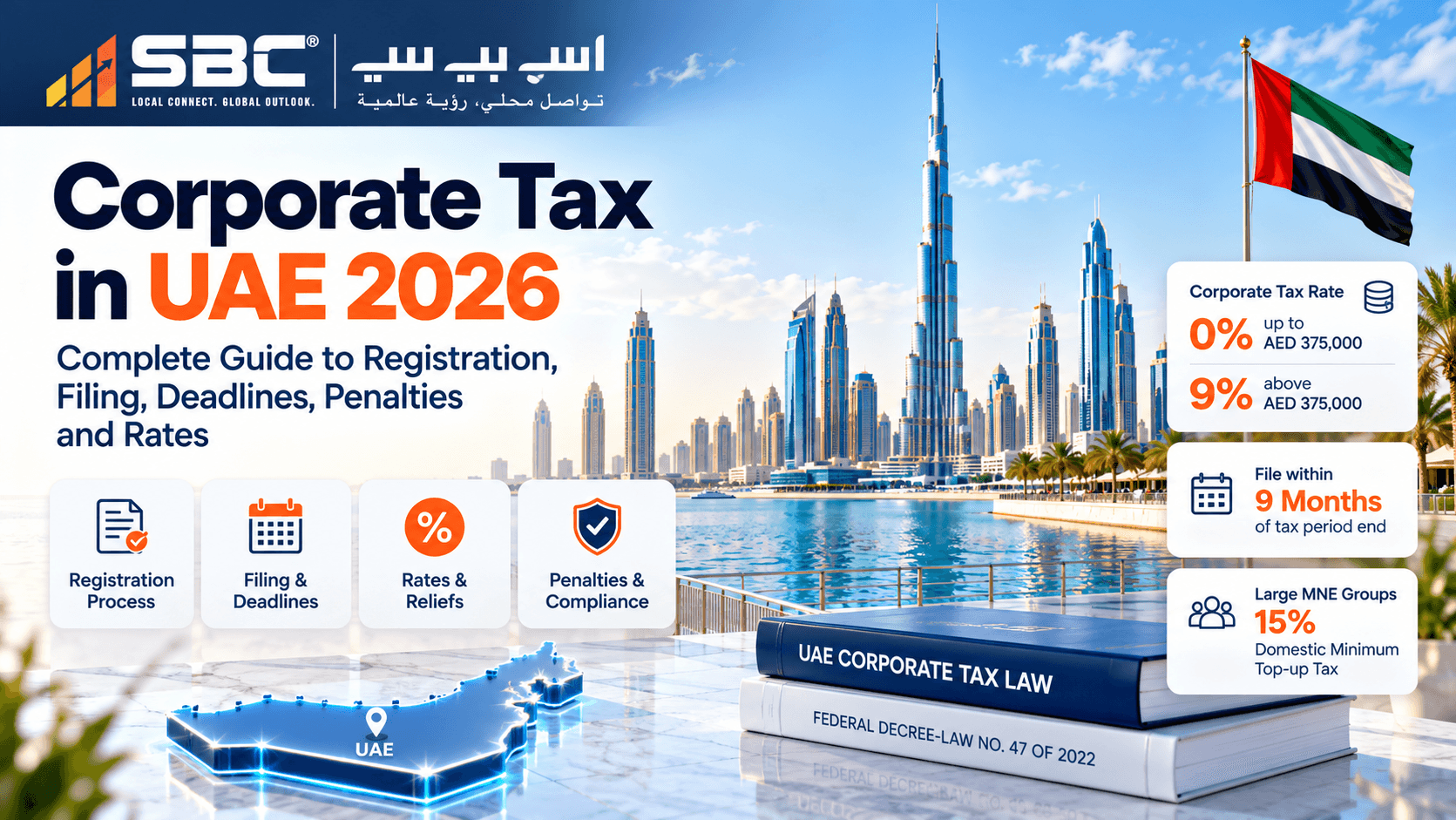
Corporate Tax in UAE: Complete 2026 Guide to Registration, Filing, Deadlines, Penalties and Rates
Direct answer: Corporate tax in the UAE is a federal tax on business profits. It applies under Federal Decree-Law No. 47 of 2022 to financial years starting on or after 1 June 2023. The rate is 0% on taxable income up to AED 375,000 and 9% above that. Every taxable business must register with the Federal Tax Authority (FTA) on EmaraTax. It must then file a corporate tax return and pay any tax within nine months of the end of each tax period. Large multinational groups may also pay a 15% domestic minimum top-up tax.
UAE corporate tax at a glance
| Item | Position in 2026 |
|---|---|
| Law | Federal Decree-Law No. 47 of 2022 on the Taxation of Corporations and Businesses |
| Applies from | Financial years starting on or after 1 June 2023 |
| Standard rates | 0% up to AED 375,000 of taxable income, 9% above |
| Qualifying Free Zone Person | 0% on qualifying income, 9% on non-qualifying income |
| Large multinational groups | 15% domestic minimum top-up tax from financial years starting on or after 1 January 2025 |
| Administered by | Federal Tax Authority, through the EmaraTax portal |
| Return and payment deadline | 9 months after the end of the tax period |
| Late registration penalty | AED 10,000, waivable in defined cases |
| Small Business Relief | Revenue up to AED 3 million, for tax periods ending on or before 31 December 2029 |
| Record keeping | 7 years after the end of the tax period |
What is corporate tax in UAE?
Corporate tax, also called corporate income tax, is a direct tax on the net profit of businesses. Before June 2023, most UAE businesses outside the oil and foreign bank sectors paid no federal tax on profits. The UAE introduced corporate tax to align with international standards, while keeping one of the most competitive rates in the world.
The legal basis is Federal Decree-Law No. 47 of 2022, supported by Cabinet Decisions, Ministerial Decisions and FTA Decisions. The Ministry of Finance makes tax policy. The FTA administers the tax, registers taxpayers, receives returns and carries out audits. The FTA's corporate tax page and corporate tax topics page are the primary official references. The UAE government portal also has a plain-language overview.
In more than twenty years of advising businesses as a chartered accountant, I have found that most corporate tax problems come from missing a basic step rather than from complex law. Common examples are registering late, misreading the free zone rules, or filing without reconciled accounts. This guide is built to prevent those mistakes.
Is corporate tax the same as income tax or VAT?
No. Corporate tax is charged on business profits. VAT is a 5% consumption tax on supplies of goods and services. The UAE has no federal personal income tax on salaries. A natural person pays corporate tax only on business income from a licensed or unlicensed business above the AED 1 million turnover threshold.
UAE corporate tax rate
What is the corporate tax rate in UAE?
The standard UAE corporate tax rates are:
- 0% on taxable income up to AED 375,000.
- 9% on taxable income above AED 375,000.
- 0% on qualifying income of a Qualifying Free Zone Person, with 9% on non-qualifying income.
- 15% effective minimum for in-scope multinational groups through the domestic minimum top-up tax.
The rates are the same in every emirate. The corporate tax rate in Abu Dhabi, Dubai, Sharjah and the other emirates is identical, because corporate tax is federal.
Corporate tax calculator: worked example
A mainland company has taxable income of AED 1,000,000 for its financial year ending 31 December 2025.
| Step | Calculation | Amount (AED) |
|---|---|---|
| Taxable income | From the tax computation | 1,000,000 |
| Taxed at 0% | First 375,000 | 0 |
| Taxed at 9% | 1,000,000 minus 375,000 = 625,000 at 9% | 56,250 |
| Corporate tax payable | 56,250 | |
| Due date | 9 months after 31 December 2025 | 30 September 2026 |
Taxable income is not the same as accounting profit. It starts from accounting net profit and is adjusted for items such as exempt income, non-deductible expenses, interest limitation, related party pricing and tax losses brought forward. Tax losses can be carried forward and set off against up to 75% of taxable income in a later period, subject to conditions.
What is the 15% top-up tax?
The UAE introduced a domestic minimum top-up tax under Cabinet Decision No. 142 of 2024. It applies to multinational groups with consolidated revenue of at least EUR 750 million in at least two of the four preceding financial years, for financial years starting on or after 1 January 2025. Its aim is that in-scope groups pay an effective rate of 15% in the UAE. See the Ministry of Finance top-up tax page and our guide comparing the 9% corporate tax with the 15% Pillar Two rate.
UAE corporate tax law: who is subject to tax?
Who has to pay corporate tax in UAE?
The following are taxable persons:
- Companies and other juridical persons incorporated in the UAE, on the mainland or in a free zone.
- Foreign companies effectively managed and controlled in the UAE.
- Foreign companies with a permanent establishment or nexus in the UAE, on the income linked to it.
- Natural persons doing business in the UAE whose turnover from business activities exceeds AED 1 million in a calendar year.
Salary, personal investment income and personal real estate investment income of individuals are generally outside the scope of corporate tax.
Who is exempt from corporate tax?
Certain persons are exempt, either automatically or by application. These include government entities, government-controlled entities, businesses in extractive and non-extractive natural resources (subject to conditions), qualifying public benefit entities, qualifying investment funds, and public or private pension and social security funds. Several exempt categories must still register or file an annual declaration. An exemption should be confirmed in writing before you decide not to register.
Corporate tax registration UAE
Do all businesses need to register for corporate tax?
Yes, every taxable person must register, including free zone companies that expect to pay 0% and businesses that make a loss. Registration is not optional because your profit is low. A business below the AED 375,000 band still registers and files a return.
How to register for corporate tax in UAE: step by step
Registration is made online through EmaraTax, which is available around the clock. Existing VAT or excise tax registrants can use their current EmaraTax account. Applications can also be submitted through Tas'heel centres, according to the FTA's announcement. The FTA's corporate tax registration service page sets out the official process.
- Create or log in to your EmaraTax account using your email or UAE Pass.
- Create or select the taxable person profile for the business.
- Open the corporate tax registration application from the dashboard.
- Enter the entity details, including legal name, legal form, trade licence and date of incorporation.
- Add business activities and branches, with licence numbers and issuing authorities.
- Add owners and the authorised signatory, with identity documents and proof of authority.
- Add contact details, then review every field against your trade licence.
- Submit the application. Once approved, the FTA issues a corporate tax registration number (TRN).
Documents usually needed are the trade licence, memorandum or articles of association, the passport and Emirates ID of the authorised signatory, and proof of the signatory's authority, such as a power of attorney or board resolution.
Corporate tax registration deadline UAE
FTA Decision No. 3 of 2024 sets the corporate tax registration deadlines. It took effect on 1 March 2024. The deadlines that matter for most businesses today are below.
| Type of person | Registration deadline |
|---|---|
| UAE company or free zone company incorporated on or after 1 March 2024 | 3 months from the date of incorporation |
| Foreign company effectively managed and controlled in the UAE, incorporated on or after 1 March 2024 | 3 months from the end of its financial year |
| Non-resident with a permanent establishment arising on or after 1 March 2024 | 6 months from the date the permanent establishment exists |
| Non-resident with a nexus arising on or after 1 March 2024 | 3 months from the date the nexus is established |
| Resident natural person doing business | 31 March of the year after turnover exceeds AED 1 million |
| Non-resident natural person | 3 months from the date of becoming subject to tax |
Companies that existed before 1 March 2024 had deadlines between 31 May 2024 and 31 December 2024, based on the month their licence was issued. Those deadlines have passed. Any such business that has not registered should do so now, and should look at the penalty waiver below. See PwC's summary of FTA Decision No. 3 of 2024 for the full licence-month table.
What is the last date for corporate tax registration?
There is no single last date. Your deadline depends on when your business was incorporated, whether it is resident or non-resident, and whether it is a natural person. A new UAE company has 3 months from incorporation.
Corporate tax filing UAE
When is the corporate tax return due date?
The corporate tax return must be filed within nine months of the end of the tax period, and any tax due must be paid by the same date. The tax period is normally the business's 12-month financial year. The FTA confirmed 30 September 2026 as the filing date for tax periods ending on 31 December 2025, as reported by WAM.
| Financial year ends | Return and payment due |
|---|---|
| 31 December 2025 | 30 September 2026 |
| 31 March 2026 | 31 December 2026 |
| 30 June 2026 | 31 March 2027 |
| 31 December 2026 | 30 September 2027 |
What is the corporate tax form in UAE?
There is no paper form to download. The corporate tax return is completed online in EmaraTax. It has a main return and 20 additional schedules, and the portal shows the schedules that apply to your profile. A summary of the FTA's return guide is available from Middle East Briefing.
The return typically requires:
- Financial statements, with a breakdown of the income statement, statement of financial position and other comprehensive income.
- Audited financial statements where revenue exceeds AED 50 million, or where the business claims Qualifying Free Zone Person benefits.
- Adjustments from accounting profit to taxable income.
- Disclosures for reliefs, exemptions, related party transactions and tax losses.
- Details of the auditor and audit opinion, where the accounts are audited.
How to file the corporate tax return: practical steps
- Close and reconcile the books for the financial year.
- Prepare or obtain the financial statements, audited where required.
- Prepare the tax computation from accounting profit to taxable income.
- Check reliefs and elections, such as Small Business Relief, free zone status or tax group membership.
- Complete the return and schedules in EmaraTax, then review against the computation.
- Submit the return and pay the tax by the deadline.
- Keep all records for seven years after the end of the tax period, as the FTA has reminded taxpayers.
If related party transactions are material, review your transfer pricing before filing. Our transfer pricing services and our transfer pricing SOP guide explain what the FTA expects.
UAE corporate tax penalty
What are the penalties for corporate tax in UAE?
| Violation | Penalty |
|---|---|
| Late registration | AED 10,000, waivable if the first return is filed within 7 months of the end of the first tax period |
| Late filing of the return | Commonly reported as AED 500 per month for the first 12 months, then AED 1,000 per month (confirm with the FTA) |
| Late payment of tax | Flat penalty at an annual rate of 14%, accrued monthly, from 14 April 2026 |
| Failure to keep records | Penalty under the administrative penalties schedule |
The late payment penalty was changed by Cabinet Decision No. 129 of 2025, published on 10 November 2025 and effective from 14 April 2026. It replaced the earlier 2% plus 4% monthly structure, as summarised by PwC.
Can the late registration penalty be waived?
Yes, in defined cases. Under the FTA's waiver initiative, the AED 10,000 penalty is waived, or credited if already paid, where the first corporate tax return or annual declaration is filed within seven months of the end of the first tax period, instead of nine. The payment deadline remains nine months. See Deloitte's summary of the FTA clarification.
UAE corporate tax relief 2029: Small Business Relief
Who qualifies for Small Business Relief?
Small Business Relief lets an eligible resident business be treated as having no taxable income for a tax period. It is available where revenue does not exceed AED 3 million in the relevant and previous tax periods. Ministerial Decision No. 131 of 2026 extended it to tax periods ending on or before 31 December 2029, as reported by Khaleej Times.
The relief must be elected in the return, so a business claiming it still registers and files. Qualifying Free Zone Persons and members of large multinational groups cannot use it. If you elect for it, you give up the ability to carry forward that period's losses, so the choice needs thought in a loss year.
Free zone corporate tax
Do free zone companies pay corporate tax?
A free zone company is a taxable person. It pays 0% on qualifying income only if it meets all the conditions to be a Qualifying Free Zone Person. Those conditions include having adequate substance in the free zone, earning qualifying income, meeting the de minimis test, complying with transfer pricing rules, and preparing audited financial statements. The de minimis test limits non-qualifying revenue to the lower of 5% of total revenue or AED 5 million. If a condition is breached, the company loses the regime and is taxed at the standard rates for that period and the following four tax periods.
From tax periods starting on or after 1 January 2026, FTA Decision No. 6 of 2026 requires Qualifying Free Zone Persons distributing goods in or from a Designated Zone to obtain an agreed-upon procedures report from an independent auditor (Deloitte summary).
Corporate tax in Dubai and Abu Dhabi
Corporate tax in Dubai, Abu Dhabi and every other emirate follows the same federal law, the same rates and the same FTA processes. What differs is the licensing authority, such as the Dubai Department of Economy and Tourism, the Abu Dhabi Department of Economic Development or a free zone authority. The licence issuing date mattered for the original registration deadlines, and the licence details must match your EmaraTax registration.
UAE corporate tax reform: what changed in 2025 and 2026?
- Domestic minimum top-up tax for large multinational groups from financial years starting on or after 1 January 2025.
- Late payment penalty reform under Cabinet Decision No. 129 of 2025, effective 14 April 2026.
- Small Business Relief extended to 31 December 2029 by Ministerial Decision No. 131 of 2026.
- R&D tax credit for tax periods beginning on or after 1 January 2026, under Cabinet Decision No. 215 of 2025 and Ministerial Decision No. 24 of 2026, subject to pre-approval from the Emirates Research and Development Council (Deloitte summary).
- New compliance reporting for free zone distributors under FTA Decision No. 6 of 2026.
- Pillar Two information returns for in-scope groups. See our guide to the UAE Pillar Two information return.
Registered tax agents in UAE
What is a registered tax agent?
A registered tax agent is a person or firm approved by the FTA to represent taxpayers before the authority. You can prepare and file your own return. If someone acts for you before the FTA, they must be registered. The FTA publishes a list of registered tax agents that you can search.
What are the FTA requirements to become a tax agent?
According to the FTA's tax agent page, an individual needs:
- A bachelor's or master's degree in tax, accounting or law, or another degree plus an internationally recognised tax certification.
- At least three years of recent experience in tax, accounting or law.
- Written and spoken proficiency in Arabic and English.
- Certificates of good conduct and medical fitness.
- A pass in the FTA tax agent examination.
- Professional indemnity insurance.
- A registration fee of AED 3,000, with registration renewable every three years.
A firm can register as a tax agent only if it has at least one registered individual tax agent and a licence to operate as an audit, tax or law firm.
How to choose a corporate tax consultant in UAE
Searches for a tax consultant in Dubai or tax consultants in Abu Dhabi are among the most common corporate tax searches in the UAE. The right corporate tax advisor is not always the largest firm or the cheapest quote. Use these tests:
- Verify registration. Check that the firm and the individual who will sign are on the FTA's registered tax agent list.
- Test technical depth. Ask specific questions about free zone status, Small Business Relief, transfer pricing and tax groups, and expect answers that cite the law.
- Meet the team. Find out who will actually prepare your return.
- Agree a written scope. It should cover the tax periods, deliverables, fees, exclusions and support if the FTA raises a query.
- Check fit. A start-up needs clean registration and filing. A group with free zone entities or cross-border transactions needs structuring and transfer pricing capability as well.
- Watch for red flags. These include guaranteed outcomes, claims of FTA affiliation, pressure to sign near a deadline, and advice that free zone companies need not register.
| Business profile | Support usually needed |
|---|---|
| New mainland company | Registration, first return, deadline calendar |
| Free zone company | Qualifying Free Zone Person review before filing, audited accounts |
| Small business under AED 3 million revenue | Small Business Relief assessment and simplified filing |
| Group with related party transactions | Transfer pricing documentation and arm's length review |
| Multinational group | Pillar Two, top-up tax and information return support |
| Foreign company with UAE activity | Permanent establishment and tax residency analysis |
For related party fees and procurement, see our guide to arm's length pricing for related party procurement.
How SBC UAE helps with corporate tax in UAE
SBC UAE advises UAE and international businesses on corporate tax registration, return preparation, free zone analysis, transfer pricing, Pillar Two and audit readiness. Our corporate tax services cover the full cycle, from first registration to filing and FTA queries.
Apply the same tests in this guide to us. Ask for our tax agent registration details, ask who will do the work, and ask for a written scope. To discuss your position, contact SBC.
Common corporate tax mistakes in UAE
- Not registering because profits are below AED 375,000.
- Assuming a free zone company pays nothing without testing the conditions.
- Filing the return without reconciled financial statements.
- Missing the seven-month window for the late registration penalty waiver.
- Ignoring related party pricing between group companies or with owners.
- Electing Small Business Relief in a loss year without considering the lost losses.
- Not keeping records for seven years.
- Paying late and running up the 14% annual late payment penalty.
Frequently asked questions about corporate tax in UAE
What is the corporate tax rate in UAE?
0% on taxable income up to AED 375,000 and 9% above that. Qualifying Free Zone Persons pay 0% on qualifying income, and large multinational groups may pay a 15% top-up tax.
When did corporate tax start in UAE?
It applies to financial years starting on or after 1 June 2023. A business with a calendar financial year was first taxable for the year starting 1 January 2024.
Who needs to register for corporate tax in UAE?
All taxable persons, including mainland and free zone companies, foreign companies with a UAE permanent establishment or effective management in the UAE, and individuals with business turnover above AED 1 million.
How do I register for corporate tax in UAE?
Online through EmaraTax. Create or log in to your account, select the taxable person, complete the corporate tax registration form with licence, ownership and signatory details, and submit. The FTA then issues a tax registration number.
What is the corporate tax registration deadline in UAE?
For a UAE company incorporated on or after 1 March 2024, the deadline is 3 months from incorporation. Resident individuals must register by 31 March of the year after their business turnover exceeds AED 1 million.
What is the penalty for late corporate tax registration?
AED 10,000. It is waived or credited if the first return is filed within seven months of the end of the first tax period.
When is the corporate tax return due in UAE?
Nine months after the end of the tax period. For a financial year ending 31 December 2025, the due date is 30 September 2026.
Is there a corporate tax form to download?
No. The return is filed online in EmaraTax, with a main return and 20 schedules that apply depending on your profile.
Do free zone companies have to file a corporate tax return?
Yes. Free zone companies must register and file, even if they qualify for the 0% rate on qualifying income.
Do small businesses pay corporate tax in UAE?
Resident businesses with revenue up to AED 3 million can elect Small Business Relief for tax periods ending on or before 31 December 2029. They must still register and file.
Is corporate tax different in Dubai and Abu Dhabi?
No. Corporate tax is federal, so the same law, rates and deadlines apply in all emirates.
How long must corporate tax records be kept?
Seven years after the end of the tax period.
Do I need a registered tax agent?
Not to file yourself. You need a registered tax agent if someone is to represent you before the FTA. Check registration on the FTA's published list.
Disclaimer
This article is for general information only and is not legal, tax or professional advice. UAE tax law, penalties and administrative practice change, and the application of any rule depends on your facts. Please verify all figures, dates and legal references with the Federal Tax Authority and the Ministry of Finance, and obtain advice from a qualified, FTA-registered tax agent before acting. Keyword volumes cited in the SEO block come from Semrush and are estimates.