
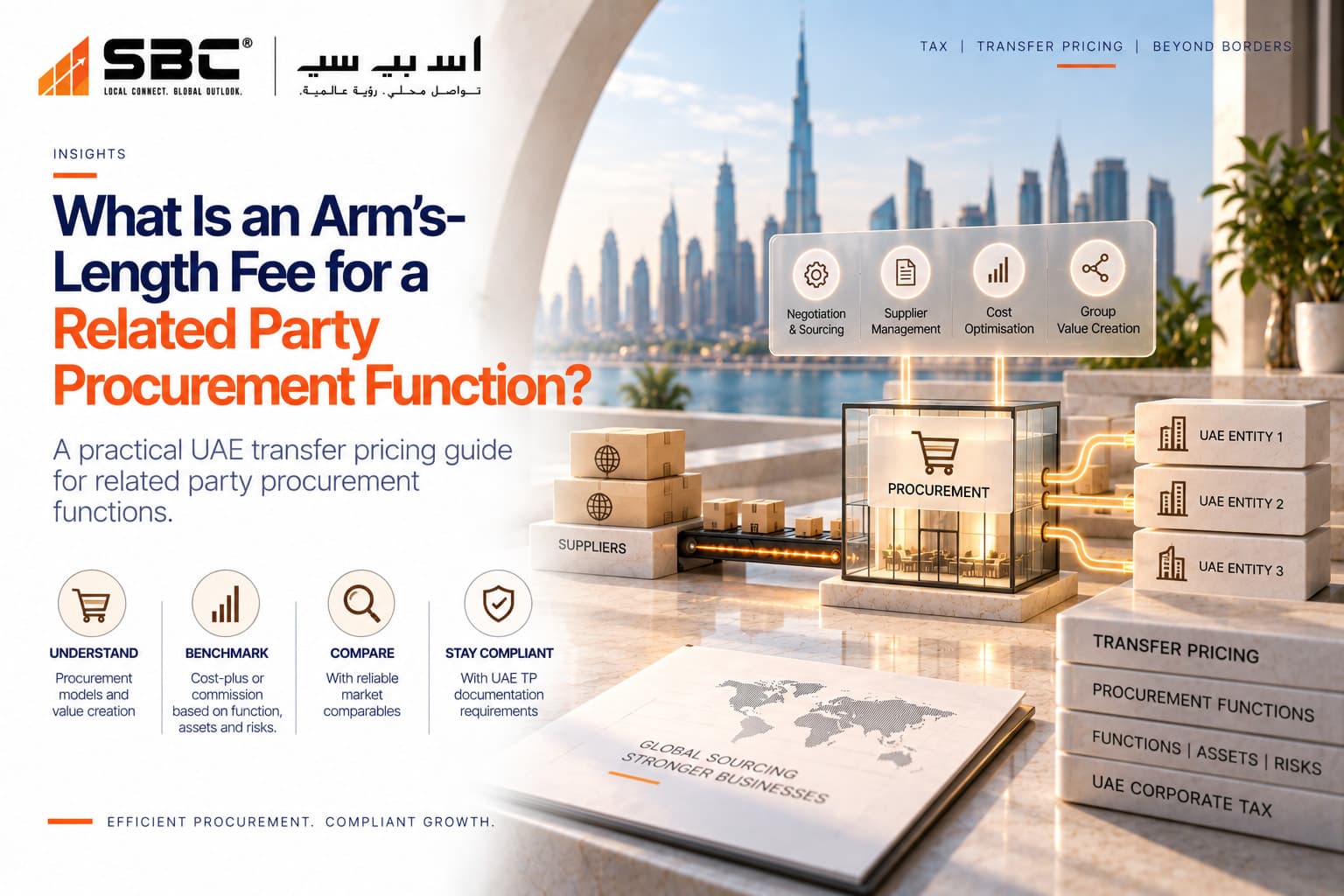
It depends entirely on what the procurement entity actually does. A related-party procurement function that only negotiates terms and passes supplier invoices through is priced very differently from one that takes title to goods, holds inventory and carries credit risk. UAE transfer pricing requires the fee to match the functions performed, assets used and risks assumed - not a single default markup applied regardless of the model.
Key official references include UAE Corporate Tax Law: Article 34 on the Arm's Length Principle, the UAE Federal Tax Authority Transfer Pricing Guide and the FTA Advance Pricing Agreements Guide. Related questions sit in commission and agency arrangements, related-party trading margins and centralised group services.
Groups centralise procurement to gain buying power, standardise supplier terms, and reduce duplication across operating entities. One entity ends up negotiating with suppliers, or buying and reselling goods, on behalf of related companies. Once Corporate Tax applies, the fee, commission or resale margin earned by that procurement entity becomes a related party transaction that needs its own arm's-length analysis. See FTA guidance on Related Parties and Article 35 and FTA guidance on Connected Persons and Article 36.
Why do UAE groups centralise procurement through one related entity?
Consolidated purchasing volume typically secures better pricing, rebates and payment terms than each operating entity negotiating alone. A single procurement function can also standardise supplier vetting, quality control and contract terms across a group. These are genuine commercial benefits, but they do not answer the transfer pricing question of how much the procurement entity should be paid for delivering them.
What are the two basic procurement models, and why does the distinction matter?
The file should describe the procurement model - agent or principal - for each category of goods handled. In the agent or service model, the entity negotiates, coordinates or facilitates purchases without taking title or bearing meaningful risk. In the buy-sell or trading model, the entity buys from third-party suppliers and resells to related operating companies, taking title in between. The fee, commission or resale margin has to match that model, because the two are priced differently.
How is an arm's-length fee for the agent / service model usually determined?
Where the entity only negotiates, coordinates or facilitates purchases without taking title or bearing meaningful risk, a cost-plus fee or a commission expressed as a percentage of purchase value handled is typically the starting point, benchmarked against independent procurement agents, buying groups or sourcing service providers performing a comparable role. The percentage should reflect the complexity of the sourcing activity, not simply the volume of spend passing through the entity.
Can a procurement fee simply be a fixed percentage of purchase volume?
A flat percentage can be reasonable as a mechanic, but the rate itself needs support, and it should not automatically scale with spend if the underlying work does not. Negotiating a large, standardised order is not the same task as sourcing a complex, bespoke component from a new supplier, even though the second may involve a smaller purchase value. Where volume grows but the procurement entity's effort does not grow proportionately, an unadjusted percentage fee can over- or under-reward the function over time.
What if the procurement entity also negotiates rebates or volume discounts from suppliers?
The treatment of rebates should be addressed explicitly rather than left ambiguous. If the procurement entity negotiates a rebate using the group's aggregate buying power and the benefit is intended to flow through to the operating entities that generated the volume, the rebate should generally be passed on, net of a reasonable fee for the entity's role in obtaining it. Allowing rebates to be retained by the procurement entity without economic justification can distort its return well beyond what a comparable independent buying agent would earn.
The FTA's wider corporate tax guidance can be reviewed through FTA Corporate Tax Guides and References.
Does a procurement service entity qualify for the 5% low value-adding simplified approach?
It depends on the activity. The FTA's low value-adding safe harbour specifically excludes certain purchasing activities related to production inputs, so a procurement function tied closely to the group's core production or trading activity may fall outside the simplified approach even if it looks administrative on the surface. A routine, purely administrative purchasing support function with no strategic sourcing role may be a better candidate, but the classification should be tested against the qualifying criteria rather than assumed.
How should a buy-sell procurement or trading entity be priced?
Where the entity buys from third-party suppliers and resells to related operating companies, taking title in between, the arm's-length return is usually a resale margin or markup on cost, benchmarked against independent distributors or trading companies performing comparable functions with comparable risk. The margin should reflect the value the trading entity adds - supplier management, quality assurance, warehousing, credit terms extended to customers - not just the fact that goods physically pass through its books.
What risks does a procurement or trading entity need to actually bear to earn a resale margin?
Taking legal title on paper is not, by itself, enough. To support a genuine trading return, the entity should have the financial capacity to absorb losses, make real decisions about supplier selection, pricing and inventory levels, and actually experience the consequences of those decisions - unsold stock, price movements, or bad debts. An entity that takes title only briefly, is fully indemnified by a related supplier or customer, or has no capital to absorb a loss looks more like an agent than a principal, regardless of how the contract is labelled. See contract versus actual conduct.
What should a related party procurement transfer pricing file contain?
-
A description of the procurement model - agent or principal - for each category of goods handled.
-
A functional analysis covering sourcing, negotiation, quality control, logistics, credit and inventory management.
-
The intercompany procurement or distribution agreement and its fee, commission or margin mechanics.
-
Benchmarking of the fee percentage or resale margin against comparable independent agents or traders.
-
Treatment of rebates, volume discounts and supplier incentives, and how they are shared.
-
Evidence of where inventory, credit and price risk actually sit, including financial capacity to bear them.
-
Reconciliation of fees, commissions or margins to invoices, ledgers and the Corporate Tax Return.
-
A review point where purchase volumes, supplier terms or the operating model change materially.
See FTA Corporate Tax Guides and Public Clarifications and, where thresholds apply, what a UAE Local File should contain.
Who should review a related party procurement arrangement?
Procurement, finance and tax together. Procurement knows what the function actually does day to day; finance knows where risk and margin land in the accounts; tax translates that into a defensible fee or margin structure. A procurement arrangement priced purely on a headline percentage, without checking whether the underlying model is agent or principal, is one of the more common gaps in related party service pricing.
Is cost-plus always the right method for a procurement service entity?
It is a common starting point for a limited-risk agent model, but the mark-up still needs benchmarking, and a principal / buy-sell model is generally tested on a resale margin instead.
For the overall UAE corporate tax context, see the FTA Corporate Tax portal.
Should supplier rebates be kept by the procurement entity?
Generally rebates earned using group buying power should flow through to the entities that generated the volume, net of a reasonable fee, unless there is a specific economic justification for the procurement entity to retain them.
Can the same procurement entity use both models for different goods?
Yes. It is common for an entity to act as agent for some categories and as principal for others; each should be identified and priced on its own facts.
Does the 5% simplified approach automatically apply to a procurement function?
No. Certain purchasing activities related to production inputs are specifically excluded from the low value-adding safe harbour, so the classification needs to be tested.
FTA Corporate Tax Guide - Transfer Pricing (CTGTP1), guidance on low value-adding intra-group services and distribution functions.
OECD Transfer Pricing Guidelines 2022 - Chapter VII, and Chapter I on risk and functional analysis.
Federal Decree-Law No. 47 of 2022 on the Taxation of Corporations and Businesses, as amended - Article 34. UAE Corporate Tax Law: Article 34 on the Arm's Length Principle
How should a UAE finance team start with the facts rather than the tax result?
A strong transfer pricing position starts with the transaction itself. A finance team should first identify what was actually supplied, who performed the work, where the people and assets were located, which entity carried the commercial risk, and what the accounting records show. The tax result should come after that fact pattern is clear. This is especially important in the UAE because the arm's length analysis is not limited to the wording of an invoice. The commercial substance of the arrangement determines which comparability questions need to be answered.
The FTA also explains the arm's length principle in its FTA Transfer Pricing FAQ.
For a UAE group, the practical exercise is usually to build a transaction inventory. List each related party and connected person, describe the transaction, identify the contractual terms, record the annual value, and note the pricing method currently used. Then compare that list with the general ledger, intercompany confirmations, contracts, and tax return disclosures. Differences between those records are often more important than a small difference in the final margin. They can show that the group has not consistently applied its own policy. FTA guidance on Related Parties and Article 35
The FTA's Transfer Pricing Guide is useful as the starting reference because it explains the UAE framework, related party concepts, arm's length analysis and documentation expectations. A finance team should read the guide together with the Corporate Tax Law and the relevant implementing decisions rather than treating a summary article as the legal source.
Why does the functional analysis matter more than the label used in the agreement?
The label of a UAE entity does not determine its transfer pricing outcome. A company described as a distributor may in practice perform substantial marketing, inventory management, credit control and market development functions. Similarly, an entity called a service company may employ senior decision makers, own important assets or assume significant commercial risk. The functional analysis tests what the business actually does.
A useful functional analysis records functions, assets and risks separately. Functions include procurement, sales, manufacturing, logistics, marketing, treasury, management and technology support. Assets include tangible operating assets, working capital and relevant intangible assets. Risks include inventory, foreign exchange, credit, market, product and capacity risk. The analysis should identify who controls each economically significant risk and who has the financial capacity to bear it.
This approach also makes the benchmarking exercise more defensible. If the tested party is selected because it performs routine distribution functions, the comparable set should reflect businesses with similar functions and risk. If the facts show a more complex business, a routine TNMM analysis may need to be reconsidered. The OECD framework and the FTA guide both emphasise comparability and accurate delineation rather than relying on a label alone. FTA Transfer Pricing Methodologies FAQ
The documentation framework is set out by the Ministry of Finance in its Ministry of Finance transfer pricing documentation decision.
How can a UAE group make its transfer pricing evidence consistent with its accounting records?
A defensible file should tell the same story as the books. The intercompany agreement should describe the transaction in a way that is consistent with invoices, ledger accounts, payment flows and the actual conduct of the parties. If the agreement says that a UAE company provides management support but the ledger shows substantial royalty payments, the file should explain the distinction. If a policy says a distributor earns a routine margin but the accounts contain large year-end service charges, the reason should be documented.
The practical control is a transaction reconciliation. Start with the related party ledger and map each material account to the relevant agreement and transfer pricing policy. Reconcile the annual value to the disclosure position. Then check whether the pricing method and tested party in the study correspond to the transaction that was actually booked. This is a simple exercise, but it can identify problems before an FTA request.
The FTA documentation guidance is particularly useful here because documentation is not only a narrative exercise. The purpose is to enable the taxpayer to demonstrate how the arm's length outcome was reached. Good documentation therefore connects the facts, method, comparables, calculations and financial data.
What should management review before signing off the UAE transfer pricing position?
Management should be able to answer five practical questions. What related party transactions occurred? Why did the group choose the pricing method? What evidence supports the price or margin? Does the actual year-end result remain within the intended policy? And can the business reproduce the analysis if the FTA asks for it?
A senior review should also consider changes during the year. A new shareholder, new financing arrangement, new distribution model, major acquisition, new intellectual property arrangement or change in business strategy can affect the comparability analysis. A study prepared at the beginning of the year does not automatically remain appropriate when the operating model changes.
The detailed statutory requirements should be read with Ministerial Decision No. 97 of 2023.
For UAE groups with operations across several jurisdictions, management should also consider consistency between countries. The same transaction may be reviewed by two tax authorities. A position that is accepted in one country may create an adjustment elsewhere if the functional story is inconsistent. That is why the UAE file should be prepared as part of the group's wider transfer pricing governance rather than as a document created only for the UAE tax return.
How should a business prepare for an FTA transfer pricing review?
Preparation should focus on speed, consistency and evidence. The business should know where the current agreements, benchmarking study, transaction schedule, calculations and supporting invoices are stored. The people responsible for tax, finance and the relevant business function should also understand the commercial background well enough to explain the transaction without relying entirely on the adviser who prepared the report.
An audit-ready file normally includes the legal basis, organisational structure, transaction descriptions, functional analysis, selected method, comparability analysis, financial calculations and supporting documents. It should also contain a clear bridge from the tested party's statutory accounts to the financial information used in the benchmarking analysis. Where adjustments have been made, the file should explain why.
The FTA's published materials should be treated as the primary reference point. Where an issue is not answered clearly in a guide, the business should avoid creating a technical conclusion simply because a secondary source says it is common practice. The better approach is to identify the uncertainty, review the legislation and official guidance, and document the judgement applied.
How should a UAE benchmarking study explain the selection of comparables?
A good benchmarking study does not begin with a database screen and end with a percentile range. It explains why the selected companies are economically comparable to the tested party. The search strategy should be understandable to a reader who was not involved in preparing the study.
Where the legal basis needs to be checked, refer to the UAE Corporate Tax Law.
The analysis should explain the tested party, geographic market, industry, functions, assets and risks. It should state the financial period used, screening criteria, reasons for rejecting material candidates and any adjustments made. If the final set is small, the report should explain why. If the set is broad, it should explain why the differences do not undermine reliability.
This is particularly important when an FTA reviewer challenges a comparable. The strongest response is not that the company appeared in a commercial database. It is that the company satisfies the relevant comparability factors and that the differences have been assessed. The OECD Transfer Pricing Guidelines provide the wider international framework for this comparability analysis.
What should a UAE company do when its actual margin is outside the benchmark range?
An outside-range result should trigger an investigation, not an automatic accounting entry. Management should first establish whether the actual result reflects genuine commercial conditions. A distributor may have earned a lower margin because freight costs increased, a new market was entered, inventory became obsolete or the company incurred one-off launch expenses. Those facts may explain the outcome, but they do not automatically prove that the transfer price was arm's length.
The next step is to compare the actual functions and risks with the tested party profile in the benchmarking study. If the business has changed, the study may no longer be reliable. If the business has not changed, management should analyse whether the deviation is temporary or structural. The conclusion should then be documented before any year-end true-up is considered.
For advance pricing agreement considerations, the FTA provides its FTA Advance Pricing Agreement Guide.
A year-end adjustment should be supported by the transfer pricing policy, contractual framework, accounting treatment and tax consequences. It should not be used merely to force the accounts into the middle of a statistical range.
What should be checked at year end before the UAE transfer pricing file is closed?
Year end is where the policy meets the actual numbers. The finance team should compare the agreed pricing mechanism with the recorded transactions and calculate the resulting margin or price. If the result differs materially from the policy expectation, the difference should be investigated before a true-up is booked.
The review should also consider whether the underlying business changed during the year. A new customer segment, supply chain change, new financing, acquisition or restructuring can affect comparability. A transfer pricing file that accurately described the business in January may not fully describe it in December.
The final review should be documented with a short management conclusion. That conclusion should explain whether the policy was applied, whether any adjustment was required and what evidence supports the decision.
How can the technical conclusion be kept practical for UAE management teams?
Transfer pricing is ultimately a business process. The tax department may own the technical analysis, but finance owns the numbers, legal owns many agreements, treasury owns financing, HR owns employee arrangements and business teams understand the commercial reality. A useful UAE policy connects those functions instead of leaving transfer pricing as an isolated annual report.
The FTA's general corporate tax guidance is available in the FTA Corporate Tax General Guide.
For management, the most useful output is a short dashboard showing related party transactions, material movements, current benchmark status, disclosure position, documentation readiness and open technical questions. The detailed report remains important, but the dashboard helps management act before a compliance deadline.
This practical approach also improves the quality of future benchmarking. Each year the group already has a reliable transaction inventory and evidence trail, so the adviser spends more time on technical analysis and less time reconstructing the facts.
What questions is a UAE tax reviewer likely to ask first?
The first questions are usually factual. What is the transaction? Who are the parties? What does each party actually do? Why was the price set this way? What evidence supports the price? How was the tested party selected? Which comparables were considered? How does the result reconcile to the accounts?
A taxpayer should be able to answer these questions consistently across its agreement, TP report, tax return and financial statements. If different documents tell different stories, the reviewer may spend more time testing the transaction.
Preparing these answers in advance is one of the simplest ways to improve the quality of a transfer pricing position. It also forces the business to identify gaps while there is still time to fix them.
For current implementing legislation and FTA decisions, consult the FTA Corporate Tax legislation page.
Official government and international references
For the domestic legal framework, refer to UAE Corporate Tax, Ministry of Finance. FTA FAQ on Domestic and Cross-Border Transfer Pricing
The main FTA guidance is available in FTA Transfer Pricing Guide.
The FTA also maintains current references in FTA Corporate Tax Guides and Public Clarifications.
The FTA explains the core concept in its FTA Transfer Pricing FAQ.
For documentation questions, see FTA Transfer Pricing Documentation FAQ.
The Ministry of Finance explains the documentation framework in Ministry of Finance Transfer Pricing Documentation Decision.
For the international arm's length framework, see OECD Transfer Pricing topic.
For the detailed OECD methodology, see OECD Transfer Pricing Guidelines 2022.
A practical action plan for UAE groups
-
Map all related parties, connected persons and transaction categories against the legal entity structure and general ledger. FTA guidance on Connected Persons and Article 36
-
Document the commercial facts, including functions, assets, risks, contractual terms and actual conduct.
-
Select and document the most appropriate transfer pricing method and explain why the method fits the transaction.
-
Test the pricing or margin against reliable comparable evidence and record the reasons for accepting or rejecting material comparables. OECD Transfer Pricing Guidelines
-
Reconcile the final transfer pricing result to the statutory accounts, intercompany invoices and Corporate Tax return data.
-
Complete the relevant disclosure and documentation checks before the filing process is closed, and retain supporting evidence in an accessible audit file.
Frequently asked questions
Is cost-plus always the right method for a procurement service entity?
It is a common starting point for a limited-risk agent model, but the mark-up still needs benchmarking, and a principal / buy-sell model is generally tested on a resale margin instead.
Should supplier rebates be kept by the procurement entity?
Generally rebates earned using group buying power should flow through to the entities that generated the volume, net of a reasonable fee, unless there is a specific economic justification for the procurement entity to retain them.
Can the same procurement entity use both models for different goods?
Yes. It is common for an entity to act as agent for some categories and as principal for others; each should be identified and priced on its own facts.
Does the 5% simplified approach automatically apply to a procurement function?
No. Certain purchasing activities related to production inputs are specifically excluded from the low value-adding safe harbour, so the classification needs to be tested.
Does the UAE arm's length principle apply to domestic related party transactions?
Yes. The UAE framework applies to relevant related party and connected person transactions regardless of whether the counterparty is in the UAE or outside the UAE, subject to the applicable rules and definitions.
When should a UAE business refresh its transfer pricing analysis?
The analysis should be reviewed when the business, transaction, functions, assets or risks change materially. Comparable financial data should also be kept current in line with the taxpayer's benchmarking approach.
What evidence should be retained for an FTA review?
Retain agreements, invoices, transaction schedules, functional analysis, benchmarking support, calculations, allocation keys, approvals and the evidence used to reconcile the TP result to the accounts.
Is a benchmarking report enough to support an arm's length position?
Not by itself. The report should explain the transaction, functional profile, method selection, comparable selection, financial calculations and the link between the tested result and the accounting records.
Can the actual year end result differ from the transfer pricing policy?
Yes, but the difference should be investigated and documented. A year end true up should be supported by the commercial facts, policy, contractual framework and applicable tax and accounting treatment.
How should management respond when the transaction facts change during the year?
The change should be documented promptly. A new financing arrangement, acquisition, restructuring, new service, change in functions or major market change can affect the existing analysis and should trigger a review.
Which official sources should a UAE taxpayer check before relying on transfer pricing guidance?
Start with the official Ministry of Finance and Federal Tax Authority materials in the UAE. For international methodology, the OECD Transfer Pricing Guidelines are the main reference. For Saudi matters, use ZATCA's published regulations and guidance.
Primary sources and further reading
How SBC Tax Consulting can help
SBC's transfer pricing team delineates agent and principal procurement models, benchmarks the fee or resale margin, and documents rebates and risk for the Local File. Related reading includes management fees and commission arrangements. Contact SBC before the next group purchasing or buy-sell arrangement is priced.
This publication is for general information only and does not constitute professional advice. Please consult your SBC advisor before acting on any matter covered here.