
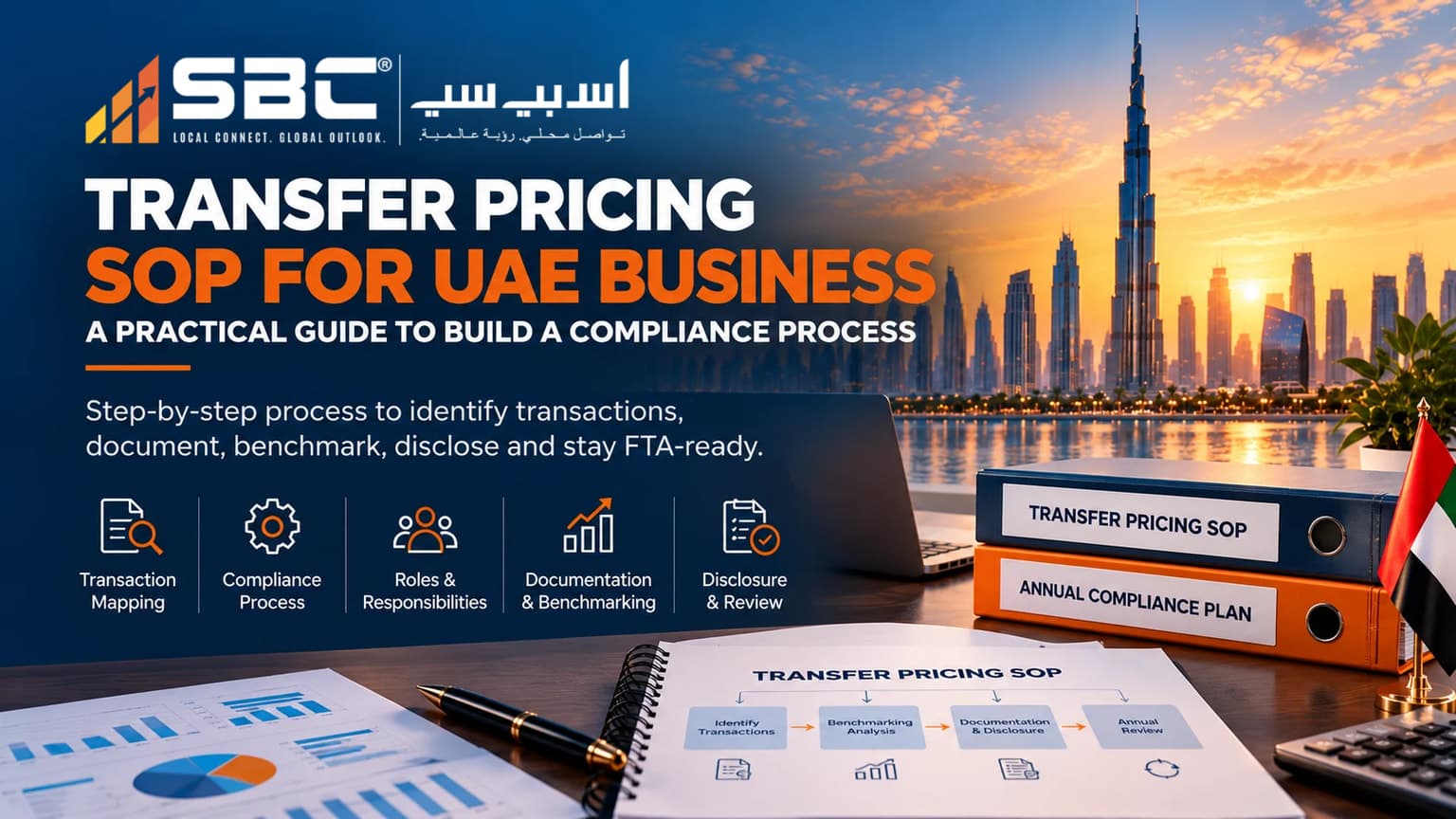
A transfer pricing standard operating procedure (SOP) is the internal playbook that turns the FTA's arm's length requirements into a repeatable annual process, rather than a scramble every time a return is due or a request letter arrives. Under Federal Decree-Law No. 47 of 2022 and Ministerial Decision No. 97 of 2023, a UAE business transacting with related parties or connected persons must be able to show, on 30 days' notice, that its pricing is arm's length and properly documented. An SOP is what makes that possible without a fire drill.
Key official references include UAE Corporate Tax Law: Article 34 on the Arm's Length Principle, the UAE Federal Tax Authority Transfer Pricing Guide and Ministerial Decision No. 97 of 2023 on Transfer Pricing Documentation. Related questions sit in how to build a transfer pricing policy, the UAE Local File and an audit-ready defence file.
What is a transfer pricing SOP, and why does a UAE business need one?
A TP SOP is a written internal procedure that assigns ownership, sets deadlines and fixes the steps a business follows to stay compliant with Article 34 (arm's length principle) and Article 55 (documentation and disclosure) of the Corporate Tax Law. Without one, TP compliance tends to depend on a single person's memory of what was done last year, which breaks down exactly when it matters most - during a restructuring, a new hire in the finance team, or an FTA information request with a tight deadline.
What should a UAE TP SOP actually cover?
At minimum, an SOP should cover six things: how related-party and connected-person transactions are identified and mapped, how the Master File and Local File thresholds are tested each year, who owns each documentation task, when the benchmarking calendar runs, how the disclosure form is compiled and reviewed, and what happens when a material business change occurs mid-cycle. See FTA guidance on Transfer Pricing Documentation and the Local File.
Step 1: Map related-party and connected-person transactions
Start by listing every transaction with a related party or connected person for the tax period - intercompany sales, service charges, financing, royalties, cost-sharing arrangements and management fees. The SOP should specify who compiles this list, which systems or ledgers they pull it from, and how often it is refreshed, since new intercompany arrangements are one of the easiest things to miss between filings. See FTA guidance on Connected Persons and Article 36.
Step 2: Assess Master File and Local File thresholds
Under Ministerial Decision No. 97 of 2023, a Taxable Person must maintain both a Master File and a Local File if it is part of an MNE Group with total consolidated global revenue of AED 3.15 billion or more, or if its own standalone revenue is AED 200 million or more. The SOP should set out how this test is re-run every tax period, since revenue can cross a threshold even when the business structure has not changed. Businesses below both thresholds are not exempt from the arm's length principle - they must still be able to support their pricing, including with benchmarking studies, if the FTA asks. See Ministry of Finance guidance on Master File and Local File thresholds and Ministerial Decision No. 97 of 2023.
Step 3: Assign ownership and set review triggers
Name an owner for each documentation task, and separately name who is responsible for flagging trigger events - a restructuring, an acquisition, a new category of related-party transaction, or a comparable becoming unreliable. These triggers usually originate outside the tax function, so the SOP should require finance and the business unit to notify tax as soon as they happen, not at year-end.
The FTA's wider corporate tax guidance can be reviewed through FTA Corporate Tax Guides and References.
Step 4: Build the documentation and benchmarking calendar
Fix dates for the annual benchmarking data refresh, the three-year full comparable search, and the three-year TP policy review, and align all three where possible so they are not run separately in different years. The calendar should sit with the same owner who tracks the disclosure form deadline, so documentation and filing do not drift out of sync.
Step 5: Set the disclosure form and filing checklist
The Related Party and Connected Person disclosure form is filed alongside the Corporate Tax return, and the SOP should set out who prepares it, who reviews it, and what supporting workpapers back each disclosed figure. Building this checklist once and reusing it each period is one of the simplest ways an SOP saves time. See the UAE Transfer Pricing Disclosure Form.
Step 6: Put governance and sign-off in writing
Before anything is submitted to the FTA, the SOP should require a named sign-off - typically the head of tax or CFO - confirming that the transaction mapping, threshold assessment, benchmarking and disclosure form are all consistent with one another. It should also set the retention period for supporting files, which is seven years under the UAE's record-keeping rules.
Does the SOP replace the TP policy or the benchmarking study?
No. The three documents serve different purposes: the TP policy sets the pricing methodology, the benchmarking study evidences that the methodology produces an arm's length result, and the SOP is the internal process that keeps both current and makes sure they are produced, reviewed and filed on time. A business can have a sound TP policy and still fail an audit if the SOP behind it is missing. See transfer pricing policy versus documentation.
Who should own the SOP?
Tax should hold the master SOP document and be accountable for keeping it current, but the SOP only works if finance and the business unit are built into it - specifically, required to flag restructurings, new intercompany arrangements or major contract changes as they happen. An SOP that lives only in the tax team's inbox will miss the triggers that reset the documentation clock.
For the overall UAE corporate tax context, see the FTA Corporate Tax portal.
Is a transfer pricing SOP a legal requirement under UAE Corporate Tax?
Not by name. The Corporate Tax Law requires arm's length pricing, documentation and a disclosure form, but it does not mandate a document called an "SOP." In practice, an SOP is the internal control that makes those legal requirements repeatable year after year instead of being re-solved from scratch each filing season.
Who should draft the SOP - tax, finance or an external advisor?
Tax typically drafts and owns it, since the disclosure form and documentation sit with tax. Finance and the business unit should review it, because they hold the transaction data and are usually the first to know about a restructuring or new intercompany arrangement.
Does a small UAE company below the documentation thresholds still need an SOP?
Yes, in a lighter form. Even a Taxable Person below the AED 200 million standalone or AED 3.15 billion MNE Group thresholds must still support the arm's length nature of related-party transactions on request and complete the disclosure form, so a simplified SOP still helps.
How often should the SOP itself be reviewed?
Align it with the same three-year cycle as the TP policy and full benchmarking refresh, and revisit it sooner whenever a trigger event - restructuring, new transaction type, or a change in group structure - occurs.
What is the single most common gap in a UAE company's TP process?
Missing ownership. Documentation requirements are usually known, but no one is named as responsible for tracking the three-year clock or flagging a material change, so the update simply does not happen until the FTA asks for it.
The FTA also explains the arm's length principle in its FTA Transfer Pricing FAQ.
Federal Decree-Law No. 47 of 2022 on the Taxation of Corporations and Businesses, as amended - Articles 34 and 55.
Ministerial Decision No. 97 of 2023 on Requirements for Maintaining Transfer Pricing Documentation.
OECD Transfer Pricing Guidelines for Multinational Enterprises and Tax Administrations (2022). FTA Transfer Pricing Guide
How should a UAE finance team start with the facts rather than the tax result?
A strong transfer pricing position starts with the transaction itself. A finance team should first identify what was actually supplied, who performed the work, where the people and assets were located, which entity carried the commercial risk, and what the accounting records show. The tax result should come after that fact pattern is clear. This is especially important in the UAE because the arm's length analysis is not limited to the wording of an invoice. The commercial substance of the arrangement determines which comparability questions need to be answered.
For a UAE group, the practical exercise is usually to build a transaction inventory. List each related party and connected person, describe the transaction, identify the contractual terms, record the annual value, and note the pricing method currently used. Then compare that list with the general ledger, intercompany confirmations, contracts, and tax return disclosures. Differences between those records are often more important than a small difference in the final margin. They can show that the group has not consistently applied its own policy.
The FTA also explains the arm's length principle in its FTA Transfer Pricing FAQ.
The FTA's Transfer Pricing Guide is useful as the starting reference because it explains the UAE framework, related party concepts, arm's length analysis and documentation expectations. A finance team should read the guide together with the Corporate Tax Law and the relevant implementing decisions rather than treating a summary article as the legal source.
Why does the functional analysis matter more than the label used in the agreement?
The label of a UAE entity does not determine its transfer pricing outcome. A company described as a distributor may in practice perform substantial marketing, inventory management, credit control and market development functions. Similarly, an entity called a service company may employ senior decision makers, own important assets or assume significant commercial risk. The functional analysis tests what the business actually does.
A useful functional analysis records functions, assets and risks separately. Functions include procurement, sales, manufacturing, logistics, marketing, treasury, management and technology support. Assets include tangible operating assets, working capital and relevant intangible assets. Risks include inventory, foreign exchange, credit, market, product and capacity risk. The analysis should identify who controls each economically significant risk and who has the financial capacity to bear it.
This approach also makes the benchmarking exercise more defensible. If the tested party is selected because it performs routine distribution functions, the comparable set should reflect businesses with similar functions and risk. If the facts show a more complex business, a routine TNMM analysis may need to be reconsidered. The OECD framework and the FTA guide both emphasise comparability and accurate delineation rather than relying on a label alone. FTA Transfer Pricing Methodologies FAQ
How can a UAE group make its transfer pricing evidence consistent with its accounting records?
A defensible file should tell the same story as the books. The intercompany agreement should describe the transaction in a way that is consistent with invoices, ledger accounts, payment flows and the actual conduct of the parties. If the agreement says that a UAE company provides management support but the ledger shows substantial royalty payments, the file should explain the distinction. If a policy says a distributor earns a routine margin but the accounts contain large year-end service charges, the reason should be documented.
The documentation framework is set out by the Ministry of Finance in its Ministry of Finance transfer pricing documentation decision.
The practical control is a transaction reconciliation. Start with the related party ledger and map each material account to the relevant agreement and transfer pricing policy. Reconcile the annual value to the disclosure position. Then check whether the pricing method and tested party in the study correspond to the transaction that was actually booked. This is a simple exercise, but it can identify problems before an FTA request.
The FTA documentation guidance is particularly useful here because documentation is not only a narrative exercise. The purpose is to enable the taxpayer to demonstrate how the arm's length outcome was reached. Good documentation therefore connects the facts, method, comparables, calculations and financial data.
What should management review before signing off the UAE transfer pricing position?
Management should be able to answer five practical questions. What related party transactions occurred? Why did the group choose the pricing method? What evidence supports the price or margin? Does the actual year-end result remain within the intended policy? And can the business reproduce the analysis if the FTA asks for it?
A senior review should also consider changes during the year. A new shareholder, new financing arrangement, new distribution model, major acquisition, new intellectual property arrangement or change in business strategy can affect the comparability analysis. A study prepared at the beginning of the year does not automatically remain appropriate when the operating model changes.
The detailed statutory requirements should be read with Ministerial Decision No. 97 of 2023.
For UAE groups with operations across several jurisdictions, management should also consider consistency between countries. The same transaction may be reviewed by two tax authorities. A position that is accepted in one country may create an adjustment elsewhere if the functional story is inconsistent. That is why the UAE file should be prepared as part of the group's wider transfer pricing governance rather than as a document created only for the UAE tax return.
How should a business prepare for an FTA transfer pricing review?
Preparation should focus on speed, consistency and evidence. The business should know where the current agreements, benchmarking study, transaction schedule, calculations and supporting invoices are stored. The people responsible for tax, finance and the relevant business function should also understand the commercial background well enough to explain the transaction without relying entirely on the adviser who prepared the report.
An audit-ready file normally includes the legal basis, organisational structure, transaction descriptions, functional analysis, selected method, comparability analysis, financial calculations and supporting documents. It should also contain a clear bridge from the tested party's statutory accounts to the financial information used in the benchmarking analysis. Where adjustments have been made, the file should explain why.
The FTA's published materials should be treated as the primary reference point. Where an issue is not answered clearly in a guide, the business should avoid creating a technical conclusion simply because a secondary source says it is common practice. The better approach is to identify the uncertainty, review the legislation and official guidance, and document the judgement applied.
What makes related party financing different from ordinary operating transactions?
Financial transactions require a different level of analysis because the price is closely linked to credit risk, maturity, currency, security, ranking, guarantees and the borrower's ability to repay. A simple comparison of interest rates can be misleading. The first question is whether the arrangement should be treated as debt at all. The next question is what an independent lender would have considered before agreeing to the terms.
Where the legal basis needs to be checked, refer to the UAE Corporate Tax Law.
For UAE groups, the credit profile of the borrower should be documented before selecting an interest rate. The analysis can consider standalone financial strength, group support, purpose of the funding, repayment profile, available security, currency and market conditions. Where a guarantee is involved, the benefit of the guarantee should be analysed rather than assuming that every group guarantee automatically attracts a fee.
The OECD financial transactions guidance is a useful technical reference for these questions, while the UAE FTA guide provides the domestic transfer pricing framework. FTA FAQ on Domestic and Cross-Border Transfer Pricing
How should treasury teams document the commercial terms of a related party loan?
The loan file should look like the file a bank would expect to see. It should state principal, currency, drawdown date, maturity, repayment schedule, interest basis, security, covenants, subordination and default provisions. The group should also retain evidence of how the borrower was expected to service the debt at the time the transaction was entered into.
For a UAE taxpayer, this evidence is important because an arm's length interest rate cannot be assessed properly without understanding the underlying instrument. A five-year unsecured loan to a financially weak entity is not comparable to a short-term secured facility to a highly profitable borrower. The documentation should therefore explain the economic characteristics before presenting the comparable rates.
Where the transaction is part of a wider cash pooling or treasury arrangement, the analysis should also distinguish the central treasury function from the individual funding positions. The economic role of the cash pool leader, the allocation of funding benefits and the treatment of liquidity risk should be considered separately.
For advance pricing agreement considerations, the FTA provides its FTA Advance Pricing Agreement Guide.
What should be checked at year end before the UAE transfer pricing file is closed?
Year end is where the policy meets the actual numbers. The finance team should compare the agreed pricing mechanism with the recorded transactions and calculate the resulting margin or price. If the result differs materially from the policy expectation, the difference should be investigated before a true-up is booked.
The review should also consider whether the underlying business changed during the year. A new customer segment, supply chain change, new financing, acquisition or restructuring can affect comparability. A transfer pricing file that accurately described the business in January may not fully describe it in December. OECD Transfer Pricing Guidelines
The final review should be documented with a short management conclusion. That conclusion should explain whether the policy was applied, whether any adjustment was required and what evidence supports the decision.
How can the technical conclusion be kept practical for UAE management teams?
Transfer pricing is ultimately a business process. The tax department may own the technical analysis, but finance owns the numbers, legal owns many agreements, treasury owns financing, HR owns employee arrangements and business teams understand the commercial reality. A useful UAE policy connects those functions instead of leaving transfer pricing as an isolated annual report.
For management, the most useful output is a short dashboard showing related party transactions, material movements, current benchmark status, disclosure position, documentation readiness and open technical questions. The detailed report remains important, but the dashboard helps management act before a compliance deadline.
The FTA's general corporate tax guidance is available in the FTA Corporate Tax General Guide.
This practical approach also improves the quality of future benchmarking. Each year the group already has a reliable transaction inventory and evidence trail, so the adviser spends more time on technical analysis and less time reconstructing the facts.
What questions is a UAE tax reviewer likely to ask first?
The first questions are usually factual. What is the transaction? Who are the parties? What does each party actually do? Why was the price set this way? What evidence supports the price? How was the tested party selected? Which comparables were considered? How does the result reconcile to the accounts?
A taxpayer should be able to answer these questions consistently across its agreement, TP report, tax return and financial statements. If different documents tell different stories, the reviewer may spend more time testing the transaction.
Preparing these answers in advance is one of the simplest ways to improve the quality of a transfer pricing position. It also forces the business to identify gaps while there is still time to fix them.
For current implementing legislation and FTA decisions, consult the FTA Corporate Tax legislation page.
Official government and international references
For the domestic legal framework, refer to UAE Corporate Tax, Ministry of Finance.
The main FTA guidance is available in FTA Transfer Pricing Guide.
The FTA also maintains current references in FTA Corporate Tax Guides and Public Clarifications.
The FTA explains the core concept in its FTA Transfer Pricing FAQ.
For documentation questions, see FTA Transfer Pricing Documentation FAQ.
The Ministry of Finance explains the documentation framework in Ministry of Finance Transfer Pricing Documentation Decision.
For the international arm's length framework, see OECD Transfer Pricing topic.
For the detailed OECD methodology, see OECD Transfer Pricing Guidelines 2022.
A practical action plan for UAE groups
-
Map all related parties, connected persons and transaction categories against the legal entity structure and general ledger.
-
Document the commercial facts, including functions, assets, risks, contractual terms and actual conduct.
-
Select and document the most appropriate transfer pricing method and explain why the method fits the transaction.
-
Test the pricing or margin against reliable comparable evidence and record the reasons for accepting or rejecting material comparables.
-
Reconcile the final transfer pricing result to the statutory accounts, intercompany invoices and Corporate Tax return data.
-
Complete the relevant disclosure and documentation checks before the filing process is closed, and retain supporting evidence in an accessible audit file.
Frequently asked questions
Is a transfer pricing SOP a legal requirement under UAE Corporate Tax?
Not by name. The Corporate Tax Law requires arm's length pricing, documentation and a disclosure form, but it does not mandate a document called an "SOP." In practice, an SOP is the internal control that makes those legal requirements repeatable year after year instead of being re-solved from scratch each filing season.
Who should draft the SOP - tax, finance or an external advisor?
Tax typically drafts and owns it, since the disclosure form and documentation sit with tax. Finance and the business unit should review it, because they hold the transaction data and are usually the first to know about a restructuring or new intercompany arrangement.
Does a small UAE company below the documentation thresholds still need an SOP?
Yes, in a lighter form. Even a Taxable Person below the AED 200 million standalone or AED 3.15 billion MNE Group thresholds must still support the arm's length nature of related-party transactions on request and complete the disclosure form, so a simplified SOP still helps.
How often should the SOP itself be reviewed?
Align it with the same three-year cycle as the TP policy and full benchmarking refresh, and revisit it sooner whenever a trigger event - restructuring, new transaction type, or a change in group structure - occurs.
What is the single most common gap in a UAE company's TP process?
Missing ownership. Documentation requirements are usually known, but no one is named as responsible for tracking the three-year clock or flagging a material change, so the update simply does not happen until the FTA asks for it.
Does the UAE arm's length principle apply to domestic related party transactions?
Yes. The UAE framework applies to relevant related party and connected person transactions regardless of whether the counterparty is in the UAE or outside the UAE, subject to the applicable rules and definitions.
When should a UAE business refresh its transfer pricing analysis?
The analysis should be reviewed when the business, transaction, functions, assets or risks change materially. Comparable financial data should also be kept current in line with the taxpayer's benchmarking approach.
What evidence should be retained for an FTA review?
Retain agreements, invoices, transaction schedules, functional analysis, benchmarking support, calculations, allocation keys, approvals and the evidence used to reconcile the TP result to the accounts.
Is a benchmarking report enough to support an arm's length position?
Not by itself. The report should explain the transaction, functional profile, method selection, comparable selection, financial calculations and the link between the tested result and the accounting records.
Can the actual year end result differ from the transfer pricing policy?
Yes, but the difference should be investigated and documented. A year end true up should be supported by the commercial facts, policy, contractual framework and applicable tax and accounting treatment.
How should management respond when the transaction facts change during the year?
The change should be documented promptly. A new financing arrangement, acquisition, restructuring, new service, change in functions or major market change can affect the existing analysis and should trigger a review.
Which official sources should a UAE taxpayer check before relying on transfer pricing guidance?
Start with the official Ministry of Finance and Federal Tax Authority materials in the UAE. For international methodology, the OECD Transfer Pricing Guidelines are the main reference. For Saudi matters, use ZATCA's published regulations and guidance.
Primary sources and further reading
How SBC Tax Consulting can help
SBC's transfer pricing team designs the SOP, assigns ownership across tax and finance, and lines the benchmarking calendar up with the disclosure form and Local File. See also how to build a transfer pricing policy and an audit-ready defence file. Contact SBC before the next filing cycle.
This publication is for general information only and does not constitute professional advice. Please consult your SBC advisor before acting on any matter covered here.