
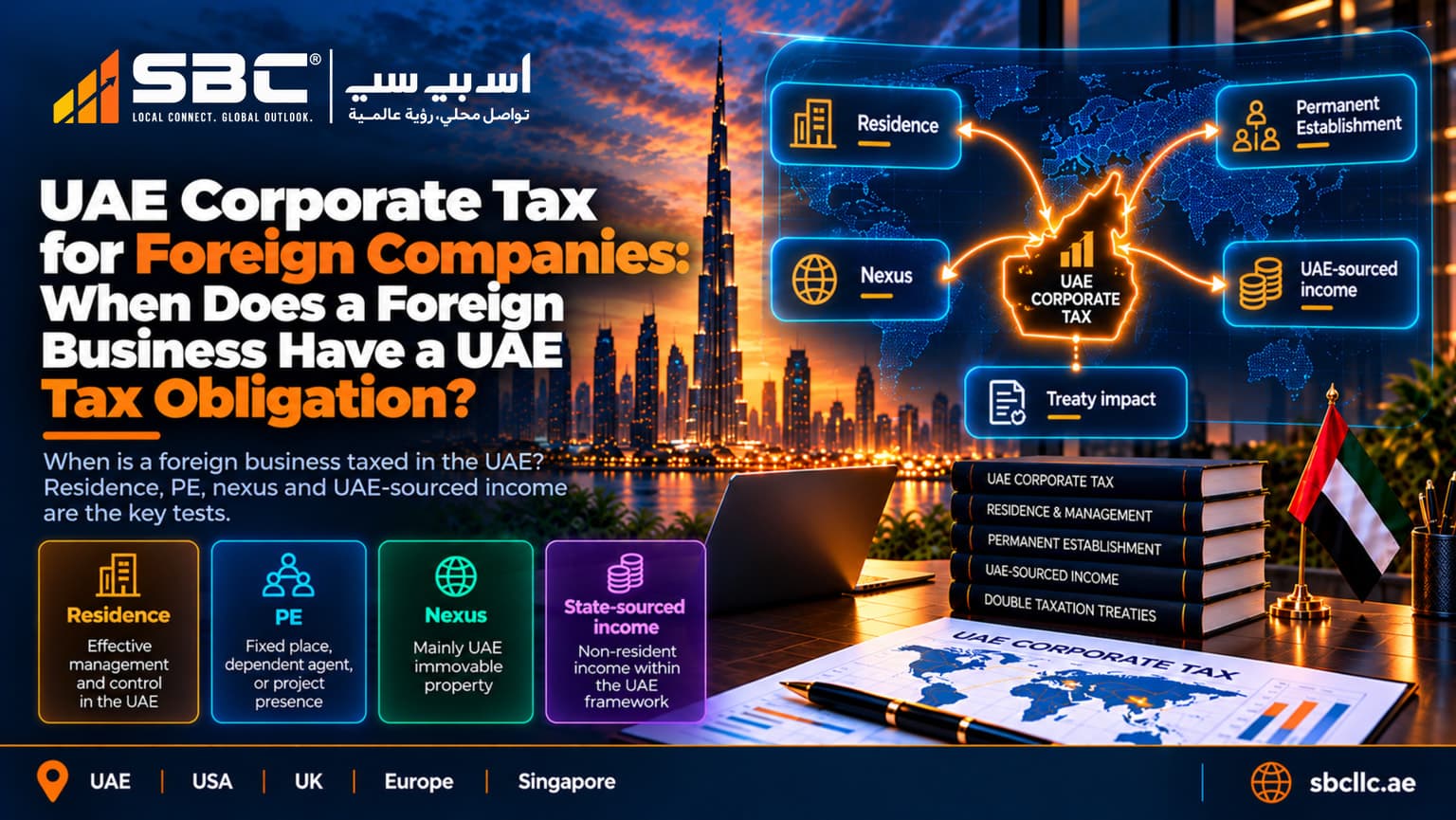
Direct answer: A foreign company does not become liable to UAE Corporate Tax simply because it sells to UAE customers or receives money from the UAE. Liability arises only if the company is a UAE Resident Person (because it is effectively managed and controlled in the UAE), has a Permanent Establishment (PE) in the UAE, has a UAE nexus (mainly income from UAE immovable property), or earns State Sourced Income that falls within the non-resident rules. Where a double tax treaty applies, it can narrow each of these outcomes.
Why this question keeps coming up
Almost every week a business owner or CFO asks me some version of the same question: "We are incorporated overseas and we have a few clients in Dubai. Do we owe tax in the UAE?" The honest answer is "not necessarily, but you need to test it properly."
The UAE Corporate Tax regime, introduced by Federal Decree-Law No. 47 of 2022 and applicable to Tax Periods starting on or after 1 June 2023, does not tax foreign companies by reference to where their customers are. It taxes them by reference to residence, presence and source. Those three ideas are easy to confuse, and confusing them is the most common reason foreign groups either register when they do not need to or, more seriously, fail to register when they do.
This guide walks through the tests in the order I apply them in practice, explains how a foreign company is taxed once it is in scope, and sets out the evidence worth keeping. It is written for business owners, CFOs and finance teams. The official starting points are the Ministry of Finance Corporate Tax hub and the Federal Tax Authority's Corporate Tax guides and references.
What is a "foreign company" for UAE Corporate Tax?
In practical terms, a foreign company is a juridical person incorporated or formed outside the UAE. That covers:
-
An overseas company with no UAE presence at all that sells goods or services to UAE customers.
-
An overseas company with a UAE branch, representative office or other place of business.
-
An overseas company whose employees, agents or related parties operate in the UAE.
-
An overseas company that is owned or directed by people based in the UAE.
Place of incorporation is the starting point, not the answer. The Corporate Tax Law looks at where the company is managed, what it does in the UAE and where its income comes from. Two foreign companies incorporated in the same country can have completely different UAE outcomes.
The five-question test for a foreign company
I find it useful to work through five questions in a fixed order. Stop as soon as you reach a conclusion that is supported by evidence, but do not skip a question just because the answer seems obvious.
-
Is the company effectively managed and controlled in the UAE? If yes, it is a Resident Person and is taxed on worldwide income.
-
Does the company have a Permanent Establishment in the UAE? If yes, it is taxed on the income attributable to that PE.
-
Does the company have a nexus in the UAE? Under Cabinet Decision No. 35 of 2025, this mainly concerns income from UAE immovable property.
-
Does the company earn State Sourced Income that is not attributable to a PE? If yes, it falls within the withholding tax framework, currently at 0%.
-
Does a double tax treaty with the company's home country change the result? Treaty rules on residence, PE and business profits can override the domestic position.
The sections below take each in turn.
Route 1: Residence through effective management and control
A foreign-incorporated juridical person is a UAE Resident Person if it is effectively managed and controlled in the UAE (Article 11 of the Corporate Tax Law). A Resident Person is taxable on its worldwide income, which is a very different position from the limited, UAE-focused taxation of a non-resident.
The FTA describes effective management and control as the place where the key management and commercial decisions needed to run the business as a whole are, in substance, made. The test is about substance, not formality. Some practical points that matter:
-
Directors need not live in the UAE. A UAE-resident director does not by itself make the company UAE-resident, and a non-resident director does not by itself prevent it.
-
A UAE bank account or UAE customers are not enough. They are, at most, background facts.
-
Where decisions are really made matters more than where minutes are signed. If a board in Dubai merely ratifies decisions already taken by management elsewhere, the formal meeting location carries little weight.
-
The assessment is made over the Tax Period. What counts is where key decisions are regularly and predominantly made during that period.
I deal with this test, the evidence that supports or rebuts it, and the difference between residence and a Tax Residency Certificate in UAE Tax Residency for Companies: Where Is Your Business Tax Resident?.
Route 2: Permanent Establishment in the UAE
A Non-Resident Person is taxable on income attributable to a UAE Permanent Establishment. Article 14 of the Corporate Tax Law sets out the PE rules, and the FTA's Permanent Establishment guidance explains how they are applied.
In broad terms, a foreign company can create a UAE PE through:
-
A fixed place of business through which it carries on business, such as an office, branch, factory, workshop or place of management. A UAE branch will usually fall into this category because it is an extension of the foreign company, not a separate legal entity.
-
A dependent agent who habitually concludes contracts, or plays the principal role in concluding them, on the foreign company's behalf.
-
A building site, construction, assembly or installation project (or related supervisory activity) that continues for more than six months, alone or together with connected projects.
Two carve-outs are important. Activities that are only preparatory or auxiliary, such as storing, displaying or delivering goods, or collecting information, do not by themselves create a PE. An agent that is genuinely independent and acts in the ordinary course of its own business does not normally create one either.
The most common problem I see is not a formal branch. It is a senior salesperson or country manager, employed by the foreign company or by a related UAE entity, who negotiates and effectively closes deals from a Dubai office or co-working space. That pattern deserves a proper review. For a full treatment, see Permanent Establishment in the UAE: Comprehensive Corporate Tax Guide.
Owning a UAE subsidiary does not, by itself, create a PE of the foreign parent. The subsidiary is a separate taxpayer. The risk arises when the parent is in substance carrying on its own business through the subsidiary's premises or personnel.
Route 3: Nexus, mainly through UAE immovable property
The Corporate Tax Law also allows a Cabinet Decision to specify when a non-resident has a "nexus" in the UAE. Cabinet Decision No. 35 of 2025 replaced the earlier Cabinet Decision No. 56 of 2023 and applies to Tax Periods starting on or after 1 January 2025. The Ministry of Finance announced it in its news release on the nexus decision.
In summary, a non-resident has a nexus where it derives income from immovable property in the UAE. That includes income from the sale, disposal, letting, sub-letting or other exploitation of the property, and it also reaches certain artificial transfers of rights in UAE property. A non-resident with a nexus must register for Corporate Tax under Article 51 of the Corporate Tax Law.
If your overseas company, or a fund or investor structure behind it, owns UAE real estate, do not assume that "no office, no staff" means "no UAE tax". Property income is the area where foreign companies are most likely to be surprised.
Route 4: State Sourced Income and the 0% withholding tax rate
Article 13 of the Corporate Tax Law defines State Sourced Income. Broadly, it is income accruing in, or derived from, the UAE, including income from activities performed, assets located, capital invested, rights used or services performed or benefited from in the UAE, and certain specified categories such as interest secured on UAE property.
A Non-Resident Person with State Sourced Income that is not attributable to a UAE PE falls within the withholding tax framework in Article 45. The rate set by Cabinet Decision is currently 0%. That means the UAE payer does not deduct tax, and the framework by itself does not normally create a filing burden for the foreign recipient. It is a rate, not a permanent exemption, and the Cabinet can change it.
This is why "we have UAE customers" is not a sufficient trigger for liability. Whether the income is State Sourced, and whether it is attributable to a PE, are separate questions. I cover the payer's side of this in UAE Withholding Tax on Cross-Border Payments: What Businesses Need to Know.
How a foreign company is taxed once it is in scope
The outcome depends on the route into the net.
| Route | What is taxed | Typical result |
|---|---|---|
| Resident Person (effective management and control) | Worldwide Taxable Income, subject to exemptions and foreign tax credit | 0% up to AED 375,000, 9% above |
| Permanent Establishment | Taxable Income attributable to the PE | 0% up to AED 375,000, 9% above |
| Nexus (immovable property) | Taxable Income attributable to the nexus | Standard rates, registration required |
| State Sourced Income without a PE | Within the withholding framework | 0% withholding at present |
Four practical points on the numbers:
-
The standard rates are 0% on Taxable Income up to AED 375,000 and 9% on the excess.
-
Taxable Income starts from accounting profit prepared under IFRS (or IFRS for SMEs where revenue is AED 50 million or less) and is then adjusted. The FTA's Determination of Taxable Income guide is the best practical reference.
-
For a PE, profits are determined as if the PE were a separate and independent person dealing at arm's length. That requires a proper functional analysis and records.
-
Transactions between a PE and its head office or other group companies can bring transfer pricing rules into play.
A branch registered in a Free Zone is treated as a Free Zone Person. Whether it can access the 0% regime is a separate assessment under the Qualifying Free Zone Person rules, and income attributable to a PE is excluded from Qualifying Income under Cabinet Decision No. 100 of 2023. The FTA's Free Zone Persons guide deals with this in detail.
Double tax treaties can change the answer
The UAE has an extensive treaty network, and the Ministry of Finance publishes the treaties on its double taxation agreements page and in an interactive treaty dashboard. Under Article 66 of the Corporate Tax Law, a treaty prevails to the extent it is inconsistent with the domestic law.
For a foreign company, a treaty can matter in three ways:
-
Residence. If both the UAE and the home country treat the company as resident, the treaty tie-breaker (commonly based on place of effective management) decides.
-
PE definition. A treaty may set a longer construction threshold, such as 12 months, or a different dependent-agent test, than the domestic six-month rule.
-
Business profits. The treaty may limit the UAE's right to tax business profits of a treaty resident to those attributable to a treaty PE.
Treaties are not interchangeable. The wording of the specific agreement controls, and the structure of the OECD Model Tax Convention is a guide to how most are built, not a substitute for reading the text. I explain the practical steps in UAE Double Tax Treaties: How Can UAE Businesses Reduce International Tax Exposure?.
Illustrative scenarios
These are simplified examples. Real outcomes depend on the full facts and on any applicable treaty.
| Scenario | Likely UAE position |
|---|---|
| A foreign software company sells subscriptions online to UAE customers, with no UAE staff, office or agent | Likely no PE and no residence. Income is within the withholding framework at 0%. Review source rules and treaty |
| A foreign trading company leases an office in Dubai where its employees negotiate and sign customer contracts | A fixed place of business and possibly agent activity. A PE is likely, so profits attributable to it are taxable and registration is required |
| A foreign holding company is incorporated overseas, but its CEO and CFO take all investment decisions from Abu Dhabi | Real risk of Resident Person status through effective management and control. Governance evidence is critical |
| A foreign contractor completes a four-month installation project in the UAE | Below the six-month domestic threshold. Check whether connected projects aggregate and whether the treaty is more favourable |
| A foreign investor holds a Dubai apartment and receives rent | A nexus arises through UAE immovable property income. Registration is required |
Registration, returns and records
A foreign company that is a Resident Person, has a PE, or has a nexus must register for Corporate Tax through the FTA's registration service. The FTA also offers a self-assessment questionnaire that helps businesses test whether registration is required. Once registered, the entity files a Corporate Tax return, and the tax is generally due within nine months of the end of the Tax Period.
A foreign company that concludes it has no UAE obligation should still keep a short file explaining why. If the FTA asks, the file should show that you tested residence, PE, nexus and source, and what facts supported the conclusion.
The records I would expect to see are:
-
Contracts with UAE customers, showing who negotiates, signs and performs them.
-
Employee, secondee and contractor records, including travel and day-count logs for people who work in the UAE.
-
Agency and distribution agreements, with evidence of the agent's independence.
-
Lease agreements and a description of how any UAE premises are used.
-
Board minutes, delegations of authority and evidence of where key decisions are made.
-
Records of UAE immovable property owned or let.
-
A written treaty analysis where a treaty position is relied on.
Common mistakes I see
-
Assuming that a foreign company with a UAE-incorporated subsidiary automatically has a PE, or automatically does not.
-
Treating UAE customers as the trigger, and ignoring where contracts are actually negotiated and concluded.
-
Overlooking senior employees or related-party agents who habitually conclude contracts.
-
Forgetting immovable property income when reviewing nexus.
-
Relying on a treaty without checking the residence article, the PE article and any anti-abuse clause.
-
Treating the 0% withholding rate as permanent, or as meaning "no UAE tax issue at all".
-
Registering "just in case" without a documented analysis, or failing to register because "we have no office".
-
Leaving the analysis until the return is due, by which time the facts are hard to reconstruct.
A practical checklist before you act
-
Map where the company's directors and senior managers actually work and where key decisions are made.
-
List every UAE premises, employee, agent and related party that acts for the company.
-
Review contracts for who negotiates and concludes them.
-
Identify any UAE immovable property or UAE-secured financing.
-
Classify each income stream as UAE-sourced or not, and note whether it is attributable to a PE.
-
Check the applicable treaty and, if relevant, the company's own residence evidence.
-
Decide on registration, document the reasoning, and set a review trigger for changes such as a new office, a new executive or a new contract model.
For the underlying rules, the FAQ page of the FTA (Corporate Tax FAQs) and the FTA's basis of taxation for non-residents are worth reading alongside this article. If you want a second opinion on a specific structure, SBC's Corporate Tax team and International Tax team can review it.
Frequently asked questions
Does a foreign company have to pay UAE Corporate Tax?
Only if it is within scope. A foreign company is taxable in the UAE if it is a Resident Person through effective management and control in the UAE, has a UAE Permanent Establishment, has a UAE nexus, or has State Sourced Income within the non-resident rules. Having UAE customers alone does not create liability.
Does having UAE customers create a UAE Corporate Tax obligation?
No, not by itself. The tests are residence, PE, nexus and source of income. A foreign company that sells remotely to UAE customers with no UAE presence is unlikely to have a PE, although the income may still be State Sourced Income that falls within the 0% withholding framework.
What is a Permanent Establishment in the UAE?
A PE is a sufficient presence in the UAE to bring profits into the UAE tax net. It can arise through a fixed place of business, a dependent agent who habitually concludes contracts, or a building or installation project lasting more than six months. A treaty may modify these thresholds.
Can a foreign company become UAE tax resident?
Yes. A company incorporated outside the UAE is a Resident Person if it is effectively managed and controlled in the UAE. The test looks at where key management and commercial decisions are really made, not just where board meetings are held.
Does a UAE branch of a foreign company have to register for Corporate Tax?
A branch is not a separate legal entity, but it is generally a PE of the foreign company and the profits attributable to it are taxable in the UAE. The foreign company must register and file a Corporate Tax return in respect of the branch.
Are UAE-sourced payments to a foreign company subject to withholding tax?
Withholding tax applies in principle to certain UAE-sourced income of non-residents that is not attributable to a PE, but the rate is currently 0%. UAE payers therefore do not deduct tax at present. The Cabinet could set a different rate in future.
Does owning UAE property create a UAE tax obligation for a non-resident?
It can. Under Cabinet Decision No. 35 of 2025, a non-resident that derives income from UAE immovable property has a nexus and must register for Corporate Tax. This applies to Tax Periods starting on or after 1 January 2025.
Can a double tax treaty remove a UAE tax liability?
It can reduce or remove it. Under Article 66 of the Corporate Tax Law, a treaty prevails over inconsistent domestic provisions. Treaties may, for example, set a higher threshold for a construction PE or restrict taxation of business profits to those attributable to a treaty PE. You must read the specific treaty.
What tax rates apply to a foreign company with a UAE PE?
Taxable Income attributable to the PE is taxed at 0% up to AED 375,000 and 9% on the excess, subject to the specific rules that apply to Qualifying Free Zone Persons and other special cases.
What records should a foreign company keep to support its UAE tax position?
Keep contracts, employee and travel records, agency agreements, lease documents, board minutes, evidence of where decisions are made, records of UAE property and any treaty analysis. The file should show how you tested residence, PE, nexus and source for each Tax Period.
This publication is for general information only and does not constitute professional advice. Please consult your SBC advisor before acting on any matter covered here.