
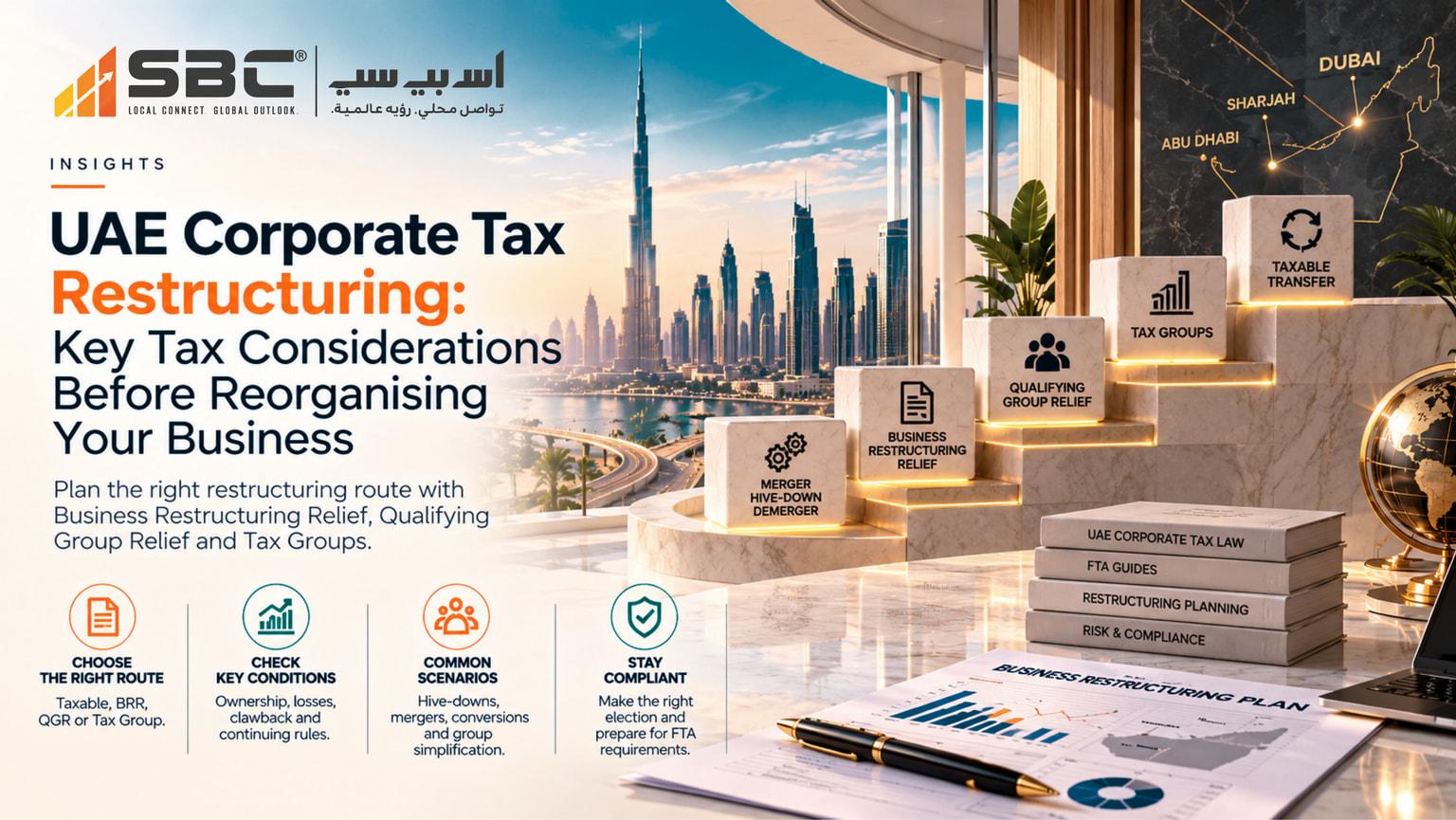
Direct answer: Before reorganising a UAE business, decide the tax route first. A transfer between Taxable Persons can be taxable at market value, tax neutral under Business Restructuring Relief (Article 27), tax neutral within a 75% Qualifying Group under Qualifying Group Relief (Article 26), or disregarded because the entities form a Tax Group. Each route has different conditions, treats tax losses differently and carries a two-year clawback or other continuing conditions. The relief must be elected, so the choice has to be made before the transaction, not at return time.
Choose the tax route before the legal steps
In my experience, the most expensive restructuring tax problems share a pattern. The legal and commercial steps were agreed first. Tax was brought in afterwards to "confirm it is neutral". By then the structure no longer fitted any relief, or the planned sale two months later guaranteed a clawback.
The better order is to map the transaction, identify the possible reliefs, test their conditions, choose the route and only then settle the legal steps and timetable. This article follows that order. The conditions of each relief are explained in detail in UAE Business Restructuring Relief: When Can a Restructuring Be Tax Neutral?, so here I concentrate on choosing between routes and on the scenarios that arise most often. The statutory basis is Federal Decree-Law No. 47 of 2022, and the FTA's Business Restructuring Relief Guide and Qualifying Group Relief Guide explain the rules.
Step 1: Map the transaction
Start with a simple description of what moves from whom to whom, and in exchange for what.
-
Which entities are involved, and are they Resident Persons, Free Zone Persons, QFZPs, Exempt Persons or foreign entities?
-
What is transferred: an entire business, an independent part of a business, specific assets and liabilities, or shares?
-
What is the consideration: new shares, cash, debt, or nothing?
-
What are the Financial Year ends and accounting standards of the entities?
-
What are the ownership percentages before and after?
-
Are there tax losses, unutilised net interest expenditure or elections in place?
-
Is any sale, listing or further reorganisation planned in the next two years?
Common restructuring types
| Type | What it usually involves | Likely route |
|---|---|---|
| Hive-down | A business moves into a subsidiary for new shares | Business Restructuring Relief, or Qualifying Group Relief if in a 75% group and no shares are needed |
| Legal merger | Transferor transfers everything and is dissolved without liquidation | Business Restructuring Relief under Article 27(1)(b) |
| Demerger | A part (or all) of the business moves to other persons | Business Restructuring Relief |
| Incorporating a sole proprietorship | A natural person transfers a business to a new company for its shares | Business Restructuring Relief |
| Intragroup asset transfer | Individual assets or liabilities move between group companies | Qualifying Group Relief |
| Parent absorbing a subsidiary | No shares can be issued by the parent to itself | Not Article 27. Qualifying Group Relief may be available |
| Branch to subsidiary | Foreign branch transferred to a new foreign company | Foreign PE exemption and Participation Exemption analysis, plus foreign law |
| Joining a Tax Group | Eligible UAE companies elect to be one Taxable Person | Tax Group rules, not a transfer relief |
| Liquidation | Entity dissolved and assets distributed | Not covered by Article 27. Taxable analysis |
Step 2: Compare the routes
| Business Restructuring Relief (Art. 27) | Qualifying Group Relief (Art. 26) | Tax Group (Art. 40) | No relief | |
|---|---|---|---|---|
| What it covers | Transfer of a Business or independent part for shares | Transfer of assets or liabilities within a Qualifying Group | Members treated as one Taxable Person | Any transfer |
| Ownership condition | None | 75% common ownership (direct or indirect) | 95% by the UAE parent | None |
| Consideration | Shares required, plus limited other consideration | No share requirement | Not applicable | Market value or arm's length |
| Exempt Person or QFZP | Neither can be a party | Neither can be a member | Neither can be a member | Not relevant |
| Financial Year and standards | Same year end and standards | Same year end and standards | Same financial year and standards | Not relevant |
| Election | By the Transferor for each transaction | By the Transferor | Joint application to the FTA | Not applicable |
| Tax Losses | Can pass to the Transferee if same or similar business continues | Cannot transfer. Article 38 is separate | Pre-grouping losses restricted | Stay where they are, subject to ownership rules |
| Clawback | Two years: relief shares moved outside the group, or the business transferred again | Two years: asset leaves the group, or a party leaves the group | Consequences on leaving the group | Not applicable |
| Gain recognised | Deferred through net book value | Deferred through net book value | Intragroup transactions eliminated | Immediately |
Qualifying Group Relief in brief
Article 26 allows tax neutral transfers of assets and liabilities between two Taxable Persons in the same Qualifying Group. A Qualifying Group requires:
-
Both are juridical persons that are Resident Persons, or non-residents with a UAE PE.
-
One owns at least 75% of the other, or a third person owns at least 75% of each, directly or indirectly.
-
Neither is an Exempt Person or a QFZP.
-
They have the same Financial Year end.
-
They use the same accounting standards.
The Transferor must elect. The transfer is at net book value. The relief is clawed back if, within two years, the Transferee disposes of the asset outside the group, or the Transferor or Transferee leaves the group. It does not transfer Tax Losses, and the FTA's guide, summarised in the KPMG note, confirms that loss transfers happen only under Article 38 or Article 27. The Ministerial Decision is No. 132 of 2023.
Which is better?
-
For individual assets or liabilities, or where no shares will be issued: Qualifying Group Relief is usually the only route.
-
For a business or independent part for shares, between unrelated or lightly related parties: Business Restructuring Relief, because it has no ownership condition.
-
For Tax Losses: Business Restructuring Relief if the same or similar business continues. Qualifying Group Relief cannot move losses.
-
For flexibility after the deal: compare the clawback triggers. Business Restructuring Relief is triggered by moving the relief shares outside the Qualifying Group or by a further transfer of the business. Qualifying Group Relief is triggered by the asset or a party leaving the group.
If both reliefs are available and elected, both sets of conditions need to be tracked. The FTA's Business Restructuring Relief Guide addresses the overlap in its section 8, and I would read it before electing both.
Tax Groups are a different tool
A Tax Group is not a restructuring relief. It treats eligible UAE companies as a single Taxable Person from the date of formation, so transactions between members are eliminated in computing the group's Taxable Income. Eligibility requires 95% ownership, UAE resident juridical persons, the same financial year and accounting standards, and no Exempt Person or QFZP members. The group is formed by joint application to the FTA before the end of the Tax Period, and each member needs a Tax Registration Number first. Members are jointly liable. See UAE Corporate Tax Tax Groups, and the KPMG summary of the FTA's Tax Groups guide.
A Tax Group can make later restructuring simpler, but a transfer of a business within a Tax Group can still trigger clawback of an earlier Business Restructuring Relief, so consider the combined effect.
Share transfers versus business transfers
A restructuring can move shares instead of assets. A sale or transfer of shares in a subsidiary may be exempt under the Participation Exemption if the shares are a qualifying Participating Interest, but the exemption looks at ownership, a 12-month holding period, the investee's tax status and other tests at the date of sale. A transfer of a business or assets is taxable unless a relief applies, since the Corporate Tax Law does not generally distinguish capital from revenue gains. Compare the two routes for tax, legal, regulatory and commercial reasons.
Six scenarios that come up repeatedly
1. A sole proprietor incorporating
A natural person with a UAE business incorporates it into a company and holds the shares. Business Restructuring Relief can apply if the conditions are met, including that the Transferee is a Taxable Person and the consideration is shares. Consider whether the business is below the AED 3 million revenue level for Small Business Relief. A person that elects Small Business Relief cannot apply Article 27, so the two cannot be combined.
2. A hive-down before a sale
A group hives a division into a new subsidiary and plans to sell the subsidiary six months later. The sale of the relief shares to a third party within two years triggers clawback, so the hive-down gain is taxed at market value in the period of the sale. A sale after two years does not. If a sale is already planned, do not rely on the relief. Also consider whether the hive-down lacks a valid commercial reason other than tax, which raises anti-abuse concerns.
3. Merging sister companies
Two sister companies merge. If the surviving company issues shares to the common parent and the other conditions are met, Business Restructuring Relief under Article 27(1)(b) can apply. If no shares are issued, Qualifying Group Relief may be the route. Check Financial Year ends and accounting standards first, because a mismatch removes both reliefs unless aligned.
4. Converting a foreign branch into a foreign subsidiary
This is a foreign tax and a UAE tax question. In the UAE, a foreign branch's losses may have been used against UAE profits. The FTA's foreign source income guide and Ministerial Decision No. 302 of 2024 provide that where a Foreign PE is later incorporated, the Participation Exemption cannot apply to income from the new company until the previously used losses have been recouped. Foreign law will apply its own rules to the incorporation. See UAE Corporate Tax Position on Foreign Branches.
5. A Free Zone entity in the structure
Neither Article 26 nor Article 27 is available if a party is a QFZP. A Free Zone Person that is not a QFZP can qualify. A restructuring can also change the nature of a QFZP's activities, its revenue mix or its substance, so test QFZP status before and after the transaction. See UAE Free Zone Corporate Tax: QFZP Eligibility.
6. A restructuring to access tax losses
Moving a profitable business into a company that has tax losses, or the reverse, attracts scrutiny. Loss rules are strict: the 75% annual cap, ownership continuity and the same or similar business test. Article 50, the general anti-abuse rule, allows the FTA to adjust arrangements that lack valid commercial or non-fiscal reasons and have a main purpose of obtaining a Corporate Tax advantage inconsistent with the law. See UAE Corporate Tax Losses.
Other issues to check
-
Transfer pricing. A transfer between related parties outside a relief must be at arm's length. Even within a relief, other related-party transactions in the reorganised structure must still meet the arm's length principle.
-
Interest. Unutilised net interest expenditure does not transfer under Article 27, and the general interest deduction limitation and the specific limitation on certain related-party loans can affect acquisition and reorganisation financing.
-
Registration and Tax Periods. New entities need Corporate Tax registration through the FTA's registration service. Entities that cease to exist need to be deregistered, with returns filed to the right date. The FTA's Determination of Taxable Income guide explains the computation adjustments. Aligning Financial Years may require an FTA application.
-
R&D Tax Credit. Credits can transfer to a successor under Article 27 if the qualifying R&D activities continue for at least two years, and are clawed back if they stop, according to the EY summary of Ministerial Decision No. 24 of 2026.
-
Pillar Two. A restructuring can bring an entity into or out of scope or change its classification. Acquired or new UAE entities of an in-scope group must register for Top-up Tax within the applicable window.
-
Foreign taxes and other taxes. Foreign income tax, stamp duty, VAT, licence transfers and employment law are separate analyses.
-
Accounting. The Transferee may record assets at fair value while tax follows net book value, so deferred tax and adjustments need to be tracked.
A planning process that works
-
Define the commercial objective and the legal steps.
-
Map entities, ownership, assets, liabilities, losses and elections.
-
Identify candidate routes: Article 27, Article 26, Tax Group, share transfer or taxable transfer.
-
Test each condition for each route and write down the conclusion.
-
Model the tax cost of each route, including a clawback scenario.
-
Check Free Zone, Exempt Person, Small Business Relief and Pillar Two status.
-
Align Financial Years and accounting standards where needed.
-
Decide the route and prepare the election and records.
-
Prepare a relief eligibility memo before signing.
-
Implement, with a calendar for the two-year window and a restriction on disposals.
-
File returns correctly, including the election and adjustments.
-
Monitor conditions after closing and keep evidence.
Documentation to keep
-
Agreements, board and shareholder resolutions and regulatory approvals.
-
A written statement of the commercial reasons for the restructuring.
-
Valuations and net book value schedules at the transfer date.
-
Evidence of the share issuance and the register of members.
-
Calculations of adjustments for the Transferee.
-
Tax Loss schedules and the business continuity analysis.
-
The election and its supporting records.
-
A post-closing monitoring log.
Common mistakes
-
Choosing the legal steps first and testing tax afterwards.
-
Assuming that a group reorganisation is automatically neutral.
-
Overlooking Financial Year and accounting standards conditions.
-
Planning a sale within two years of a relief transaction.
-
Using both reliefs without tracking each set of conditions.
-
Forgetting that Qualifying Group Relief does not move Tax Losses.
-
Ignoring Free Zone, Exempt Person and Small Business Relief status.
-
Failing to prepare the election and records.
-
Leaving transfer pricing, financing and foreign tax until after closing.
For support with a restructuring, speak to SBC's Corporate Tax practice. Keep the Ministry of Finance announcement on the 2024 decisions, the FTA's Corporate Tax guides and references and the Ministry of Finance Corporate Tax hub to hand.
Frequently asked questions
What are the main tax considerations before reorganising a UAE business?
Whether the transfer is taxable, which relief (if any) applies, whether the conditions are met, how tax losses are treated, the two-year clawback, Free Zone and Exempt Person status, transfer pricing and foreign taxes. The route should be chosen before the transaction.
What is the difference between Business Restructuring Relief and Qualifying Group Relief?
Business Restructuring Relief covers transfers of a Business or independent part for shares, with no ownership condition. Qualifying Group Relief covers transfers of assets and liabilities within a group with at least 75% common ownership. Only Business Restructuring Relief can move Tax Losses.
Can I use both reliefs on one transaction?
A transaction can be eligible for both, and both can be elected. Each has its own conditions and clawback, so both need to be monitored. Read the FTA's guide before electing both.
Is a Tax Group a restructuring relief?
No. A Tax Group treats eligible UAE companies as a single Taxable Person, so intragroup transactions are eliminated. It requires 95% ownership and has its own rules on losses and exits.
What triggers clawback of restructuring relief?
For Business Restructuring Relief, within two years, a transfer of the relief shares outside the Qualifying Group or a further transfer of the Business. For Qualifying Group Relief, within two years, the asset leaving the group or a party leaving the group.
Can a company with tax losses be used in a restructuring?
Losses can move to a Transferee under Business Restructuring Relief if it continues the same or a similar business. Qualifying Group Relief does not transfer losses. The FTA may challenge arrangements made mainly to access losses.
Can Free Zone companies use restructuring relief?
A Free Zone Person that is not a Qualifying Free Zone Person can. A QFZP cannot be a party to either relief, and a restructuring can affect QFZP status.
Does restructuring relief remove transfer pricing obligations?
No. Related-party transactions must still meet the arm's length principle, and transfers outside a relief between related parties must be at arm's length.
Should I make the election before or after the transaction?
The Transferor makes the election in the form and manner prescribed by the FTA, and records must be kept. Decide the route before the transaction and prepare the election and eligibility memo in advance.
This publication is for general information only and does not constitute professional advice. Please consult your SBC advisor before acting on any matter covered here.