
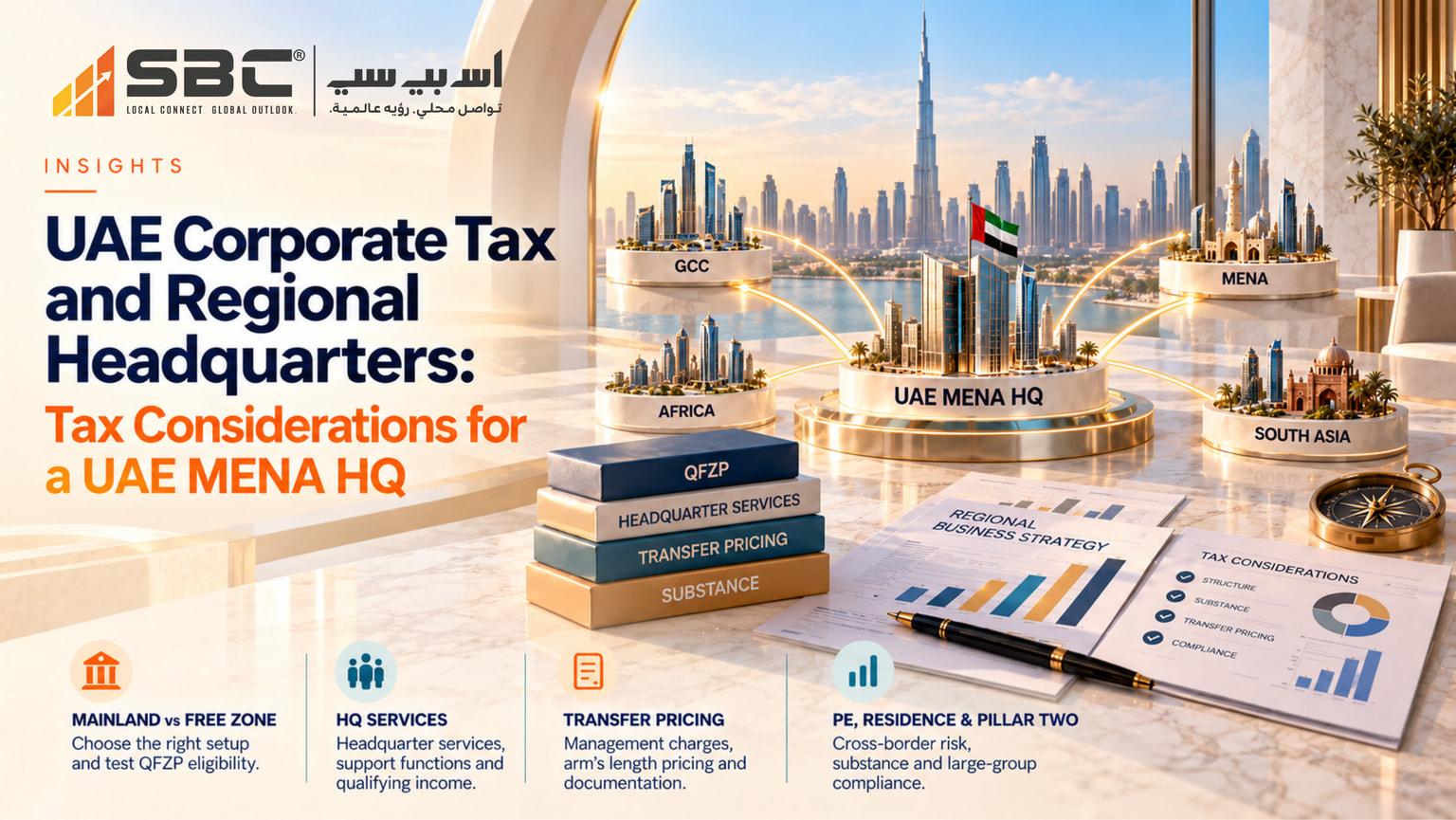
Direct answer: A UAE regional headquarters (RHQ) is a UAE Resident Person and is taxed at 0% up to AED 375,000 and 9% above, like any other company. It gets no special rate because it is called a headquarters. A Free Zone RHQ can reach 0% on Qualifying Income only if it is a Qualifying Free Zone Person, and headquarter services to Related Parties are a Qualifying Activity only on conditions. The main risks are transfer pricing of management charges, foreign permanent establishments and residence, and Pillar Two for large groups.
Why groups base regional functions in the UAE
International groups choose the UAE for a regional headquarters for practical reasons: connectivity to markets in the Middle East, Africa and South Asia, infrastructure, banking, professional services and the ability to centralise support functions. Those are commercial reasons. They do not decide the Corporate Tax result.
When a group asks me to review a proposed RHQ, I begin with four questions. What exactly will the UAE company do? Who will it charge, and how much? Where will its people take decisions, and for which other countries? And is the group large enough for Pillar Two? The answers matter more than the label. This article walks through the tax considerations in that order. The legal framework is Federal Decree-Law No. 47 of 2022, and the FTA's Corporate Tax guides explain the details.
What is a regional headquarters?
An RHQ is a company set up to coordinate and support group operations across a region, not to trade directly with end customers. Typical RHQ functions include:
-
Strategy, planning and regional management.
-
Finance, accounting and treasury support.
-
Human resources and recruitment.
-
Procurement and supply chain coordination.
-
Marketing coordination and business development.
-
IT, legal and administrative support.
-
Management reporting and governance.
These are different from operating activities such as sales, manufacturing or service delivery to customers, which are normally performed by local or foreign subsidiaries. The tax treatment follows the substance of what the UAE entity does, so describe the functions precisely before choosing the structure.
The baseline Corporate Tax treatment
A UAE RHQ company is a UAE juridical person and so a Resident Person and a Taxable Person. It is taxed at:
-
0% on Taxable Income up to AED 375,000.
-
9% on Taxable Income above AED 375,000.
This applies to RHQ income whether the counterparties are related or unrelated. The RHQ is taxed on worldwide income, so dividends, interest and gains from regional investments are also in scope, subject to the exemptions described below and in the FTA's Taxation of Foreign Source Income guide. The company must register with the FTA, file a return and keep records. A Free Zone RHQ is a Free Zone Person, and whether it qualifies for 0% depends on the QFZP conditions.
Mainland or Free Zone?
This is usually the first structuring decision. Both can host an RHQ, but the tax and practical outcomes differ.
| Factor | Mainland RHQ | Free Zone RHQ |
|---|---|---|
| Corporate Tax | 0% to AED 375,000, 9% above, on worldwide income | 0% on Qualifying Income if a QFZP, 9% on other Taxable Income, or standard rates if not a QFZP |
| Participation Exemption and Foreign Tax Credit | Available on the usual conditions | Available, but interacts with QFZP rules |
| Tax Group | Possible with eligible UAE subsidiaries | Not available to a QFZP |
| Substance | Normal governance and operations | Core activities in the Free Zone with adequate staff, assets and expenditure |
| Trading with the UAE market | Unrestricted by zone | May need a mainland licence or branch, which can create a Domestic PE |
| Compliance | Standard | Adds audited accounts, de minimis monitoring and QFZP evidence |
| Perception abroad | Often seen as stronger UAE presence | May attract more questions from foreign authorities on substance |
| Pillar Two | In scope if the group meets the threshold | In scope if the group meets the threshold, and 0% profits lower the UAE effective rate |
No option is universally better. A group with mostly intragroup service income and genuine Free Zone staff may find the QFZP route attractive. A group that needs to invoice UAE customers, form a Tax Group or place regional management close to the market may prefer the mainland. Compare the after-tax and after-cost result, including the cost of maintaining QFZP status.
Can a Free Zone RHQ qualify as a QFZP?
Calling a company a regional headquarters does not create QFZP status. A Free Zone RHQ must meet every condition in Article 18 of the Corporate Tax Law and Cabinet Decision No. 100 of 2023 in every Tax Period:
-
Adequate substance in the Free Zone.
-
Qualifying Income.
-
No election for the standard regime.
-
Arm's length transactions with Related Parties.
-
Audited financial statements.
-
Non-qualifying revenue within the de minimis limit of the lower of 5% of revenue and AED 5 million.
Headquarter services as a Qualifying Activity
Under Ministerial Decision No. 229 of 2025 (see the PwC summary and the KPMG note), headquarter services provided to Related Parties are a Qualifying Activity, and so are treasury and financing services to Related Parties or for the QFZP's own account and the holding of shares for investment. But each has conditions. The FTA's private clarifications to May 2026, as summarised in the Simmons & Simmons note, add three practical points:
-
A QFZP providing headquarter services need not perform every listed headquarter activity, but the FTA expects it to take responsibility for the overall success of the group, or an important aspect of its performance, and to ensure corporate governance.
-
A company that only provides a routine service, such as IT support to one related party, rather than overall group management, is unlikely to be treated as providing headquarter services.
-
Treasury services can include short and long-term investments in securities, as well as cash deposits, though the boundaries of the activity are not fully settled.
Private clarifications are fact-specific, so use them as an indication of the FTA's approach. Do not treat them as binding. Each Qualifying Activity needs its own substance analysis, and the FTA's position is that substance is assessed per activity while aggregating the QFZP's presence across Free Zones.
Where Free Zone RHQs commonly go wrong
-
Revenue from third-party customers for services that are not Qualifying Activities, which counts as non-qualifying revenue.
-
A sales team or contract signatories based on the mainland, which can create a Domestic PE taxed at 9%.
-
Outsourcing core functions to mainland vendors, which does not generally preserve substance.
-
Intercompany charges that are not at arm's length, which put a QFZP condition at risk.
-
Failing to keep evidence that group-level decisions are really made in the Free Zone.
For the full test, see UAE Free Zone Corporate Tax: QFZP Eligibility and the 0% Rate Explained.
Management and support service fees
Where the RHQ provides management, finance, HR, IT, marketing or procurement support to group companies, the fees are taxable income of the UAE company. The usual challenge is whether the amount charged is supportable. Check:
-
Related or unrelated parties. Related-party pricing must follow the arm's length principle under Article 34.
-
Intercompany agreements. They should describe the services, the recipients, the charging method and the term.
-
Evidence of performance. Invoices must reflect services actually performed, with supporting records.
-
The benefit test. Independent parties would have paid for the service.
-
Consistency. The same charging method should be used across years and jurisdictions unless there is a reason to change.
Illustration. A UAE RHQ provides finance and management support to group companies in Saudi Arabia, India and elsewhere. The charges should be determined with a functional analysis of what the RHQ does, an identification of the costs of the service, an appropriate allocation key and a benchmarked mark-up where required. The recipients' own countries may apply withholding tax to the fees, restrict the deduction or ask for evidence of benefit. Aligned documentation across jurisdictions reduces the risk of double taxation.
The RHQ should also keep a file that shows how its own costs (salaries, premises, systems) are recovered, because an RHQ that charges less than an arm's length amount may be adjusted. Transfer pricing documentation requirements depend on the thresholds in the rules, and related-party transactions must be disclosed in the Corporate Tax return. The FTA's Determination of Taxable Income guide covers the computation, and the FTA's Free Zone Persons guide covers QFZP conditions.
Permanent Establishment and residence risks abroad
This is the area where I see the greatest difference between a well-structured RHQ and one that has grown by accident. A regional hub is meant to support operations elsewhere, but if its people take decisions for other countries, three risks arise.
-
PE of the group company in the other country. If RHQ employees habitually negotiate or conclude contracts, or manage operations, on behalf of a foreign group company, that company may have a taxable presence under local law or the treaty. See Permanent Establishment in the UAE for the concepts.
-
PE of the UAE RHQ in another country. If RHQ staff work from, or regularly travel to and operate in, a foreign country in a way that creates a fixed place or an agent, the UAE company may be taxable there.
-
Residence of foreign subsidiaries. If the RHQ takes the key management and commercial decisions of foreign subsidiaries, they may become effectively managed and controlled in the UAE, and thus UAE Resident Persons, as well as being resident abroad. See UAE Tax Residency for Companies.
Mitigation starts with clear delegation of authority. Local boards and local management should take the local decisions, and RHQ roles should be defined as support, advice and oversight, with evidence to match. Travel and day-count records for key staff are worth keeping. Treaties may set different PE tests, so read the specific treaty.
Dividends, financing and holding activities
Many RHQs also hold regional subsidiaries or provide financing. The tax treatment of each income stream is separate.
-
Dividends from UAE companies are exempt under Article 22. Dividends and gains from qualifying foreign participations are exempt under the Participation Exemption if the conditions are met: 5% ownership or AED 4 million cost, a 12-month holding period, subject-to-tax at 9% or more, entitlement to profits and liquidation proceeds and, for related-party investees, the asset test.
-
Interest on intragroup loans is taxable and must be at arm's length. The general interest deduction limitation may apply to the RHQ if it borrows.
-
Foreign withholding tax on dividends, interest, royalties and fees should be managed through treaty claims, which need a Tax Residency Certificate. A Foreign Tax Credit is available only on income that remains taxable in the UAE.
-
Holding company activity needs its own review. See UAE Holding Company: Corporate Tax and International Tax Considerations and Repatriating Profits from Overseas Subsidiaries.
Double tax treaties
The UAE's treaty network, published on the Ministry of Finance's double taxation agreements page, can reduce foreign withholding tax on payments to the RHQ, set PE thresholds for the RHQ's staff and give a method for relieving double taxation. Treaties differ, and a UAE company must show that it is a resident under the treaty, usually with a TRC from the FTA's tax certificates service. The OECD Model Tax Convention shows the usual structure, but each treaty differs. A holding or service company with no real substance and no commercial reason for being in the UAE is exposed to anti-abuse rules such as the principal purpose test.
Substance and governance
Substance affects almost every issue above: QFZP status, treaty access, PE and residence analysis, and transfer pricing. A credible RHQ has:
-
Senior staff with real authority, based in the UAE.
-
Premises, systems and budgets appropriate to its functions.
-
Board and management meetings where decisions are actually taken, with minutes that reflect real discussion.
-
Clear delegations of authority and written job descriptions.
-
Accounting records and financial statements that match the commercial reality.
-
Intercompany agreements that describe what the RHQ does and what it is paid for.
Pillar Two for larger groups
If the group has consolidated revenue of at least EUR 750 million in two of the four preceding fiscal years, the UAE Domestic Minimum Top-up Tax may apply to the RHQ for fiscal years starting on or after 1 January 2025. A Free Zone RHQ taxed at 0% on Qualifying Income lowers the UAE effective tax rate, which can increase the top-up, but the group-level computation, the substance-based income exclusion and safe harbours determine the outcome, not the Free Zone label. Registration with the FTA is required even if no top-up is due. See UAE Pillar Two and Free Zones: QFZP 0% Corporate Tax vs the 15% Global Minimum and the FTA's Scope and Registration Guide.
VAT and other taxes
VAT, customs, payroll and employment rules are separate from Corporate Tax. Recharges of costs and management fees to group companies may have different VAT treatment depending on whether the recipient is in the UAE, in a Designated Zone or abroad. Review them separately and do not assume that a Corporate Tax conclusion carries over.
What to review before establishing an RHQ
-
The functions, people and decisions the RHQ will have, and for which countries.
-
Mainland or Free Zone, and the QFZP analysis if a Free Zone is chosen.
-
The income streams: service fees, dividends, interest, other.
-
Transfer pricing policy, agreements and benchmarking.
-
PE and residence risk in each country served.
-
Treaty access and the TRC plan.
-
Substance plan and governance.
-
Pillar Two scope.
-
Registration, accounting, audit and return calendar.
-
VAT and other taxes.
Common mistakes
-
Assuming that an RHQ gets a special rate or exemption.
-
Treating "headquarter services" as automatically Qualifying Income.
-
Charging management fees without a service or a benchmark.
-
Allowing RHQ staff to conclude contracts for other group companies without a PE analysis.
-
Running foreign subsidiaries from the UAE without a residence review.
-
Choosing a Free Zone for the rate without testing substance and de minimis.
-
Overlooking Pillar Two registration for larger groups.
For a review of an RHQ structure, speak to SBC's International Tax practice or Corporate Tax practice.
Frequently asked questions
What is a regional headquarters?
A company that coordinates and supports a group's operations across a region, for example through strategy, finance, HR, procurement, marketing and IT support, rather than trading directly with end customers.
Is a UAE regional headquarters subject to Corporate Tax?
Yes. A UAE RHQ is a Resident Person and a Taxable Person. It is taxed at 0% on Taxable Income up to AED 375,000 and 9% above, unless it is a Qualifying Free Zone Person with Qualifying Income.
Can a Free Zone regional headquarters qualify for 0% Corporate Tax?
Possibly, if it meets every QFZP condition. Headquarter services to Related Parties can be a Qualifying Activity, but the FTA expects the company to take responsibility for the group or an important aspect of it, and non-qualifying revenue must stay within the de minimis limit.
Are management fees charged by an RHQ taxable?
Yes. They are taxable income of the UAE company and must be at arm's length. They should reflect services actually performed, supported by agreements and invoices.
Can an RHQ create a permanent establishment in other countries?
Yes. If its personnel perform decision-making, contracting or management activities for operations elsewhere, a taxable presence may arise there under local law or the treaty.
Could foreign subsidiaries become UAE tax resident because the RHQ manages them?
Possibly. If their key management and commercial decisions are made in the UAE, they may be effectively managed and controlled here. Review residence, and the position under any treaty.
Are dividends received by a UAE RHQ taxable?
Dividends from UAE companies are exempt. Dividends from foreign subsidiaries are exempt if the Participation Exemption conditions are met. Otherwise they are taxable, with a possible Foreign Tax Credit.
Does a mainland or Free Zone RHQ have more permanent establishment risk abroad?
Neither is inherently riskier. The risk depends on what staff do and where. A mainland RHQ with real management may be easier to defend on substance, while a Free Zone RHQ may face more questions. Document the real functions either way.
Is Pillar Two relevant to a regional headquarters?
Yes, for groups with consolidated revenue of at least EUR 750 million in two of the four preceding fiscal years. The RHQ may be a Constituent Entity, and registration and filing duties arise even if no top-up is due.
This publication is for general information only and does not constitute professional advice. Please consult your SBC advisor before acting on any matter covered here.