
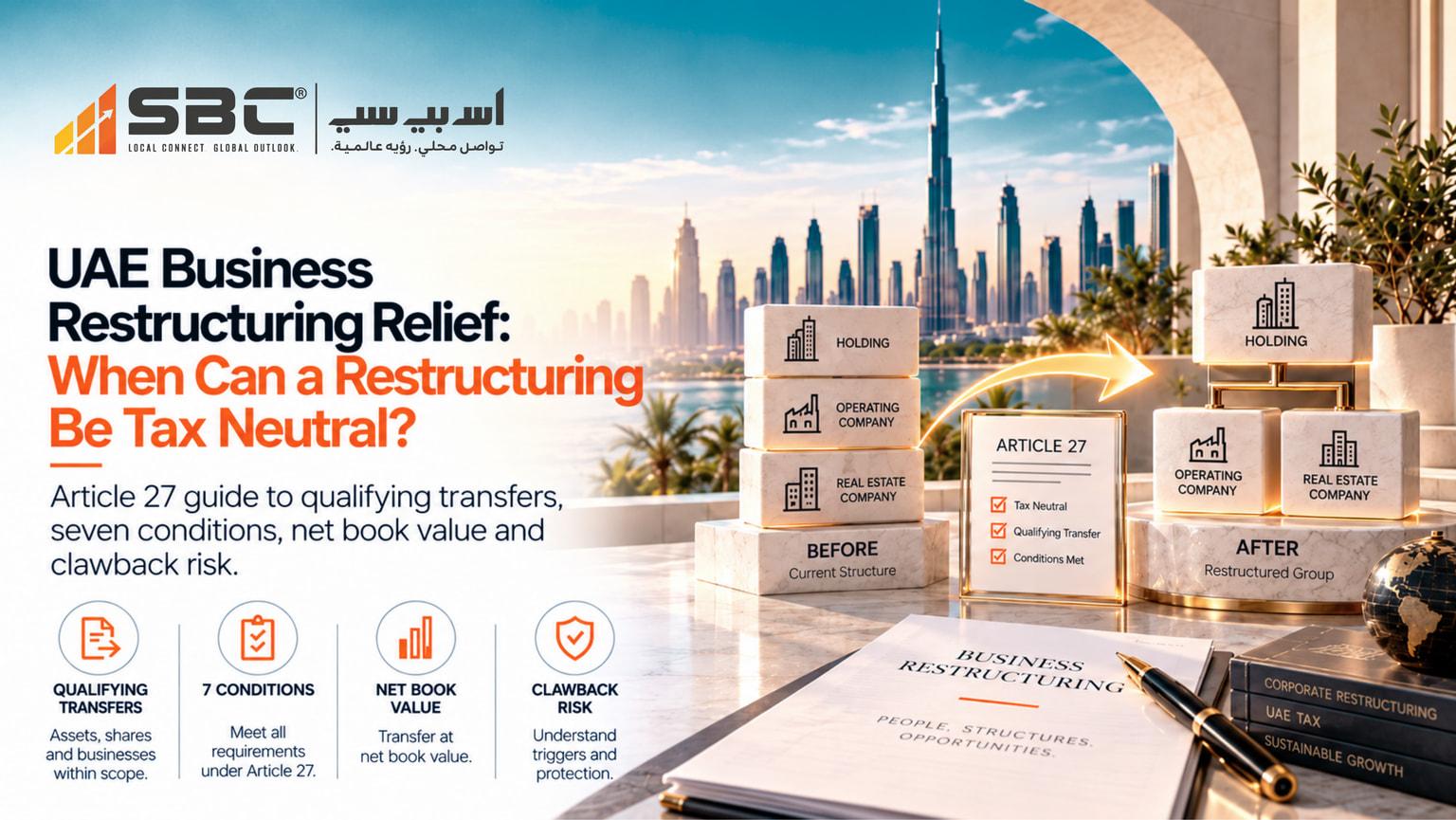
Direct answer: A restructuring can be tax neutral under Business Restructuring Relief (Article 27 of the UAE Corporate Tax Law) if a Business, or an independent part of one, is transferred between Taxable Persons for shares or other ownership interests, all seven statutory conditions are met and the Transferor elects the relief. The assets are then treated as transferred at net book value, so no gain or loss arises, but the gain is deferred, not forgiven, and the relief is clawed back if the shares or the business are transferred within two years.
Why this relief needs care
UAE groups restructure for sound commercial reasons: simplifying structures, separating or combining businesses, preparing for a sale, converting a sole proprietorship into a company or implementing succession. Without relief, a transfer between two Taxable Persons is generally a disposal at market value, so a business worth AED 15 million with a tax base of AED 10 million produces a gain of AED 5 million even though no cash has left the group.
Business Restructuring Relief removes that barrier for qualifying transactions. It is also one of the reliefs most often assumed rather than tested. The FTA's Business Restructuring Relief Guide (CTGBRR1) and Ministerial Decision No. 133 of 2023 set out the rules. (This is a 2023 decision and is not to be confused with Ministerial Decision No. 133 of 2026 on the Pillar Two Information Return.) This article summarises them. The broader planning context is in UAE Corporate Tax Restructuring.
What is Business Restructuring Relief?
Article 27 of Federal Decree-Law No. 47 of 2022 allows certain restructuring transactions to take place on a no gain or loss basis. The relief is available only if the conditions are met and the Transferor has elected for it. Three features define it:
-
It is conditional. Every condition must be satisfied.
-
It is elective. The Transferor must make an election for each qualifying transaction. It does not carry over to later reorganisations.
-
It is a deferral. The tax base is carried over, so the gain remains within the tax system and is recognised later.
Two categories of qualifying transactions
The FTA's guide distinguishes two categories.
| Article 27(1)(a) | Article 27(1)(b) | |
|---|---|---|
| What is transferred | An entire Business or an independent part of a Business | An entire Business |
| The Transferor | A Taxable Person that continues to exist | One or more Taxable Persons that cease to exist as a result |
| Transferee | Another Taxable Person, or a person that becomes a Taxable Person because of the transfer | Another Taxable Person |
| Typical examples | Hive-down into a subsidiary, demerger where the Transferor survives, business merger for shares, sole proprietor incorporating | Legal merger where the Transferor is dissolved without liquidation, full legal demerger to two or more transferees |
Examples that the FTA's guide treats as qualifying, subject to the conditions, include:
-
A natural person converting a sole proprietorship into a company and holding its shares.
-
An unincorporated partnership that applies to be treated as a Taxable Person, where the partners are treated as transferring their businesses to it.
-
A hive-down where the Transferor transfers a business to its subsidiary and receives additional shares.
-
A legal demerger where an independent part of a business moves to another Taxable Person for shares.
-
A legal merger where the Transferor transfers its business under universal title and is dissolved without liquidation.
Transactions that do not qualify
-
A liquidation where a Taxable Person ceases to exist and its assets pass to another Taxable Person as a result of the liquidation.
-
A subsidiary merging into its parent where there is no consideration, because the parent cannot issue shares to itself.
-
A transfer of a business to a wholly owned subsidiary without issuing shares, and the reverse. No share consideration is paid, so the condition is not met, although Qualifying Group Relief may be available.
-
Transfers between a UAE PE and its head office, since they are the same person.
-
Transfers by or to a non-resident of a business that is not attributable to a UAE PE.
What is a "Business" or "independent part of a Business"?
A Business is any activity conducted regularly, on an ongoing and independent basis. For a partial transfer, the question is whether the assets and liabilities transferred form an independent part of a Business. The FTA's guide gives indicative factors:
-
The assets and liabilities can be operated independently as a separate and distinct Business. Individual assets that need ongoing support from other assets are not enough, although an integrated pool can qualify.
-
The part is transferred as a going concern under the applicable accounting standards.
-
Some operational support, such as accounts, IT or HR, may remain behind without defeating the test, but a function that is key to continued operation is not mere support.
The point matters because a transfer of a single asset, or a collection of assets that cannot operate as a Business, falls outside Article 27 and is taxed as an ordinary disposal unless another relief applies.
The consideration test
Consideration for the transfer must generally be shares or other ownership interests.
-
Form. Ordinary shares, preferred shares, redeemable shares, membership and partner interests and similar instruments qualify if they are classified as equity under the holder's accounting standards. Debt instruments generally do not, unless classified as equity.
-
Recipient. The consideration may be received by the Transferor or by a person that holds at least 50% of the Transferor directly or indirectly.
-
Payer. The shares may be issued by the Transferee or by a person that holds at least 50% of the Transferee directly or indirectly.
-
Other consideration. Cash or other consideration may accompany the shares, but only if its market value does not exceed the lower of the net book value of the assets and liabilities transferred and 10% of the nominal value of the ownership interests issued.
Example from the FTA's guide. Company A transfers its whole business to Company B for shares with a nominal value of AED 6 million and AED 0.5 million in cash. The net book value is AED 6.5 million, and 10% of the nominal value of the shares is AED 0.6 million. The cash of AED 0.5 million is below the lower figure, so relief is available, assuming the other conditions are met. Had the cash been AED 0.8 million, the transaction would have failed the test, which would have taken the whole transaction outside the relief and not just the excess.
There is one exception to the need for consideration: an unincorporated partnership that applies to be treated as a Taxable Person.
The seven conditions
All of the following must be met.
-
Legally compliant. The transfer complies with the applicable UAE law, for instance the merger requirements in the Commercial Companies Law.
-
Taxable Persons. Both the Transferor and the Transferee are Resident Persons, or non-residents with a UAE Permanent Establishment (or become Taxable Persons through the transfer).
-
No Exempt Person. Neither is an Exempt Person under Article 4.
-
No QFZP. Neither is a Qualifying Free Zone Person under Article 18. A Free Zone Person that is not a QFZP may qualify. The condition is tested in the Tax Period of the transaction, so becoming a QFZP later does not trigger clawback.
-
Same Financial Year end. The Financial Years of the Transferor and Transferee end on the same date. They can apply to the FTA to align them, subject to conditions: the return for the period has not been filed, the period is not lengthened beyond 18 months or shortened below 6 months, and the application is made within six months of the end of the original Tax Period.
-
Same accounting standards. Both use IFRS, or both use IFRS for SMEs. If one uses IFRS for SMEs and the other IFRS, one may switch to IFRS without an application.
-
Valid commercial reasons. The transfer is for valid commercial or other non-fiscal reasons that reflect economic reality, and documents are kept to show it.
There is no condition about the relationship between the parties. The relief applies between related parties and between unrelated parties. A Resident Person that has elected Small Business Relief cannot apply Article 27. The FTA's General Corporate Tax Guide gives the wider context.
What "tax neutral" actually means
The assets and liabilities are treated as transferred at their net book value at the date of transfer. The Transferor therefore has no gain or loss. The Transferee takes the assets at the same net book value for tax purposes, even if it records them at market value in its accounts.
Illustration. A company transfers a business with a net book value of AED 10 million and a market value of AED 15 million to its subsidiary for new shares. Without relief, the gain is AED 5 million, taxed at up to 9%, which is up to AED 450,000. With relief, no gain is taxed on the transfer. If the subsidiary sells the business three years later for AED 15 million, the AED 5 million gain, adjusted for depreciation and amortisation adjustments, is recognised then.
Several consequences follow.
-
Transferee adjustments. Where the Transferee depreciates the assets using market values, it must exclude depreciation to the extent it relates to the gain that was not taxed. On realisation it includes amounts not previously recognised. The FTA's guide has a worked example in which depreciation of AED 1.2 million a year on an asset acquired at market value is partly disallowed until the deferred gain is absorbed.
-
Value of shares received. The Transferor treats the shares as having a value not exceeding the net book value transferred, less other consideration received. In the cash example above, the shares are treated as received for AED 6 million (6.5 million less 0.5 million).
-
Tax losses. Unutilised Tax Losses of the Transferor from earlier Tax Periods can be carried forward by the Transferee if the Transferee continues the same or a similar Business. Similarity is assessed by whether the Transferee uses some or all of the same assets, whether the core identity or operations change significantly, and whether changes result from developing existing assets and processes. For a partial transfer, similarity is tested against the part transferred.
-
Net interest expenditure. Unutilised net interest expenditure is not transferred under Article 27, unlike Tax Losses. See UAE Corporate Tax Losses.
-
Related-party pricing if relief fails. If conditions are not met or the Transferor does not elect, the transfer is outside Article 27. Between Related Parties it must be at arm's length, so the gain is measured at market value.
The two-year clawback
Relief does not apply, and the transfer is treated as having happened at market value on the date of transfer, if either of these occurs within two years:
-
Shares are transferred. Shares or other ownership interests in the Transferor or Transferee, issued as part of the relief, are sold, transferred or otherwise disposed of, wholly or partly, to a person outside the relevant Qualifying Group.
-
The business is transferred again. There is a subsequent transfer or disposal of the Business or the independent part of it that was transferred.
The gain or loss is included in the Taxable Income of the Transferor in the Tax Period in which the clawback arises. If the Transferor has ceased to exist or is an individual, it falls on the Transferee.
Several practical points come from the FTA's examples:
-
Only relief shares count. The clawback applies only to shares issued as part of the relief. A sale of the Transferee's other shares does not trigger it, and an indirect change of ownership does not, if the shares were not issued under Article 27.
-
A single share can be enough. The clawback applies to a transfer in whole or in part.
-
Transfers within a Qualifying Group are safe. A transfer between members of a Qualifying Group does not trigger it. Whether the parties are in a Qualifying Group is tested when the shares are transferred. An Exempt Person, an individual or a QFZP cannot be in one, so transfers by such shareholders can trigger it.
-
Ordinary operational changes do not count. Selling surplus equipment or consolidating functions does not usually transfer an independent part of a Business. A transfer of an independent part, such as a product line, within two years does, and clawback applies in full even if the Transferee keeps another part.
-
A further restructuring is a transfer. A second merger within two years, even with Article 27 relief, triggers clawback of the first.
Interaction with Qualifying Group Relief
Qualifying Group Relief (Article 26) allows transfers of assets and liabilities within a group with 75% common ownership on a no gain or loss basis, with its own two-year clawback. The two reliefs overlap, and a transaction can be eligible for both. The FTA's guides, including the Qualifying Group Relief guide and the KPMG summary, explain the interaction. Read section 8 of the Business Restructuring Relief Guide before electing both, and track each relief's conditions through the clawback period. Qualifying Group Relief does not transfer Tax Losses. That can only happen under Article 27 or Article 38.
Compliance and records
-
Election. The Transferor must make the election in the form and manner the FTA prescribes. See the FTA's Corporate Tax guides and references.
-
Records. Both parties must keep the records specified in Article 9 of Ministerial Decision No. 133 of 2023, including the agreement to transfer at net book value, evidence of the valuation and net book value, the adjustments needed under the taxable income rules and documents showing valid commercial reasons.
-
Eligibility memo. Prepare a short memo before the transaction, testing each condition, not after.
-
Post-closing controls. Assign an owner to the two-year window, track share movements and any planned disposals, and record who approves them.
The FTA's Determination of Taxable Income guide is relevant to the Transferee adjustments.
Free Zone and other special cases
-
Free Zone Persons. A Free Zone Person that is not a QFZP can qualify. A QFZP cannot. Test the position before and after the transaction, and consider the effect of the transfer on any later QFZP position. See Qualifying Free Zone Person: UAE QFZP Conditions.
-
Tax Groups. A transfer of the business within a Tax Group can itself trigger clawback of an earlier relief, as the FTA's guide notes.
-
Transfer pricing. The relief does not remove the arm's length requirement for related-party transactions generally.
-
Foreign taxes. A UAE-neutral transfer can still trigger foreign tax if assets or shares are in other countries.
Pre-restructuring checklist
-
Map the entities, assets, liabilities, shares, activities and consideration.
-
Decide whether the transfer is a Business or an independent part of one.
-
Test each of the seven conditions, including Financial Year end and accounting standards.
-
Test the consideration, including the 10% cap on other consideration.
-
Check whether either party is an Exempt Person, a QFZP or has elected Small Business Relief.
-
Decide whether Tax Losses are to be transferred and whether the same or similar business will continue.
-
Prepare the valuation and net book value schedules.
-
Plan the election and the records.
-
Diarise the two-year window and restrict disposals.
-
Consider foreign tax and transfer pricing consequences.
Common mistakes
-
Assuming every merger or group reorganisation is tax neutral.
-
Failing to test each condition, such as different Financial Year ends.
-
Paying cash or other consideration above the cap.
-
Overlooking the two-year clawback when a sale is already planned.
-
Not making the election, or making it without preparing the records.
-
Treating the gain as permanently exempt.
-
Assuming Tax Losses and net interest expenditure transfer automatically.
-
Forgetting transfer pricing and foreign tax.
If you would like a second opinion on a proposed reorganisation, speak to SBC's Corporate Tax practice. The Ministry of Finance Corporate Tax hub and the FTA's Corporate Tax FAQs are the best places to check for updates. For acquisitions, see UAE Corporate Tax and Mergers & Acquisitions.
Frequently asked questions
What is Business Restructuring Relief in the UAE?
A relief under Article 27 of the Corporate Tax Law that allows qualifying transfers of a Business or an independent part of a Business to take place on a no gain or loss basis, if all conditions are met and the Transferor elects.
Is every merger or restructuring automatically tax neutral?
No. The relief applies only to qualifying transactions where all seven conditions are met and the Transferor has elected. If one condition fails, for instance different Financial Year ends, the relief is not available.
Does tax neutral mean the gain is permanently exempt?
No. The assets are transferred at net book value, so the gain is deferred. It is recognised when the Transferee later realises the assets, adjusted for depreciation and amortisation.
What consideration is allowed?
Shares or other ownership interests. Other consideration, such as cash, is allowed only if its market value does not exceed the lower of the net book value transferred and 10% of the nominal value of the ownership interests issued.
Can Business Restructuring Relief apply between unrelated parties?
Yes. There is no ownership condition. It applies between related parties and between third parties, if all conditions are met.
What triggers the clawback?
Within two years of the transfer, a transfer of the relief shares in the Transferor or Transferee to a person outside the relevant Qualifying Group, or a subsequent transfer or disposal of the Business or independent part transferred.
What happens on a clawback?
The transfer is treated as made at market value on the original date, and the resulting gain or loss is included in the Transferor's Taxable Income in the Tax Period in which the clawback occurs. It falls on the Transferee if the Transferor no longer exists or is an individual.
Can Tax Losses move to the Transferee?
Yes, unutilised Tax Losses of the Transferor from earlier periods can be carried forward by the Transferee if it continues the same or a similar business. Unutilised net interest expenditure does not transfer.
Can a QFZP or Exempt Person use the relief?
No. Neither the Transferor nor the Transferee may be an Exempt Person or a Qualifying Free Zone Person at the time of the transaction. A Free Zone Person that is not a QFZP may qualify.
Does the relief remove transfer pricing obligations?
No. Related-party transactions must still meet the arm's length principle, and a transfer outside the relief between related parties must be at arm's length.
This publication is for general information only and does not constitute professional advice. Please consult your SBC advisor before acting on any matter covered here.