
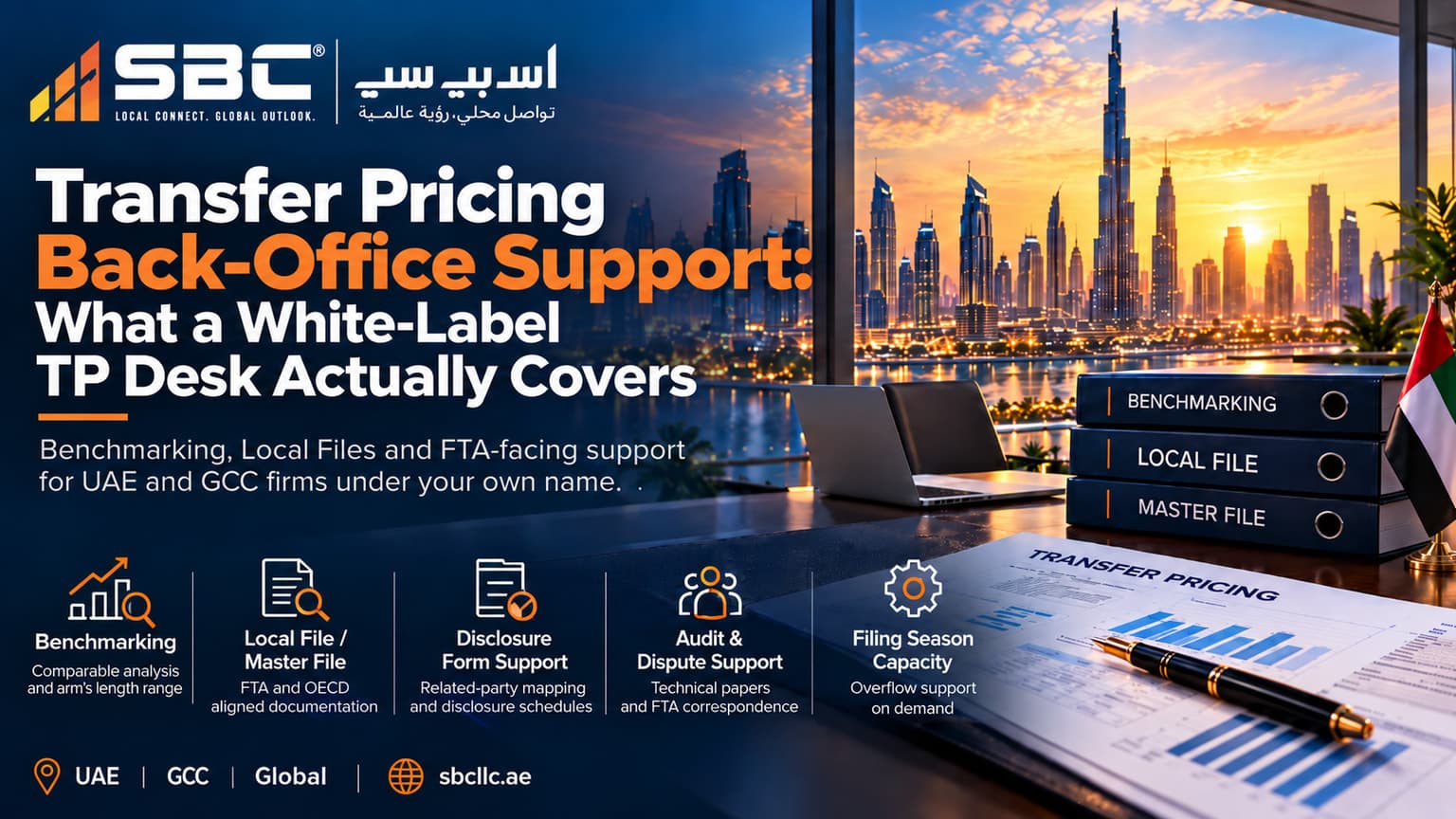
A white-label transfer pricing desk lets an accounting, audit or law firm offer benchmarking, Local File and Master File preparation, and FTA-facing transfer pricing support to its own clients under its own name, while SBC Tax Consulting LLC delivers the technical work behind the scenes. The client relationship, the invoice, and the advice all stay with the partner firm; SBC operates as the production capacity that makes it possible to say yes to a transfer pricing mandate without building an in-house TP bench from scratch. Firms searching for a genuine TP white label service in the UAE are usually looking for exactly this combination: real transfer pricing back-office capacity, delivered discreetly, that lets the firm say yes to a mandate it would otherwise have to decline or attempt without specialist support.
Why transfer pricing became every firm's problem, not just Big Four's
Since Federal Decree-Law No. 47 of 2022 brought UAE Corporate Tax into force, transfer pricing has moved from a niche multinational concern into a mainstream compliance item for mid-market groups, family businesses, and Free Zone entities alike. Every accounting firm handling UAE Corporate Tax returns now fields Related Party and Connected Person questions weekly — an intercompany management fee here, a shareholder loan there, a Free Zone entity's related-party sale that could jeopardise its 0% rate. Most of these firms were built around audit, bookkeeping and general tax compliance, not around functional-asset-risk (FAR) analysis, comparable benchmarking, or Ministerial Decision No. 97 of 2023's Local File and Master File requirements.
Building that capability in-house means hiring transfer pricing economists, buying access to benchmarking databases, and establishing a methodology governance process — a multi-year investment that is hard to justify when TP is one line item among many services a firm offers. Outsourcing to a specialist desk solves the same problem in weeks rather than years.
What a white-label TP desk actually delivers
| Workstream | What SBC delivers behind the scenes | What the partner firm's client sees |
|---|---|---|
| Benchmarking | Comparable screening, PLI computation, arm's length range analysis | A benchmarking report under the partner firm's letterhead |
| Local File / Master File | Full documentation drafting aligned to FTA and OECD standards | A completed, review-ready Local or Master File |
| Disclosure Form support | Related-party mapping and disclosure-schedule preparation | A completed TP Disclosure Form ready for the Corporate Tax return |
| Audit & dispute support | Technical position papers, FTA correspondence drafting | Partner-firm-branded representation support |
| Capacity during filing season | Overflow benchmarking and documentation capacity on demand | On-time delivery without the partner firm hiring seasonal staff |
Benchmarking without building a database subscription and an economics team
The single hardest part of transfer pricing to outsource well is benchmarking, because it depends on judgement, not just software — knowing when a comparable company genuinely survives an independence and functional screen, versus when it should be rejected under the same discipline our own specialists describe in how comparables should actually be selected. A white-label desk gives a partner firm access to that judgement, along with the underlying benchmarking database access and Profit Level Indicator (PLI) computation, without the firm needing to build any of that infrastructure itself. The output — an arm's length range, a rejected-comparable log, a defensible narrative — is delivered ready to sit inside the partner firm's own client report.
Local File and Master File, drafted to the standard an FTA review expects
Under Ministerial Decision No. 97 of 2023, a Local File becomes mandatory once a taxable person's revenue crosses AED 200 million, or where the entity belongs to a multinational group with consolidated global revenue above AED 3.15 billion; Master File obligations layer on top of that for genuinely multinational structures. A partner firm's client hitting either threshold for the first time is a common trigger for a white-label engagement — the firm's existing audit or Corporate Tax relationship stays intact, while SBC drafts the Local File's FAR narrative, method selection and benchmarking annex to the standard set out in the FTA's Transfer Pricing Guide.
Disclosure Form support: the filing that ties everything together
The Transfer Pricing Disclosure Form is filed inside the Corporate Tax Return via EmaraTax once a client's Related Party transactions cross the AED 40 million aggregate threshold, or the AED 4 million per-category and AED 500,000 Connected Persons thresholds. A white-label desk maps every in-scope relationship, tests each threshold, and prepares the schedule so the figures tie directly back to the benchmarking study and Local File — rather than a Disclosure Form assembled in isolation by a preparer without visibility into the underlying TP analysis, which is one of the most common inconsistencies an FTA review surfaces.
Audit and dispute support: staying in the room when the FTA asks questions
A white-label arrangement does not stop at filing. Where the FTA raises a query or opens an audit on a related-party position, the same desk that built the original benchmarking and documentation prepares the technical position papers and correspondence needed to defend it — still under the partner firm's name, with SBC's specialists supporting the partner firm's client conversation rather than replacing it. This continuity matters because the person best placed to defend a Local File's methodology is the person who built it, not a second adviser reconstructing the reasoning after the fact.
Confidentiality and delivery model
-
NDA-backed engagement — client identity and data are never disclosed beyond the scoped delivery team
-
Co-branded or fully white-labeled deliverables, at the partner firm's preference
-
Delivery from SBC's 250+-professional team across Dubai, Hyderabad, Mumbai and Pune
-
Defined SLAs for turnaround during the UAE Corporate Tax filing season
-
Direct access to SBC's benchmarking infrastructure and TP DOC GEN AI platform for production-scale documentation
The technology behind the desk
White-label engagements run on the same benchmarking and documentation infrastructure SBC uses for its own direct clients, including TP DOC GEN AI, SBC's automated benchmarking and documentation platform. That means a partner firm's white-labeled Local File is produced on the same production-grade system, not a manual, ad hoc process assembled specifically for the outsourcing arrangement — the same entity master data, benchmarking engine, and maker-checker governance apply whether the end client is SBC's own or a partner firm's.
Partner firms retain full control of client communication and pricing. SBC Tax Consulting LLC's role is production capacity and technical sign-off support, not client acquisition.
Who this is for
This model is built for three kinds of firms. Boutique accounting and tax advisory firms that already have the client relationship but not the in-house TP bench use it to add transfer pricing to their service list without a multi-year build-out. Audit firms preparing aggregated financial statements for UAE Corporate Tax groups use it when a client's related-party position needs specialist TP sign-off alongside the audit itself. And larger firms with an existing but thin TP team use it specifically for overflow capacity in the run-up to the Corporate Tax filing deadline each year, when internal capacity is stretched across every client at once. It is not a referral arrangement — SBC does the technical work, the partner firm keeps the client relationship, the invoicing, and the advisory judgement calls that sit closest to the client.
What onboarding a partner firm actually looks like
A white-label relationship typically starts with a single client engagement rather than a firm-wide rollout — usually the partner firm's largest or most time-sensitive Local File requirement for the current filing season. SBC scopes the engagement, agrees confidentiality terms and branding preference, and delivers the first Local File or benchmarking report against the partner firm's own deadline. Firms that continue the arrangement typically expand it from single-client overflow support into a standing capacity agreement, with an agreed SLA covering turnaround times across the whole Corporate Tax filing season rather than one engagement at a time.
Pricing and commercial structure
White-label pricing is scoped per partner firm rather than published as a fixed rate card, because volume, turnaround requirements and the mix of benchmarking-only versus full Local File engagements vary significantly firm to firm. The commercial relationship sits entirely between SBC Tax Consulting LLC and the partner firm — the end client is never billed by SBC directly, and is not typically aware that a white-label arrangement exists unless the partner firm chooses a co-branded rather than fully white-labeled delivery model.
White-label versus hiring a contract transfer pricing specialist
Firms facing their first large TP mandate often consider two alternatives to a white-label desk: hiring a contract transfer pricing specialist for the filing season, or referring the client onward to a specialist firm entirely. A contract hire solves capacity for one season but leaves the firm rebuilding institutional knowledge every year the contractor changes, and typically cannot match the benchmarking database access or Ministerial Decision No. 97 of 2023 documentation experience a dedicated TP practice maintains year-round. Referring the client onward solves the capability gap but costs the firm the relationship and the revenue entirely. A white-label desk is structured specifically to avoid both trade-offs — the firm keeps the client and the revenue, and the technical capability is permanent rather than rebuilt each season.
Quality control: what stops a white-label deliverable from reading as generic
The risk partner firms raise most often before starting a white-label engagement is quality — whether a benchmarking report or Local File built by an outside desk will read as generic, disconnected from the client's actual business. SBC's engagement process runs the same FAR interview and value-chain mapping process used on its own direct clients, described on our Transfer Pricing service page, specifically so the resulting narrative reflects the client's actual functions, assets and risks rather than a templated description. A partner firm reviewing the deliverable before it reaches the client retains final quality control throughout — the white-label model does not remove the partner firm's own review step, it simply gives that review step a properly built document to start from. Partner firms that have worked with SBC across several filing seasons typically report that their own review time drops significantly once the desk understands the firm's house style and client base well enough to anticipate the kind of questions the firm's own reviewers will raise.
Regional reach: one desk covering the whole GCC, not just the UAE
A partner firm with clients operating across the UAE, Saudi Arabia, Bahrain and Qatar faces the same fragmentation problem internally that its clients face externally — four different transfer pricing regimes, four different filing calendars, four sets of thresholds. Because SBC's own transfer pricing practice already advises across the wider GCC, a white-label engagement can cover a partner firm's regional client base from one coordinated desk, rather than the firm needing separate outsourcing relationships in each jurisdiction. Our broader coverage of this is set out in our GCC Transfer Pricing Compliance Calendar, which maps the UAE, KSA, Bahrain and Qatar filing obligations a regional partner firm's clients are typically juggling at once.
An illustrative scenario: what changes for a mid-market accounting firm
Consider a mid-market UAE accounting firm with forty Corporate Tax clients, three of which have just crossed the AED 200 million Local File threshold for the first time this filing cycle. Before a white-label arrangement, the firm has two unattractive options: turn the TP work away, or attempt it without a specialist bench and accept the risk of a weak Local File. With a white-label desk in place, the firm scopes the three engagements with SBC, retains the client conversation and sign-off, and delivers three completed Local Files under its own letterhead within the same filing season — without having hired a single TP specialist or purchased a benchmarking database subscription of its own.
What we need from a partner firm to start
-
The client's financial statements and existing intercompany agreements, if any exist
-
A description of the related-party or Connected Person transactions in scope
-
Confirmation of the preferred branding model — fully white-labeled or co-branded
-
The filing deadline the engagement needs to be delivered against
-
A signed NDA covering the scope of client data to be shared
None of this requires the partner firm to have any existing transfer pricing documentation in place — first-time Local File engagements, where a client has just crossed a threshold for the first time, make up a significant share of white-label mandates.
Frequently asked questions
What is a white-label transfer pricing service?
A white-label transfer pricing service is an arrangement where SBC Tax Consulting LLC delivers benchmarking, documentation and TP advisory work behind the scenes, while a partner accounting, audit or law firm retains the client relationship and delivers the output under its own name.
Does SBC Tax Consulting LLC offer white-label or back-office transfer pricing support?
Yes. SBC Tax Consulting LLC supports accounting firms, boutique advisories and law firms across the UAE and GCC with white-labeled or co-branded benchmarking, Local File and Master File preparation, and FTA-facing documentation support.
Is the partner firm's client identity disclosed to SBC?
Engagements run under NDA, and the scope of disclosure is agreed per partner firm; SBC's role can be fully invisible to the end client if the partner firm prefers a completely white-labeled arrangement.
Can a white-label TP desk handle overflow capacity during Corporate Tax filing season?
Yes, this is one of the most common use cases — firms use SBC's back-office capacity specifically to meet Local File, Master File and Disclosure Form deadlines around the UAE Corporate Tax return filing date without hiring seasonal staff.
How does pricing work for a white-label transfer pricing arrangement?
Pricing is scoped per partner firm based on expected volume and turnaround requirements, and is agreed directly between SBC Tax Consulting LLC and the partner firm, not disclosed to or billed directly to the end client.
Does the partner firm need its own transfer pricing database subscription?
No. Benchmarking is run through SBC's own database access and TP DOC GEN AI platform, so the partner firm does not need to purchase or maintain a separate comparable-company database subscription.
Can a white-label desk support audit and dispute matters, not just filing?
Yes. Where the FTA raises a query on a related-party position, SBC's specialists prepare technical position papers and correspondence support, delivered under the partner firm's name.
What size of firm typically uses a white-label TP desk?
Usage spans boutique accounting and advisory firms with no in-house TP capability at all, through to larger firms with a thin internal TP team that need overflow capacity during peak filing season.
How quickly can a white-label engagement start?
Most engagements begin with a single client mandate, scoped and delivered within the current filing season, rather than requiring a firm-wide onboarding process before any work begins.
Does SBC Tax Consulting LLC compete with the partner firm for the client relationship?
No. SBC's role is production capacity and technical delivery; client acquisition, pricing to the end client, and the advisory relationship remain entirely with the partner firm.
Start a white-label conversation
If your firm needs transfer pricing production capacity without building an in-house TP bench, contact SBC Tax Consulting LLC to scope a white-label or back-office arrangement, or explore our full Transfer Pricing practice and SaaS platforms that power it.
Further reading — official sources
This publication is for general information only and does not constitute professional advice. Please consult your SBC advisor before acting on any matter covered here.