
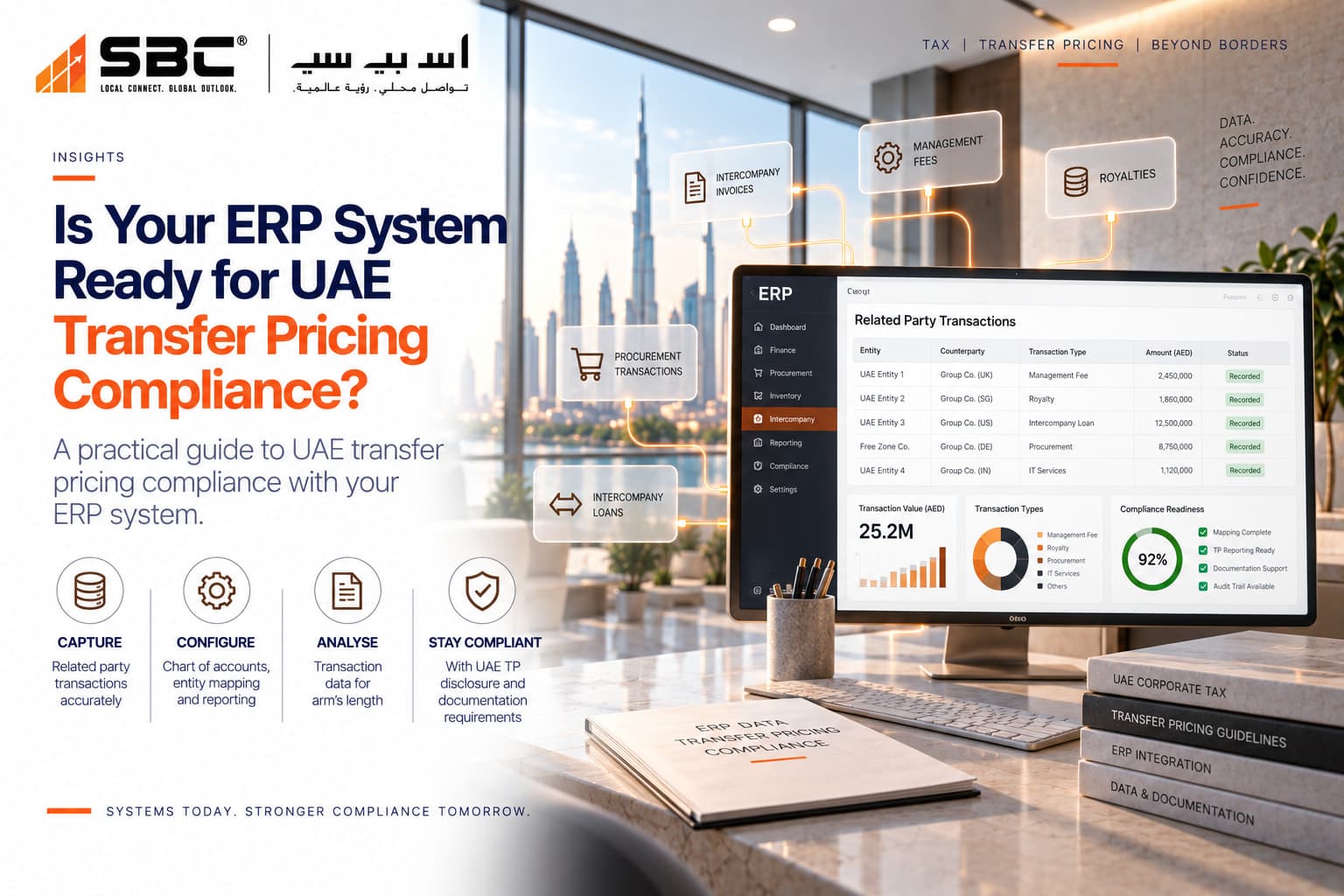
Most UAE groups already record every intercompany invoice, loan and management fee inside their ERP system. Few have configured that same system to prove those transactions were priced at arm's length. As transfer pricing moves from a compliance afterthought to a recurring UAE Corporate Tax obligation, the gap between what an ERP captures and what a transfer pricing file requires is where most exposure sits.
Key official references include UAE Corporate Tax Law: Article 34 on the Arm's Length Principle, the UAE Federal Tax Authority Transfer Pricing Guide and Ministerial Decision No. 97 of 2023 on Transfer Pricing Documentation. Related questions sit in from policy to invoice, the UAE Local File and the Transfer Pricing Disclosure Form.
The UAE Corporate Tax Law introduced a formal arm's length requirement under Article 34 of Federal Decree-Law No. 47 of 2022, alongside documentation obligations under Article 55 and disclosure requirements under Article 56. For a group with several UAE entities, free zone companies and overseas branches, related party transactions are not rare events - they are a routine part of daily ERP processing. The practical question for finance teams is no longer whether transfer pricing applies, but whether the systems already recording these transactions can be made to support compliance, rather than requiring a manual reconstruction of a year's activity each time a filing is due. See FTA guidance on Related Parties and Article 35.
Why are UAE groups turning to their ERP for transfer pricing?
Two UAE statutory triggers make ERP-level visibility important. First, the Corporate Tax return requires disclosure of transactions with Related Parties and Connected Persons, with a more detailed Related Party Transactions Schedule required once transactions in a given category exceed an aggregate threshold that is commonly referenced at AED 40 million for the relevant tax period. Second, taxable persons that are part of a Multinational Enterprise Group meeting the Country-by-Country Reporting consolidated revenue threshold, or whose own revenue for the relevant tax period reaches the threshold set out in Ministerial Decision No. 97 of 2023 (commonly cited at AED 200 million), must maintain a Master File and Local File. Both triggers depend on transaction values that are already sitting inside the ERP general ledger - they are simply not yet organised in a way that answers the question directly. See FTA guidance on Connected Persons and Article 36 and FTA guidance on Transfer Pricing Documentation and Local File.
It is worth separating what is a UAE legal requirement from what is good practice. The obligation to disclose and, where thresholds are met, to document related party transactions is a statutory requirement. Configuring the ERP itself in a particular way is not mandated by the Federal Tax Authority - it is a practical recommendation that makes meeting the statutory requirement considerably easier and less error-prone.
What ERP data actually feeds a transfer pricing file?
A transfer pricing file draws on two broad categories of ERP information. Master data establishes who the related parties are: the legal entity hierarchy, related-party flags on vendor and customer records, and the chart of accounts used for intercompany postings. Transactional data captures what actually happened: intercompany invoices, loan drawdowns and interest accruals, cost allocations, guarantee fees and management charges. When these two categories are properly linked, a transfer pricing analyst can extract a related party transaction listing directly from the system rather than assembling one manually from disparate reports.
The FTA's wider corporate tax guidance can be reviewed through FTA Corporate Tax Guides and References.
How should ERP be configured for related party identification?
The most common gap is not a lack of data but a lack of structure. Many UAE groups post intercompany transactions through the same general ledger accounts used for third-party transactions, distinguishing them only by counterparty name. This works for financial consolidation but makes it difficult to isolate related party values by transaction category - management fees, financing, goods, services and cost allocations - which is precisely the segmentation the disclosure form and Local File require. Tagging related-party master records, using dedicated intercompany document types, and maintaining a current legal entity ownership map inside the ERP are practical steps that materially reduce the manual effort required at filing time.
How does ERP data feed the Local File and Master File?
Where documentation thresholds are met, the Local File requires a description of the taxpayer's related party transactions supported by a functional analysis and benchmarking. ERP data segmented by transaction category allows the benchmarking exercise to be tied to actual transaction values rather than estimates, and allows the Local File narrative to be checked against the general ledger before submission. For groups within the CbCR consolidated revenue threshold, the same underlying data - now aggregated across jurisdictions - also feeds the Country-by-Country Report, so consistency between the entity-level ERP data and the group's CbCR reporting package is worth checking as part of the same exercise rather than as two separate projects.
See Ministry of Finance guidance on Master File and Local File thresholds.
What are the common ERP pitfalls?
-
Intercompany transactions coded inconsistently across entities, making group-wide aggregation unreliable.
-
No segmentation by transaction category, so testing the AED 40 million disclosure threshold requires manual analysis each year.
-
Foreign currency intercompany balances that are not reconciled consistently between counterparties.
-
Signed intercompany agreements that no longer match what is actually posted in the ERP.
What should UAE finance teams do in practice?
A short illustration shows why this matters in practice. A UAE trading company with a related distribution branch might record management fees, inventory sales and a working capital loan to that branch. If these three categories are coded under a single generic intercompany account, testing whether the aggregate crosses the AED 40 million disclosure threshold means manually pulling and reclassifying transactions from the ledger. If each category has its own intercompany code from the outset, the same test becomes a straightforward report.
-
Map the full related party universe against the ERP legal entity hierarchy at the start of the financial year.
-
Create transaction-category-specific intercompany GL codes rather than a single generic intercompany account.
-
Automate a quarterly related party transaction report rather than a single year-end extract.
-
Reconcile intercompany agreements against actual ERP postings before the Corporate Tax return is prepared.
-
Retain a clear audit trail linking ERP data to the disclosed related party transaction values in case of an FTA request.
See also how to operationalise transfer pricing and tax technology for UAE compliance.
What are the key takeaways?
ERP systems already capture the data a UAE transfer pricing file needs; the gap is usually structure, not availability.
Disclosure and documentation thresholds are statutory; how the ERP is configured to meet them is a practical choice.
Segmenting intercompany postings by transaction category is the single change that most reduces year-end effort.
Does the FTA require a specific ERP system or configuration for transfer pricing compliance?
No. UAE Corporate Tax legislation sets requirements for disclosure and documentation content, not for the technology used to produce them. ERP configuration is a practical means of meeting those requirements efficiently.
Is ERP-generated data itself a transfer pricing document?
No. ERP reports support the Local File, Master File and disclosure form but do not replace the functional analysis, benchmarking and narrative that these documents require under Article 55 and Ministerial Decision No. 97 of 2023. Ministerial Decision No. 97 of 2023 on Transfer Pricing Documentation
For the overall UAE corporate tax context, see the FTA Corporate Tax portal.
Should a UAE company below the current thresholds still track related party transactions in its ERP?
Yes. Thresholds are tested for each tax period, and the arm's length principle under Article 34 applies regardless of whether documentation or CbCR thresholds are met. Tracking related party transactions consistently avoids a late discovery that a threshold has been crossed.
What happens if ERP data does not reconcile with the values disclosed on the Corporate Tax return?
Inconsistencies between disclosed related party transaction values and underlying accounting records increase the risk of FTA queries and, where discrepancies are material, potential penalties for inaccurate disclosure.
Federal Decree-Law No. 47 of 2022 on the Taxation of Corporations and Businesses, as amended - Articles 34, 55 and 56.
Ministerial Decision No. 97 of 2023 on Requirements for Maintaining Transfer Pricing Documentation.
Cabinet Decision No. 44 of 2020 on Country-by-Country Reporting, as amended.
OECD Transfer Pricing Guidelines for Multinational Enterprises and Tax Administrations. FTA Transfer Pricing Guide
FTA Corporate Tax Guide - Transfer Pricing (CTGTP1).
How should a UAE finance team start with the facts rather than the tax result?
A strong transfer pricing position starts with the transaction itself. A finance team should first identify what was actually supplied, who performed the work, where the people and assets were located, which entity carried the commercial risk, and what the accounting records show. The tax result should come after that fact pattern is clear. This is especially important in the UAE because the arm's length analysis is not limited to the wording of an invoice. The commercial substance of the arrangement determines which comparability questions need to be answered.
For a UAE group, the practical exercise is usually to build a transaction inventory. List each related party and connected person, describe the transaction, identify the contractual terms, record the annual value, and note the pricing method currently used. Then compare that list with the general ledger, intercompany confirmations, contracts, and tax return disclosures. Differences between those records are often more important than a small difference in the final margin. They can show that the group has not consistently applied its own policy.
The FTA also explains the arm's length principle in its FTA Transfer Pricing FAQ.
The FTA's Transfer Pricing Guide is useful as the starting reference because it explains the UAE framework, related party concepts, arm's length analysis and documentation expectations. A finance team should read the guide together with the Corporate Tax Law and the relevant implementing decisions rather than treating a summary article as the legal source.
Why does the functional analysis matter more than the label used in the agreement?
The label of a UAE entity does not determine its transfer pricing outcome. A company described as a distributor may in practice perform substantial marketing, inventory management, credit control and market development functions. Similarly, an entity called a service company may employ senior decision makers, own important assets or assume significant commercial risk. The functional analysis tests what the business actually does.
A useful functional analysis records functions, assets and risks separately. Functions include procurement, sales, manufacturing, logistics, marketing, treasury, management and technology support. Assets include tangible operating assets, working capital and relevant intangible assets. Risks include inventory, foreign exchange, credit, market, product and capacity risk. The analysis should identify who controls each economically significant risk and who has the financial capacity to bear it.
This approach also makes the benchmarking exercise more defensible. If the tested party is selected because it performs routine distribution functions, the comparable set should reflect businesses with similar functions and risk. If the facts show a more complex business, a routine TNMM analysis may need to be reconsidered. The OECD framework and the FTA guide both emphasise comparability and accurate delineation rather than relying on a label alone. FTA Transfer Pricing Methodologies FAQ
How can a UAE group make its transfer pricing evidence consistent with its accounting records?
A defensible file should tell the same story as the books. The intercompany agreement should describe the transaction in a way that is consistent with invoices, ledger accounts, payment flows and the actual conduct of the parties. If the agreement says that a UAE company provides management support but the ledger shows substantial royalty payments, the file should explain the distinction. If a policy says a distributor earns a routine margin but the accounts contain large year-end service charges, the reason should be documented.
The documentation framework is set out by the Ministry of Finance in its Ministry of Finance transfer pricing documentation decision.
The practical control is a transaction reconciliation. Start with the related party ledger and map each material account to the relevant agreement and transfer pricing policy. Reconcile the annual value to the disclosure position. Then check whether the pricing method and tested party in the study correspond to the transaction that was actually booked. This is a simple exercise, but it can identify problems before an FTA request.
The FTA documentation guidance is particularly useful here because documentation is not only a narrative exercise. The purpose is to enable the taxpayer to demonstrate how the arm's length outcome was reached. Good documentation therefore connects the facts, method, comparables, calculations and financial data.
What should management review before signing off the UAE transfer pricing position?
Management should be able to answer five practical questions. What related party transactions occurred? Why did the group choose the pricing method? What evidence supports the price or margin? Does the actual year-end result remain within the intended policy? And can the business reproduce the analysis if the FTA asks for it?
A senior review should also consider changes during the year. A new shareholder, new financing arrangement, new distribution model, major acquisition, new intellectual property arrangement or change in business strategy can affect the comparability analysis. A study prepared at the beginning of the year does not automatically remain appropriate when the operating model changes.
The detailed statutory requirements should be read with Ministerial Decision No. 97 of 2023.
For UAE groups with operations across several jurisdictions, management should also consider consistency between countries. The same transaction may be reviewed by two tax authorities. A position that is accepted in one country may create an adjustment elsewhere if the functional story is inconsistent. That is why the UAE file should be prepared as part of the group's wider transfer pricing governance rather than as a document created only for the UAE tax return.
How should a business prepare for an FTA transfer pricing review?
Preparation should focus on speed, consistency and evidence. The business should know where the current agreements, benchmarking study, transaction schedule, calculations and supporting invoices are stored. The people responsible for tax, finance and the relevant business function should also understand the commercial background well enough to explain the transaction without relying entirely on the adviser who prepared the report.
An audit-ready file normally includes the legal basis, organisational structure, transaction descriptions, functional analysis, selected method, comparability analysis, financial calculations and supporting documents. It should also contain a clear bridge from the tested party's statutory accounts to the financial information used in the benchmarking analysis. Where adjustments have been made, the file should explain why.
The FTA's published materials should be treated as the primary reference point. Where an issue is not answered clearly in a guide, the business should avoid creating a technical conclusion simply because a secondary source says it is common practice. The better approach is to identify the uncertainty, review the legislation and official guidance, and document the judgement applied.
What makes related party financing different from ordinary operating transactions?
Financial transactions require a different level of analysis because the price is closely linked to credit risk, maturity, currency, security, ranking, guarantees and the borrower's ability to repay. A simple comparison of interest rates can be misleading. The first question is whether the arrangement should be treated as debt at all. The next question is what an independent lender would have considered before agreeing to the terms.
Where the legal basis needs to be checked, refer to the UAE Corporate Tax Law.
For UAE groups, the credit profile of the borrower should be documented before selecting an interest rate. The analysis can consider standalone financial strength, group support, purpose of the funding, repayment profile, available security, currency and market conditions. Where a guarantee is involved, the benefit of the guarantee should be analysed rather than assuming that every group guarantee automatically attracts a fee.
The OECD financial transactions guidance is a useful technical reference for these questions, while the UAE FTA guide provides the domestic transfer pricing framework. FTA FAQ on Domestic and Cross-Border Transfer Pricing
How should treasury teams document the commercial terms of a related party loan?
The loan file should look like the file a bank would expect to see. It should state principal, currency, drawdown date, maturity, repayment schedule, interest basis, security, covenants, subordination and default provisions. The group should also retain evidence of how the borrower was expected to service the debt at the time the transaction was entered into.
For a UAE taxpayer, this evidence is important because an arm's length interest rate cannot be assessed properly without understanding the underlying instrument. A five-year unsecured loan to a financially weak entity is not comparable to a short-term secured facility to a highly profitable borrower. The documentation should therefore explain the economic characteristics before presenting the comparable rates.
Where the transaction is part of a wider cash pooling or treasury arrangement, the analysis should also distinguish the central treasury function from the individual funding positions. The economic role of the cash pool leader, the allocation of funding benefits and the treatment of liquidity risk should be considered separately.
For advance pricing agreement considerations, the FTA provides its FTA Advance Pricing Agreement Guide.
What should be checked at year end before the UAE transfer pricing file is closed?
Year end is where the policy meets the actual numbers. The finance team should compare the agreed pricing mechanism with the recorded transactions and calculate the resulting margin or price. If the result differs materially from the policy expectation, the difference should be investigated before a true-up is booked.
The review should also consider whether the underlying business changed during the year. A new customer segment, supply chain change, new financing, acquisition or restructuring can affect comparability. A transfer pricing file that accurately described the business in January may not fully describe it in December. OECD Transfer Pricing Guidelines
The final review should be documented with a short management conclusion. That conclusion should explain whether the policy was applied, whether any adjustment was required and what evidence supports the decision.
How can the technical conclusion be kept practical for UAE management teams?
Transfer pricing is ultimately a business process. The tax department may own the technical analysis, but finance owns the numbers, legal owns many agreements, treasury owns financing, HR owns employee arrangements and business teams understand the commercial reality. A useful UAE policy connects those functions instead of leaving transfer pricing as an isolated annual report.
For management, the most useful output is a short dashboard showing related party transactions, material movements, current benchmark status, disclosure position, documentation readiness and open technical questions. The detailed report remains important, but the dashboard helps management act before a compliance deadline.
The FTA's general corporate tax guidance is available in the FTA Corporate Tax General Guide.
This practical approach also improves the quality of future benchmarking. Each year the group already has a reliable transaction inventory and evidence trail, so the adviser spends more time on technical analysis and less time reconstructing the facts.
What questions is a UAE tax reviewer likely to ask first?
The first questions are usually factual. What is the transaction? Who are the parties? What does each party actually do? Why was the price set this way? What evidence supports the price? How was the tested party selected? Which comparables were considered? How does the result reconcile to the accounts?
A taxpayer should be able to answer these questions consistently across its agreement, TP report, tax return and financial statements. If different documents tell different stories, the reviewer may spend more time testing the transaction.
Preparing these answers in advance is one of the simplest ways to improve the quality of a transfer pricing position. It also forces the business to identify gaps while there is still time to fix them.
For current implementing legislation and FTA decisions, consult the FTA Corporate Tax legislation page.
Official government and international references
For the domestic legal framework, refer to UAE Corporate Tax, Ministry of Finance.
The main FTA guidance is available in FTA Transfer Pricing Guide.
The FTA also maintains current references in FTA Corporate Tax Guides and Public Clarifications.
The FTA explains the core concept in its FTA Transfer Pricing FAQ.
For documentation questions, see FTA Transfer Pricing Documentation FAQ.
The Ministry of Finance explains the documentation framework in Ministry of Finance Transfer Pricing Documentation Decision.
For the international arm's length framework, see OECD Transfer Pricing topic.
For the detailed OECD methodology, see OECD Transfer Pricing Guidelines 2022.
A practical action plan for UAE groups
-
Map all related parties, connected persons and transaction categories against the legal entity structure and general ledger.
-
Document the commercial facts, including functions, assets, risks, contractual terms and actual conduct.
-
Select and document the most appropriate transfer pricing method and explain why the method fits the transaction.
-
Test the pricing or margin against reliable comparable evidence and record the reasons for accepting or rejecting material comparables.
-
Reconcile the final transfer pricing result to the statutory accounts, intercompany invoices and Corporate Tax return data.
-
Complete the relevant disclosure and documentation checks before the filing process is closed, and retain supporting evidence in an accessible audit file.
Frequently asked questions
Does the FTA require a specific ERP system or configuration for transfer pricing compliance?
No. UAE Corporate Tax legislation sets requirements for disclosure and documentation content, not for the technology used to produce them. ERP configuration is a practical means of meeting those requirements efficiently.
Is ERP-generated data itself a transfer pricing document?
No. ERP reports support the Local File, Master File and disclosure form but do not replace the functional analysis, benchmarking and narrative that these documents require under Article 55 and Ministerial Decision No. 97 of 2023.
Should a UAE company below the current thresholds still track related party transactions in its ERP?
Yes. Thresholds are tested for each tax period, and the arm's length principle under Article 34 applies regardless of whether documentation or CbCR thresholds are met. Tracking related party transactions consistently avoids a late discovery that a threshold has been crossed.
What happens if ERP data does not reconcile with the values disclosed on the Corporate Tax return?
Inconsistencies between disclosed related party transaction values and underlying accounting records increase the risk of FTA queries and, where discrepancies are material, potential penalties for inaccurate disclosure.
Does the UAE arm's length principle apply to domestic related party transactions?
Yes. The UAE framework applies to relevant related party and connected person transactions regardless of whether the counterparty is in the UAE or outside the UAE, subject to the applicable rules and definitions.
When should a UAE business refresh its transfer pricing analysis?
The analysis should be reviewed when the business, transaction, functions, assets or risks change materially. Comparable financial data should also be kept current in line with the taxpayer's benchmarking approach.
What evidence should be retained for an FTA review?
Retain agreements, invoices, transaction schedules, functional analysis, benchmarking support, calculations, allocation keys, approvals and the evidence used to reconcile the TP result to the accounts.
Is a benchmarking report enough to support an arm's length position?
Not by itself. The report should explain the transaction, functional profile, method selection, comparable selection, financial calculations and the link between the tested result and the accounting records.
Can the actual year end result differ from the transfer pricing policy?
Yes, but the difference should be investigated and documented. A year end true up should be supported by the commercial facts, policy, contractual framework and applicable tax and accounting treatment.
How should management respond when the transaction facts change during the year?
The change should be documented promptly. A new financing arrangement, acquisition, restructuring, new service, change in functions or major market change can affect the existing analysis and should trigger a review.
Which official sources should a UAE taxpayer check before relying on transfer pricing guidance?
Start with the official Ministry of Finance and Federal Tax Authority materials in the UAE. For international methodology, the OECD Transfer Pricing Guidelines are the main reference. For Saudi matters, use ZATCA's published regulations and guidance.
Primary sources and further reading
How SBC Tax Consulting can help
SBC's transfer pricing team maps related-party postings to the disclosure form, Local File and Master File, and tests whether ERP data can be reconciled to the Corporate Tax return. See also from policy to invoice and tax technology. Contact SBC before the next filing cycle.
This publication is for general information only and does not constitute professional advice. Please consult your SBC advisor before acting on any matter covered here.