
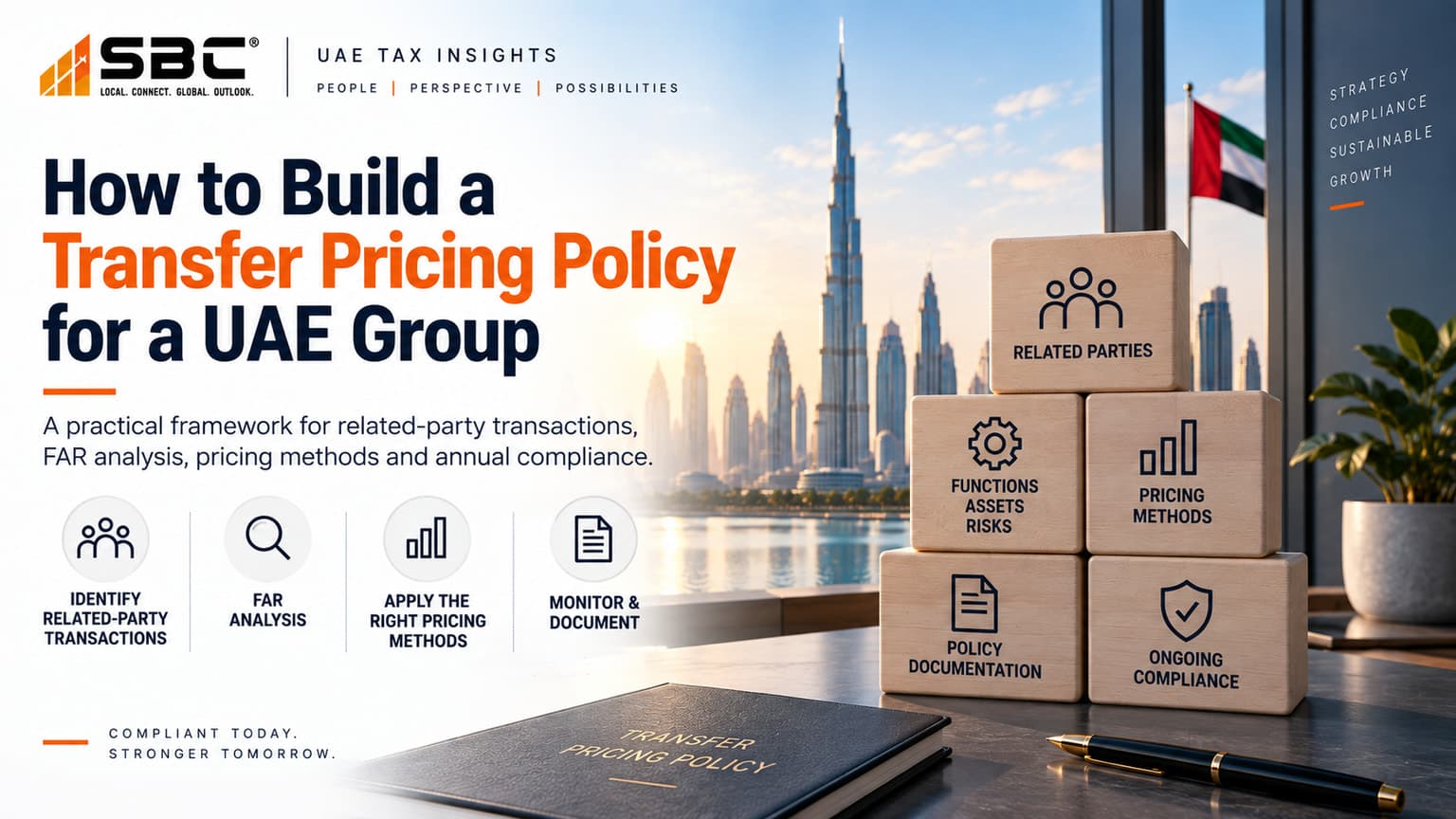
A transfer pricing policy is more than a document that sets prices between group companies. For a UAE group, it should provide a practical framework for identifying Related Party transactions, understanding how value is created across the group, and determining how those transactions should be priced at arm's length under Article 34 of the Corporate Tax Law.
This becomes particularly important where a UAE group has multiple entities involved in trading, distribution, manufacturing, management services, financing, intellectual property or other intra-group activities. A well-designed policy helps the group apply a consistent approach while maintaining supporting evidence for UAE Corporate Tax and transfer pricing.
What should a UAE transfer pricing policy cover?
A practical policy should answer five basic questions:
-
What transactions take place between group entities?
-
Which entity performs the relevant functions, uses the assets and assumes the risks?
-
What transfer pricing method should be applied?
-
What pricing mechanism should be used in practice?
-
How will the policy be documented, monitored and reviewed?
The policy should therefore be connected to the group's actual business model rather than being prepared as a standalone tax document. For the official framework, start with the FTA Transfer Pricing Guide (CTGTP1).
Step 1: How do you start building the policy?
Start with the group structure and business model.
Identify the UAE entities, overseas Related Parties, ownership relationships and the principal activities performed by each entity. The analysis should also identify where key commercial, operational and financial decisions are made.
A transaction map can then be prepared to show how goods, services, funds, intellectual property and other resources move between group entities. The starting point should be the actual business and transaction flows — not simply the accounting entries. The FTA Corporate Tax FAQs confirm that the arm's length principle can apply to domestic as well as cross-border Related Party and Connected Person dealings.
Which related-party transactions should be included?
The next step is to identify and document the transactions undertaken between group entities.
| Transaction | Key transfer pricing question |
|---|---|
| Purchase / sale of goods | What price would independent parties agree on for comparable goods? |
| Management services | What is the arm's length value of the services received? |
| Support services | What costs should be included and what mark-up is appropriate? |
| Loans / financing | What interest rate and financing terms are arm's length? |
| Guarantees | Would an independent party pay for the guarantee? |
| Royalty / IP arrangements | What would an independent party pay for the use of the IP? |
| Cost recharges | Which costs should be recharged and using what allocation basis? |
| Distribution arrangements | What return is appropriate for the functions and risks of the distributor? |
The transaction matrix should be reconciled with the general ledger, intercompany agreements and financial statements so that material transactions are captured. A policy that omits a shareholder loan, guarantee or IP licence because it is not invoiced monthly is incomplete.
Why is the FAR analysis important?
The Functions, Assets and Risks (FAR) analysis forms the foundation of the transfer pricing policy.
For each transaction, the group should determine:
-
Functions: What activities does each entity actually perform?
-
Assets: What tangible and intangible assets does each entity use?
-
Risks: Which entity assumes and controls the economically significant risks?
For example, a UAE entity described as a routine service provider may have limited functions and risks, while another group entity may make strategic decisions, manage key assets and assume significant commercial risks. The expected return should reflect these differences.
A contractual description should not be considered in isolation from the actual conduct of the parties. Where documentation is required, the FTA documentation FAQ and Ministerial Decision No. 97 of 2023 set the Local File and Master File thresholds.
How should the role of each group company be defined?
Following the FAR analysis, each entity should be assigned an appropriate economic profile. Depending on the facts, an entity may be characterised as:
-
a routine service provider;
-
a limited-risk distributor;
-
a full-fledged distributor;
-
a manufacturer;
-
a procurement entity;
-
a financing entity; or
-
an entrepreneur assuming significant commercial risks.
This characterisation provides the foundation for determining the expected arm's length return. The international benchmark for the arm's length principle is the OECD Transfer Pricing Guidelines.
How do you select the transfer pricing method?
The next step is to determine the most appropriate transfer pricing method for each transaction. The UAE framework follows the OECD approach and recognises:
-
Comparable Uncontrolled Price (CUP) Method;
-
Resale Price Method;
-
Cost Plus Method;
-
Transactional Net Margin Method (TNMM); and
-
Transactional Profit Split Method.
The selection should consider the nature of the transaction, the functions performed, the availability and reliability of comparable data, and the degree of comparability between the controlled and uncontrolled transactions.
A routine intra-group service arrangement may be analysed using a cost-plus or TNMM approach, while a financing transaction may be suitable for a CUP analysis where reliable comparable loan terms are available. The policy should document why the selected method is appropriate, rather than simply stating the method used.
How should the actual pricing mechanism be established?
A transfer pricing policy should convert the economic analysis into a mechanism that finance and business teams can actually apply.
For a routine service provider, for example:
Eligible operating costs + arm's length mark-up = service charge
For a distributor, the policy may instead establish a target operating margin based on the distributor's functions, assets and risks.
The policy should clearly define:
-
cost base;
-
mark-up or target margin;
-
allocation keys;
-
treatment of pass-through costs;
-
invoicing frequency;
-
payment terms;
-
currency; and
-
a year-end true-up mechanism, where appropriate.
This is what turns a transfer pricing policy from a theoretical document into an operational framework. The companion article on operationalising transfer pricing from policy to invoice covers how those rules should flow through ERP, invoices and year-end adjustments.
How should benchmarking support the policy?
The pricing mechanism should be supported by appropriate economic analysis. Depending on the transaction, this may involve:
-
internal comparable transactions;
-
external comparable companies;
-
comparable uncontrolled prices;
-
industry data;
-
interest-rate benchmarks; or
-
other reliable market information.
For a TNMM analysis, the group may need to identify an appropriate tested party, select a suitable profit-level indicator and determine an arm's length range using reliable comparables. The benchmarking should remain consistent with the actual functions and risks of the tested party. Stating a 5% mark-up because it is commonly used is not economic analysis.
Should intercompany agreements be aligned with the policy?
Yes. The transfer pricing policy and intercompany agreements should tell the same commercial story. The agreements should be consistent with functions performed, risk allocation, pricing methodology, scope of services, payment terms, intellectual property arrangements and the actual conduct of the parties.
An agreement alone does not establish that the pricing is arm's length. The actual conduct and financial results should also support the arrangement. See SBC's guide to intercompany agreements under UAE transfer pricing.
How should the policy be implemented and monitored?
A transfer pricing policy should not be prepared once and then left unchanged. The group should establish an annual review process covering:
-
changes in group structure;
-
new or discontinued Related Party transactions;
-
changes in functions, assets or risks;
-
changes in intercompany agreements;
-
actual financial results against the policy;
-
benchmarking updates; and
-
changes in UAE Corporate Tax or transfer pricing requirements.
A year-end review can also identify whether a transfer pricing adjustment or true-up is required. The objective is not simply to have a policy. It is to ensure that the group's actual transactions continue to follow it.
What should a UAE group maintain as supporting evidence?
A practical transfer pricing policy should be supported by an organised documentation file, including:
-
group structure and transaction mapping;
-
FAR analysis;
-
intercompany agreements;
-
transfer pricing method selection;
-
benchmarking studies;
-
pricing calculations;
-
invoices and supporting schedules;
-
financial results and margin calculations;
-
year-end true-up calculations, where applicable; and
-
evidence of periodic policy review.
The policy should work together with the group's transfer pricing documentation rather than operating as a separate document. That distinction is explained in policy versus documentation.
What are the common mistakes when building a policy?
Starting with a fixed mark-up. A 5%, 10% or 15% mark-up should not be selected simply because it is commonly used. The appropriate return should follow the economic analysis.
Using one method for every transaction. Goods, services, financing, guarantees and IP transactions have different economic characteristics and may require different methodologies.
Relying only on agreements. The contractual terms should be consistent with the actual conduct of the parties.
Ignoring actual financial results. A policy targeting a particular margin should be tested against the results actually reported by the entity.
Failing to update the policy. Changes in the business model, group structure or regulatory environment may require the policy to be revised.
Key takeaways
-
Start with the group structure and actual transaction flows.
-
Identify all material Related Party transactions.
-
Perform a robust Functions, Assets and Risks analysis.
-
Define the economic profile of each group entity.
-
Select the most appropriate transfer pricing method for each transaction.
-
Support the pricing with reliable benchmarking and economic analysis.
-
Align intercompany agreements, accounting records and actual conduct.
-
Establish an annual monitoring and review process.
Frequently asked questions
Is a transfer pricing policy mandatory for every UAE group?
Not necessarily. The specific UAE transfer pricing documentation requirements depend on the taxpayer and its circumstances. However, a documented policy can provide a practical framework for managing and supporting Related Party transactions even where a Local File is not required.
Can one transfer pricing policy cover the entire UAE group?
Yes. A group-wide framework can establish common principles, while individual transaction categories may require different pricing methodologies and mechanisms.
Can the same mark-up be applied to all intra-group services?
Not automatically. The appropriate return depends on the functions performed, assets used, risks assumed and the availability of reliable comparable data.
How often should a transfer pricing policy be reviewed?
The policy should be reviewed when there are material changes in the group's structure, business model, transactions, functions or risks. An annual implementation review is also advisable.
Does an intercompany agreement prove that the transaction is at arm's length?
No. The agreement is relevant, but the pricing should also be supported by the economic analysis, actual conduct and appropriate financial evidence.
Can a UAE transfer pricing policy cover cross-border transactions?
Yes. A UAE group can establish a policy covering both domestic and cross-border Related Party transactions, subject to the applicable UAE and foreign-country requirements.
Primary sources and further reading
How SBC Tax Consulting can help
SBC's transfer pricing team helps UAE groups map Related Party transactions, complete the FAR analysis, select methods, set operational pricing mechanisms and keep agreements, ledgers and documentation aligned. Where the same arrangement has to hold outside the UAE, our international tax and corporate tax specialists keep both sides of the position consistent. Contact SBC to review the policy before the next filing or documentation deadline.
This publication is for general information only and does not constitute professional advice. Please consult your SBC advisor before acting on any matter covered here.