
A transfer pricing policy and transfer pricing documentation are often treated as the same thing. They are not.
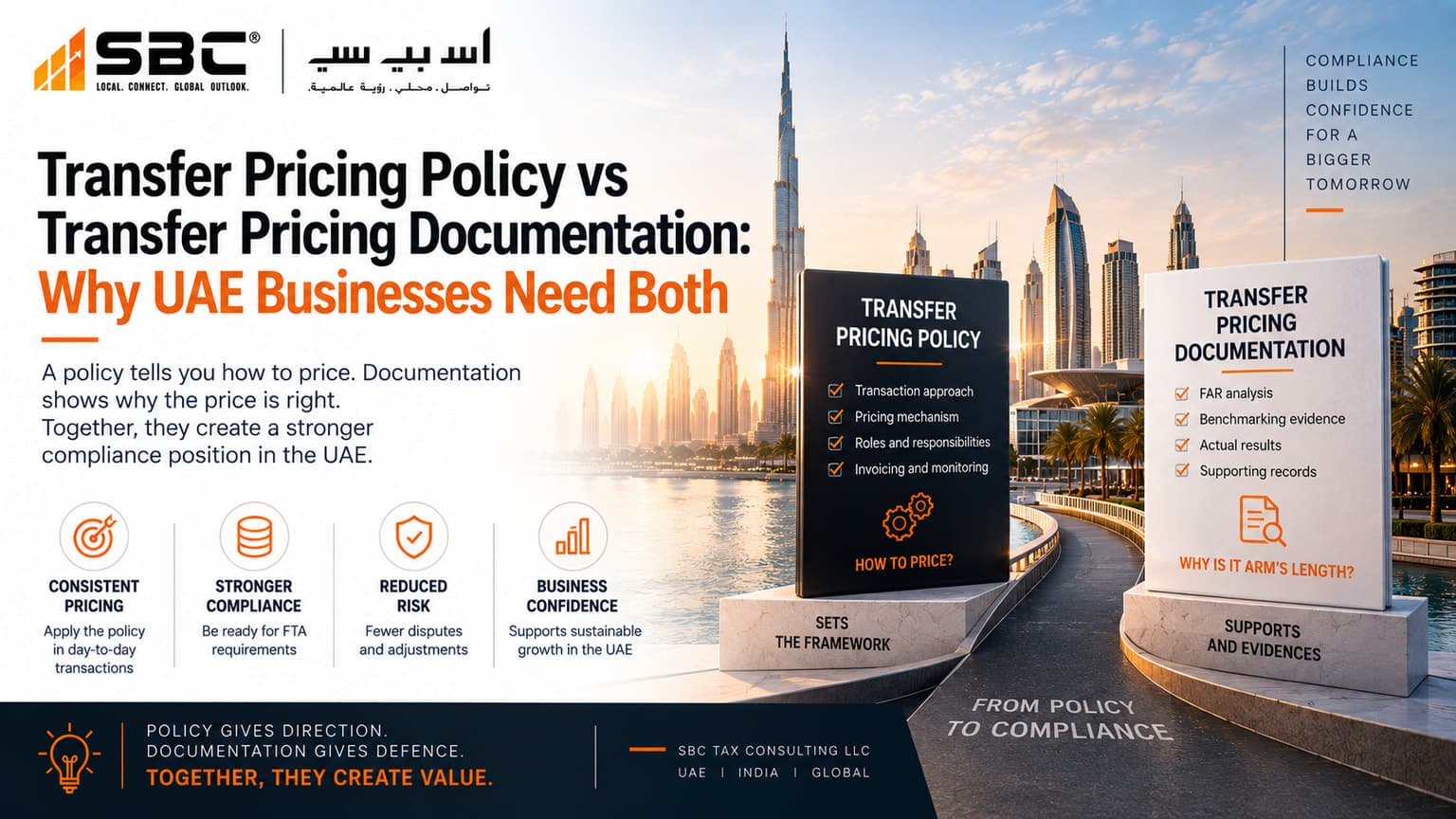
A transfer pricing policy explains how a business intends to price its Related Party transactions. Transfer pricing documentation demonstrates why those prices are consistent with the arm's length principle and provides the supporting analysis and evidence. This distinction matters for UAE businesses because a group may have a well-written policy but still be unable to demonstrate how its actual transactions were priced. Conversely, a detailed Local File or Master File may document transactions without giving finance teams a practical framework for applying consistent prices throughout the year.
The two therefore serve different purposes — but work best together. For the official UAE framework, see the FTA Transfer Pricing Guide (CTGTP1) and the OECD Transfer Pricing Guidelines.
What is a transfer pricing policy?
A transfer pricing policy is an internal framework that establishes how a group prices transactions between its Related Parties. It typically sets out:
-
the types of Related Party transactions undertaken;
-
the functions, assets and risks of the parties;
-
the transfer pricing method applicable to each transaction;
-
the pricing mechanism or target return;
-
allocation keys for shared costs;
-
invoicing and payment procedures; and
-
year-end monitoring or true-up procedures.
For example, a UAE group providing centralised management services to its subsidiaries may establish a cost-plus pricing mechanism under which eligible costs are identified and an arm's length mark-up is applied. The policy answers the practical question: "How should we price this transaction?"
Building that framework is covered in how to build a transfer pricing policy for a UAE group.
What is transfer pricing documentation?
Transfer pricing documentation is the evidence and analysis supporting the arm's length nature of the group's Related Party transactions.
Depending on the applicable UAE requirements, this can include the Master File, Local File, benchmarking studies, financial information, intercompany agreements, transaction schedules and other supporting records. The documentation generally demonstrates:
-
what transactions actually occurred;
-
how the parties performed their functions;
-
which assets were used;
-
which risks were assumed and controlled;
-
why a particular transfer pricing method was selected;
-
how the arm's length price or margin was determined; and
-
whether the actual results are consistent with the arm's length outcome.
The documentation therefore answers a different question: "Why is the price we applied considered arm's length?"
Ministerial Decision No. 97 of 2023 sets the Local File and Master File thresholds. Falling below those thresholds does not remove the arm's length obligation in Article 34.
What is the difference between a policy and documentation?
| Area | Transfer pricing policy | Transfer pricing documentation |
|---|---|---|
| Purpose | Provides a framework for pricing transactions | Supports and evidences the arm's length outcome |
| Timing | Primarily prospective | Primarily evidences actual transactions and analysis |
| Focus | How transactions should be priced | Why the pricing is appropriate |
| Users | Tax, finance and business teams | Tax authorities, tax teams and management |
| Content | Pricing mechanisms and procedures | FAR analysis, benchmarking, financials and supporting evidence |
| Example | Cost plus 5% policy for a service provider | Benchmarking supporting the arm's length mark-up |
| Outcome | Consistent implementation | Defensible compliance position |
A policy tells the business what to do. Documentation helps demonstrate that what was done is supportable.
Does having a transfer pricing policy mean documentation is no longer required?
No. A policy is not a substitute for transfer pricing documentation where documentation requirements apply.
A policy may state that a UAE entity providing routine services should earn an arm's length operating margin. The supporting documentation would need to demonstrate the functional profile of the entity and the economic analysis supporting the selected margin.
Similarly, a policy may establish that intra-group financing should be priced using an arm's length interest rate. The supporting analysis should demonstrate how the rate was determined based on the relevant characteristics of the financing arrangement.
The policy sets the approach; the documentation supports the approach.
How should a UAE business use both together?
The strongest approach is to connect the policy and documentation through a common transaction framework:
Transaction → FAR analysis → Method → Benchmark → Pricing policy → Actual result → Documentation
For each material Related Party transaction, the group should:
-
identify the intra-group service or other dealing;
-
perform the FAR analysis;
-
determine the appropriate transfer pricing method;
-
conduct the relevant benchmarking;
-
establish the pricing mechanism in the policy;
-
apply the pricing during the year;
-
compare actual results against the policy; and
-
document the outcome and any required adjustment.
This creates a clear link between the commercial arrangement, pricing methodology and final financial result. Making that chain operational is covered in from policy to invoice.
What happens if policy and actual results do not match?
This is one of the most important areas for annual review.
Suppose a UAE distributor's transfer pricing policy targets an arm's length operating margin within a particular range, but the entity's actual year-end results fall outside that range. The group should investigate why. Possible reasons include changes in market conditions, unexpected operating costs, changes in functions or risks, changes in product mix, one-off expenses, changes in business strategy, or incorrect application of the pricing policy.
The difference should not simply be ignored. Depending on the facts, the group may need to consider a transfer pricing adjustment or revise the policy for future periods.
Which documents should be connected to the policy?
A practical UAE transfer pricing framework may include:
-
group organisational chart;
-
Related Party transaction matrix;
-
FAR analyses;
-
intercompany agreements;
-
transfer pricing policy;
-
benchmarking studies;
-
Master File and Local File, where applicable;
-
pricing calculations;
-
invoices and supporting schedules;
-
general ledger and financial statements;
-
year-end margin analysis; and
-
true-up or adjustment calculations, where relevant.
The objective is to ensure that the commercial arrangement, contractual terms, pricing policy, accounting records and transfer pricing documentation tell the same story. The FTA Corporate Tax FAQs set the Related Party disclosure context that those records also have to support.
Who should own the transfer pricing policy?
Transfer pricing should not be treated as a tax team's responsibility alone.
Finance typically implements the pricing and monitors actual margins. Tax determines the transfer pricing framework and evaluates UAE Corporate Tax implications. Business teams understand the actual functions, commercial arrangements and risks. Legal helps ensure that intercompany agreements reflect the intended arrangements.
A coordinated process reduces the risk of having a policy that looks appropriate on paper but is not followed operationally.
How often should the policy and documentation be reviewed?
Both should be reviewed periodically, but not necessarily for the same purpose.
The policy should be revisited when there are changes in group structure, business model, Related Party transactions, functions, assets or risks, intercompany agreements, pricing mechanisms, or applicable UAE transfer pricing requirements.
Documentation should also be updated to reflect the relevant financial year, actual transactions, financial results and applicable benchmarking. An annual reconciliation between the policy and actual results can identify issues before the business finalises its tax and transfer pricing compliance.
What are the common mistakes UAE businesses should avoid?
Treating the policy as the documentation. A policy alone does not provide all the evidence required to support an arm's length outcome.
Preparing documentation without an operational policy. A detailed benchmarking study is of limited practical value if finance teams do not know how to apply the resulting pricing.
Using outdated benchmarks. Economic conditions and comparable company results can change, making periodic review important.
Ignoring actual results. The group should test whether the prices actually charged produce outcomes consistent with the policy.
Keeping agreements, policy and accounts separate. Differences between these documents can create questions about the substance and implementation of the arrangement.
Why do UAE businesses need both?
A transfer pricing policy and transfer pricing documentation address different parts of the same problem. The policy provides consistency by telling the group how transactions should be priced. The documentation provides support by demonstrating the economic basis for those prices.
Together, they help create a transfer pricing framework that is consistent across the group, evidence-based, operationally practical, aligned with the business model, and defensible from a UAE Corporate Tax and transfer pricing perspective.
Key takeaways
-
A transfer pricing policy is not the same as transfer pricing documentation.
-
The policy explains how Related Party transactions should be priced.
-
Documentation explains why the pricing is arm's length.
-
FAR analysis should provide the foundation for both.
-
Benchmarking should support the pricing methodology and outcome.
-
Actual financial results should be compared against the policy.
-
Intercompany agreements, accounting records and documentation should remain aligned.
-
Annual monitoring can identify pricing differences and potential adjustments.
Frequently asked questions
Is a transfer pricing policy mandatory in the UAE?
The requirement to maintain specific transfer pricing documentation depends on the taxpayer and the applicable UAE Corporate Tax rules. A formal policy may not be separately prescribed in every case, but it can be an important governance tool for managing Related Party transactions.
Is a transfer pricing policy part of the Local File?
Not necessarily. A transfer pricing policy is generally an internal framework, whereas the Local File is documentation supporting the UAE entity's material Related Party transactions and arm's length analysis, where applicable.
Can a company have documentation without a transfer pricing policy?
Yes. However, without a policy, the business may lack a consistent mechanism for applying the conclusions of its transfer pricing analysis throughout the year.
Can the policy replace a benchmarking study?
No. Where benchmarking is appropriate, the policy should be supported by reliable economic analysis. Simply stating a mark-up or margin does not establish that it is arm's length.
Should the transfer pricing policy be updated every year?
It should be reviewed regularly. An update may be necessary where there are material changes to the business, transactions, functions, risks, group structure or applicable transfer pricing requirements.
What if actual results do not match the transfer pricing policy?
The difference should be investigated. Depending on the circumstances, the group may need to consider a true-up or adjustment, reassess the underlying analysis, or revise the policy for future periods.
Primary sources and further reading
How SBC Tax Consulting can help
SBC's transfer pricing team helps UAE groups write a policy that finance can actually apply, and a Local File that can defend the same numbers. We connect FAR analysis, benchmarking, intercompany agreements and year-end results so the documentation does not describe a different business from the one in the ledger. Contact SBC to review both sides of the file before the next Corporate Tax deadline.
This publication is for general information only and does not constitute professional advice. Please consult your SBC advisor before acting on any matter covered here.