
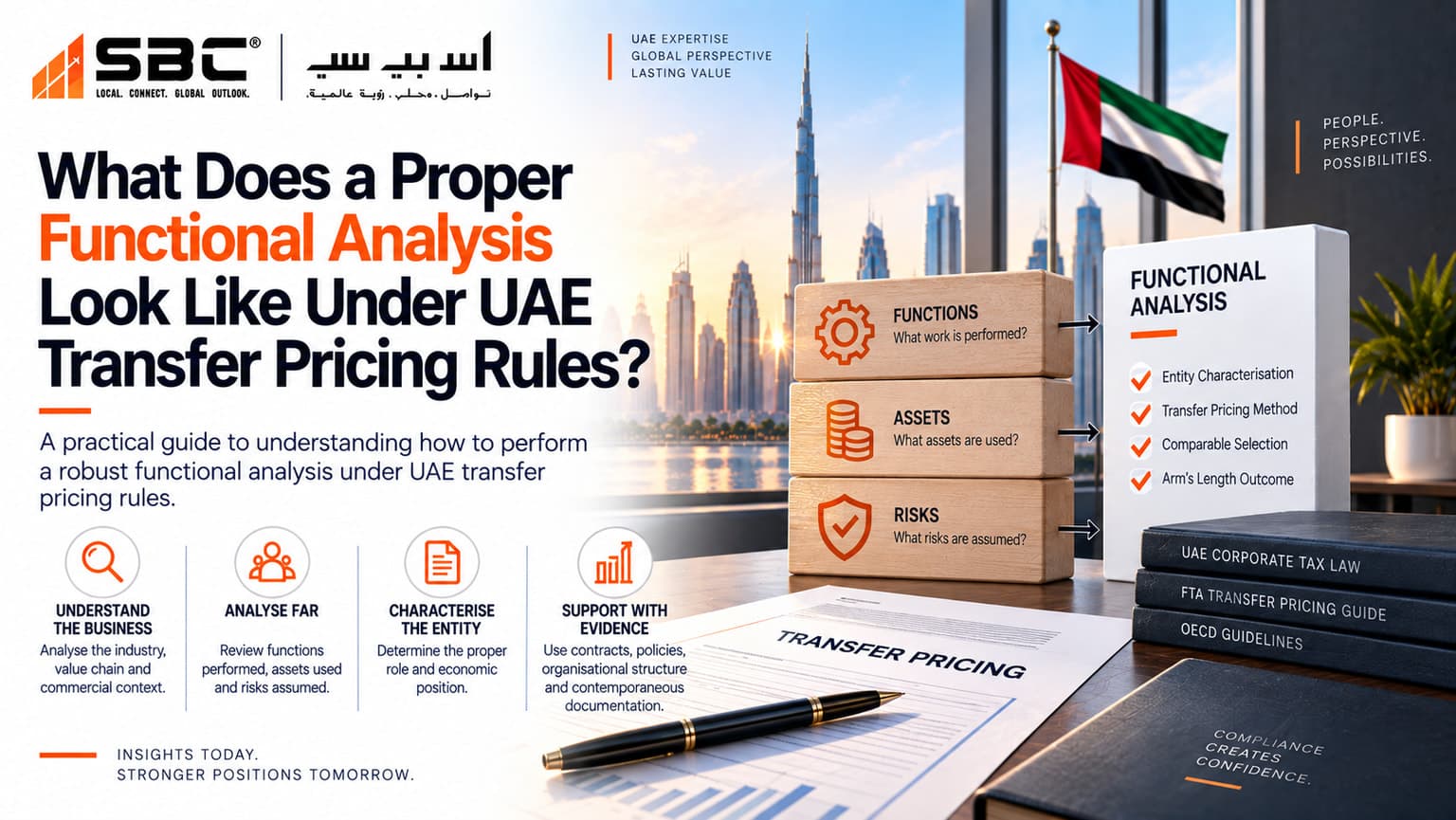
A functional analysis is not paperwork to complete before running a benchmarking search. It is the analytical foundation that determines how a UAE entity should be characterised, which transfer pricing method fits the transaction, and what a business should reasonably expect to earn from it. Article 34 of the UAE Corporate Tax Law places this analysis at the centre of testing whether Related Party and Connected Person transactions meet the arm's length standard.
Businesses that treat the functional analysis as a short narrative describing what a department "generally does" tend to run into two problems later. First, the wrong tested party or comparables get selected because the characterisation was too generic. Second, when facts change through growth, restructuring or a new product line, the pricing policy is left resting on a description of the business that is no longer accurate. A properly built functional analysis avoids both, and forms the core of the Local File for any UAE taxpayer that crosses the Master File and Local File thresholds under Ministerial Decision No. 97 of 2023.
What is a functional analysis, and what is it actually for?
A functional analysis identifies the functions performed, assets used and risks assumed — commonly referred to as the FAR analysis — by each party to a controlled transaction. Its purpose is threefold: it allows the parties to a transaction to be characterised (for example, as a routine service provider or as an entrepreneurial principal), it identifies the factors that need to be comparable when searching for third-party benchmarks, and it informs which transfer pricing method is most appropriate for the transaction being tested.
The FTA Transfer Pricing Guide (CTGTP1) and Chapter I of the OECD Transfer Pricing Guidelines treat this as accurate delineation of the transaction, not a label copied from the intercompany agreement.
What are the practical steps in building a functional analysis?
-
Understand the industry and the group's value chain, including where value is created and by which entities.
-
Map the group structure and identify each controlled transaction that needs to be analysed separately.
-
Gather facts directly from the business through structured interviews or questionnaires with the people who actually perform the relevant activities, not only from finance.
-
Document the functions performed by each party, distinguishing routine activities from those that are strategically or economically significant.
-
Identify the assets used, including tangible assets, financial assets and intangibles, and who legally owns and who functionally develops or exploits each one.
-
Analyse the risks assumed, testing contractual assumption against actual control and financial capacity to bear each risk.
-
Characterise each entity based on the combined FAR profile.
-
Link the characterisation to the selection of the tested party, the transfer pricing method and the comparability criteria used in benchmarking.
Which functions typically need to be mapped in a UAE group?
Map functions transaction by transaction, not only at group level. Typical categories in a UAE group include procurement, manufacturing or contract production, sales and distribution, marketing and business development, logistics and warehousing, treasury and financing, management and governance, and technology or R&D support.
The useful distinction is not the department name. It is whether the activity is routine and readily comparable, or economically significant because it drives value, strategy or risk. A UAE entity that "provides support" on paper but employs the people who set prices, approve credit or decide inventory levels is not a routine service provider for that transaction.
What counts as an asset in a functional analysis?
Assets include tangible property such as plant, equipment and premises, financial assets, and intangibles such as trademarks, trade names, technical know-how, customer relationships and proprietary processes.
For intangibles in particular, legal ownership is only the starting point. The entity performing the development, enhancement, maintenance, protection and exploitation functions connected to an intangible has a stronger claim to the return generated by that intangible than an entity that holds legal title but performs none of those functions. That DEMPE analysis is developed further in SBC's guide to transfer pricing for intangibles.
How should risks be identified and tested?
Start by identifying the economically significant risks in the transaction, such as market risk, inventory risk, credit risk, product liability risk, R&D risk and foreign exchange risk.
For each risk, note which party assumes it contractually, then test which party actually exercises control — meaning the capability to make decisions about taking on, laying off or declining the risk and to respond to the outcomes of those decisions — and which party has the financial capacity to absorb the consequences if the risk materialises.
Where control and financial capacity sit with a different party than the one named in the contract, the functional analysis should record that outcome clearly, since it directly affects how the transaction is subsequently priced. Economic conduct prevails over the written contract, a point the FTA Transfer Pricing Guide also emphasises.
How does the functional analysis determine entity characterisation?
Characterisation is the conclusion drawn from the combined FAR profile, not a title in the shareholders' agreement. Typical profiles include a limited-risk distributor, a full-function distributor, a contract or toll manufacturer, a routine service provider, and an entrepreneurial principal that owns key intangibles and controls economically significant risks.
The same legal entity can be a routine service provider for one transaction and a more entrepreneurial party for another, depending on the functions, assets and risks specific to each transaction. That is why characterisation should be recorded per controlled transaction, not as a single group-wide label. Distribution-model differences are set out in FFD, LRD and agency structures.
How does the functional analysis feed into method selection and benchmarking?
Once the characterisation is settled, the party with the simpler functional profile is normally selected as the tested party, since it is easier to find broadly comparable independent companies for a routine function than for a complex, integrated one.
The characterisation also narrows the search for comparables: a business described as a limited-risk distributor should be benchmarked against independent distributors with a similarly limited risk profile, not against full-function principals or agents, even if their industry classification looks similar on a database screen. If the facts show a more complex business, a routine TNMM analysis may need to be reconsidered.
What should the functional analysis section of a UAE Local File contain?
-
Group and local organisational charts current as at the relevant tax period.
-
A summary of interviews or questionnaire responses from the people who actually perform the relevant functions.
-
A description of the functions performed, assets used and risks assumed for each controlled transaction, not only at group level.
-
An asset register identifying tangible, financial and intangible assets and who develops, enhances, maintains, protects and exploits each intangible.
-
A risk matrix linking each economically significant risk to the party that controls it and has the financial capacity to bear it.
-
A clear characterisation conclusion for each relevant entity, with reasoning rather than a bare label.
-
Cross-references to the intercompany agreements and to any divergence between those agreements and actual conduct.
How often should the functional analysis be refreshed?
At least annually as part of the Local File update cycle, and promptly after any event that changes who performs the relevant functions, such as a restructuring, an acquisition, a new product launch, a systems migration or a significant change in senior personnel. A functional analysis that has not been revisited in several years is one of the more common weaknesses seen in transfer pricing files during a review.
A transfer pricing policy that is not tied to a current FAR analysis will not survive contact with the general ledger.
Frequently asked questions
Is a functional analysis only needed once, when the transfer pricing policy is first set?
No. It should be revisited at least annually and refreshed whenever functions, assets or risks materially change, since the pricing policy needs to reflect the business as it currently operates.
Does a functional analysis apply to domestic Related Party transactions, not only cross-border ones?
Yes. Article 34 applies to Related Party and Connected Person transactions generally, and the accurate delineation of the transaction is a factual exercise regardless of whether the counterparty is inside or outside the UAE. See whether domestic related-party dealings need transfer pricing.
Can two entities in the same group have different characterisations for different transactions?
Yes. The same entity can be a routine service provider for one transaction and a more entrepreneurial party for another, depending on the functions, assets and risks specific to each transaction.
Is a job title enough evidence of the functions a person performs?
No. A title indicates a role on paper. The functional analysis should be based on actual authority and activity, evidenced through interviews, decision records and day-to-day conduct.
Does the functional analysis replace the need for a benchmarking study?
No. It precedes and informs the benchmarking study by determining which party should be tested and what comparability criteria the search for third-party comparables should apply.
Primary sources and further reading
-
Federal Decree-Law No. 47 of 2022 on the Taxation of Corporations and Businesses — Article 34
-
OECD Transfer Pricing Guidelines — Chapter I, Sections C and D
How SBC Tax Consulting can help
SBC's transfer pricing team builds FAR analyses from interviews, agreements and the general ledger — then ties characterisation to method selection and a defensible comparable search. Contact SBC before the next Local File cycle or FTA information request.
This publication is for general information only and does not constitute professional advice. Please consult your SBC advisor before acting on any matter covered here.