
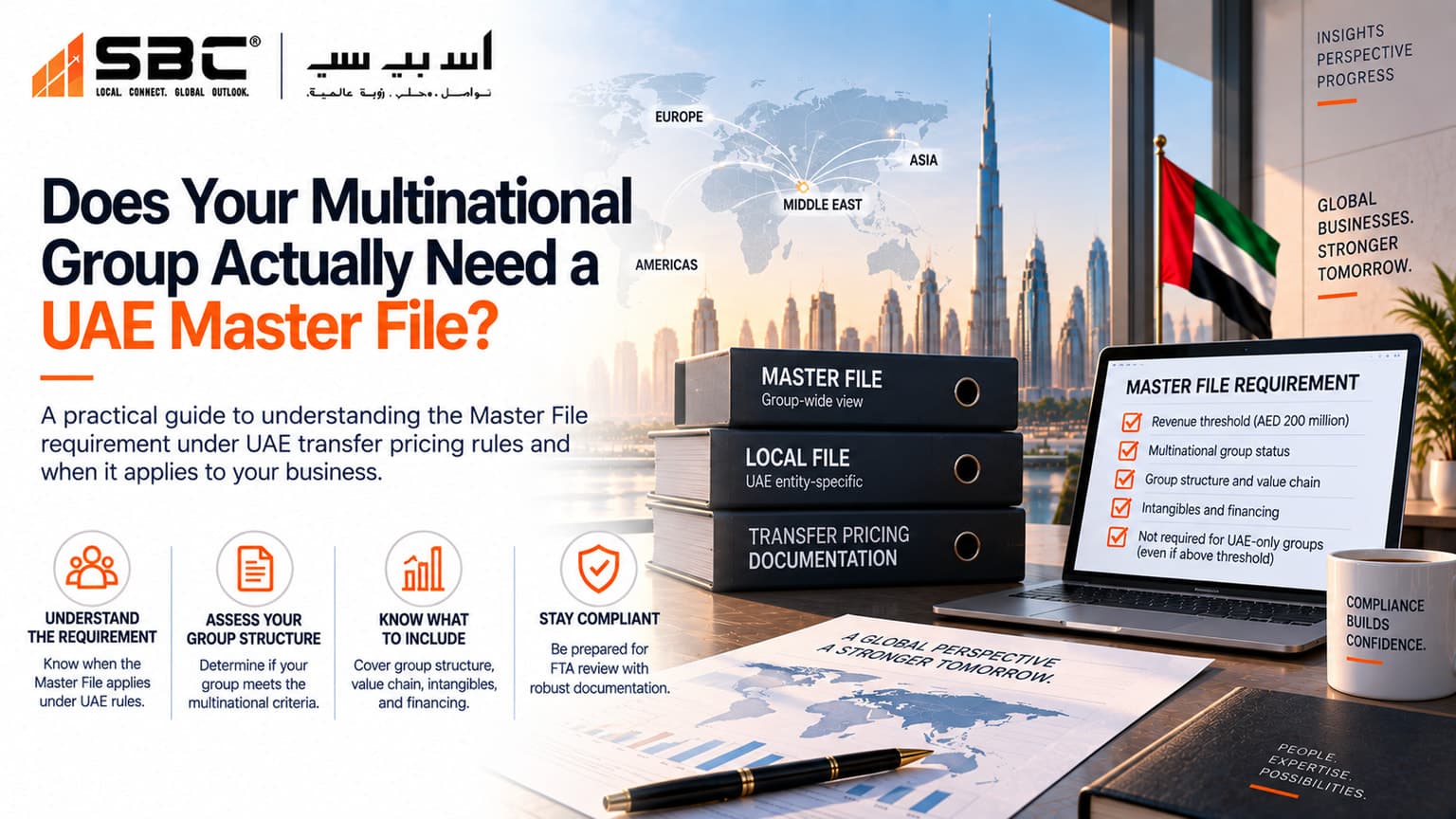
Not automatically — even if your UAE entity is well past the AED 200 million revenue mark. The Master File obligation under Ministerial Decision No. 97 of 2023 turns on two separate tests, a revenue threshold and genuine multinational group status, and both need to be satisfied before the obligation applies. A UAE-only business that clears the revenue threshold but has no related parties outside the country typically owes a Local File, not a Master File.
Since the UAE Corporate Tax regime took effect for tax periods beginning on or after 1 June 2023, "Master File" has become one of the most repeated phrases in UAE transfer pricing conversations — and also one of the most misapplied. Groups with large UAE revenue sometimes assume they need one simply because the number feels big enough. Groups that are genuinely multinational sometimes assume a Master File is required the moment a foreign shareholder exists, regardless of the actual figures involved. Both assumptions create either wasted compliance effort or a real documentation gap.
What is a Master File, and how is it different from a Local File?
The Master File and the Local File are the two documentation tiers introduced by Article 55(2) of Federal Decree-Law No. 47 of 2022 and detailed in Ministerial Decision No. 97 of 2023. They serve different purposes.
The Master File gives the FTA a group-wide picture: how the multinational group is structured, where value is created, what intangibles exist, and how the group finances itself. The Local File is entity-specific: it sets out the UAE Taxable Person's own related-party transactions, the counterparties involved, the transfer pricing method applied, and the supporting comparability analysis. The two documents are read together, but only one of them describes the group as a whole.
| Document | What it describes | Who it is for |
|---|---|---|
| Master File | Group structure, value chain, intangibles, financing and TP policies | The FTA, as a high-level picture of the MNE |
| Local File | The UAE entity's material controlled transactions, FAR analysis and benchmarking | The FTA, as the entity-level evidence file |
| Disclosure Form | Related Party and Connected Person schedules inside the Corporate Tax Return | Filed with the return on EmaraTax |
What has to be reported on the return is a different exercise from maintaining these files. See what businesses need to report for Related Party transactions.
Which UAE Taxable Persons must prepare a Master File?
Under Ministerial Decision No. 97 of 2023, a Taxable Person must prepare and maintain both a Master File and a Local File if it meets either of the following two conditions during the relevant tax period:
-
The Taxable Person is a Constituent Entity of a Multinational Enterprise Group with total consolidated group revenue of AED 3.15 billion or more.
-
The Taxable Person's own revenue in the relevant tax period is AED 200 million or more.
Meeting either test on its own is sufficient to trigger the documentation obligation — the two are alternative, not cumulative, conditions. For the Master File specifically, the group also needs to be multinational in substance. Taxable Persons that form part of a group within the scope of the OECD's Pillar Two framework may also need to maintain transfer pricing documentation regardless of their own revenue level, reflecting the closer scrutiny larger groups face under that separate regime.
Does meeting the AED 200 million threshold alone trigger a Master File?
Not necessarily. The Master File is a description of a multinational group — its global structure, its intangibles, its cross-border financing. If every entity connected to the UAE Taxable Person is itself UAE-resident, with no related party incorporated, managed or tax resident outside the UAE, there is no multinational structure to describe.
In that scenario, a UAE entity that crosses the AED 200 million standalone threshold is still expected to prepare a Local File covering its domestic related-party transactions, but the Master File obligation has no practical basis to apply. The moment a foreign related party enters the picture — a shareholder, a sister company, a branch, or a related lender outside the UAE — that analysis needs to be revisited, because the group has become multinational in substance. Domestic related-party dealings remain in scope of Article 34 either way.
What counts as a Multinational Enterprise Group for this purpose?
Ministerial Decision No. 97 of 2023 borrows its definition of an MNE Group from the Country-by-Country Reporting framework under Cabinet Decision No. 44 of 2020. In broad terms, a group qualifies as an MNE Group where it includes two or more enterprises that are tax resident in different jurisdictions, or where an enterprise resident in one jurisdiction is taxable in another jurisdiction through a permanent establishment.
A single UAE company with a foreign holding company sitting above it, or a UAE branch of a foreign head office, is enough to bring the structure within this definition — the group does not need dozens of entities across multiple continents before the concept applies.
What should the Master File actually contain?
The FTA Transfer Pricing Guide (CTGTP1) follows the OECD's BEPS Action 13 template for the Master File, organised into five broad categories:
| Category | Typical content |
|---|---|
| Organisational structure | Legal and ownership structure, and the geographic location of operating entities |
| Description of the business | Drivers of business results, supply chain, principal markets, and important service arrangements |
| Intangibles | Overall strategy, important intangibles, important agreements and DEMPE-related transfer pricing policies |
| Intercompany financial activities | How the group is financed, including important financing arrangements with unrelated lenders and among group members |
| Financial and tax positions | Annual consolidated financial statements and existing unilateral APAs and other tax rulings on the allocation of income |
The level of detail expected is proportionate to the size and complexity of the group rather than exhaustive for its own sake. The FTA's guidance is clear that the Master File should provide a high-level overview, with entity-specific detail reserved for the Local File.
Can we simply submit our group's existing global Master File to the FTA?
In most cases, yes. Because the UAE's documentation framework follows the same OECD Annex I structure used by most jurisdictions that have implemented BEPS Action 13, a Master File prepared centrally for the group — and already used to satisfy documentation obligations elsewhere — will generally cover what the FTA expects, provided its content genuinely maps onto the five categories above.
What often needs local attention is not the Master File itself but the bridge to it: a short covering note or index confirming where each required category is addressed in the group document, and, where the Master File is not in English or Arabic, an accurate translation or summary the FTA can work with. Groups should also check that the version on hand reflects the group as it existed during the relevant tax period, since restructurings, disposals and new acquisitions can leave an outdated version circulating internally.
When does the Master File need to be ready, and when must it be filed?
The Master File and the Local File are not filed with the annual Corporate Tax Return. Instead, under Article 55(2), a Taxable Person must provide them to the FTA within 30 days of a written request, or by such later date as the FTA may direct.
That 30-day window is a production deadline, not a preparation deadline. The underlying documentation is expected to be prepared contemporaneously, meaning it should already exist, substantially in its final form, by the time the relevant tax period's transactions and pricing positions are finalised. A group that starts drafting its Master File only after an FTA notice arrives is working against the clock on a document that was supposed to already exist.
How long should the Master File and supporting records be retained?
UAE Corporate Tax record-keeping obligations generally require Taxable Persons to retain their records, including transfer pricing documentation, for a period of seven years from the end of the relevant tax period. Multinational groups should apply the same retention discipline to the Master File as they do to entity-level records, and should keep dated versions so that the file used to respond to an FTA request accurately reflects the tax period under review rather than the group's current structure.
What happens if the Master File is not ready when the FTA asks for it?
Failure to maintain adequate records, including transfer pricing documentation, carries administrative penalties under Cabinet Decision No. 75 of 2023 — a fixed penalty for a first violation, rising for a repeated violation within a 24-month period.
Beyond the direct penalty, an incomplete or hastily assembled Master File tends to invite closer FTA scrutiny of the related Local File and the underlying related-party pricing, and can weaken a Taxable Person's position if the FTA proposes an adjustment to taxable income. For a Qualifying Free Zone Person, documentation gaps carry an additional layer of risk, since compliance with the arm's length principle and transfer pricing documentation requirements is one of the ongoing conditions for retaining the 0% Corporate Tax rate on qualifying income.
What should a multinational group do before the FTA ever asks?
-
Map every UAE constituent entity against both threshold tests, on a tax-period-by-tax-period basis, rather than assuming last year's answer still applies.
-
Confirm whether the UAE entity sits within a genuinely multinational structure, or whether — despite strong revenue — its related parties are all UAE-resident.
-
Request the group's current Master File from the global tax or transfer pricing team and check it against the FTA's five required categories.
-
Prepare a short UAE-specific index or reconciliation note mapping the Master File's contents to the FTA's requirements.
-
Arrange translation or an English-language summary where the group's Master File is prepared in another language.
-
Refresh the Master File at least annually, or whenever the group undergoes a material restructuring, acquisition or disposal.
-
Store dated versions so that the file available for a given tax period matches the group structure that actually existed during that period.
-
Align the narrative in the Master File with the specific transactions and positions taken in the UAE Local File, so the two documents tell a consistent story.
Who should own the UAE Master File process within a multinational group?
In practice, no single function can complete this alone. The group's central tax or transfer pricing team typically owns the Master File itself, but the UAE finance team needs to confirm the entity's own threshold position each year, and local tax advisers need to validate that the group document actually satisfies FTA-specific requirements rather than assuming equivalence with another jurisdiction's rules.
Groups that treat the Master File as a one-off deliverable produced for a single filing tend to fall behind; groups that treat it as a living document, refreshed on a set annual cycle and cross-checked against UAE-specific thresholds, are the ones that can produce a complete file within 30 days without a scramble.
Frequently asked questions
Does every UAE company with related-party transactions need to prepare a Master File?
No. Only Taxable Persons that meet one of the two thresholds under Ministerial Decision No. 97 of 2023 — AED 3.15 billion or more in consolidated MNE Group revenue, or AED 200 million or more in the entity's own UAE revenue — and that form part of a genuinely multinational structure need to prepare one. Smaller businesses still need to support arm's length pricing on request.
Is the AED 200 million threshold based on UAE revenue or worldwide revenue?
It is based on the Taxable Person's own revenue for the relevant tax period, not the group's worldwide figure. The AED 3.15 billion figure, by contrast, is a consolidated group-wide test.
Do Free Zone Persons need to prepare a Master File?
Yes, if the applicable thresholds are met. The requirement applies regardless of whether the Taxable Person operates on the mainland or in a Free Zone, including Qualifying Free Zone Persons.
Can the Master File be submitted together with the Corporate Tax Return?
It is not required to be filed with the return. It must instead be available to provide to the FTA within 30 days of a formal request, or such later date as the FTA specifies.
What if our group's Master File was prepared to satisfy another country's transfer pricing rules?
It can generally be used for UAE purposes provided its content aligns with the FTA's required categories under the OECD Annex I framework. A short reconciliation note and, where needed, translation into English are good practice to accompany it.
Primary sources and further reading
-
Federal Decree-Law No. 47 of 2022 on the Taxation of Corporations and Businesses — Article 55
-
OECD Transfer Pricing Guidelines — Chapter V and Annex I
How SBC Tax Consulting can help
SBC's transfer pricing team maps UAE entities against the Master File thresholds, reconciles group Master Files to FTA categories and aligns them with the Local File. Corporate tax specialists then keep the same facts consistent with the return. Contact SBC before the next filing cycle or FTA information request.
This publication is for general information only and does not constitute professional advice. Please consult your SBC advisor before acting on any matter covered here.