
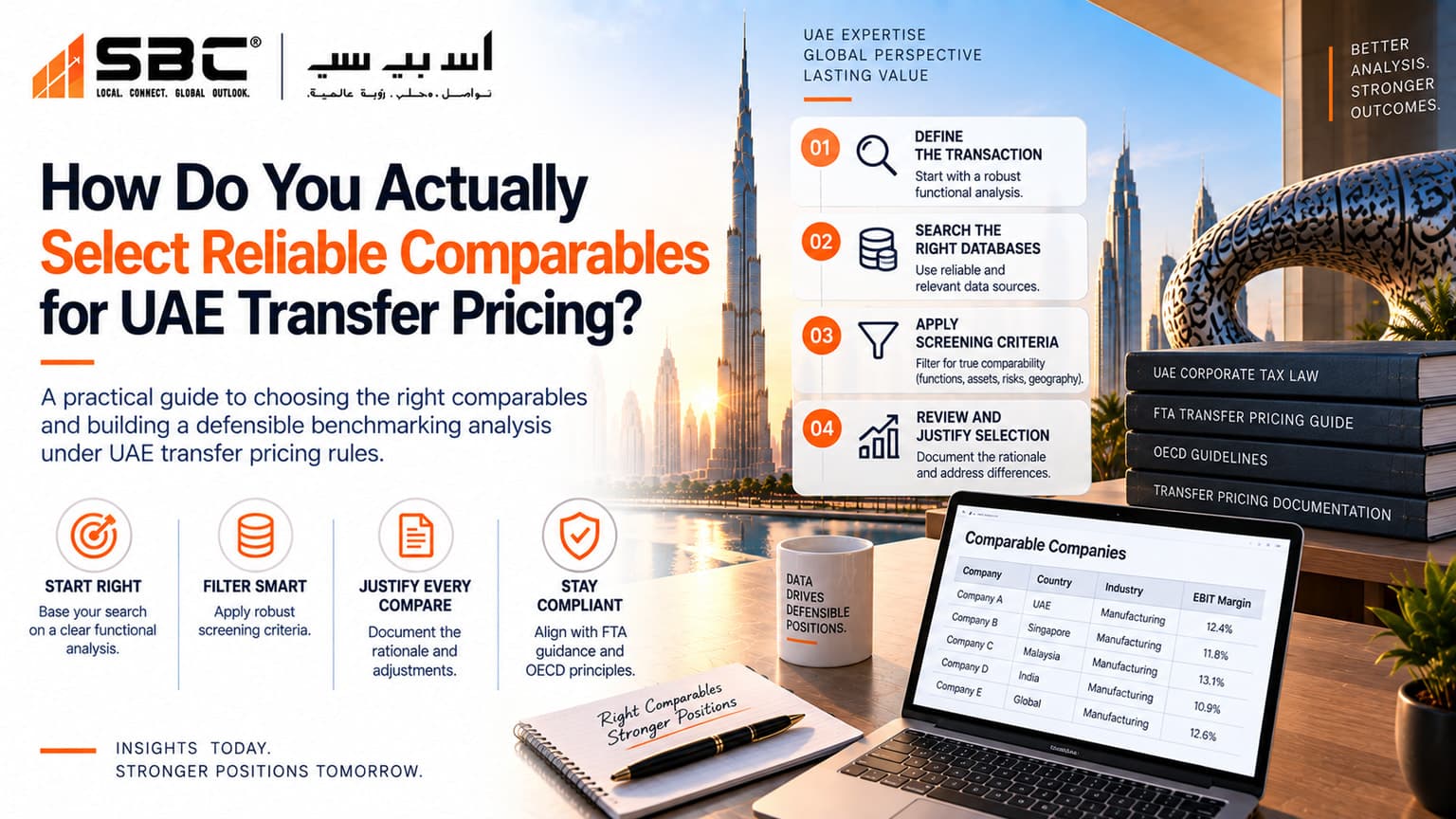
A benchmarking study is only as reliable as the comparables behind it. Selecting UAE transfer pricing comparables is not a matter of running a database screen on an industry code and taking the first page of results — the FTA expects a documented, defensible search process that reflects the accurately delineated transaction and produces a genuine arm's length range.
For Taxable Persons that meet the Master File and Local File thresholds under Ministerial Decision No. 97 of 2023, the benchmarking analysis is a core part of the Local File. Even businesses below those thresholds are still required to price Related Party and Connected Person transactions at arm's length under Article 34, so a defensible comparability approach matters well beyond the taxpayers formally required to document one.
What is the purpose of a benchmarking study?
A benchmarking study tests whether the pricing or profitability of a controlled transaction falls within the range that independent parties would have achieved in comparable circumstances. It does not set the price in isolation; it supports or challenges a price or margin that should already flow logically from the functional analysis and the transfer pricing method selected for the transaction.
Where should the search for comparables actually start?
With the functional analysis, not with a database. The characterisation of the tested party — whether a routine distributor, a contract manufacturer, a limited-risk service provider or another profile — determines the type of independent companies that can genuinely be considered comparable. A search that begins directly in a database, filtered only by industry classification, risks pulling in companies that share a sector label but not a functional profile.
What are the key comparability factors under UAE transfer pricing?
Article 34(5) of the Corporate Tax Law requires that the most appropriate method be selected having regard to the same factors that define comparability. A candidate is only a reliable comparable to the extent that none of these differences would materially affect the price or margin being tested, or that a reasonably accurate adjustment can remove the effect of any difference that does exist:
| Factor | What to compare |
|---|---|
| Contractual terms | Allocation of rights, responsibilities, volume commitments and termination rights |
| Characteristics of the property or services | Product or service type, quality, features and stage of development |
| Functions, assets and risks | FAR profile of the tested party versus the candidate |
| Economic circumstances | Markets, geography, competition and business cycle |
| Business strategies | Market-penetration, diversification or innovation strategies that affect pricing |
The FTA Transfer Pricing Guide (CTGTP1) also makes a point that is easy to overlook at the search stage: economic conduct between the parties prevails over the written contract, so a comparable's public filings and business description carry more weight than a label on a database screen.
Which databases and data sources can be used for UAE benchmarking?
UAE-specific financial data on independent companies is limited, so most benchmarking studies widen the geographic scope to a broader Middle East, pan-EMEA or, where relevant, global data set, using commercial databases that provide standardised financial statements for independent companies.
Widening the geography is a recognised practical response to data scarcity, but it should be supported by a reasoned explanation of why the broader set remains reliable for the transaction being tested, and by comparability adjustments where economically relevant differences, such as market size or cost of doing business, are identified.
Internal comparables — meaning transactions the UAE entity or its counterparty has with genuinely independent third parties on similar terms — should be considered first where they exist, since they are often more reliable than external database searches.
What quantitative and qualitative screens should be applied?
-
Qualitative review of each candidate's business description to confirm it performs a genuinely comparable activity, not merely a similar-sounding one.
-
Independence screens to exclude companies that are themselves part of a group with related-party dealings above a reasonable threshold.
-
Persistent loss-making companies are generally excluded, since sustained losses are inconsistent with the conduct of an independent party operating on a stand-alone basis over time.
-
Minimum data availability, typically requiring several years of financial data to support a multi-year analysis.
-
Functional screens to exclude companies performing materially different functions, even where their industry classification matches.
A rejection without a specific reason is not a screen. The search log should record why each candidate was dropped, which is the point the FTA will test if it challenges the set.
How many years of data, and how large a sample, is enough?
Multi-year data, commonly spanning three to five years, is generally used to smooth out business-cycle effects and one-off events, rather than relying on a single year that may not be representative.
There is no fixed statutory minimum sample size under UAE transfer pricing rules. The objective is a sample large and consistent enough to produce a statistically meaningful range, with the search criteria and rejection reasons documented so the outcome can be reconstructed and defended.
What is the interquartile range, and how should results be interpreted?
Once a final set of comparables is accepted, their financial results are typically expressed as a range, most commonly using the interquartile range, which narrows the full spread of results to the middle fifty percent and reduces the influence of outliers at either end.
As a simple illustration, if the accepted comparables produce operating margins ranging from 3.5% to 6.2% at the interquartile range, a tested party's result within that band would generally support the pricing adopted, while a result outside it would warrant closer review of the functional analysis, the method or the comparable set itself. Common TNMM traps are covered in four benchmarking pitfalls.
What should the benchmarking documentation include in the Local File?
-
The rationale for selecting the tested party, linked back to the functional analysis.
-
The database used, the search string or screening criteria applied, and the date the search was performed.
-
A rejection matrix showing candidates considered and the specific reason each was excluded.
-
The final list of accepted comparables with the source of their financial data.
-
Any comparability adjustments made, together with the reasoning and calculation behind each one.
-
The resulting range and where the tested party's actual result falls within it.
-
The policy for updating the study, distinguishing an annual financial data refresh from a full search refresh.
Who should be involved in preparing a UAE benchmarking study?
A transfer pricing professional with access to an appropriate commercial database and experience applying comparability adjustments should lead the search, working with finance to confirm the tested party's own financial data is presented on a consistent basis. The output should be reviewed against the functional analysis before it is finalised, since a benchmarking study that is technically well executed but tests the wrong party or the wrong profile does not support the position it is meant to defend.
Frequently asked questions
Can I use the illustrative rates or margins shown as examples in the FTA Transfer Pricing Guide as my benchmark?
No. Those examples illustrate methodology only. A benchmark should be built from the taxpayer's own accurately delineated transaction and an independent search for comparable data.
Do I need to run a completely new comparable search every year?
Not necessarily. A common practical approach is to refresh the financial data of the accepted comparables annually and repeat the full search every few years, or sooner if the functional profile of the tested party changes materially.
Must the comparables be UAE companies?
Not as a rule. Given limited UAE-specific data availability, regional or broader data sets are commonly used, supported by comparability adjustments where economically relevant differences exist.
Are loss-making comparables always excluded?
Persistent, multi-year losses are generally excluded because they are inconsistent with the conduct of an independent party. An isolated loss year may still be acceptable depending on the underlying facts and the reason for the loss.
Can the FTA rely on data the taxpayer cannot access during a review?
A taxpayer's own benchmarking analysis should be built on independently available, documented data. Where a review raises comparables the taxpayer has not seen, the taxpayer should seek to understand and respond to the basis used, as with any tax administration's use of information in an examination.
Primary sources and further reading
-
Federal Decree-Law No. 47 of 2022 on the Taxation of Corporations and Businesses — Article 34
-
OECD Transfer Pricing Guidelines — Chapter III
How SBC Tax Consulting can help
SBC's transfer pricing team designs comparable searches from the tested-party FAR profile, documents rejection matrices and keeps the range reconcilable to the Local File. Contact SBC before the next benchmarking refresh or FTA review.
This publication is for general information only and does not constitute professional advice. Please consult your SBC advisor before acting on any matter covered here.