
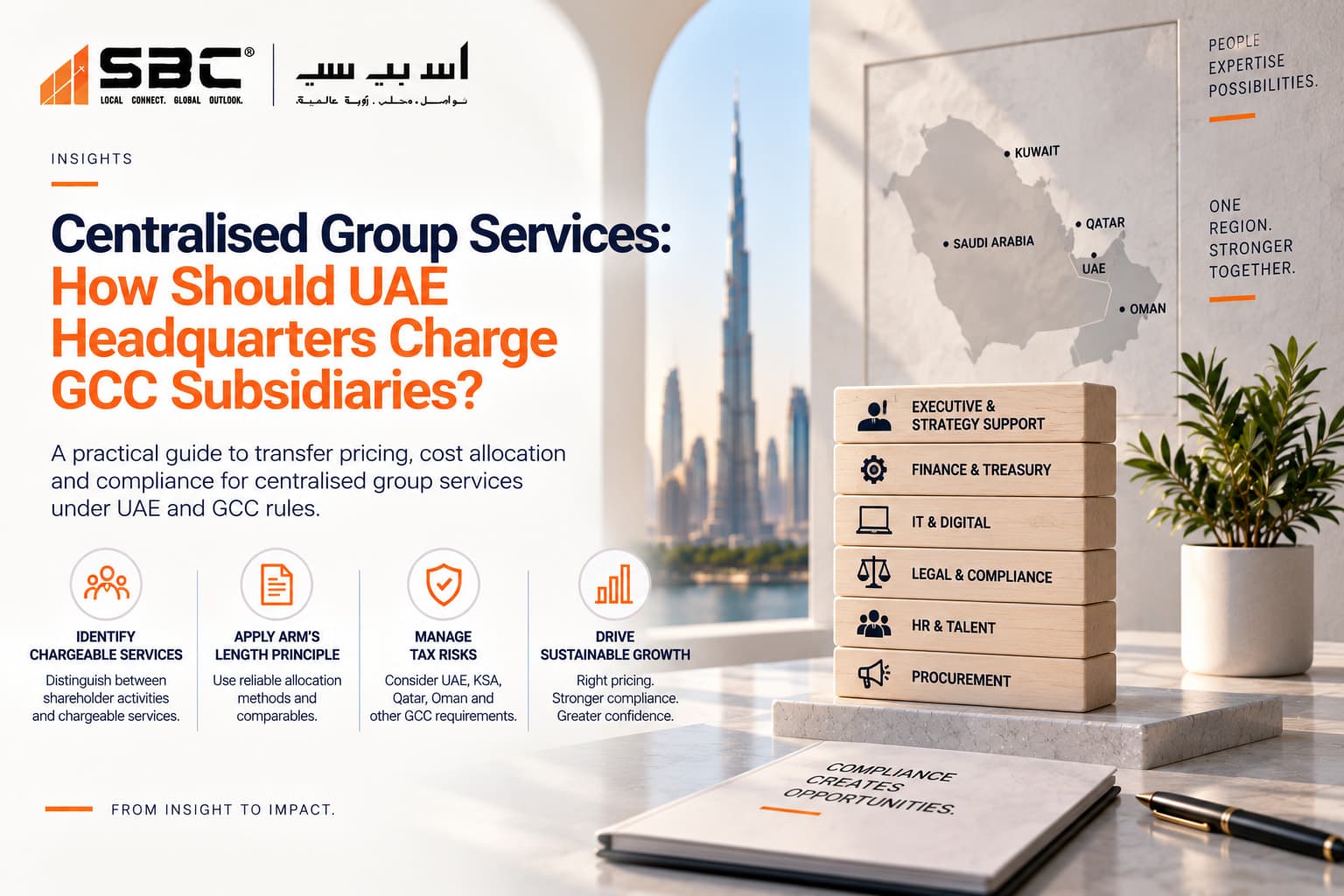
A lump-sum management fee from a UAE regional headquarters to GCC subsidiaries is no longer a workable default. Under Article 34 of Federal Decree-Law No. 47 of 2022, every outbound intercompany service charge has to clear the arm's length principle in the UAE. In Saudi Arabia, Qatar and Oman the same invoice also has to survive deductibility and withholding tax tests. Pricing the charge is step two. Proving that a genuine, chargeable service occurred is step one.
Groups locate regional headquarters and shared service centres in Dubai or Abu Dhabi to coordinate treasury, IT, marketing, legal and HR across the GCC. The FTA Transfer Pricing Guide (CTGTP1) and Chapter VII of the OECD Transfer Pricing Guidelines apply a benefit test to those activities. A fee that is fully taxable in the UAE can still be disallowed, or hit with withholding tax, if the subsidiary cannot show a commercial benefit — or if local auditors treat the charge as shareholder oversight. Related questions sit in management fees and intragroup services and the benefit test.
Has an intercompany service actually occurred?
Tax authorities apply a two-part gateway before they reach the mark-up.
The benefit test asks whether the central activity gave the GCC subsidiary demonstrable economic or commercial value — something that enhanced its position, reduced its costs or generated revenue — and whether an independent party in comparable circumstances would have paid for it or done it in-house.
Direct versus remote benefit matters. A regional cloud ERP that the subsidiary actually uses is a direct operational benefit. Reorganising executive committee reporting lines purely for parent board visibility is generally not. Passive association with a group brand or a better group credit rating does not, by itself, justify a service charge.
What can a UAE headquarters recharge, and what can it not?
Head-office costs cannot be poured into one pot and charged down at an arbitrary 5% or 10%. Overheads fall into three buckets.
Chargeable shared and operational services are activities the subsidiary would otherwise have bought locally or performed itself: centralised IT support, infrastructure hosting, regional marketing execution, legal drafting, HR policy rollout, group procurement and central accounting. How marketing and BD support should be priced is a separate characterisation question; see arm's length mark-up for marketing support.
Non-chargeable shareholder activities — stewardship — cannot be passed to operating subsidiaries. Parent board meetings, statutory audits of the parent, listing fees, investor relations, consolidation solely for parent reporting, and capital-raising for acquisitions belong in this bucket.
Duplicative services fail unless the headquarters can show specialised, non-duplicative support. A Riyadh subsidiary with a fully staffed legal and accounting team should not be paying Dubai for local statutory bookkeeping or routine contract review without that extra layer being identified.
Direct charging versus allocation keys
The OECD Guidelines and UAE rules prefer the direct charge method wherever it is commercially feasible: identifiable work for an identifiable subsidiary, such as three weeks of internal audit at a Dammam warehouse, or a joint-venture contract drafted for Qatar.
Where costs are pooled — enterprise SAP licences, regional cloud, global HR software — an indirect allocation is permitted if the key reflects economic reality. Headcount, active users or regional turnover can each be right for a different service. Revenue is not the default key for every cost centre.
How should the arm's length mark-up be set?
Once the net cost pool excludes shareholder and pass-through costs, the headquarters has to decide cost-only versus a profit element.
Qualifying low value-adding intra-group services can use the simplified 5% cost mark-up recognised by the OECD and applied in UAE practice for routine administrative support that does not create core IP, does not carry high commercial risk and is not the group's income-generating business. That presumption does not extend to executive strategy, specialised engineering, trading or R&D. Those activities need CUP or TNMM support from a benchmarking study.
Pass-through costs take a 0% mark-up. When the UAE entity is only a paying intermediary for Microsoft 365, an external audit retainer or group insurance, it may mark up its own handling time, not the third-party invoice.
People deployed from the headquarters into a subsidiary sit next to this analysis; they may be a secondment rather than a central service.
What is the cross-border withholding tax overlay?
A recharge that is supportable in the UAE can still create tax in the paying country.
Saudi Arabia is particularly strict. Management services paid to a foreign head office can attract 20% withholding tax, while technical and consulting services are generally 5%. If ZATCA reclassifies an IT recharge as a management fee, the higher rate can be assessed with delay fines. Unsupported management fees can also be disallowed in full. The UAE–KSA double tax treaty may characterise some fees as business profits taxable only in the UAE in the absence of a KSA permanent establishment, but treaty relief typically needs residency certificates, clearance and substance evidence. See KSA withholding tax on technical fees.
Qatar generally imposes 5% withholding on technical fees paid to non-residents and expects proof of actual performance. Oman can impose 10% on management services and challenges un-apportioned group recharges.
Can UAE VAT apply to fees charged to GCC subsidiaries?
Cross-border services supplied to a non-resident established outside the UAE can qualify for zero-rating where the export-of-services conditions in the VAT Executive Regulations are met and the evidence is kept. That is a VAT analysis running alongside, not instead of, the transfer pricing file. A zero-rated invoice does not prove the fee was arm's length.
How should a UAE headquarters document the charges?
-
Written intercompany service agreements defining scope, pricing, allocation keys and payment terms.
-
Timesheets, project deliverables, tickets or memos showing the work was done.
-
General-ledger extracts of the cost centres pooled, with shareholder and pass-through items stripped out.
-
Evidence for the allocation keys actually used.
-
Cross-border tax review so the description on the invoice does not trigger a punitive withholding classification in the paying country.
-
Local File and, where needed, an economic benchmarking study.
For Taxable Persons that meet the thresholds under Ministerial Decision No. 97 of 2023, this material belongs in the Local File.
Frequently asked questions
Can a UAE headquarters charge a flat percentage of GCC subsidiary turnover as a management fee?
No. A fee set as a fixed percentage of revenue, without identifying actual costs, services or allocation keys, is routinely challenged and often disallowed across the GCC.
Can shareholder or stewardship costs ever be recharged?
No. Costs incurred purely for the ownership benefit of the holding entity — parent statutory audit, parent board meetings, investor relations — cannot be deducted by operating subsidiaries as a service.
Does a 5% mark-up always protect the headquarters under the low value-adding rules?
Only if the services genuinely qualify as low value-adding routine administration. Executive strategy, specialised engineering and sales execution are excluded and need economic benchmarking.
How does Saudi withholding tax affect UAE management fees?
Under KSA law, management services can attract 20% withholding tax and technical services 5%. Even where the UAE–KSA treaty is in point, ZATCA typically requires formal clearance and proof of substance before granting relief.
Can UAE VAT be charged on management fees to GCC subsidiaries?
Export of services to a non-resident established outside the UAE can be zero-rated if the VAT conditions are met. That does not replace the need for an arm's length transfer pricing analysis.
Primary sources and further reading
-
Federal Decree-Law No. 47 of 2022 on the Taxation of Corporations and Businesses — Articles 34, 35 and 55
-
OECD Transfer Pricing Guidelines — Chapter VII, intra-group services
-
Management fees in the UAE: arm's length pricing and business benefit
How SBC Tax Consulting can help
SBC's transfer pricing team splits UAE headquarters cost pools into chargeable services, stewardship and pass-throughs, sets allocation keys and mark-ups, and documents the file for FTA and GCC counterpart reviews. International tax specialists then map Saudi, Qatar and Oman withholding and treaty clearance onto the same invoices. Contact SBC before the next regional recharge cycle.
This publication is for general information only and does not constitute professional advice. Please consult your SBC advisor before acting on any matter covered here.